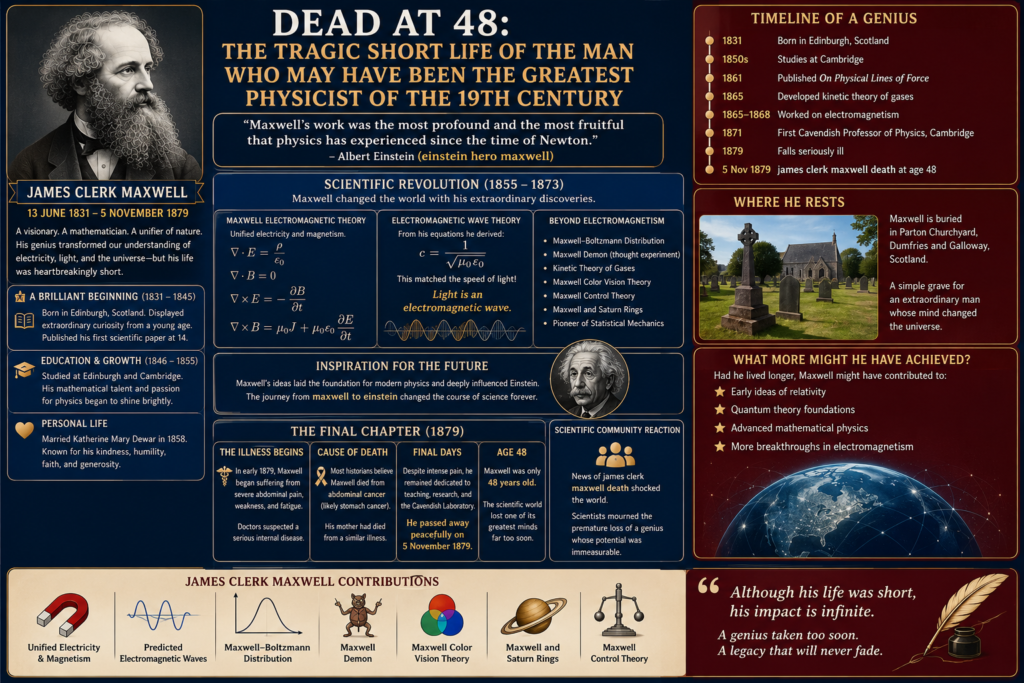
The story of james clerk maxwell death is one of the saddest chapters in the history of science. Few scientists have transformed humanity’s understanding of the universe as profoundly as James Clerk Maxwell. He unified electricity and magnetism, predicted electromagnetic waves, pioneered statistical physics, and laid foundations that would later inspire Einstein’s theory of relativity.
Yet despite these extraordinary achievements, Maxwell’s life was tragically short.
He died at only 48 years old in 1879.
Many historians believe that if Maxwell had lived another twenty or thirty years, he might have contributed even more revolutionary discoveries to science. His premature death shocked the scientific community and deprived the world of one of its greatest intellectual minds.
The story of james clerk maxwell death is not merely about loss. It is also a story of genius, dedication, humility, and a scientific legacy that continues shaping modern civilization.
A Brilliant Beginning (1831 – 1845)
The story leading to james clerk maxwell death began on June 13, 1831.
Maxwell was born in Edinburgh, Scotland.
From an early age, he displayed unusual curiosity.
As a child, he constantly asked questions about:
- Shapes
- Motion
- Light
- Nature
- Mechanical devices
Family members often referred to him affectionately as “Dafty” because of his endless curiosity.
What appeared unusual in childhood later became scientific brilliance.
Early Signs of Genius
Maxwell’s talent emerged remarkably early.
At age fourteen, he published his first scientific paper.
The work investigated geometric curves and attracted attention from mathematicians.
This achievement hinted at the extraordinary future awaiting him.
Long before james clerk maxwell death, it became clear that Maxwell possessed exceptional intellectual abilities.
Education and Scientific Growth (1846 – 1855)
Maxwell studied at:
- Edinburgh Academy
- University of Edinburgh
- University of Cambridge
Cambridge proved especially important.
There he developed advanced mathematical skills and gained recognition among leading scientists.
His academic success laid the foundation for achievements that would later make him famous worldwide.
The Scientific Revolution of Maxwell (1855 – 1873)
When discussing james clerk maxwell death, it is impossible to ignore the incredible accomplishments achieved during his relatively short life.
Maxwell transformed multiple scientific fields.
His achievements included:
- Electromagnetism
- Statistical mechanics
- Color vision theory
- Control theory
- Planetary science
Very few scientists have ever contributed so broadly.
The Birth of Electromagnetic Theory
Among Maxwell’s greatest achievements was maxwell electromagnetic theory.
He united electricity and magnetism into one mathematical framework.
His famous equations are:
∇ · E = ρ/ε₀
∇ · B = 0
∇ × E = − ∂B/∂t
∇ × B = μ₀J + μ₀ε₀(∂E/∂t
These equations changed science forever.
Their influence continued long after james clerk maxwell death.
Predicting Electromagnetic Waves
One of Maxwell’s most astonishing discoveries involved electromagnetic wave theory.
From his equations, Maxwell derived:
c = 1/√(μ₀ε₀)
Where:
- c = Speed of light
- μ₀ = Permeability of free space
- ε₀ = Permittivity of vacuum
The calculated value matched the known speed of light.
Maxwell concluded:
Light is an electromagnetic wave.
This prediction eventually led to:
- Radio
- Television
- WiFi
- Mobile communication
- Satellite systems
The Influence on Einstein
The intellectual journey from maxwell to einstein transformed modern physics.
Albert Einstein repeatedly praised Maxwell’s achievements.
The story often described as einstein hero maxwell reflects Einstein’s enormous admiration.
Einstein believed Maxwell’s work represented the greatest transformation in physics since Newton.
Without Maxwell’s discoveries, relativity might never have emerged.
Maxwell’s Work Beyond Electromagnetism
The significance of james clerk maxwell death becomes even greater when considering his diverse accomplishments.
Maxwell developed the maxwell boltzmann distribution, helping create statistical mechanics.
He proposed the famous maxwell demon thought experiment.
He solved the mystery of maxwell and saturn rings using mathematics.
He pioneered maxwell control theory through his work on governors.
His range of achievements remains astonishing.
Personal Life and Character
Behind the scientific genius was a remarkably humble individual.
Maxwell married Katherine Mary Dewar in 1858.
Their marriage was widely regarded as happy and supportive.
Friends described Maxwell as:
- Kind
- Humble
- Thoughtful
- Deeply religious
- Exceptionally generous
Unlike many famous scientists, Maxwell rarely sought public recognition.
His focus remained on understanding nature.
The Cavendish Laboratory (1871 – 1879)
In 1871, Maxwell became the first Cavendish Professor of Physics at Cambridge.
He oversaw the creation of the Cavendish Laboratory.
This institution later became one of the world’s greatest scientific research centers.
Many future discoveries emerged from the laboratory Maxwell helped establish.
The impact of his leadership extended far beyond james clerk maxwell death.
The Beginning of Illness
Around 1879, Maxwell began experiencing serious health problems.
Symptoms included:
- Severe abdominal pain
- Digestive difficulties
- Fatigue
- Weakness
Initially, the illness appeared manageable.
However, his condition rapidly worsened.
Doctors soon recognized the seriousness of the situation.
The Cause of Death
Historical evidence suggests the cause of james clerk maxwell death was abdominal cancer.
Modern historians generally believe he suffered from a form of stomach or abdominal malignancy.
Interestingly, Maxwell’s mother had died from a similar illness years earlier.
The disease progressed quickly.
Medical science of the nineteenth century offered few effective treatments.
Maxwell Age 48
One of the most tragic aspects of james clerk maxwell death is his age.
He died at only 48.
For comparison:
- Newton lived to 84.
- Faraday lived to 75.
- Einstein lived to 76.
Maxwell’s career ended decades earlier than many other scientific giants.
The loss of potential was enormous.
Final Years of Maxwell
The final years of Maxwell were marked by continued dedication to science despite declining health.
Even while suffering physically, he remained intellectually active.
He continued working on:
- Physics research
- Teaching
- Laboratory development
His commitment never wavered.
The story of james clerk maxwell death reveals extraordinary perseverance in the face of illness.
The Final Days (1879)
By late 1879, Maxwell’s condition had deteriorated significantly.
He spent increasing amounts of time resting.
Friends and colleagues recognized that recovery was unlikely.
Despite severe suffering, Maxwell reportedly maintained remarkable composure.
On November 5, 1879, James Clerk Maxwell passed away.
The scientific world lost one of its greatest minds.
Scientific Community Reaction
News of james clerk maxwell death spread rapidly throughout scientific circles.
Many researchers recognized the magnitude of the loss.
Physicists understood that an extraordinary career had ended prematurely.
Tributes emphasized:
- His intellectual brilliance
- His humility
- His scientific originality
The reaction reflected widespread admiration and respect.
Burial Place Parton
After james clerk maxwell death, he was buried in Parton, Scotland.
His grave remains a place of historical significance.
Visitors continue traveling there to honor one of science’s greatest pioneers.
The burial place Parton serves as a reminder of Maxwell’s lasting influence.
What More Might Maxwell Have Achieved?
One of the most intriguing questions surrounding james clerk maxwell death involves unfulfilled potential.
Had he lived longer, Maxwell might have contributed to:
- Early relativity concepts
- Quantum theory foundations
- Advanced statistical mechanics
- Mathematical physics
No one can know for certain.
However, given his extraordinary track record, further breakthroughs seem highly likely.
James Clerk Maxwell Contributions
When discussing James Clerk Maxwell Contributions, the list is remarkable:
- Electromagnetic theory
- Light as an electromagnetic wave
- Statistical mechanics
- Color photography
- Control theory
- Saturn ring stability
- Mathematical physics
Few scientists have achieved so much within such a short lifetime.
This reality makes james clerk maxwell death even more tragic.
The Legacy of 19th Century Physicists
Many historians regard Maxwell as one of the greatest figures among the legacy of 19th century physicists.
His work influenced:
- Einstein
- Planck
- Hertz
- Bohr
- Feynman
Entire branches of modern science trace their origins to Maxwell’s ideas.
His influence continues expanding long after his death.
Why Maxwell Is Sometimes Underrated
Despite his achievements, Maxwell often receives less public attention than Newton or Einstein.
Several factors contribute:
- His work was highly mathematical.
- He avoided public fame.
- He died relatively young.
- Many technologies based on his discoveries emerged after his death.
Yet among physicists, Maxwell is often regarded as one of the greatest scientific minds in history.
The Lasting Impact on Modern Civilization
The technologies surrounding us today exist largely because of Maxwell’s discoveries.
Examples include:
- Radio communication
- Television
- Mobile networks
- Internet infrastructure
- Radar systems
- Satellite communication
The modern world reflects Maxwell’s influence everywhere.
His ideas remain deeply embedded in everyday life.
Frequently Asked Questions (FAQs)
What was the cause of James Clerk Maxwell’s death?
Most historians believe Maxwell died from abdominal cancer, likely similar to the illness that claimed his mother’s life.
How old was James Clerk Maxwell when he died?
He was only 48 years old.
When did James Clerk Maxwell die?
Maxwell died on November 5, 1879.
Where is Maxwell buried?
He is buried in Parton, Scotland.
Why is Maxwell considered one of the greatest physicists?
His work unified electricity and magnetism, predicted electromagnetic waves, and helped establish modern physics.
Conclusion
The story of james clerk maxwell death is both heartbreaking and inspiring. At only 48 years old, Maxwell left the world far too soon, ending one of the most brilliant scientific careers in history. His premature loss deprived humanity of decades of potential discoveries and innovations.
Yet Maxwell’s legacy remains extraordinary. From electromagnetism and light to statistical mechanics and control theory, his contributions continue shaping science, technology, and modern civilization. The influence that stretched from Maxwell to Einstein demonstrates the depth of his impact on human knowledge.
Although his life was tragically short, Maxwell achieved more in 48 years than many scientists accomplish in a lifetime. That is why many historians still believe he may have been the greatest physicist of the nineteenth century.