Introduction to History of Natural Language Processing
Imagine asking a computer a question and receiving a thoughtful, accurate answer. This seems ordinary today. But it took decades of research to achieve. The history of natural language processing is a remarkably inspiring story of human ingenuity, persistence, and breakthrough. From simple rule based systems to the powerful large language models history , NLP has transformed how we interact with machines.
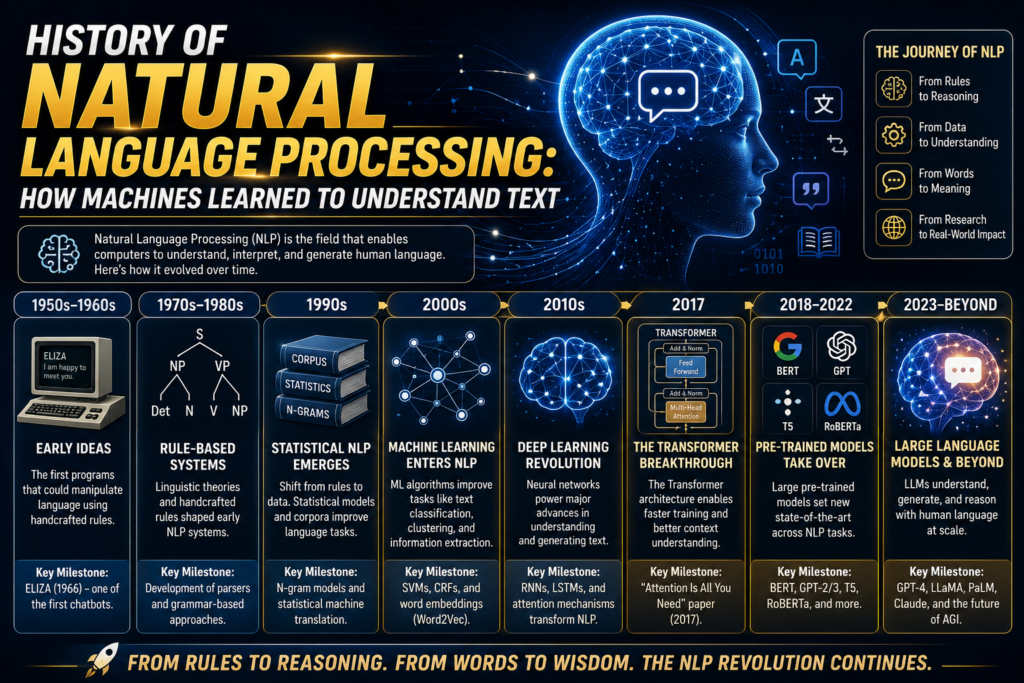
The history of natural language processing begins in the 1950s, when computers were room sized machines with less power than a pocket calculator. Early researchers dreamed of machine translation, automated question answering, and conversational agents. These dreams seemed impossibly ambitious. Yet each decade brought progress, building toward the AI systems we use today.
Understanding the history of natural language processing helps us appreciate modern AI. Every technique we use, from word embeddings to transformers, stands on the shoulders of earlier work. The field has seen winters of disappointment and summers of breakthrough.
The Early Years (1950 – 1960): Dreams of Machine Translation
The earliest NLP research focused on a grand challenge: teaching computers to translate between human languages. This ambition captured the imagination of researchers worldwide.
The Georgetown-IBM Experiment (1954)
The Georgetown-IBM experiment of 1954 was a landmark event in the history of natural language processing. Researchers programmed an IBM computer to translate 60 Russian sentences into English. The system had only 250 words and 6 grammar rules. Yet it worked convincingly.
The experiment captured public imagination. Newspapers declared that machine translation was solved. Funding poured in. Researchers promised fully automatic translation within years. These predictions were wildly optimistic.
Early Rule-Based NLP Systems (1950 – 1960)
Early rule-based NLP systems relied on handcrafted linguistic rules. Linguists and computer scientists worked together to encode grammar rules, dictionaries, and knowledge about the world.
These systems analyzed morphology and syntax, breaking words into parts and identifying sentence structures. Part-of-speech tagging assigned categories like noun, verb, and adjective to each word. Dependency parsing identified relationships between words.
The Turing Test, proposed by Alan Turing in 1950, asked whether a machine could fool a human into thinking it was human. This became a philosophical touchstone for NLP research.
The ELIZA Era and Early AI (1960 – 1970)
The 1960s brought increased funding and optimism. Researchers built increasingly sophisticated language systems. The eliza chatbot history shows how effective simple techniques could be.
ELIZA and Early AI (1964 – 1966)
Created by Joseph Weizenbaum at MIT between 1964 and 1966, ELIZA simulated a Rogerian psychotherapist. It used simple pattern matching and substitution rules to respond to user input.
Many users became convinced they were talking to a real therapist. Weizenbaum was disturbed by this reaction. He knew ELIZA had no real understanding.
ELIZA demonstrated a crucial insight. Humans project understanding onto machines. A program does not need true comprehension to appear intelligent.
The ALPAC Report and the First AI Winter (1966)
The “AI Winter” impact on NLP began with the ALPAC report of 1966. The Automatic Language Processing Advisory Committee evaluated machine translation research. Its conclusion was devastating. Machine translation had failed to deliver practical results. Funding was dramatically reduced.
The ALPAC report triggered a funding crisis across AI and NLP. The first AI Winter had begun. Many researchers left the field entirely.
The Statistical Revolution (1970 – 1990)
The 1970s and 1980s brought a fundamental shift. Researchers moved from handcrafted rules to statistical methods. This statistical NLP shift transformed the field.
Hidden Markov Models (1970 – 1980)
Hidden Markov Models (HMM) became a cornerstone of statistical NLP. HMMs modeled sequences of words as probabilistic processes.
HMMs excelled at part-of-speech tagging. Given a sentence, the model identified the most likely sequence of tags. Accuracy was far better than rule based systems for many tasks.
The Shift to Statistical Machine Translation (1980 – 1990)
The 1980s saw the shift to statistical machine translation. Instead of encoding grammar rules, researchers aligned bilingual texts and learned translation probabilities from data.
Information retrieval benefited from statistical methods. Search engines ranked documents by relevance.
The Rise of Machine Learning (1990 – 2010)
The 1990s and 2000s saw machine learning dominate the history of natural language processing. The history of word embeddings shows how meaning could be captured in vector spaces.
Word Embeddings and Word2Vec (2000 – 2013)
Distributional semantics history shows that meaning can be learned from word distributions. Words that appear in similar contexts have similar meanings.
The development of Word2Vec in 2013 was a breakthrough. Word2Vec learned dense vector representations where similar words had similar vectors.
Recurrent Neural Networks and LSTMs (1990 – 2010)
Recurrent neural networks history began in the 1980s, but practical success came later. RNNs processed sequences by maintaining a hidden state.
Long Short Term Memory networks, introduced in 1997, solved the vanishing gradient problem. LSTMs could learn dependencies across hundreds of steps.
The Deep Learning Revolution (2010 – 2017)
The 2010s brought deep learning to the history of natural language processing. Neural networks with many layers achieved state of the art results.
Sequence-to-Sequence Models (2014 – 2015)
Seq2seq models introduced the encoder decoder architecture. The encoder processed the input into a vector. The decoder generated the output.
The Attention Mechanism (2015 – 2017)
Attention mechanism explained simply: attention allows a model to focus on relevant parts of the input when generating each output word.
Instead of compressing everything into one vector, the model can look back at the entire input. This dramatically improved long sentence handling.
The Transformer Era (2017 – 2020)
The transformer architecture history begins in 2017 with the paper “Attention Is All You Need.” This single paper changed everything.
The Transformer Model (2017)
Transformer model explained simply: it is a neural network that processes all words in parallel using attention. Recurrence is gone.
The attention is all you need paper introduced multi head attention, position encoding, and layer normalization.
BERT and GPT (2018)
Bert model history began in 2018. Google’s BERT introduced masked language modeling. The model predicted randomly masked words using both left and right context.
OpenAI’s GPT used unidirectional language modeling, predicting the next word. Each generation grew larger and more capable.
The Large Language Model Era (2020 – 2026)
Recent years have seen the full flowering of the history of natural language processing. Large language models have transformed what machines can do.
GPT-3 and ChatGPT (2020 – 2022)
Gpt-3 history began in 2020 with 175 billion parameters. GPT-3 demonstrated zero-shot learning. It could perform tasks it had never been explicitly trained on.
Chatgpt history changed everything. Released in November 2022, ChatGPT became the fastest growing consumer application in history. The chatgpt growth 100 million users milestone was reached in two months.
Modern Models (2023 – 2026)
Google Bard, Claude, Meta Llama, Deepseek, Mistral, and Grok have all pushed the field forward.
Retrieval augmented generation (RAG) grounded LLMs in external knowledge. Multimodal AI models now process images, audio, and video.
Frequently Asked Questions
When did natural language processing begin?
NLP began in the 1950s with the Georgetown-IBM machine translation experiment in 1954.
What was ELIZA and why was it important?
ELIZA was a chatbot created in 1966. It showed that simple pattern matching could create the illusion of understanding.
What is Word2Vec?
Word2Vec is a 2013 technique that learns vector representations where similar words have similar vectors.
What is the transformer architecture?
The transformer, introduced in 2017, processes all words in parallel using attention. It powers all modern LLMs.
What is the difference between BERT and GPT?
BERT uses bidirectional attention for understanding. GPT uses unidirectional attention for generation.
How did ChatGPT become so popular?
ChatGPT reached 100 million users in two months due to its natural conversation abilities and free access.
Conclusion
The history of natural language processing from 1950 to 2026 is a remarkable journey of persistence and breakthrough. From the Georgetown-IBM experiment to ChatGPT, each generation built on the last. The best free ai tools 2026 now incorporate NLP in ways early pioneers could only dream of.
The field has seen AI Winters and funding crises. It has seen rule based systems replaced by statistical models, then by neural networks, then by transformers.
As we look ahead, challenges remain. But the trajectory is clear. The history of natural language processing is still being written. The ai tools for productivity we use today barely scratch the surface of what is possible.