Introduction to Large Language Models History
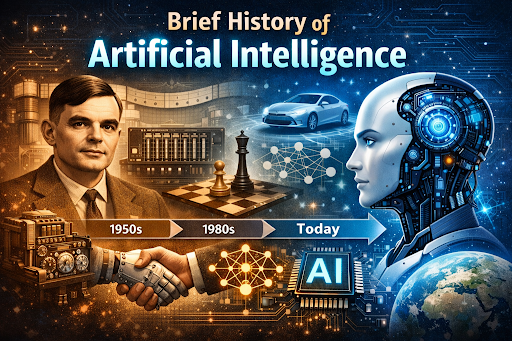
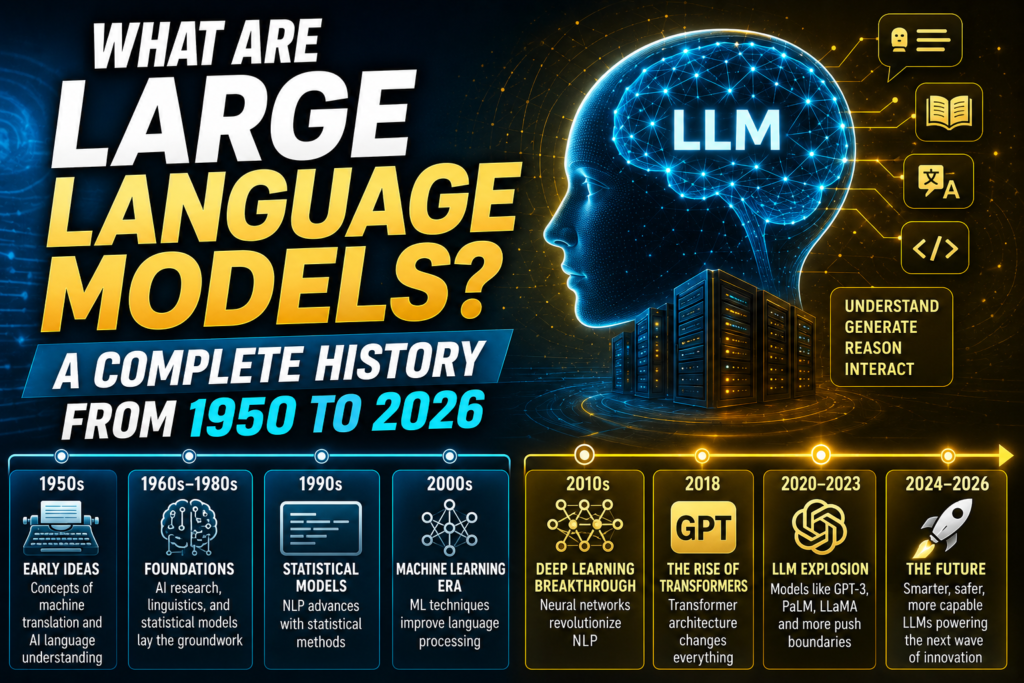
Imagine a machine that can write poetry, answer questions, translate languages, and hold conversations. This is not science fiction. This is the reality of modern artificial intelligence. The large language models history is a remarkably fascinating journey from simple statistical predictions to the powerful generative AI that captures the world’s imagination in 2026.
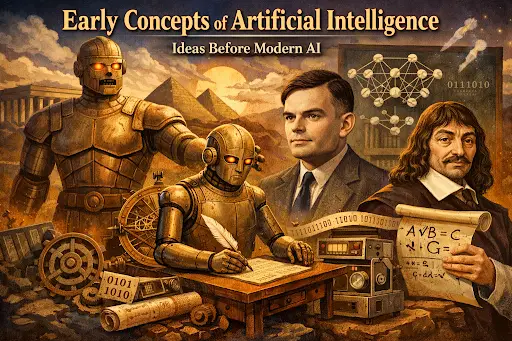
Large language models history begins in the 1950s, long before computers could understand even a single sentence. Early researchers dreamed of machines that could process human language. They built simple programs that could answer basic questions or simulate conversations. These early efforts were primitive by today’s standards, but they planted the seeds for everything that followed.
Understanding large language models history helps us appreciate how far AI has come. The field has seen winters of disappointment and summers of breakthrough. Researchers have tried and abandoned countless approaches. The history of natural language processing shows a similar trajectory of slow progress followed by rapid acceleration.
The Early Years (1950 – 1980): Rule Based Systems
The earliest attempts at language AI used handcrafted rules. Linguists and computer scientists worked together to encode grammar rules, vocabulary, and world knowledge into computer programs. This was the era of symbolic AI.
N-Gram Models Era (1950 – 1970)
Statistical language modeling emerged as an alternative to rule based systems. Instead of teaching computers grammar rules, researchers fed them large amounts of text and let statistics reveal patterns. The N-gram model era analysis looked at sequences of words and calculated the probability of one word following another.
An n-gram is simply a sequence of n words. A bigram model looks at pairs of words. A trigram model looks at triples. The probability of a word given previous words was estimated by counting how often that sequence appeared in training text.
This approach worked surprisingly well for simple tasks like speech recognition. But n-gram models had a serious limitation. They could only look at a short window of previous words. Long distance dependencies, like the relationship between the subject and verb in a complex sentence, were invisible to these models.
ELIZA Chatbot (1964 – 1966)
The eliza chatbot history represents one of the most famous early chatbot architectures. Created by Joseph Weizenbaum at MIT between 1964 and 1966, ELIZA simulated a Rogerian psychotherapist. It used pattern matching and simple rules to respond to user input.
ELIZA was remarkably effective at fooling people into thinking they were talking to a real therapist. But Weizenbaum was disturbed by this reaction. He knew ELIZA had no understanding whatsoever. It simply recognized keywords and applied transformation rules.
ELIZA demonstrated both the promise and the danger of language AI. It showed that simple rules could create the illusion of understanding. But it also revealed how far AI was from genuine comprehension.
The Rise of Computational Linguistics (1970 – 1980)
The 1970s saw the emergence of computational linguistics as a distinct field. Researchers developed more sophisticated grammars and parsing algorithms. They built systems that could analyze sentence structure, identify parts of speech, and extract meaning.
Early neural networks were explored during this period. But computing power was limited. Neural networks with more than a few layers were impossible to train. The dominant paradigm remained symbolic, with researchers hand coding linguistic knowledge.
These early systems were fragile. A slight change in sentence structure could break them completely. They worked well in narrow domains but failed in the open ended complexity of natural language.
The Neural Network Revolution (1980 – 2010)
The 1980s brought a paradigm shift. Researchers began applying neural networks to language tasks. This transition to deep learning marked a turning point in large language models history.
Recurrent Neural Networks and LSTMs (1986 – 1997)
Recurrent neural networks history began in the 1980s. Unlike standard neural networks, RNNs have loops that allow information to persist. This makes them naturally suited for sequential data like text.
However, early RNNs suffered from the vanishing gradient problem. As information flowed through many time steps, the signal faded. The network could not learn long range dependencies. Backpropagation history showed that gradient based learning had limits with recurrent architectures.
The solution arrived in 1997 with Long Short Term Memory networks. What is LSTM in ai? LSTM introduced a cell state that acts as a memory highway. Gated mechanisms control what information gets added, stored, or forgotten. This allowed LSTMs to learn dependencies stretching hundreds of steps.
LSTMs became the dominant architecture for language tasks for nearly two decades. They powered speech recognition, machine translation, and text generation.
Word Embeddings and Word2Vec (2000 – 2013)
One of the most important breakthroughs in large language models history was the development of word embeddings. Traditional language models treated words as atomic symbols. Cat was just a different symbol from dog, with no relationship between them.
What is word2vec? Word2Vec, released by Google researchers in 2013, changed everything. It learned dense vector representations of words where similar words had similar vectors. The relationships between vectors captured semantic meaning.
Man was to woman as king was to queen. Paris minus France plus Italy equaled Rome. These algebraic properties emerged from the statistics of large text corpora. The history of word embeddings shows how this breakthrough enabled neural networks to understand word meanings.
Sequence-to-Sequence Models (2014 – 2015)
Sequence-to-sequence models history began in 2014. The seq2seq models history introduced an encoder decoder architecture. The encoder processed the input sequence into a fixed length vector. The decoder generated the output sequence from this vector.
Seq2seq models revolutionized machine translation. Instead of translating phrase by phrase, the model could consider the entire sentence. The encoder captured the meaning, and the decoder generated the translation.
However, seq2seq models had a bottleneck. The fixed length vector could not capture long sentences. Important information was lost.
The Transformer Revolution (2017 – 2018)
The transformer architecture history begins in 2017 with the paper “Attention Is All You Need.” This single paper changed large language models history forever. The transformer model explained simply is a neural network that processes all words in parallel using attention mechanisms.
The Attention Mechanism (2017)
Attention mechanism explained simply: attention allows a model to focus on relevant parts of the input when generating each output word. Instead of compressing the entire input into a fixed vector, the decoder can look back at the entire input sequence and decide which parts are most important.
The transformer went further. It replaced recurrence entirely with attention. The model processes all words in parallel, using self attention to capture relationships between words. This parallelism made training much faster. The attention is all you need paper introduced the architecture that powers every major LLM today.
Transformers had another advantage. Self attention creates paths of length one between any two words. This means the model can easily learn dependencies regardless of distance. The vanishing gradient problem that plagued RNNs was gone.
Pre-Training and Fine-Tuning Origins (2018)
The concepts of pre-training and fine-tuning origins transformed how language models were built. Pre training in ai on large, general text corpora taught the model language understanding. Fine tuning in ai on small, task specific datasets adapted the model to particular applications.
This paradigm allowed researchers to train models once and reuse them for many tasks. This dramatically reduced the need for labeled data. A single pre-trained model could be fine tuned for sentiment analysis, question answering, or named entity recognition.
This paradigm became the foundation of large language models history. Every major LLM today follows this pattern.
GPT-1 and BERT (2018)
Gpt models history began with GPT-1 in 2018. OpenAI’s Generative Pre-trained Transformer used unidirectional language modeling, predicting the next word given previous words. It showed that pre training followed by fine tuning worked well.
What is bert model? BERT, released by Google in 2018, took a different approach. Bert model history introduced masked language modeling. The model predicted randomly masked words using both left and right context. This bidirectional understanding made BERT exceptionally powerful for understanding tasks.
Bert vs gpt vs t5 became a common comparison. BERT excelled at understanding. GPT excelled at generation. The Development of BERT represented a major machine learning milestone.
The Era of Large Language Models (2019 – 2022)
The years 2019 to 2022 saw exponential growth in large language models history. Models grew larger, data grew bigger, and capabilities expanded dramatically. Model parameters growth accelerated at an unprecedented rate.
GPT-2 and GPT-3 (2019 – 2020)
Gpt-3 history begins with GPT-2 in 2019. OpenAI initially hesitated to release GPT-2 fully, concerned about potential misuse. The model was far more capable than anything before.
GPT-3 arrived in 2020 with 175 billion parameters. Evolution of GPT models showed that scaling up model size and training data led to emergent abilities. Smaller models could not translate languages. Larger models could. Compute-intensive training became the standard approach.
The gpt models history demonstrates how ai scaling laws predicted these improvements. GPT-3 demonstrated zero-shot learning abilities. It could perform tasks it had never been explicitly trained on, simply by reading instructions.
ChatGPT and the Public Launch (2022)
Chatgpt history changed everything. When OpenAI released ChatGPT in November 2022, it became the fastest growing consumer application in history. The Rise of generative AI captured global attention.
The chatgpt growth 100 million users milestone was reached in just two months. No product before had grown so quickly. People worldwide discovered they could talk to an AI about anything.
What is rlhf? Reinforcement Learning from Human Feedback (RLHF) was the key innovation. Human trainers ranked model responses, and this feedback was used to fine tune the model. RLHF aligned ChatGPT with human preferences, making it helpful, harmless, and honest.
Ai hallucination history also began in this era. Users discovered that LLMs sometimes invent information confidently. These hallucinations remain an unsolved challenge.
The AI Arms Race (2023)
The year 2023 saw an ai arms race companies battle for dominance. Openai history continued with GPT-4. Gpt-4 history demonstrated multimodal capabilities, processing both images and text.
Google bard gemini history began as Google rushed to respond. Mistral ai history showed that smaller, efficient models could compete. Claude ai history from Anthropic emphasized safety. Meta llama history released powerful open source models. Deepseek ai history demonstrated Chinese innovation. Grok ai history from xAI brought personality. Microsoft copilot history integrated LLMs into Office.
Ibm watson vs llms comparisons showed how far the field had advanced. Cohere ai history demonstrated specialization in enterprise applications.
Modern LLMs and Generative AI (2024 – 2026)
Recent years have seen large language models history enter a new phase. The focus has shifted from raw size to efficiency, capability, and integration.
RAG and Model Efficiency
Retrieval augmented generation rag emerged as a technique to ground LLMs in external knowledge. Instead of relying solely on internal parameters, RAG models retrieve relevant information from databases, reducing hallucinations.
Parameter efficient fine tuning methods like LoRA allowed adaptation without retraining all billions of parameters. Knowledge distillation allowed large, powerful models to teach smaller, efficient models. This reduced the computational cost of deployment.
Multimodal AI and AI Agents
Multimodal ai history shows how models expanded beyond text. Modern LLMs can process images, audio, and video. GPT-4V can describe pictures. Gemini can understand video.
What is ai agent describes autonomous systems that use LLMs to plan, act, and iterate. Agents can browse the web, use tools, and complete complex tasks without human supervision.
The multimodal artificial intelligence evolution represents the next frontier of large language models history.
AI Regulation, Education, and Future Directions
Ai regulation history has accelerated alongside AI capabilities. The EU AI Act, executive orders, and international agreements seek to govern LLM development.
Ai in education llms has transformed classrooms. Students use LLMs for research, writing assistance, and personalized tutoring.
History of ai scaling laws suggests that simply making models larger yields diminishing returns. The future of large language models lies in efficiency, reasoning, and true understanding. Artificial General Intelligence (AGI) history may be written by the descendants of today’s LLMs.
Ai generated content history shows how LLMs have become content creation tools. Chatgpt vs google search debates continue about the future of information retrieval.
Frequently Asked Questions
When were large language models invented?
The foundations were laid in the 1950s, but the modern era of LLMs began in 2017 with the transformer architecture.
Who invented the transformer model?
The transformer was introduced by Google researchers in the 2017 paper “Attention Is All You Need.”
What is the difference between BERT and GPT?
BERT uses bidirectional masking for understanding tasks. GPT uses unidirectional generation for creative tasks.
How did ChatGPT become so popular so quickly?
ChatGPT reached 100 million users in two months due to its natural conversation abilities and free accessibility.
What is RLHF in AI?
Reinforcement Learning from Human Feedback uses human preferences to align LLM responses with user expectations.
Will LLMs continue to grow larger?
Recent research suggests scaling laws are changing. Efficiency and reasoning may matter more than raw size going forward.
Conclusion
The large language models history from 1950 to 2026 is a story of persistence, breakthrough, and transformation. From n-gram models to billion parameter transformers, each generation built on the last. The best free ai tools 2026 now incorporate LLMs in ways early pioneers could only dream of.
The journey has seen decades of slow progress followed by years of explosive growth. The transformer architecture, released in 2017, was the key that unlocked the modern era. How llms work is now understood by millions of users worldwide.
As we look ahead, challenges remain. Hallucinations, bias, safety, and regulation all require attention. But the trajectory is clear. Large language models history is still being written, and the most exciting chapters may lie ahead. The AI tools for productivity we use today barely scratch the surface of what is possible.