If you want to understand why modern AI is so powerful, you need the attention mechanism explained properly. It is not just a technical detail buried inside a neural network. It is the single most important idea in the history of modern artificial intelligence, the breakthrough that made large language models possible, and the concept that transformed how machines process language, images, and almost every other form of data.
Getting the attention mechanism explained clearly means starting before transformers, back when sequence models had a serious bottleneck problem that no one knew how to fix.
The Bottleneck Problem That Attention Solved (2013 – 2014)
To get the attention mechanism explained properly, you need to understand the problem it was designed to solve. In the early 2010s, sequence-to-sequence models using LSTMs were the state of the art for machine translation. These models used an encoder LSTM to read the entire source sentence and compress it into a single fixed-size vector. A decoder LSTM then used that vector to generate the translation word by word.
This architecture worked well for short sentences. But for longer sentences, the encoder-decoder bottleneck became a serious problem. Compressing an entire long sentence into one fixed vector inevitably lost information. The longer the sentence, the worse the compression, and the worse the translation quality.
Researchers could clearly see the problem: the model needed a way to look back at specific parts of the source sentence while generating each word of the translation, rather than trying to remember everything from one compressed vector. This insight led directly to the attention mechanism explained in its first practical form.
Bahdanau Attention: The First Breakthrough (2014 – 2015)
The attention mechanism explained in its original practical form comes from a 2014 paper by Dzmitry Bahdanau, Kyunghyun Cho, and Yoshua Bengio. Their paper introduced what is now called Bahdanau attention, or additive attention, and it changed everything about how seq2seq models worked.
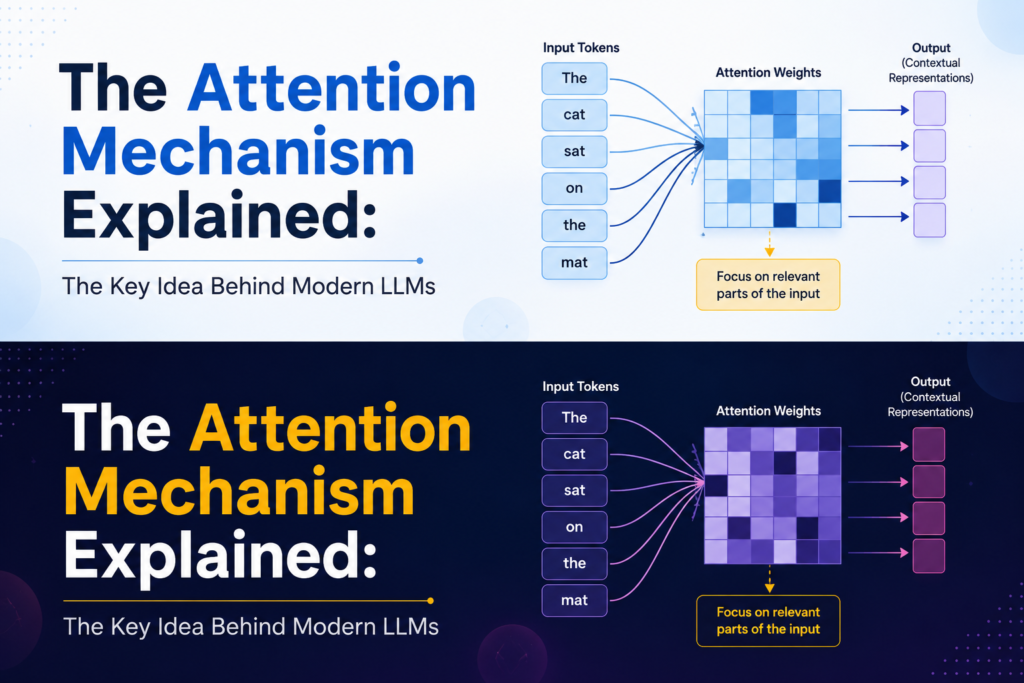
The core idea was beautifully simple. Instead of forcing the encoder to compress everything into one vector, Bahdanau attention allowed the decoder to look at all the encoder hidden states at each decoding step. At each step, the model computed a score for every encoder state indicating how relevant that position was for generating the current output word. These scores were normalized using softmax normalization into attention weights that summed to 1. The weighted sum of encoder states produced a context vector that was specific to each decoding step.
This soft alignment mechanism meant the model could focus on “I” and “am” when generating the French word for “I am,” and then shift its focus to “happy” when generating the French word for happy. The attention mechanism explained through Bahdanau’s lens is essentially: let the decoder ask which parts of the input are most relevant right now, rather than trying to remember everything at once.
The improvement in translation quality, especially for long sentences, was dramatic and immediate.
Luong Attention: A Simpler and Faster Approach (2015)
Shortly after Bahdanau’s work, Minh-Thang Luong introduced a simplified version of the attention mechanism explained slightly differently. Luong attention, also called multiplicative or dot-product attention, computed relevance scores through direct dot products between the decoder state and encoder states, rather than through a small learned neural network as Bahdanau had done.
This made Luong attention faster to compute and easier to implement while achieving comparable or better results on many translation benchmarks. The scaled dot-product attention that powers modern transformers is a direct descendant of Luong’s approach, scaled by the square root of the vector dimension to prevent very large dot products from pushing the softmax into regions with tiny gradients.
Understanding the attention mechanism explained through both Bahdanau and Luong’s contributions shows how quickly the core idea was refined and simplified once researchers understood what they were actually building.
Self-Attention: Attention Turns Inward (2016 – 2017)
The attention mechanism explained so far involves cross-attention, where a decoder attends to encoder states from a different sequence. The next revolutionary step was self-attention, where a sequence attends to itself.
In self-attention, every position in a sequence computes attention weights over every other position in the same sequence, including itself. This allows the model to capture rich relationships between all pairs of positions simultaneously, regardless of how far apart they are in the sequence.
For a sentence like “The animal didn’t cross the street because it was too tired,” self-attention allows the model to connect “it” with “animal” rather than “street” by attending to the right context. This is exactly the kind of long-range contextual dependency that LSTMs struggled with despite years of refinement. Self-attention makes the attention mechanism explained as a global relationship detector, not just a local pattern finder.
Query, Key, and Value: The Elegant Framework (2017)
The most powerful formalization of the attention mechanism explained comes from the Query, Key, and Value framework, commonly abbreviated as QKV. This framework, central to the transformer architecture, gives self-attention its mathematical elegance and computational efficiency.
Every input position produces three vectors: a Query vector representing what this position is looking for, a Key vector representing what this position offers to others, and a Value vector representing the actual content this position contributes when selected.
Attention scores are computed by taking the dot product of each Query with all Keys, scaling by the square root of the vector dimension, and applying softmax normalization to produce attention weights. These weights are then applied to the Value vectors to produce the output. The attention mechanism explained through QKV is essentially a learned soft search: every position searches all other positions for relevant content and retrieves a weighted blend of their values.
The parallelization in training that this enables is massive. Unlike LSTMs that must process positions sequentially, the QKV attention computation can be performed for all positions simultaneously as a series of matrix multiplications, making it ideal for modern GPU hardware.
Multi-Head Attention: Looking in Multiple Ways at Once (2017)
One of the most powerful extensions of the attention mechanism explained in the transformer paper is multi-head attention. Rather than performing attention once with a single set of QKV projections, multi-head attention runs the attention operation multiple times in parallel with different learned projections for each head.
Each attention head can learn to focus on different types of relationships simultaneously. One head might learn to connect pronouns with their antecedents. Another might learn syntactic dependencies. A third might capture semantic similarities. The outputs of all heads are concatenated and projected to produce the final output.
This dramatically increases the expressive power of the attention mechanism explained beyond what a single attention operation could achieve. Modern large language models use dozens of attention heads per layer and dozens of layers deep, creating a rich hierarchy of relationship modeling that spans from surface patterns to deep semantic understanding.
Attention Is All You Need: The Transformer Paper (2017)
The attention mechanism explained in its most complete and transformative form appears in the 2017 paper “Attention Is All You Need” by Vaswani et al. at Google. This paper proposed removing recurrent connections entirely and building a model purely on stacked self-attention and feedforward layers.
The result was the transformer architecture, which processed entire sequences in parallel using multi-head self-attention, added positional encoding to give the model a sense of word order, and used residual connections and layer normalization to enable training of very deep networks.
The attention is all you need paper is arguably the single most influential AI research paper of the 21st century. Every major language model released since 2017, from BERT to GPT-4 to Claude, is built on the transformer architecture it introduced. Understanding the attention mechanism explained in this paper is understanding the foundation of all modern AI.
How Attention Powers BERT and GPT (2018 – 2020)
Once the transformer was established, the attention mechanism explained in different ways produced two major families of models. BERT used bidirectional self-attention, allowing every position to attend to all other positions in both directions simultaneously. This gave BERT an extraordinarily rich contextual understanding of each word in relation to its full surrounding context.
GPT used unidirectional or causal attention, where each position could only attend to previous positions. This autoregressive design was perfect for text generation: the model produced one token at a time, each conditioned on everything that came before it.
The seq2seq models history shows how the encoder-decoder attention that Bahdanau introduced in 2014 evolved into the full transformer attention that powers both BERT and GPT, two architectures that approach language from completely different but equally powerful directions.
Sparse Attention and Scaling to Longer Contexts (2019 – Present)
One limitation of standard self-attention is computational cost. Computing attention weights between every pair of positions in a sequence requires quadratic memory and compute relative to sequence length. For a sequence of 1000 tokens, that means computing a million attention scores. For 10,000 tokens, a hundred million.
Sparse attention addresses this by limiting each position to attending to only a subset of other positions, chosen by position, content, or a combination of both. Models like Longformer and BigBird use sparse attention patterns to handle documents far longer than standard transformers could manage.
This line of research has become critical as AI applications increasingly need to process very long documents, codebases, and conversations. The chatgpt history shows how context window length, directly determined by how well a model implements the attention mechanism explained for long sequences, became one of the most competitive dimensions in modern AI development.
Visual Attention and Multimodal AI
The attention mechanism explained is not limited to text. Visual attention in computer vision has been a parallel research thread since the 2010s, where models learn to focus on specific regions of an image rather than processing all pixels equally.
Vision Transformers, or ViTs, introduced in 2020, apply the full self-attention mechanism to patches of images with remarkable effectiveness. Modern multimodal models like GPT-4 with vision and Google’s Gemini use cross-attention to connect visual and language representations, allowing models to answer questions about images by attending jointly to image patches and text tokens.
The attention mechanism explained in this multimodal context is the same fundamental idea as in language: compute relevance scores, apply weights, and aggregate information from the most relevant sources, whether those sources are words, image patches, or audio frames.
For developers and creators looking to use these multimodal attention-powered tools today, exploring the fine tuning in ai landscape shows how even the most powerful attention-based models can be adapted to specific tasks and domains with relatively small amounts of targeted training data.
Why the Attention Mechanism Changed Everything
The attention mechanism explained in full reveals why it was such a transformative idea. It replaced a fixed compression bottleneck with a flexible, learned routing system. It allowed models to scale to much longer sequences. It enabled parallelization that made training on massive datasets practical. And it provided a framework that works equally well for text, images, audio, and combinations of all three.
Every powerful AI system you interact with today, whether it is a search engine, a writing assistant, a code generator, or an image creator, is built on some form of attention. The researchers who developed it, from Bahdanau in 2014 to Vaswani in 2017, gave the field the key it needed to unlock the full potential of deep learning at scale.
If you want to experience what attention-powered AI can do for you right now, the ai tools for productivity available today represent the most practical demonstration of why the attention mechanism explained in this article became the foundation of the entire modern AI industry.
Frequently Asked Questions (FAQs)
What is the attention mechanism explained simply?
The attention mechanism is a way for neural networks to focus on the most relevant parts of their input when producing each part of their output. Instead of treating all input positions equally, it computes relevance scores and uses them to weight the contribution of each position.
Who invented the attention mechanism?
The practical attention mechanism for neural machine translation was introduced by Dzmitry Bahdanau, Kyunghyun Cho, and Yoshua Bengio in their 2014 paper. The self-attention mechanism central to transformers was formalized in the 2017 “Attention Is All You Need” paper by Vaswani et al.
What is the difference between self-attention and cross-attention?
Self-attention allows a sequence to attend to itself, computing relationships between all pairs of positions within the same sequence. Cross-attention allows one sequence to attend to another, as in encoder-decoder architectures where the decoder attends to encoder representations.
What are Query, Key, and Value vectors in attention?
Query, Key, and Value are three learned linear projections of each input position. The Query represents what a position is looking for, the Key represents what it offers, and the Value represents the content it contributes. Attention scores are computed from Query-Key dot products and applied to Values.
Why is multi-head attention better than single-head attention?
Multi-head attention runs multiple attention operations in parallel with different learned projections, allowing the model to simultaneously capture different types of relationships such as syntactic structure, semantic similarity, and coreference. This makes it far more expressive than a single attention operation.
Conclusion
Getting the attention mechanism explained is getting the key to understanding modern AI at its deepest level. From Bahdanau’s 2014 breakthrough to the transformer revolution of 2017 and beyond, attention transformed neural networks from narrow sequential processors into flexible, powerful systems capable of understanding context across long sequences, multiple modalities, and complex reasoning tasks. The attention mechanism explained is not just a technical concept. It is the idea that made artificial general intelligence feel genuinely possible for the first time. Every token generated by every modern language model is produced through attention, and that simple fact speaks more powerfully than any explanation ever could.