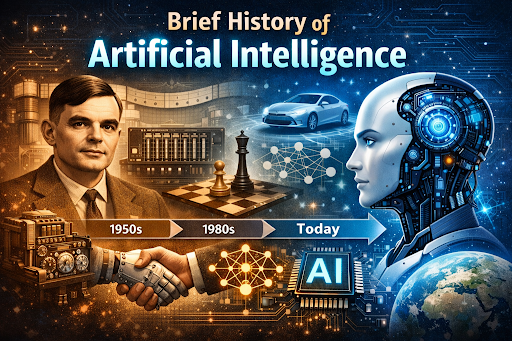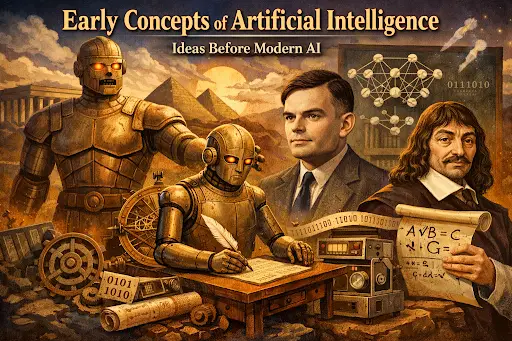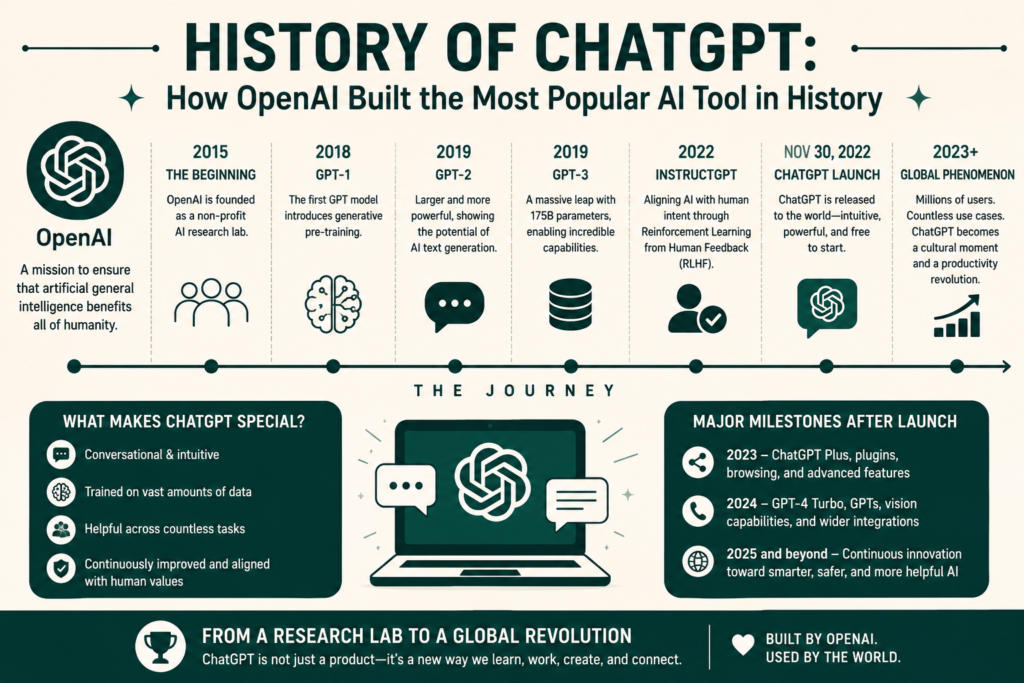
The story of chatgpt history is not just about a chatbot. It is the result of decades of research in natural language processing, machine learning model iterations, and the rapid evolution of large language models. What looks like a simple conversational AI today is actually built on more than sixty years of research, experimentation, and technical transformation at OpenAI and across the AI community.
Understanding this AI chatbot historical timeline helps us see how ChatGPT became a global phenomenon, reaching millions of users in record time and redefining how humans interact with machines.
A 1960 – 1970 Early Roots of Conversational AI
The journey begins with the famous ELIZA program in 1966 at MIT. ELIZA simulated conversation using pattern matching. This was the first time people interacted with a machine in natural language.
This period marks the start of the history of natural language processing. Computers were rule based and could not truly understand context, but they laid the groundwork for conversational AI milestones.
B 1980 – 1990 Neural Networks and Language Understanding
During this period, researchers explored recurrent neural networks and early sequence models. Work on memory based networks helped machines process text sequences.
These efforts contributed to the recurrent neural networks history and inspired the future development of more advanced architectures for language understanding.
C 2000 – 2013 Word Embeddings and Deep Learning
A major breakthrough came with Word2Vec in 2013. Instead of rules, machines began learning word meanings from data.
This era represents the history of word embeddings and allowed models to understand relationships between words, forming the basis of prompt engineering origins and context window expansion in later systems.
D 2014 – 2017 Attention and Transformer Breakthrough
In 2017, Google researchers published the attention is all you need paper. This introduced the transformer model that changed everything.
The transformer model explained how attention mechanisms allow machines to focus on relevant parts of text. This was the foundation of transformer architecture history and later GPT and BERT models.
E 2018 – 2019 Birth of GPT Models
OpenAI released GPT in 2018 and GPT 2 in 2019. These generative pre-trained transformer systems used massive datasets and pre training in ai to learn language patterns.
This phase is central to gpt models history and demonstrated that scaling data and parameters leads to better language understanding, an example of ai scaling laws in action.
F 2020 GPT 3 and the Real Turning Point
The OpenAI GPT-3 release date in 2020 changed the AI industry. GPT 3 had 175 billion parameters and showed human like writing abilities.
This moment is key in the llm timeline because GPT 3 proved that large language model evolution could produce realistic text, code, and conversation with minimal supervision.
G 2021 InstructGPT and Supervised Fine Tuning
OpenAI introduced InstructGPT development using supervised fine-tuning history and reinforcement learning from human feedback.
This is where what is rlhf becomes important. RLHF trained models to be helpful, safe, and aligned with human intent. It shaped the early ChatGPT prototypes.
H 2022 ChatGPT Launch Date and Global Explosion
The ChatGPT launch date was November 30, 2022. Within five days, it crossed one million users. Soon, chatgpt growth 100 million users became a historic milestone.
This period defines modern chatgpt history. The public finally saw the power of conversational AI milestones built on decades of research.
Users discovered prompt engineering origins, content creation, coding help, and educational support.
I 2023 GPT 4 Architecture Updates and Expansion
GPT 4 architecture updates introduced better reasoning, a larger context window expansion, and multimodal ai history where images could be processed along with text.
The ChatGPT iOS app release made it even more accessible. This strengthened ChatGPT user milestones and daily usage across education, business, and development.
This era also highlights transformer model explained in real world applications.
J 2023 – 2024 Competition and AI Arms Race
After ChatGPT’s success, companies rushed into the ai arms race companies competition.
Google launched Bard and later Gemini. Anthropic introduced Claude. Meta released Llama. Others like Mistral, Cohere, DeepSeek, and Grok entered the race.
This competitive phase shows how openai history influenced the entire AI ecosystem.
K Why ChatGPT Became More Popular Than Search
Many users now compare chatgpt vs google search. Instead of searching multiple links, users get direct, contextual answers.
This shift shows the rise of ai generated content history and retrieval augmented generation rag techniques that combine memory and reasoning.
You can explore more about the future of ai and how such systems may replace traditional search patterns.
L Challenges Like AI Hallucination and Regulation
As usage grew, concerns about ai hallucination history appeared. Models sometimes generate confident but incorrect answers.
Governments started discussing ai regulation history to ensure responsible usage of these powerful systems.
M ChatGPT in Education and Work
ChatGPT changed ai in education llms by helping students learn, write, and research. Businesses use it for communication, automation, and coding.
Understanding how llms work helps explain why ChatGPT adapts to different tasks so effectively.
N The Technology Behind ChatGPT Success
ChatGPT success depends on pre training in ai, fine tuning in ai, RLHF, and massive data processing.
These elements connect deeply with transformer architecture history and the evolution of natural language processing history.
Frequently Asked Questions (FAQs)
What is the actual ChatGPT launch date?
ChatGPT was launched on November 30, 2022 by OpenAI.
How did GPT 3 contribute to ChatGPT?
GPT 3 provided the large language foundation that enabled human like conversation abilities.
What role did RLHF play in ChatGPT?
RLHF helped align responses with human expectations and made ChatGPT safer and more helpful.
Why did ChatGPT grow faster than other AI tools?
Its usability, free access, and conversational nature led to rapid adoption and impressive ChatGPT growth statistics.
Is ChatGPT based on the transformer model?
Yes, ChatGPT is built on transformer architecture using attention mechanisms.
Conclusion
The journey of chatgpt history shows how decades of research in NLP, neural networks, and transformers led to the world’s most popular AI tool. From ELIZA to GPT 4, from rule based chatbots to multimodal AI, this timeline represents one of the fastest technological adoptions in history.
ChatGPT is not just software. It is the result of human curiosity, scientific progress, and OpenAI’s commitment to pushing AI forward for everyone.