Introduction
Fine tuning in ai is one of the most important ideas in modern machine learning, yet it often goes unnoticed by people who benefit from it every day. Every time you use a chatbot that stays on topic, a medical AI that understands clinical language, or a coding assistant that generates working scripts, fine tuning in ai is quietly doing some of the most essential work behind the scenes.
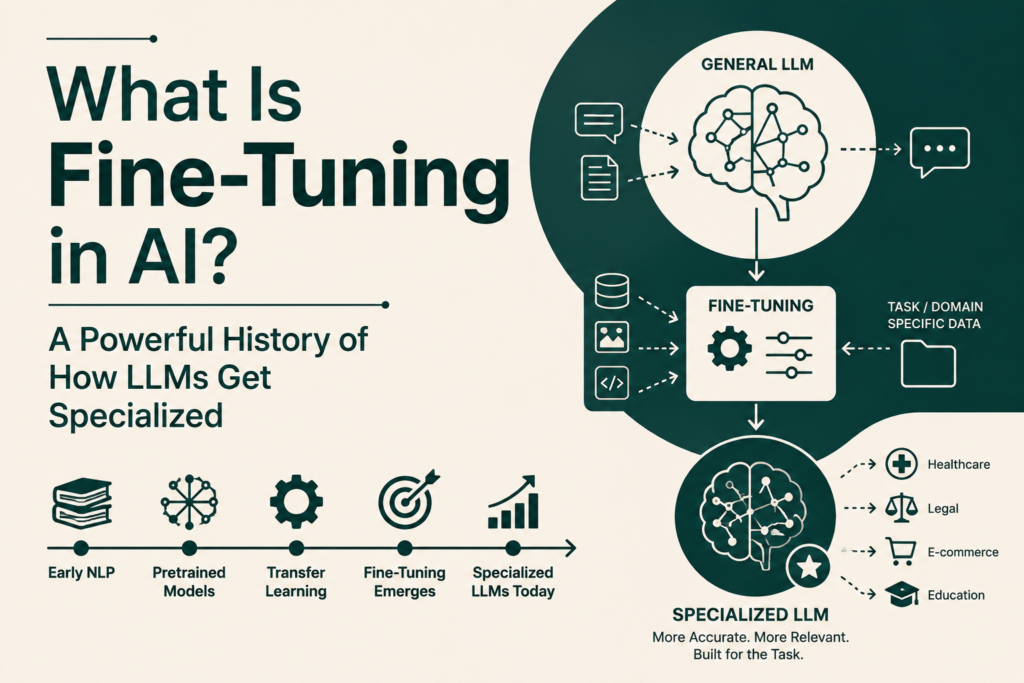
At its core, fine tuning in ai is the process of taking a large pre-trained model and continuing to train it on a smaller, more specific dataset so it becomes better at a particular task or domain. It is the bridge between a general-purpose foundation model and a specialized tool that actually solves real problems. Without fine tuning, even the most powerful language models would remain impressive but frustratingly unpredictable in production.
This article traces the full story of fine tuning in ai, from its early conceptual roots in transfer learning to the sophisticated parameter-efficient techniques that define the field today. Understanding this history is essential for anyone who wants to understand how AI systems go from raw capability to reliable, deployable intelligence.
The Roots of Fine-Tuning: Transfer Learning (1990 – 2012)
Fine tuning in ai did not emerge fully formed. It grew out of a broader idea in machine learning called transfer learning, the notion that knowledge learned while solving one problem can be reused to help solve a related problem. This idea has roots stretching back to cognitive science and early neural network research in the 1990s, where researchers observed that networks trained on one task often had internal representations that were useful for other tasks.
In the field of computer vision, transfer learning became a practical tool well before it took hold in natural language processing. Researchers discovered that a neural network trained on a large image classification dataset like ImageNet would develop early layers that detected general visual features such as edges, textures, and color gradients. These early layers could be reused for new vision tasks with much less data, while only the final task-specific layers needed retraining. This dramatically reduced the cost and data requirements of building new vision models.
The history of natural language processing shows a parallel but slower development. Language is more abstract and context-dependent than visual features, and for many years researchers lacked both the architectures and the data to make transfer learning work reliably in NLP. That changed with the arrival of word embeddings and then transformer-based models, which provided the pre-trained weights and representational richness that made fine tuning in ai genuinely powerful.
Word Embeddings and the First Wave of NLP Transfer Learning (2013 – 2017)
The practical story of fine tuning in ai in language begins with word embeddings. When Word2Vec was released by Google in 2013, it gave practitioners a new option: instead of training a model entirely from scratch on a small labeled dataset, you could initialize word representations using pre-trained embeddings learned from billions of words of unlabeled text. This was a primitive but genuine form of transfer learning.
The pre-trained weights embedded in these vector representations encoded meaningful semantic relationships, such as synonymy, analogy, and category membership. When used to initialize a model for a downstream task, they provided a richer starting point than random initialization, which typically reduced training time and improved final performance, especially when labeled data was scarce.
But this approach had clear limits. Word embeddings were static, meaning the same word always had the same vector regardless of context. The representation of “bank” in a financial sentence and a river sentence was identical. Fine tuning in ai at this stage was shallow, applying only to the final task-specific layers while the pre-trained embeddings were often kept frozen. The full power of fine-tuning would only emerge when models could learn deeply contextualized representations that changed based on surrounding text.
BERT and the Fine-Tuning Revolution (2018 – 2019)
The moment that truly transformed fine tuning in ai came in October 2018 when Google released BERT. Understanding the bert model history is inseparable from understanding how fine-tuning became the dominant paradigm in NLP.
BERT was pre-trained on enormous amounts of unlabeled text using masked language modeling, which forced it to develop deep, bidirectional, contextualized representations of language. The key innovation was not just the pre-training but the fine-tuning recipe that accompanied it. The authors showed that you could take the full pre-trained BERT model, add a simple task-specific layer on top, and then update all of the model weights together on a small labeled dataset. This end-to-end fine-tuning of all layers, rather than just the top ones, produced far stronger results than anything that had come before.
The results were extraordinary. Fine-tuned BERT models set new records on question answering, sentiment analysis, named entity recognition, and natural language inference benchmarks, often surpassing performance that had taken years to achieve with task-specific architectures. Downstream task adaptation via fine-tuning suddenly required far less labeled data and far less engineering effort.
This established the transfer learning process as it is broadly understood today: pre-train a large model on massive unlabeled data, then fine-tune on a small labeled dataset for the specific task you care about. The pre-trained weights encode general knowledge about language. The fine-tuning step applies that knowledge to your specific problem while updating the model weights through gradient descent optimization on your labeled datasets.
Supervised Fine-Tuning and Instruction Tuning (2020 – 2021)
As language models grew larger through the gpt models history, the fine-tuning landscape evolved in important new directions. GPT-3 in 2020 demonstrated that a sufficiently large model could perform many tasks through in-context learning, without any weight updates at all. But researchers quickly found that fine-tuning still dramatically improved reliability and task-specific performance compared to prompting alone.
Supervised fine-tuning, or SFT, became a standard technique for adapting large language models to follow instructions reliably. Rather than training on raw text prediction, SFT trains the model on examples of good behavior, showing it input-output pairs where the input is an instruction and the output is a high-quality response. This instruction tuning approach taught models to be helpful assistants rather than just text completers.
The challenge at this scale was the computational cost of fine-tuning. Updating all the parameters of a model with hundreds of billions of weights required enormous GPU memory and compute. Hyperparameter optimization became increasingly important and increasingly expensive. Choosing the right learning rate scheduler, batch size, number of training steps, and regularization strategy could make the difference between a successful fine-tune and a model that suffered from catastrophic forgetting, a phenomenon where the model loses its general knowledge and capabilities while being overfitted to the new narrow task.
Overfitting prevention became a central concern. With small labeled datasets relative to model size, the risk of a model memorizing the fine-tuning examples rather than generalizing from them was significant. Techniques including dropout, weight decay, and early stopping based on validation performance were applied carefully to maintain inference performance on unseen examples.
RLHF: Fine-Tuning With Human Preferences (2022)
One of the most influential developments in the story of fine tuning in ai came with the rise of reinforcement learning from human feedback, a technique that took fine-tuning beyond labeled examples and into the territory of human judgment.
The what is rlhf question is answered in three stages. First, supervised fine-tuning is applied to create a starting model that can follow instructions. Second, human raters compare pairs of model outputs and express preferences. Third, those preferences are used to train a reward model that predicts which outputs humans will prefer. The original language model is then further fine-tuned using reinforcement learning to maximize the reward model’s score.
This approach produced InstructGPT and then ChatGPT, which represented a qualitative leap in how useful and aligned language models felt to real users. RLHF showed that fine tuning in ai could go beyond teaching a model to perform a task and extend to teaching it to behave in ways that reflect human values, preferences, and safety considerations. Foundation model refinement through human feedback became a standard part of the pipeline for every major AI lab.
Parameter-Efficient Fine-Tuning: LoRA and PEFT (2022 – 2023)
The democratization of fine tuning in ai received a major boost from a class of techniques collectively known as parameter-efficient fine-tuning, or PEFT. The challenge these methods addressed was fundamental: if you want to fine-tune a model with 70 billion or 175 billion parameters, you need hardware that most organizations simply do not have. PEFT methods found clever ways to achieve most of the benefit of full fine-tuning while updating only a small fraction of the model’s parameters.
Low-Rank Adaptation, or LoRA, became the most widely adopted of these techniques. The core insight behind LoRA is that the changes to model weights during fine-tuning tend to have a low intrinsic rank, meaning they can be approximated by the product of two small matrices rather than requiring a full update to every weight. By inserting these small trainable matrices into each layer of the transformer and keeping the original pre-trained weights frozen as frozen parameters, LoRA achieves fine-tuning quality close to full fine-tuning at a fraction of the memory and compute cost.
This breakthrough made fine tuning in ai accessible to researchers and organizations without access to clusters of high-end GPUs. A single consumer-grade GPU could fine-tune a substantial language model using LoRA, opening the door to domain-specific training across medicine, law, finance, customer service, and education in ways that had been prohibitively expensive before.
Other PEFT techniques emerged alongside LoRA, including prefix tuning, prompt tuning, and adapter layers. Each represented a different approach to the problem of learning task-specific behavior while keeping most of the foundation model refinement stable and reusable. Knowledge distillation also became relevant here, compressing the behavior of a large fine-tuned model into a smaller, faster one for deployment.
Domain-Specific Fine-Tuning Across Industries (2022 – Present)
The practical impact of fine tuning in ai across real industries has been profound. Medical AI companies have fine-tuned large language models on clinical notes, research papers, and diagnostic guidelines to produce assistants that understand the specific vocabulary and reasoning patterns of healthcare. Legal technology companies have fine-tuned models on contracts, case law, and regulatory filings to produce tools that can draft, review, and compare legal documents with genuine competence.
In software development, models fine-tuned on code repositories in Python, JavaScript, and dozens of other languages have produced coding assistants that can complete functions, suggest fixes, and explain existing code with a level of accuracy that general-purpose models cannot match. The pre training in ai phase provides the general linguistic and reasoning foundation, but it is the domain-specific fine-tuning that makes these tools truly useful in professional contexts.
Education, finance, retail, and manufacturing have all seen the emergence of fine-tuned models tailored to their specific data, terminology, and task requirements. The pattern is consistent: the pre-trained foundation model provides the general capability, and fine tuning in ai applies that capability precisely where it is needed.
The Future of Fine-Tuning in AI
Fine tuning in ai continues to evolve rapidly. Researchers are exploring ways to make fine-tuning more efficient, more reliable, and more interpretable. Techniques that reduce catastrophic forgetting while enabling continual learning are an active area of research. Methods for combining multiple fine-tuned adapters to handle complex multi-domain tasks are gaining traction.
The future of AI will almost certainly involve fine tuning remaining a central technique, even as foundation models become more capable. The gap between general-purpose pre-training and specific real-world deployment is unlikely to disappear, and fine-tuning is the most reliable bridge across that gap that researchers have found so far.
For a broader perspective on how these developments fit into the overall arc of AI progress, the llm timeline traces how fine-tuning went from a theoretical concept in transfer learning to the production technique behind the most widely used AI products in the world.
FAQ:
What is fine-tuning in AI and how does it work?
Fine tuning in ai is the process of taking a large pre-trained model and continuing its training on a smaller, task-specific dataset. The pre-trained model has already learned general representations of language or vision from massive amounts of data. Fine-tuning updates the model weights through gradient descent optimization on labeled data for your specific task, adapting the general knowledge to the specific domain or behavior you need.
What is the difference between pre-training and fine-tuning?
Pre-training trains a model from scratch on massive amounts of unlabeled data using a general objective like predicting the next word or reconstructing masked tokens. It builds broad, general knowledge. Fine-tuning takes that pre-trained model and continues training it on a much smaller labeled dataset for a specific task. Pre-training is expensive and done once. Fine-tuning is relatively cheap and done many times for different applications.
What is LoRA and why does it matter?
LoRA, or Low-Rank Adaptation, is a parameter-efficient fine-tuning technique that updates only a small set of trainable matrices inserted into the pre-trained model while keeping the original weights frozen. This achieves performance close to full fine-tuning at a dramatically lower memory and compute cost, making fine-tuning accessible to organizations and researchers who cannot afford to update billions of parameters.
What is catastrophic forgetting in fine-tuning?
Catastrophic forgetting happens when a model is fine-tuned so aggressively on a narrow dataset that it loses the general knowledge and capabilities it gained during pre-training. For example, a model fine-tuned too heavily on medical text might lose its ability to handle general language tasks. Preventing this requires careful choices of learning rate, number of training steps, and regularization strategy.
What is instruction tuning and how is it different from standard fine-tuning?
Instruction tuning is a form of supervised fine-tuning where the training examples consist of natural language instructions paired with desired outputs. Rather than training a model to predict the next token in raw text, instruction tuning teaches the model to follow directions and complete tasks as specified in plain language. This is the technique that transformed raw pre-trained language models into helpful AI assistants.
Conclusion
Fine tuning in ai has traveled a long way from the early days of frozen word embeddings and shallow transfer learning. It has grown into a rich, sophisticated field of techniques ranging from full end-to-end fine-tuning to parameter-efficient methods like LoRA and PEFT, from simple supervised adaptation to complex RLHF pipelines that encode human values into model behavior.
Every major AI product you interact with today has been shaped by fine tuning in ai. BERT fine-tuned for search ranking. GPT-3 fine-tuned into ChatGPT. Open-source models fine-tuned for medicine, law, code, and education. The technique is not a footnote in AI history. It is one of the central mechanisms by which AI systems become genuinely useful in the real world.
Understanding fine tuning in ai means understanding how the gap between impressive and reliable, between general and specialized, between capable and aligned, gets closed. That gap is where most of the real work in AI happens, and it is where fine-tuning has proven indispensable.