Before transformers took over the world of artificial intelligence, there was a quieter revolution happening inside neural networks. If you have ever asked what is lstm in ai, you are asking about one of the most important and genuinely clever inventions in the history of deep learning. LSTM, which stands for Long Short-Term Memory, was the architecture that finally taught machines to remember, and it powered everything from speech recognition to machine translation for nearly two decades.
Understanding what is lstm in ai means going back to a time when researchers were wrestling with a problem so frustrating it nearly stopped the field of sequential AI in its tracks.
The Problem LSTM Was Built to Solve (1980 – 1990)
To understand what is lstm in ai, you first need to understand what came before it and why it was failing. In the 1980s, recurrent neural networks, or RNNs, were the dominant tool for processing sequences of data. Unlike feedforward networks that processed each input independently, RNNs could pass information from one step to the next through a hidden state vector. This made them theoretically perfect for language, speech, and time series tasks.
But there was a devastating flaw. When you trained an RNN using error backpropagation through time, or BPTT, the gradients that carried learning signals backward through the network would either shrink to near zero or explode to massive values over long sequences. This is the vanishing gradient problem, and it meant RNNs could only effectively learn from the last few steps of a sequence. They had terrible long-term memory in practice, no matter how large you made them.
For tasks like language understanding, where the meaning of a word often depends on something said many sentences earlier, this was a fatal limitation. Researchers needed something smarter.
Who Invented LSTM and When (1997)
The answer to what is lstm in ai begins with two researchers: Sepp Hochreiter and Jürgen Schmidhuber. In 1997, they published a landmark paper titled “Long Short-Term Memory” in the journal Neural Computation. This paper introduced a completely new type of recurrent unit designed specifically to solve the vanishing gradient problem.
Hochreiter had actually identified the vanishing gradient problem years earlier in his 1991 diploma thesis, making him one of the few researchers who truly understood why RNNs were failing so badly on long sequences. LSTM was his solution, built with Schmidhuber, and it was elegant in a way that few AI inventions have been.
The core idea behind what is lstm in ai is the memory cell state, a kind of conveyor belt running through the sequence that could carry information forward over very long distances without the gradients decaying away.
How LSTM Actually Works: Gates and Memory
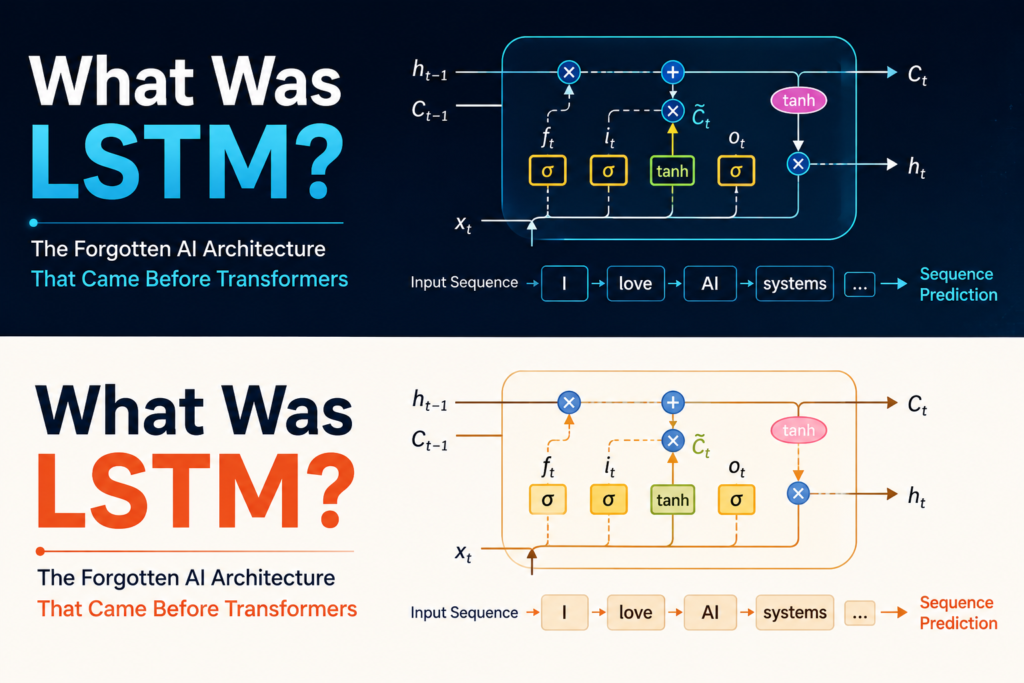
The brilliance of what is lstm in ai lies in its gating system. Traditional RNNs had one operation: mix the new input with the previous hidden state and produce an output. LSTM replaced this with a sophisticated system of three learnable gates: the input gate, the forget gate, and the output gate.
The forget gate decides what information from the previous memory cell state should be thrown away. It uses a sigmoid activation function that outputs values between 0 and 1, where 0 means forget completely and 1 means keep everything perfectly.
The input gate decides what new information from the current input should be added to the memory cell. It combines a sigmoid function for selection with a tanh activation function that creates candidate values to potentially store.
The output gate controls what part of the current memory cell state gets passed forward as the hidden state vector for the next step. Together, these three gates give what is lstm in ai its extraordinary ability to selectively remember and forget over very long sequences. This pointwise multiplication of gate outputs with the cell state is what keeps gradients healthy during training.
LSTM vs Standard RNN: A Massive Improvement
When you compare LSTM vs RNN performance on real tasks, the difference is not subtle. Standard RNNs struggled badly on sequences longer than 10 or 20 steps. LSTM could handle sequences hundreds of steps long while still learning meaningful temporal dependencies.
This was transformative for tasks like speech recognition, where the model needs to connect sounds heard at the beginning of a word with those at the end. It was equally powerful for machine translation, where understanding a full source sentence before generating a translation required holding information in memory across many tokens.
The gradient descent optimization that had been failing so badly with standard RNNs now worked reliably with LSTM because the memory cell state provided a path for gradients to flow backward through time without vanishing. Weights and biases initialization mattered less because the gates gave the network fine-grained control over information flow.
For anyone exploring the large language models history, LSTM represents a critical bridge between the early days of neural sequence processing and the transformer era that followed.
Bidirectional LSTM: Reading Both Ways (2005 – 2013)
One powerful extension of the basic LSTM architecture is the bidirectional LSTM, or BiLSTM. Standard LSTMs process sequences from left to right, meaning each step only sees what came before it. But for many tasks, the context that comes after a word is just as important as what came before.
Bidirectional LSTM solves this by running two separate LSTM layers over the same sequence, one going forward and one going backward. The hidden state vectors from both directions are then combined at each step, giving the model a full view of the surrounding context for every position in the sequence.
BiLSTMs became extremely popular for tasks like named entity recognition, part-of-speech tagging, and sentiment analysis. They were a key component of many state-of-the-art NLP systems right up until the transformer revolution. Understanding what is lstm in ai in its bidirectional form helps explain why these models were so competitive for so long.
LSTM and the Seq2Seq Revolution (2014)
In 2014, researchers at Google and other institutions combined LSTMs with the encoder-decoder framework to create sequence-to-sequence models. These seq2seq architectures used one LSTM to read an entire input sequence and compress it into a fixed-size context vector, and a second LSTM to generate the output sequence from that vector.
This was a massive breakthrough for machine translation. For the first time, a single end-to-end neural network could translate sentences between languages without hand-crafted rules or phrase tables. Google Neural Machine Translation, launched in 2016, was built on this LSTM-based seq2seq foundation and dramatically improved translation quality overnight.
The attention mechanism explained in the context of seq2seq models shows how researchers quickly identified a weakness in this setup: compressing an entire sentence into one fixed vector lost too much information. Attention was added to let the decoder look back at all encoder steps, and that addition pointed directly toward the transformer.
Gated Recurrent Units: A Simpler Alternative (2014)
Around the same time that seq2seq models were taking off, Kyunghyun Cho and colleagues introduced Gated Recurrent Units, or GRUs. GRUs simplified the LSTM architecture by merging the forget and input gates into a single update gate and eliminating the separate output gate entirely.
This made GRUs faster to train and easier to implement while maintaining much of the power of full LSTMs. For many tasks, GRU performance was comparable to LSTM despite having fewer parameters. The choice between LSTM and GRU became one of the practical decisions every deep learning practitioner had to make when working with sequential data processing.
GRUs remain in use today for tasks where speed and simplicity matter more than maximum accuracy, particularly in resource-constrained environments.
LSTM for Time Series and Beyond
One area where what is lstm in ai proved particularly powerful was deep learning for time series data. Financial forecasting, weather prediction, anomaly detection, and sensor data analysis all involve sequential data where past values influence future ones. LSTM’s ability to model temporal dependency made it a natural fit for these problems.
Unlike traditional statistical time series methods, LSTMs could learn complex nonlinear patterns without requiring careful feature engineering for sequences. You could feed raw time series data into an LSTM and let it discover the relevant patterns through gradient descent optimization and supervised learning.
This versatility made LSTM one of the most widely applied architectures in both research and industry throughout the 2010s. It was not just a language model. It was a general-purpose sequence learner of remarkable power.
To understand how these sequence models fit into the broader story of AI development, the who invented large language models story shows how LSTM-era research laid the foundation for the massive language models we use today.
Why LSTM Was Eventually Replaced
Despite its power, what is lstm in ai also has clear limitations that became more apparent as datasets and compute grew larger. LSTMs process sequences step by step, which means they cannot be easily parallelized during training. You have to wait for step 1 to finish before computing step 2, which makes training on very long sequences extremely slow.
Transformers, introduced in 2017, solved this by processing all positions in a sequence simultaneously using self-attention. This made them dramatically faster to train on modern GPU hardware and allowed them to scale to dataset sizes that would have been impossible for LSTMs.
The transformer architecture history tells the story of how the attention mechanism that was first added on top of LSTMs eventually replaced them entirely. Once transformers proved they could handle language better and faster, LSTM’s days as the dominant architecture were numbered.
Overfitting in neural networks was also more of a concern with LSTMs than with transformers, particularly for smaller datasets where the gating mechanisms had fewer examples to learn from properly.
The Legacy of LSTM in Modern AI
Even though transformers have replaced LSTMs in most cutting-edge applications, what is lstm in ai remains deeply relevant. LSTMs are still widely used in embedded systems, real-time applications, and edge computing where transformer models would be too large and slow.
More importantly, LSTM’s conceptual contributions are permanent. The idea of learnable gating mechanisms, the memory cell state, and the solution to the vanishing gradient problem all influenced how researchers thought about neural network design going forward. Many ideas in transformer architecture, including the careful control of information flow through layers, echo the lessons LSTM taught.
The ai scaling laws that now guide the development of massive language models were partly discovered because LSTM research showed that more data and more parameters consistently improved performance on sequence tasks, a pattern that turned out to hold far beyond anything LSTM itself could achieve.
If you want to explore what modern AI tools built on these foundations can do for you right now, check out the ai tools for productivity available today and see how far we have come from the early days of gated memory cells and gradient descent through time.
Frequently Asked Questions (FAQs)
What is lstm in ai in simple terms?
LSTM stands for Long Short-Term Memory. It is a type of recurrent neural network designed to remember information over long sequences by using a system of learnable gates that control what to keep, forget, and output at each step.
Why was LSTM invented?
LSTM was invented to solve the vanishing gradient problem that made standard RNNs unable to learn from long sequences. Sepp Hochreiter and Jürgen Schmidhuber introduced it in 1997 after years of studying why RNN training failed on long-range dependencies.
What are the three gates in an LSTM?
The three gates are the forget gate, the input gate, and the output gate. Each uses sigmoid and tanh activation functions to control how information flows through the memory cell state at every step of the sequence.
Is LSTM still used today?
Yes. While transformers have replaced LSTMs in most large-scale NLP tasks, LSTMs are still actively used in time series forecasting, real-time systems, embedded devices, and many industrial applications where transformer models are too large or slow.
What replaced LSTM and why?
Transformers replaced LSTM as the dominant architecture for language tasks primarily because transformers can process all sequence positions in parallel, making them much faster to train at scale. The self-attention mechanism also proved more effective than gated memory cells for capturing long-range dependencies in language.
Conclusion
Understanding what is lstm in ai means appreciating one of the most important inventions in the history of deep learning. LSTM solved a problem that had paralyzed neural sequence modeling for a decade, powered the first wave of truly capable AI language systems, and laid the conceptual groundwork for the transformer revolution that followed. It may no longer be the cutting edge, but what is lstm in ai is very much the foundation on which the cutting edge was built. Every powerful language model you use today owes something to the elegant gating system that Hochreiter and Schmidhuber quietly introduced in 1997.