Introduction
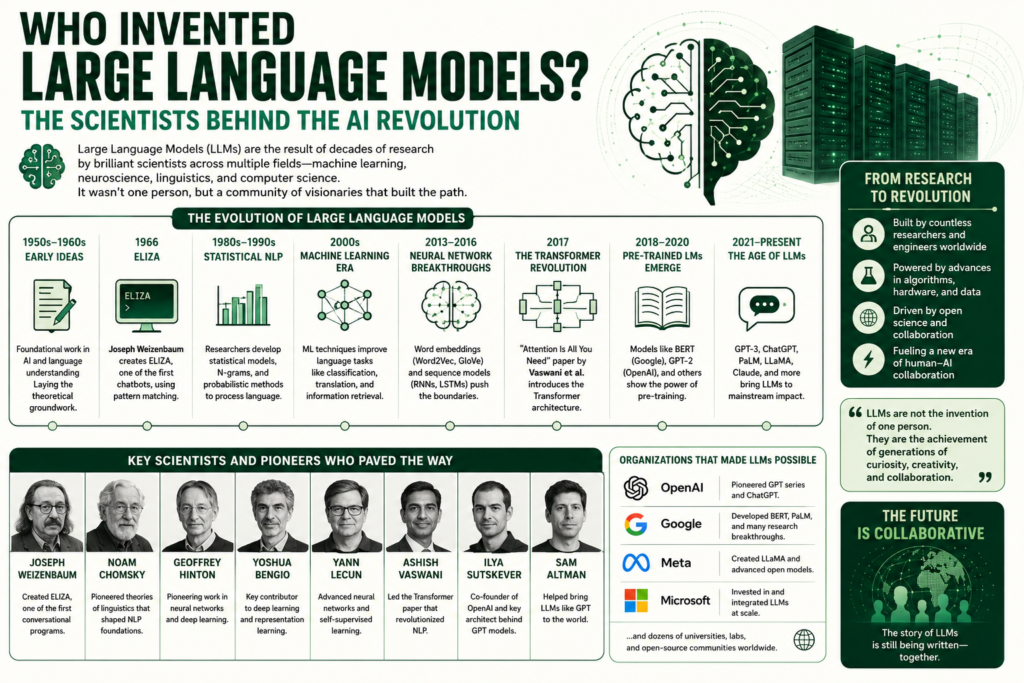
Every time you chat with an AI assistant, you are experiencing decades of collective human genius. The question who invented large language models does not have a single answer. Instead, who invented large language models is a story of collaboration across generations, institutions, and continents.
The journey began long before ChatGPT. Who invented large language models requires us to look back to the 1960s, forward through statistical breakthroughs, and finally to the transformer revolution at Google Brain.
The Early Pioneers (1960 – 1990)
Before we can answer who invented large language models, we must understand the early pioneers who laid essential groundwork.
Joseph Weizenbaum (1964 – 1966)
Joseph Weizenbaum created ELIZA at MIT between 1964 and 1966. ELIZA simulated a Rogerian psychotherapist using simple pattern matching rules. Many users became convinced they were talking to a real therapist. The eliza chatbot history shows how this simple program fooled people into thinking it was intelligent.
Statistical NLP Pioneers (1970 – 1990)
The 1970s and 1980s brought statistical methods to language processing. Researchers at IBM, Bell Labs, and universities developed hidden Markov models and early machine translation systems. Their shift from handcrafted rules to data driven approaches enabled later neural breakthroughs.
The Deep Learning Foundations (1980 – 2010)
The neural network revolution was essential to answering who invented large language models.
Geoffrey Hinton, Yann LeCun, and Yoshua Bengio
These three researchers, often called the godfathers of deep learning, laid the foundation for modern AI. Geoffrey Hinton’s work on backpropagation, Yann LeCun’s convolutional networks, and Yoshua Bengio’s neural language models were all essential. The recurrent neural networks history also includes Schmidhuber and Hochreiter, who invented LSTMs in 1997.
Tomas Mikolov and Word2Vec (2013)
Tomas Mikolov at Google led the team that developed Word2Vec in 2013. This technique learned dense vector representations where similar words had similar vectors. The history of word embeddings shows how this breakthrough enabled neural networks to understand word meanings.
The Transformer Breakthrough (2017)
The single most important answer to who invented large language models is the team behind the transformer paper.
Vaswani, Shazeer, Parmar, and the Google Brain Team
The attention is all you need, the paper was published in December 2017. Google Brain researchers Ashish Vaswani, Noam Shazeer, Niki Parmar, Jakob Uszkoreit, Llion Jones, Aidan N. Gomez, Łukasz Kaiser, and Illia Polosukhin authored this landmark work.
The paper introduced the transformer architecture. Unlike previous RNNs, the transformer processes all words in parallel using self attention. This parallelism made training much faster. The transformer architecture history begins with this single paper.
Who invented large language models points primarily to these eight authors. Their transformer architecture powers every major LLM today, from GPT to Gemini to Claude.
The Scaling Visionaries (2018 – 2022)
The transformer was the architecture. But who invented large language models also includes those who scaled it to unprecedented size.
Ilya Sutskever and OpenAI
Ilya Sutskever, a student of Geoffrey Hinton, co founded OpenAI and served as Chief Scientist. The openai history shows how he pushed aggressively toward scaling transformers. His belief in the scaling hypothesis drove the GPT series from GPT-1 to GPT-4.
GPT-3 with 175 billion parameters demonstrated emergent abilities that smaller models lacked. It could translate languages, write code, and reason without explicit training.
The OpenAI Founding Team
Sam Altman, Greg Brockman, John Schulman, and Wojciech Zaremba joined Sutskever in founding OpenAI. Their vision shaped the direction of LLM research.
The BERT Era and Modern Contributors (2018 – 2024)
Jacob Devlin and the BERT Team (2018)
Jacob Devlin and colleagues at Google created BERT in 2018. BERT introduced masked language modeling, training the model to predict randomly masked words using both left and right context. The bert model history shows how this bidirectional understanding became standard for comprehension tasks.
The Open Source Movement
Hugging Face created the model hub that democratized access to pretrained models. Meta released LLaMA, proving that powerful models could be open source.
ChatGPT and Public Awareness
OpenAI released ChatGPT in November 2022. It became the fastest growing consumer application ever, reaching 100 million users in two months. The chatgpt history shows how this launch brought LLMs into mainstream consciousness.
The Complete Answer
So who invented large language models? The answer has multiple layers.
Layer 1: The Early Pioneers
Joseph Weizenbaum (ELIZA), the statistical NLP researchers, Geoffrey Hinton, Yann LeCun, Yoshua Bengio, and Tomas Mikolov (Word2Vec).
Layer 2: The Transformer Inventors
Ashish Vaswani, Noam Shazeer, Niki Parmar, Jakob Uszkoreit, Llion Jones, Aidan Gomez, Łukasz Kaiser, and Illia Polosukhin at Google Brain. This is the most direct answer.
Layer 3: The Scaling Visionaries
Ilya Sutskever, Sam Altman, Greg Brockman, and the OpenAI team.
Layer 4: The Open Source Era
Jacob Devlin (BERT), the Hugging Face team, and Meta (LLaMA).
Who invented large language models is not one person but a community. Many people contributed essential pieces across seven decades.
Frequently Asked Questions
Who wrote the transformer paper?
The transformer paper was written by Ashish Vaswani, Noam Shazeer, Niki Parmar, Jakob Uszkoreit, Llion Jones, Aidan N. Gomez, Łukasz Kaiser, and Illia Polosukhin at Google Brain in 2017.
Who is Ilya Sutskever?
Ilya Sutskever is a co-founder and former Chief Scientist of OpenAI. He was instrumental in scaling GPT models.
Did Geoffrey Hinton invent large language models?
Hinton did not directly invent LLMs, but his deep learning research laid essential groundwork.
What role did Google Brain play?
Google Brain researchers designed the transformer architecture that powers every major LLM today.
Who created BERT?
BERT was created by Jacob Devlin and colleagues at Google in 2018.
Why is there no single inventor of LLMs?
LLMs emerged from decades of incremental research. Many scientists contributed essential pieces.
Conclusion
The question of who invented large language models reveals a remarkably inspiring story of collective genius. From Joseph Weizenbaum’s ELIZA to Ashish Vaswani’s transformer, from Geoffrey Hinton’s deep learning to Ilya Sutskever’s scaling vision, hundreds of brilliant minds contributed.
The best free ai tools 2026 we use today are the product of this multi decade collaboration. The ai tools for productivity we rely on every day continue to evolve from their foundational work. The future will bring many more inventors to this remarkable story.