Introduction
The transformer architecture history is one of the most important stories in modern technology. In just a few years, this single architectural idea went from an academic paper to the engine powering some of the world’s most powerful AI systems. Understanding how we got here, from clunky rule-based systems to machines that can write essays and generate code, reveals just how radical this transformation truly was.
The transformer architecture history did not begin in 2017. It is rooted in decades of research, false starts, hardware breakthroughs, and brilliant insights from researchers around the world. This article walks you through the full journey, covering the origins of language AI, the problems that blocked progress, and the elegant solution that changed everything.
The Early Foundations of AI Language Research (1960 – 1980)
Long before deep learning existed, researchers were already obsessed with making machines understand human language. In 1966, MIT professor Joseph Weizenbaum created ELIZA, one of the earliest chatbot programs ever built. It used simple pattern matching to simulate conversation, and it shocked many people who interacted with it because it felt eerily human. The eliza chatbot history remains a fascinating chapter in how humans anthropomorphize machines.
During this era, most AI language systems relied on hand-crafted rules. Linguists and programmers would write thousands of conditional statements trying to capture the structure of language. The approach was brittle, slow to scale, and unable to handle the natural messiness of real human speech. There was essentially no inductive bias built from data; everything was manually specified. Progress was slow.
Statistical NLP and the Rise of Machine Learning (1980 – 2000)
By the 1980s, researchers began applying statistical methods to language tasks. Instead of writing rules by hand, they trained models on real text data and let the statistics do the work. This marked a turning point in the history of natural language processing, shifting focus from symbolic logic to probabilistic reasoning.
Hidden Markov Models became popular for tasks like speech recognition and part-of-speech tagging. N-gram models were used to predict the next word in a sequence based on the previous few words. These methods worked reasonably well for narrow tasks, but they struggled to capture long-range dependencies in language. If the meaning of a word at the end of a sentence depended on a word near the beginning, these models would lose that connection entirely.
This era also saw the rise of early neural networks, though training them was painfully slow on the hardware of the time. The theoretical tools were there, but the compute and data were not yet available at the scale needed to make real progress.
Word Embeddings and the Shift to Dense Representations (2000 – 2013)
One of the biggest intellectual leaps in the history of word embeddings came when researchers started representing words not as discrete symbols but as dense numerical vectors. Instead of treating the word “king” as a unique ID, you could place it in a high-dimensional space where similar words were geometrically close to each other.
In 2013, Google researchers released Word2Vec, a method that could learn these dense vector representations from massive text corpora with remarkable efficiency. What is Word2Vec? It is a shallow neural network that learns word representations by predicting neighboring words in a sentence. The resulting vectors captured astonishing semantic relationships. The famous example is that subtracting the vector for “man” from “king” and adding “woman” would yield a vector very close to “queen.” This kind of representation became foundational for nearly everything that followed.
Word embeddings gave models a powerful starting point. Rather than learning language from scratch on every task, a model could begin with rich, pre-trained vector representations. This was an early example of transfer learning, a concept that would later become central to the entire field.
Recurrent Neural Networks and Their Painful Limits (2013 – 2017)
With better word representations in hand, researchers turned to recurrent neural networks, or RNNs, to handle sequences. The recurrent neural networks history in the context of NLP is a story of genuine promise followed by frustrating limitations.
An RNN processes a sentence word by word, maintaining a hidden state that theoretically carries information from earlier in the sequence forward to later positions. In practice, these networks suffered from what became known as the vanishing gradient problem. As the sequence grew longer, the signal from early tokens would fade almost to nothing by the time the network reached later tokens. Training stability was a persistent challenge.
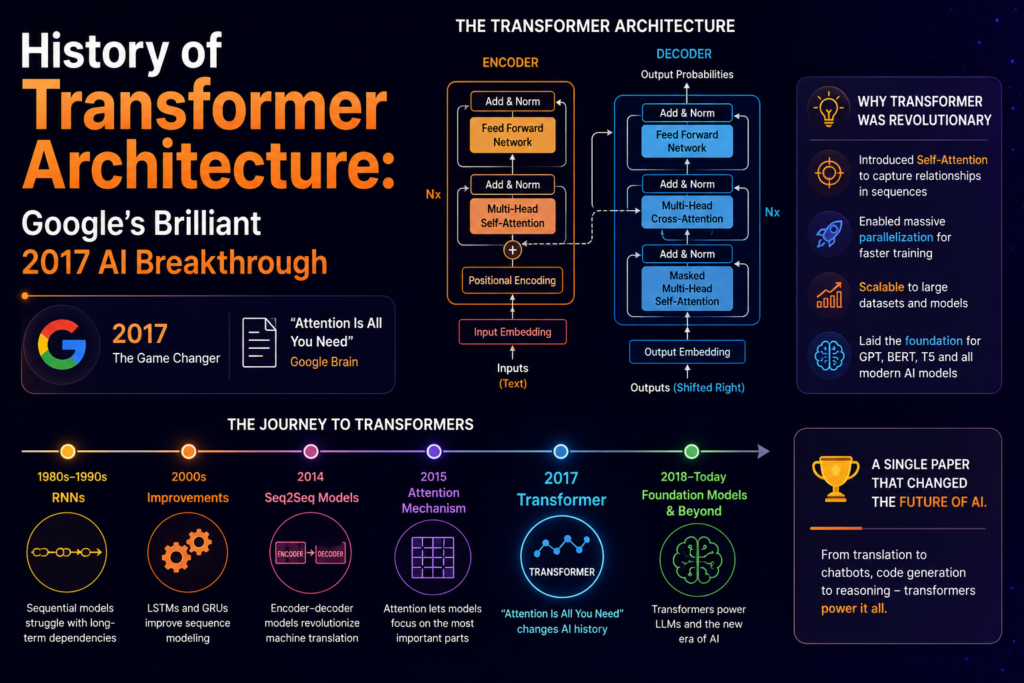
Long Short-Term Memory networks, or LSTMs, were developed specifically to address this problem. What is LSTM in AI? It is a special type of recurrent network with gating mechanisms that allow the model to selectively remember and forget information over long sequences. LSTMs improved things significantly, and they powered some impressive seq2seq models used in early machine translation systems.
The seq2seq models history is tied closely to encoder-decoder architectures, where one RNN would encode an input sentence into a fixed-length vector and another RNN would decode that vector into an output sentence. This worked well for short sentences but fell apart for longer ones because compressing an entire sentence into a single fixed-size vector lost too much information.
This bottleneck was the crack in the wall through which the attention mechanism would eventually break through.
The Attention Mechanism: The Idea That Changed Everything (2014 – 2016)
The attention mechanism explained simply: instead of forcing the encoder to compress everything into a single vector, let the decoder dynamically look back at all the encoder’s hidden states when generating each output word. For each output token, the model learns to “attend” to the most relevant parts of the input.
Bahdanau and colleagues introduced this idea in 2014, and it immediately improved translation quality. The model developed a kind of global receptive field, allowing it to connect any input position to any output position regardless of distance. This was a genuinely revolutionary insight, but at the time it was added on top of existing RNN architectures rather than replacing them.
Researchers noticed something interesting: attention was doing most of the heavy lifting. The recurrent part was becoming more of a scaffold than a load-bearing structure. The question started forming in a few minds: what if you removed the recurrence entirely and just used attention?
“Attention Is All You Need”: The 2017 Paper That Rewrote AI History
In June 2017, a team of researchers at Google Brain and Google Research published a paper titled “Attention Is All You Need.” This is the paper that formally introduced the transformer architecture, and it stands as one of the most cited and consequential papers in the entire llm timeline.
The transformer abandoned recurrence completely. Instead of processing tokens one by one in sequence, the transformer architecture history marks this as the moment when parallel processing took over. The model could attend to all positions in a sequence simultaneously using what the authors called multi-head self-attention.
The architecture had several key ingredients. Self-attention layers allowed every token to attend to every other token in the same sequence. Residual connections helped gradients flow cleanly during training, addressing training stability issues that had plagued deep networks. Layer normalization kept activations well-scaled throughout. Positional encodings told the model where each token sat in the sequence since there was no inherent order from recurrence anymore.
The result was a model that was faster to train thanks to massive parallelization, handled long-range dependencies far more naturally, and scaled up with hardware in ways that RNNs simply could not. This was not just an incremental improvement. It was a paradigm shift that made almost everything that came before it obsolete.
BERT: Bidirectional Understanding Arrives (2018 – 2019)
Google followed up its transformer paper with BERT in 2018, and the BERT model history represents the first time the broader research community truly grasped how powerful pre-training on large corpora could be.
BERT stands for Bidirectional Encoder Representations from Transformers. What is BERT model? It is a transformer encoder that is pre-trained on two tasks: predicting randomly masked tokens within a sentence and predicting whether one sentence follows another. By training on enormous amounts of unlabeled text, BERT developed a deep understanding of language context.
BERT demonstrated the power of pre-training and fine-tuning as a dominant paradigm. A single BERT model could be fine-tuned on a small labeled dataset for a specific task and achieve state-of-the-art results on benchmarks ranging from question answering to sentiment analysis. This changed how practitioners approached nearly every NLP problem.
GPT and the Generative Path Forward (2018 – 2020)
While Google was developing BERT, OpenAI was pursuing a different direction with the GPT models history. GPT-1 origins date to 2018, when OpenAI released the first Generative Pre-trained Transformer. Where BERT used the encoder portion of the transformer for bidirectional understanding, GPT used the decoder portion in an autoregressive manner, predicting the next token given all previous tokens.
GPT-2 arrived in 2019 with 1.5 billion parameters and generated such convincingly fluent text that OpenAI initially delayed its full release, citing misuse concerns. Then came GPT-3 in 2020, with a staggering 175 billion model parameters. The GPT-3 history showed that scaling laws were real and powerful: simply making models bigger and training them on more data kept producing qualitative improvements in capability.
Scaling laws in AI describe the predictable relationship between compute, data, model size, and performance. Researchers at OpenAI and DeepMind found these relationships held over many orders of magnitude, giving the field a map for how to improve models systematically. This discovery turbocharged investment in larger and larger models.
The Era of Foundational Models and the BERT vs GPT vs T5 Landscape
By 2020 and 2021, the transformer architecture history had produced a rich ecosystem of foundational models. The debate over BERT vs GPT vs T5 was not about which was best in some absolute sense but about which was best suited for different applications.
BERT-style encoder models excel at classification and understanding tasks. GPT-style decoder models excel at generation. T5, introduced by Google, took a unified text-to-text approach where every NLP task was framed as generating a text output from a text input. Each approach reflected different inductive biases and training philosophies.
The concept of tokenization methods also became increasingly important. Different models used different strategies for breaking text into tokens, including byte-pair encoding and SentencePiece, and these choices affected both efficiency and coverage of rare words.
ChatGPT, RLHF, and the Mainstream Moment (2022 – 2023)
OpenAI released ChatGPT in November 2022, and within two months it had reached 100 million users, making it the fastest-growing consumer application in history. The ChatGPT history is really the story of what is RLHF, or Reinforcement Learning from Human Feedback, applied at scale.
RLHF is a training technique where human raters compare model outputs and their preferences are used to train a reward model, which then guides further fine-tuning of the language model. This process made ChatGPT feel dramatically more helpful, honest, and safe than raw GPT-3. The gap between “impressive research demo” and “product millions of people want to use every day” was bridged largely through this technique.
Thetransformer architecture history had now produced a product that the general public was genuinely excited about. This changed the conversation around AI from something technical professionals discussed to something politicians, educators, journalists, and everyday people were debating.
The Competitive Landscape Explodes (2023 – 2024)
ChatGPT’s success triggered a full-scale AI arms race among major technology companies and startups. Google launched Bard, which later evolved into Gemini. Anthropic released Claude, built with a strong emphasis on safety and helpfulness. Meta released the LLaMA family of open-weight models, dramatically lowering the barrier for researchers to experiment with large language models. Mistral AI emerged from France offering highly efficient open models. DeepSeek from China released models that achieved impressive results at surprisingly low training costs.
The future of AI is now being shaped by competition across dozens of organizations, each pursuing different strategies around model size, efficiency, safety, and deployment.
The transformer architecture history is fundamentally a story about how one architectural breakthrough spawned an entire industry. GPT-4 arrived in 2023 with multimodal capabilities, allowing it to process both images and text. This expansion into multimodal AI history showed that transformers were not limited to language. Vision Transformers, or ViT, had already demonstrated in 2020 that the same self-attention mechanism could be applied to images by treating image patches as tokens.
Hardware acceleration, particularly the rise of specialized TPUs from Google and the dominance of NVIDIA GPUs, made all of this possible. Without massive parallelization enabled by modern hardware, even the most elegant architecture would remain theoretical.
Retrieval-Augmented Generation and the Next Chapter
One persistent weakness of transformer-based language models is their tendency toward AI hallucination, generating confident-sounding but factually incorrect statements. Retrieval-Augmented Generation, or RAG, emerged as a practical solution. Instead of relying solely on knowledge baked into model parameters during training, RAG systems retrieve relevant documents at inference time and use them as context when generating responses. This reduces inference latency in the sense that models do not need to store all knowledge internally, and it keeps responses grounded in verifiable sources.
Frequently Asked Questions (FAQs)
What is the transformer architecture and why does it matter?
The transformer is a neural network architecture introduced by Google researchers in 2017. It replaced recurrent networks with self-attention mechanisms, enabling faster training, better handling of long-range dependencies, and massive scalability. It matters because virtually every major AI language system today, from GPT-4 to Gemini to Claude, is built on this foundation.
Who invented the transformer architecture?
The transformer was introduced in the 2017 paper “Attention Is All You Need” by Ashish Vaswani, Noam Shazeer, Niki Parmar, Jakob Uszkoreit, Llion Jones, Aidan Gomez, Łukasz Kaiser, and Illia Polosukhin, all working at Google at the time.
How does the attention mechanism work in transformers?
Self-attention allows every token in a sequence to compute a weighted relationship with every other token. For each token, the model produces query, key, and value vectors. The query from one token is compared against the keys of all other tokens to produce attention weights, which determine how much each token influences the current token’s representation. This gives the model a global receptive field across the entire sequence.
What came before the transformer architecture?
Before transformers, the dominant approach to sequence modeling was recurrent neural networks, particularly LSTMs. These processed sequences step by step and struggled with long-range dependencies due to the vanishing gradient problem. Attention mechanisms were added to RNNs as improvements, but the full transformer architecture removed recurrence entirely.
What is the difference between BERT and GPT?
BERT uses the transformer encoder and is pre-trained with a masked language modeling objective, making it bidirectional and particularly strong at understanding tasks. GPT uses the transformer decoder and is pre-trained autoregressively, predicting the next token, making it naturally suited for generation. Both rely on pre-training and fine-tuning, but they optimize for different strengths.
Why did transformers outperform RNNs?
Transformers outperformed RNNs for three core reasons: they process all tokens in parallel rather than sequentially, enabling far more efficient use of modern GPU and TPU hardware; they can directly relate any two positions in a sequence regardless of distance; and they scale more predictably with more data and larger model parameters, following well-defined scaling laws.
Conclusion
The transformer architecture history is really a story about accumulated human insight finally finding the right form. Decades of research into language, statistics, neural networks, and attention mechanisms all converged in 2017 when a team at Google stripped away the unnecessary parts and showed that attention truly was all you needed.
From the ELIZA chatbot to Word2Vec to LSTM to the original transformer to BERT, GPT-3, ChatGPT, and beyond, each step built on what came before. The result is a technology that has changed how we search, write, code, learn, and communicate. The post-RNN era we now live in is only a few years old, yet it has already reshaped entire industries. Understanding this history is not just intellectually satisfying; it is essential for anyone who wants to understand where AI is going next.