There are very few moments in the history of science where a single paper changes everything. The attention is all you need paper, published in 2017 by a team of eight researchers at Google, is one of those rare moments. It did not just introduce a new model. It introduced a completely new way of thinking about how machines process language, and it made almost everything that came before it obsolete almost overnight.
If you want to understand why ChatGPT, Gemini, Claude, and every other powerful AI system works the way it does today, the attention is all you need paper is where you must start. Everything traces back to this document.
The World Before the Paper: A Field Hitting Its Limits (2014 – 2016)
To truly appreciate the attention is all you need paper, you need to understand what the field of natural language processing looked like in the years just before it arrived. The dominant tools were recurrent neural networks, particularly LSTMs and GRUs, combined with the encoder-decoder structure that had powered the seq2seq translation models of 2014 and 2015.
These models had genuine strengths. They could handle sequential data and model temporal patterns reasonably well. But they had two deep structural problems that no amount of clever engineering could fully fix.
The first problem was sequential processing. RNNs had to process text one token at a time, step by step, which meant you could not parallelize training across the sequence. Training on large datasets was painfully slow even on powerful hardware.
The second problem was long-range dependencies. Even with LSTM gating mechanisms, capturing relationships between words that were dozens or hundreds of positions apart remained extremely difficult. The gradient flow through long sequences degraded no matter how carefully you designed the architecture.
By 2016, researchers knew the field needed something fundamentally different. They just did not know yet what that something would look like. The how llms work story picks up exactly at this inflection point, where the limitations of recurrent architectures were becoming impossible to ignore.
The Authors Behind the Breakthrough (2017)
The attention is all you need paper was published by Ashish Vaswani, Noam Shazeer, Niki Parmar, Jakob Uszkoreit, Llion Jones, Aidan Gomez, Lukasz Kaiser, and Illia Polosukhin. All eight were affiliated with Google Brain or Google Research at the time. The paper was presented at the Neural Information Processing Systems conference, known as NIPS, in December 2017.
What made Vaswani et al. 2017 so striking was its boldness. The title itself was a provocation. Recurrent connections had been the backbone of sequence modeling for decades. Convolutional layers were being explored as alternatives. The paper declared that you needed neither. Attention was sufficient on its own to build a world-class sequence model.
This was not a modest incremental improvement. It was a fundamental architectural reimagining, and the results backed up the confidence of the claim completely.
The Core Idea: Self-Attention as the Engine (2017)
The central insight of the attention is all you need paper is the self-attention mechanism applied at scale across an entire sequence simultaneously. Rather than processing tokens one at a time and carrying a hidden state forward, the transformer computed relationships between every pair of positions in the sequence in a single parallel operation.
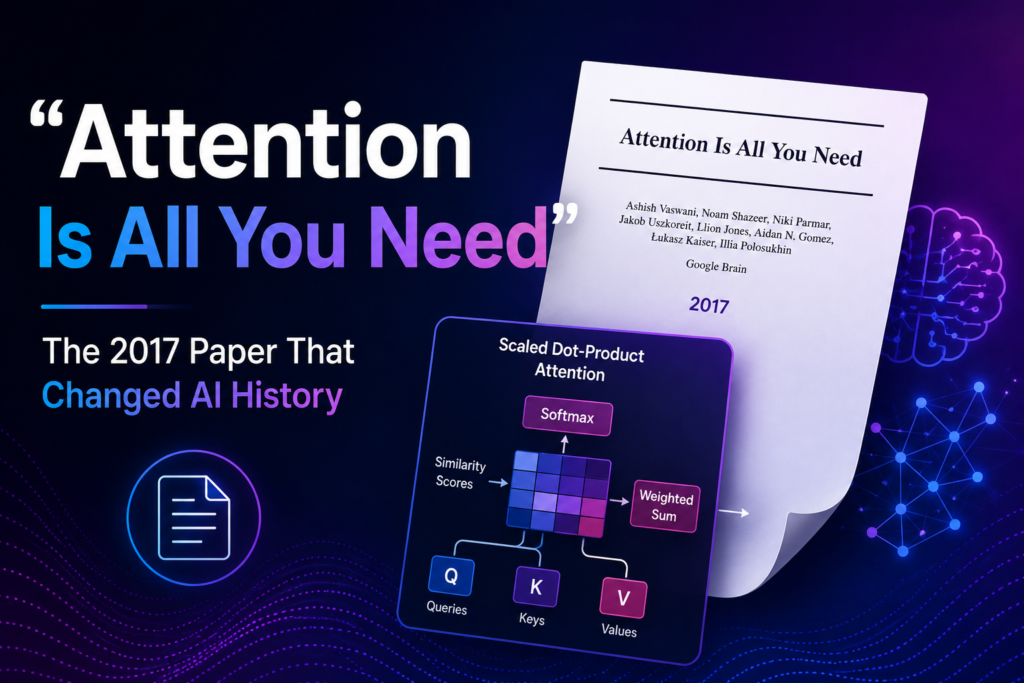
At the heart of this is scaled dot-product attention, built on the elegant framework of query key value vectors, commonly written as QKV. Every token in the sequence produces three vectors through learned linear projections: a Query representing what that token is looking for, a Key representing what that token offers to others, and a Value representing the actual content it contributes when selected.
Attention scores are computed by taking the dot product of each Query with all Keys, then dividing by the square root of the vector dimension to prevent the softmax activation function from entering regions with extremely small gradients. The softmax then normalizes these scores into attention weights that sum to 1, and the weighted sum of Value vectors produces the output for each position.
This operation captures long-range dependencies instantly. A word at position 1 can directly attend to a word at position 500 with the same computational cost as attending to the word right next to it. The gradient flow from the output back to any input position flows through just a single attention operation, making training dramatically more stable than backpropagation through long recurrent chains.
Multi-Head Attention: Seeing in Multiple Ways at Once
One of the most powerful innovations introduced in the attention is all you need paper is multi-head attention. Rather than performing the QKV attention operation once with the full model dimension, multi-head attention runs the attention operation multiple times in parallel with different learned projections for each head.
Each attention head develops its own understanding of which relationships matter. One head might learn to connect pronouns with their referents. Another might learn to track subject-verb agreement. A third might capture semantic similarity between words that mean related things. The outputs of all heads are concatenated and projected back to the model dimension.
This gives the transformer extraordinary expressive power. A single attention head is already more flexible than an LSTM. A stack of multi-head attention layers operating over the full sequence is a qualitatively different kind of model, one that can simultaneously represent dozens of different types of linguistic relationships at every layer.
Modern large language models use between 12 and 96 or more attention heads per layer, and dozens of layers deep, building an extraordinarily rich hierarchy of representational power on the foundation that the attention is all you need paper established.
Positional Encoding: Solving the Order Problem (2017)
One immediate challenge that the attention is all you need paper had to solve was word order. Because self-attention processes all positions simultaneously rather than sequentially, the model has no built-in sense of which word comes first, second, or last. A sentence’s meaning depends critically on word order, so this had to be addressed.
The solution introduced in the paper was positional encoding, a set of fixed vectors added to the input embeddings at each position. The paper used sine and cosine functions of different frequencies to generate unique positional signatures for each position in the sequence. This allowed the model to distinguish between positions and learn how word order affects meaning through the attention weights.
Positional encoding was a clever and efficient solution that allowed the full parallelization in NLP that made transformers so fast to train, while still giving the model the positional information it needed. Later models would experiment with learned positional embeddings and more sophisticated relative position encodings, but the original approach from the attention is all you need paper proved remarkably robust.
The Full Transformer Architecture (2017)
The attention is all you need paper did not just introduce the attention mechanism. It presented a complete encoder-decoder structure built entirely on attention and feed-forward neural networks, with no recurrent or convolutional components anywhere.
The encoder consisted of a stack of identical layers, each containing a multi-head self-attention sublayer followed by a position-wise feed-forward neural network. Residual connections and layer normalization were applied around each sublayer to stabilize training of the deep stack.
The decoder mirrored this structure with one addition: a cross-attention layer between the self-attention and feed-forward sublayers, which allowed the decoder to attend to the encoder’s output representations. Masked self-attention in the decoder ensured that each output position could only attend to earlier output positions, preserving the autoregressive property needed for generation.
The model hyperparameters used in the original paper were modest by today’s standards: the base model used 512-dimensional representations, 8 attention heads, and 6 encoder and decoder layers. Yet even this relatively small model achieved state-of-the-art BLEU score performance on major translation benchmarks, surpassing all previous models while training in a fraction of the time.
Why Parallelization Changed Everything
The computational complexity advantages of the attention is all you need paper cannot be overstated. The self-attention mechanism has quadratic complexity with respect to sequence length, which is a real cost for very long sequences, but it operates with full parallelization in NLP across the sequence dimension.
This means that on modern GPU and TPU hardware with thousands of parallel processors, transformers train orders of magnitude faster than LSTMs on the same data. A training job that would have taken weeks with an LSTM could be completed in days or hours with a transformer. This speed advantage compounded enormously as datasets grew larger.
The machine translation efficiency demonstrated in the attention is all you need paper was not just about accuracy. It was about the economics of training at scale. Once researchers realized that transformers could be trained faster and better, the path to scaling up to billions of parameters became practically achievable in a way it never had been with recurrent architectures.
The bert model history shows exactly how quickly researchers moved from the original transformer paper to building pre-trained models of unprecedented capability, with BERT arriving just one year later in 2018.
The Paper’s Impact on Pre-Training and Transfer Learning (2018 – 2020)
Perhaps the most profound downstream consequence of the attention you need paper was how it enabled a new paradigm of pre-training and transfer learning at massive scale. The pre training in ai approach of training a single large transformer on enormous text corpora and then fine-tuning it for specific tasks became the dominant methodology in NLP within just two years of the paper’s publication.
BERT in 2018 used the transformer encoder for bidirectional pre-training. GPT used the transformer decoder for autoregressive language modeling. Both achieved results that would have seemed impossible before the attention is all you need paper made transformers the standard architecture.
The sequence transduction framework from the original paper turned out to be general far beyond translation. The same architecture that translated French to English could, with pre-training on diverse text, understand sentiment, answer questions, summarize documents, write code, and reason across complex multi-step problems. This generality was not fully anticipated even by the paper’s authors.
Transformer vs Everything That Came Before
It is worth pausing to appreciate just how decisively the attention is all you need paper settled the deep learning architectures debate. Before 2017, researchers had serious competing camps: LSTM advocates, convolutional network advocates, and hybrid architecture proponents all had strong empirical cases for their preferred approaches.
After 2017, the transformer simply won. Not by a small margin, but by such a large margin across so many tasks that the field moved almost uniformly in the transformer direction within about two years. The machine translation efficiency, the handling of long-range dependencies, the parallelization advantages, and the scalability all pointed in the same direction.
The chatgpt vs google search conversation that dominated tech discussions in 2023 was in many ways the ultimate downstream consequence of this architectural victory. ChatGPT, built on transformer architecture, represented a challenge to text-based search that would have been unimaginable without the foundation the attention is all you need paper established.
Citations, Influence, and Legacy (2017 – Present)
The attention is all you need paper has accumulated tens of thousands of academic citations, making it one of the most cited computer science papers in history. Its influence extends far beyond NLP into computer vision, where Vision Transformers apply self-attention to image patches, into protein structure prediction with AlphaFold, into audio processing, drug discovery, and climate modeling.
The retrieval augmented generation rag systems that now allow language models to retrieve and use external information are built on transformer encoders that produce semantic embeddings through the same attention mechanisms the paper introduced. The generalization of the attention mechanism from sequence-to-sequence translation to virtually every domain of machine learning is the most remarkable aspect of the paper’s legacy.
Understanding where this technology goes next requires seeing how far it has already come. The best free ai tools 2026 landscape is a direct product of the attention is all you need paper, translated through six years of scaling, fine-tuning, and deployment into tools that hundreds of millions of people use every day.
Frequently Asked Questions (FAQs)
What is the attention is all you need paper about?
The attention is all you need paper, published by Vaswani et al. in 2017, introduced the transformer architecture, which uses self-attention mechanisms instead of recurrent or convolutional layers to process sequences. It achieved state-of-the-art machine translation results while training significantly faster than previous models.
Who wrote the attention is all you need paper?
The paper was written by eight researchers: Ashish Vaswani, Noam Shazeer, Niki Parmar, Jakob Uszkoreit, Llion Jones, Aidan Gomez, Lukasz Kaiser, and Illia Polosukhin, all affiliated with Google Brain or Google Research at the time of publication.
Why was the attention is all you need paper so important?
It introduced the transformer architecture that replaced recurrent neural networks as the dominant model for NLP. Every major AI language model since 2018, including BERT, GPT-3, GPT-4, Claude, and Gemini, is built on the transformer architecture this paper established.
What does self-attention do in the transformer?
Self-attention allows every position in a sequence to directly compute relevance scores with every other position simultaneously. This captures long-range dependencies without the gradient decay problems of recurrent networks and enables full parallelization across the sequence during training.
What is positional encoding in the attention is all you need paper?
Positional encoding is a set of vectors added to input embeddings to give the model information about word order. Since self-attention processes all positions in parallel with no built-in sense of sequence, positional encoding provides the positional information the model needs to distinguish between different word orders.
Conclusion
The attention is all you need paper is not simply an important research contribution. It is the foundation stone of the entire modern AI industry. From the scaled dot-product attention that powers each transformer layer to the multi-head attention that gives models their extraordinary expressive power, every idea in this paper has proven more important and more general than even its authors could have predicted in 2017. The attention is all you need paper gave researchers not just a better model but a better paradigm, and that paradigm is still expanding into new domains, new modalities, and new capabilities with every passing year. In the history of deep learning, very few documents deserve to be called truly revolutionary. This one does.