Introduction
If you have ever searched something on Google and been amazed at how well it understood exactly what you meant, you have likely experienced the quiet power of BERT working behind the scenes. So what is BERT model, and why did it cause such a stir across the entire AI research community?
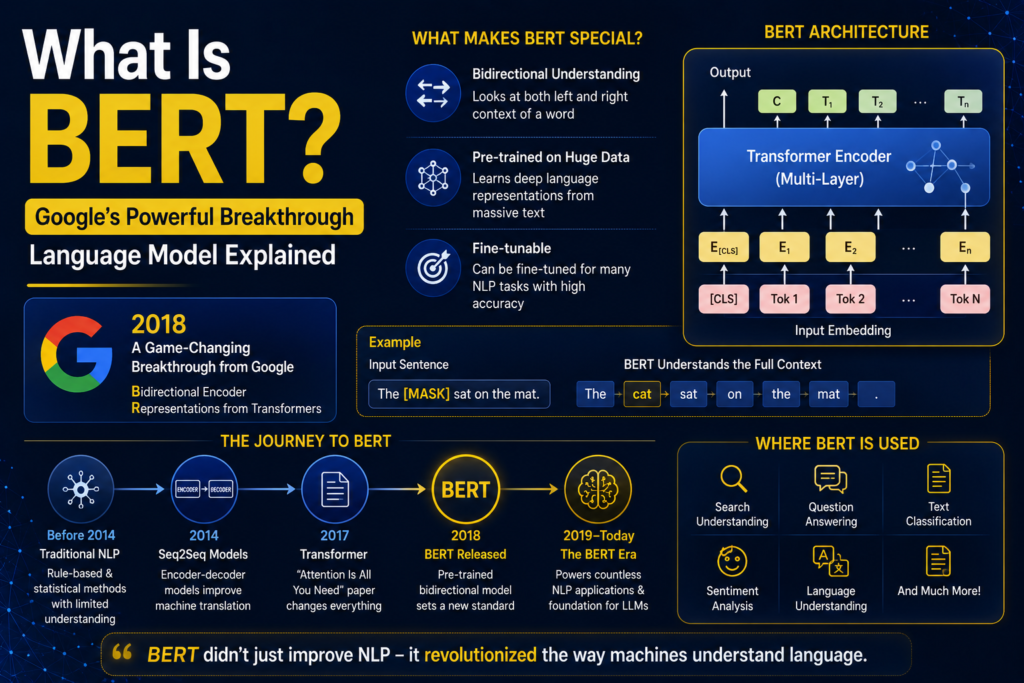
BERT, which stands for Bidirectional Encoder Representations from Transformers, is a language model developed by researchers at Google and published in late 2018. It fundamentally changed how machines read and understand text by introducing a training approach that had never been done at this scale before. Understanding what is BERT model means understanding one of the most important turning points in the history of natural language processing.
This article walks you through everything you need to know, from the problems BERT was designed to solve, to how it works under the hood, to the lasting impact it has had on AI, search engines, and the broader world of large language models.
The Problem BERT Was Built to Solve
Before BERT arrived, most language models read text in one direction. They would process a sentence from left to right or right to left, building up a representation of each word based only on the words that came before or after it, but never both at the same time.
This was a significant limitation. Human language is deeply contextual, and the meaning of a word often depends on words that appear both before and after it in a sentence. The word “bank” means something completely different in “river bank” versus “investment bank,” and a one-directional model could only capture half of that surrounding context.
Researchers had tried combining two separate directional models, one going left to right and another going right to left, and then concatenating their outputs. But this shallow approach was not the same as genuinely reading a word in light of its full surrounding context simultaneously. What was needed was deep bi-directionality, and that is precisely what what is BERT model answers at its core.
Who Created BERT and When (2018)
BERT was introduced in October 2018 in a paper titled “BERT: Pre-training of Deep Bidirectional Transformers for Language Understanding.” The lead author was Jacob Devlin, a research scientist at Google, working alongside Ming-Wei Chang, Kenton Lee, and Kristina Toutanova.
The team built BERT on top of the transformer architecture, which had been introduced by Google in 2017 in the landmark attention is all you need paper. The transformer’s self-attention mechanism was the key ingredient that made true bidirectionality possible. Because self-attention allows every token to attend to every other token in a sequence simultaneously, BERT could be trained to understand words in their full context from the very first layer of the network.
This was not simply an incremental improvement over what came before. It was a genuinely new way of thinking about language pre-training.
How BERT Works: Pre-Training Objectives
Understanding what is BERT model requires understanding how it was trained. BERT uses two pre-training objectives that work together to teach the model rich, contextualized knowledge about language.
The first is Masked Language Modeling, or MLM. During training, a random 15 percent of tokens in each input sequence are masked, meaning they are replaced with a special placeholder token. The model’s job is to predict what the original masked tokens were, using the full surrounding context on both sides. This forces the model to develop deep bi-directionality because it must look left and right simultaneously to make accurate predictions.
The second pre-training objective is Next Sentence Prediction, or NSP. The model is given pairs of sentences and must predict whether the second sentence actually follows the first in the original document or whether it is a randomly selected sentence from elsewhere. This teaches the model to understand relationships between sentences, which is critical for tasks like question answering systems and natural language inference.
Together, these two pre-training objectives allowed BERT to be trained on enormous amounts of unlabeled text, specifically the full English Wikipedia and a large collection of book texts, without needing expensive human-labeled data.
WordPiece Tokenization and Special Tokens
BERT uses a specific approach to breaking text into tokens called WordPiece tokenization. Rather than treating every word as a single unit, WordPiece breaks rare or unfamiliar words into subword pieces. For example, the word “unbelievably” might be split into “un,” “##believe,” “##ably.” This gives the model a manageable vocabulary while still handling unusual words gracefully.
BERT also uses two special tokens that carry important structural meaning. The CLS token is placed at the very beginning of every input sequence. Its final hidden state is used as the aggregate sequence representation for classification tasks. The SEP token is placed between two sentence segments and at the end of the input, telling the model where one piece of text ends and another begins. These tokens and attention masks work together to give the model clear structural signals about the input it is processing.
BERT-Base vs BERT-Large
Google released two versions of the model, and understanding the difference is part of understanding what is BERT model fully.
BERT-Base contains 12 transformer layers, 12 attention heads, and 110 million parameters. It was designed to be powerful yet practical enough to fine-tune on a single high-end GPU within a reasonable timeframe.
BERT-Large is a significantly bigger model with 24 transformer layers, 16 attention heads, and 340 million parameters. It achieves higher performance on most benchmarks but requires substantially more compute to fine-tune and deploy.
Both versions demonstrated the power of the pre-training and fine-tuning paradigm. You could take a single pre-trained BERT checkpoint and fine-tune it for downstream tasks like sentiment analysis, named entity recognition, question answering, or natural language inference with relatively small amounts of labeled data and still achieve state-of-the-art results.
Fine-Tuning BERT for Downstream Tasks
One of the most powerful aspects of what is BERT model is how it changed the workflow for NLP practitioners. Before BERT, building a high-performing NLP system for a specific task required extensive task-specific architecture design and training from scratch or with limited transfer learning.
BERT introduced a clean, unified approach: take the pre-trained model, add a simple task-specific output layer, and fine-tune all the weights together on your labeled dataset. Fine-tuning for downstream tasks suddenly became accessible to teams without massive compute budgets because the heavy lifting of pre-training had already been done.
This approach proved devastatingly effective across a wide range of benchmarks. On the GLUE benchmark, which aggregates performance across multiple language understanding tasks, BERT set a new state of the art by a significant margin. On the SQuAD dataset, a popular question answering benchmark where models must find answers within a paragraph of text, BERT surpassed human-level performance on certain metrics. It also pushed forward results on named entity recognition tasks, where models identify whether a word refers to a person, organization, location, or other category.
To learn more about how these models evolved over time, the bert model history covers the full arc from the original paper through subsequent variants and improvements.
BERT’s Impact on Google Search (2019)
Perhaps the most visible real-world deployment of what is BERT model came in October 2019, when Google announced it was using BERT in Google Search. The Google Search algorithm update was described by Google as one of the biggest leaps forward in the history of search, affecting roughly one in ten English-language queries in the United States.
What changed was Google’s ability to understand the nuance of natural language queries, particularly longer, more conversational searches. Before BERT, search systems often focused heavily on individual keywords while missing the relational meaning between words. A query like “can you get medicine for someone’s pharmacy” had the preposition “for” doing critical semantic work, indicating that you want medicine on behalf of another person. BERT could capture that relational meaning in a way that keyword-matching approaches could not.
This was a landmark moment because it showed that what is BERT model was not just an academic achievement. It was a practical tool powerful enough to change how billions of people found information every day.
Contextualized Word Embeddings: What Made BERT Different
Earlier approaches like Word2Vec produced static word embeddings, meaning the same word always had the same vector regardless of context. BERT produces contextualized word embeddings, where the representation of each word is dynamically shaped by the words surrounding it in each specific sentence.
This matters enormously for language understanding. The word “light” in “light a candle” and “light as a feather” should have different representations because the word is carrying different meanings. BERT’s contextualized representations capture these distinctions naturally because the self-attention layers blend information from the full surrounding context into each token’s representation at every layer.
This was a major advance over what came before, and it explains much of BERT’s strong performance on tasks like question answering systems, sentiment analysis, and natural language inference. For a broader look at how this fits into the evolution of AI language models, the llm timeline traces the full progression from early statistical models to today’s frontier systems.
BERT vs GPT vs T5: How They Compare
BERT did not exist in isolation. Understanding what is BERT model becomes clearer when you place it alongside other major transformer-based models. The bert vs gpt vs t5 comparison is one of the most commonly discussed topics in NLP.
GPT, developed by OpenAI, uses the decoder portion of the transformer and is trained autoregressively, predicting the next token given all previous tokens. This makes GPT naturally strong at text generation but means it is only left-to-right, not bidirectional. BERT uses the encoder portion and is specifically optimized for understanding rather than generation.
T5, which stands for Text-to-Text Transfer Transformer and was developed by Google, frames every NLP task as converting one text string into another. It combines encoder and decoder components and is more flexible in terms of the tasks it can handle, though it requires more compute than BERT-Base.
Each model reflects different design philosophies and pre-training objectives. BERT is the right tool when you need to deeply understand text. GPT-style models are better when you need to generate text. Knowing which to use for which task is a key part of modern NLP engineering.
BERT’s Variants and Legacy
BERT’s success inspired a wave of follow-up models, each refining or extending the original approach. RoBERTa, developed by Facebook AI, showed that BERT had been significantly undertrained and that removing the next sentence prediction objective and training longer on more data produced meaningfully better results.
DistilBERT compressed BERT’s knowledge into a smaller, faster model using knowledge distillation, making deployment far more practical for resource-constrained environments. ALBERT introduced parameter sharing across layers to reduce model size while maintaining performance. BioBERT and SciBERT applied BERT pre-training to domain-specific scientific corpora, showing that the approach generalized powerfully to specialized text.
The transformer architecture history shows how BERT sits at a pivotal moment: it was the model that proved to the world that large-scale pre-training on unlabeled text could produce language understanding capabilities that supervised approaches simply could not match.
BERT’s Role in the Broader AI Landscape
BERT arrived just as the field was beginning to grasp the potential of scaling laws in AI. The observation that making models bigger and training them on more data produced consistent improvements gave researchers a roadmap. BERT was an early, powerful confirmation that this scaling logic applied not just to generation tasks but to understanding tasks as well.
It also set the template for what came after. Every major language model that followed, including GPT-3, PaLM, Claude, and Gemini, owes something to the pre-training and fine-tuning paradigm that BERT popularized. The pre-training in ai concept, which BERT demonstrated so powerfully, is now the default assumption in almost all large-scale language model development.
For those who want to understand how the AI landscape evolved after BERT, exploring the fine tuning in ai techniques that BERT helped standardize is an excellent next step. And for a broader view of where this technology is headed, the future of AI continues to be shaped by the foundations that BERT helped establish.
Frequently Asked Questions (FAQs)
What does BERT stand for in AI?
BERT stands for Bidirectional Encoder Representations from Transformers. It is a language model developed by Google researchers and published in 2018. The name captures its three defining characteristics: it uses encoder-style transformer architecture, it processes text bidirectionally, and it produces dense vector representations of language.
Who invented BERT?
BERT was created by Jacob Devlin and colleagues at Google AI Language, including Ming-Wei Chang, Kenton Lee, and Kristina Toutanova. The paper was published in October 2018 and quickly became one of the most influential papers in the history of natural language processing.
How is BERT different from GPT?
BERT uses the transformer encoder and is trained to understand text by predicting masked tokens using full bidirectional context. GPT uses the transformer decoder and is trained autoregressively to predict the next token, making it more suited to text generation. BERT excels at understanding and classification tasks. GPT excels at generation tasks.
What tasks can BERT be used for?
BERT can be fine-tuned for a wide variety of NLP tasks including question answering, sentiment analysis, named entity recognition, natural language inference, text classification, and more. Its pre-trained representations transfer remarkably well across all of these applications with relatively small amounts of task-specific labeled data.
Is BERT still used today?
Yes, BERT and its variants remain widely used in production systems around the world. Google uses BERT-based models in its search engine. Many organizations use DistilBERT or RoBERTa for classification and extraction tasks because they offer strong performance at manageable computational cost. While newer and larger models have surpassed BERT on many benchmarks, BERT-style models remain efficient and practical for many real-world applications.
Conclusion
What is BERT model? It is the breakthrough that proved bidirectional pre-training on unlabeled text could produce language understanding capabilities far beyond what anyone had achieved before. It changed Google Search, it changed how NLP practitioners build systems, and it set the template for virtually every major language model that followed.
From its elegant masked language modeling objective to its practical fine-tuning framework, BERT demonstrated that the right architecture combined with the right training approach could unlock a new level of machine language understanding. Jacob Devlin and the Google team built something that continues to shape the field years after its release.
Whether you are a researcher, a developer, or simply someone curious about how AI understands human language, understanding what is BERT model is essential for understanding the world of artificial intelligence we live in today.