If you have ever wondered **how llms work**, you are not alone. Millions of people use AI tools every day without truly understanding what is happening behind the screen. Large language models feel like magic, but they are actually the result of decades of research, failed experiments, brilliant breakthroughs, and an enormous amount of data. This article breaks it all down in plain, human language, no PhD required.
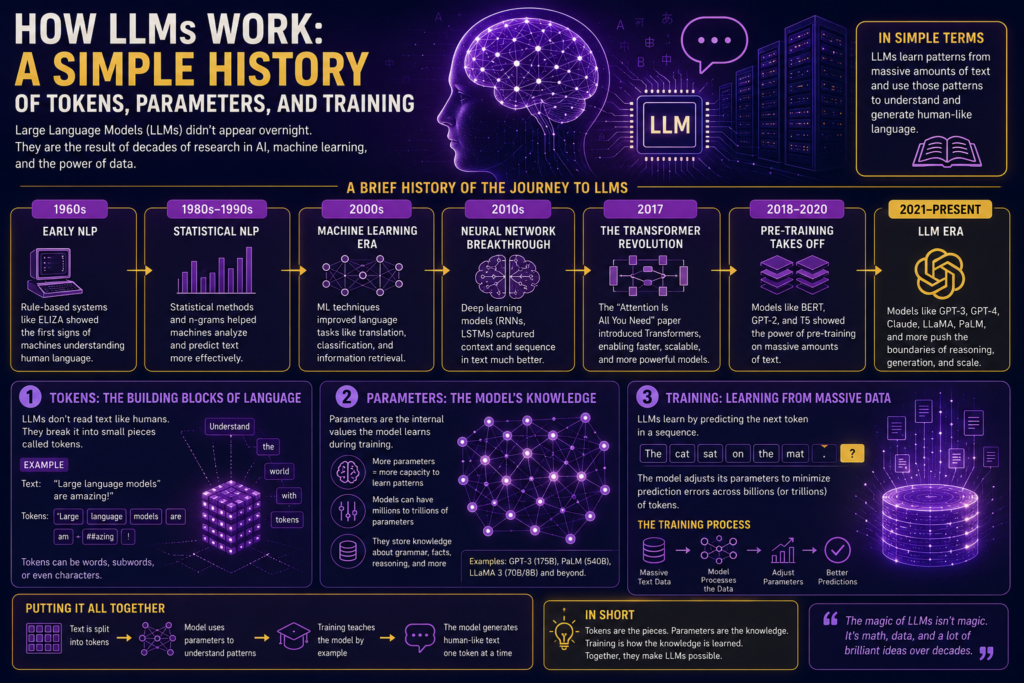
From the early days of rule-based systems to the transformer revolution, understanding how llms work means tracing one of the most exciting journeys in the history of technology.
The Early Roots of Language and Machines (1950 – 1970)
The story of how llms work does not begin with ChatGPT. It begins in the 1950s, when researchers first asked a radical question: can a machine understand language?
Alan Turing proposed his famous test in 1950, suggesting that a machine capable of holding a convincing conversation could be considered intelligent. A few years later, early natural language processing experiments tried to teach computers basic grammar rules. These were purely symbolic AI systems, built on rigid if-then logic. They could follow scripts but could not learn or adapt.
The history of natural language processing from this era is largely a history of disappointment. Machines could parse simple sentences, but they had no real grasp of meaning. Still, these early failures planted the seeds of everything that came after.
Pattern Matching and the First Chatbots (1966 – 1980)
In 1966, Joseph Weizenbaum at MIT created ELIZA, widely considered the first chatbot. ELIZA used pattern matching to simulate conversation. It was clever, but it was not learning. It was following a script. The early history of AI chatbots is a great reminder that impressive-looking AI does not always mean intelligent AI.
Throughout the 1970s and 1980s, researchers kept building rule-based systems. These systems required experts to manually write thousands of language rules. They were brittle, expensive, and could not scale. The dream of machines that truly understood language seemed very far away.
Neural Networks Enter the Picture (1980 – 1995)
The real shift came when researchers began moving away from rules and toward learning from data. Neural networks, loosely inspired by the human brain, offered a new path. Through a process called backpropagation in NLP, these networks could adjust their internal weights and biases based on examples, getting better over time.
Early neural language models were small and slow, but they introduced a powerful idea: instead of hand-coding rules, let the model figure out patterns from data. This was the beginning of weight and bias optimization as a core technique in AI.
Still, these early networks struggled with long sentences. They had short memories and could not connect ideas that were far apart in a text. This would remain a major problem for years.
The Rise of Word Embeddings and Vector Space (1990 – 2013)
One of the most important breakthroughs in understanding how llms work was the development of word embeddings. Rather than treating words as symbols, researchers began representing them as vectors in a high-dimensional space. Words with similar meanings ended up close together in this vector space representations model.
Early methods like Latent Semantic Analysis used dimensionality reduction to find hidden relationships between words. Then in 2003, Yoshua Bengio introduced neural probabilistic language models, showing that a neural network could learn rich word representations automatically.
The field truly exploded in 2013 when Google researchers introduced what is word2vec, a model that could learn word relationships at massive scale. Suddenly, you could do things like: “king minus man plus woman equals queen.” These dense vector representations became the foundation for everything that followed.
If you want to go deeper, the **[history of word embeddings](https://example.com)** is a fascinating story of how meaning became mathematics and powered the AI systems we use today.
Recurrent Networks and the Memory Problem (2013 – 2017)
As word embeddings improved, researchers needed better ways to process sequences of words. Recurrent Neural Networks, or RNNs, became the dominant tool. They processed text one word at a time, passing information forward through a kind of hidden memory.
But RNNs had a serious flaw. Over long sequences, they forgot earlier information. This was the vanishing gradient problem, and it made it nearly impossible to understand long paragraphs or documents.
The solution came in the form of LSTMs, or Long Short-Term Memory networks. What is lstm in ai explained simply: a smarter type of RNN that uses gates to decide what to remember and what to forget. LSTMs were a major step forward and powered many early translation and speech systems.
Around the same time, seq2seq models history showed how encoder-decoder architectures could handle tasks like translation. These models worked well but still struggled with very long texts because the entire input had to be compressed into a single vector.
Attention Changes Everything (2015 – 2017)
The attention mechanism was perhaps the single biggest idea in the history of how llms work. Instead of forcing the model to compress everything into one vector, attention allowed the model to look back at all parts of the input when generating each output word.
This was like giving the model a spotlight it could shine anywhere in the source text. Suddenly, translation quality improved dramatically. Long-range dependencies became manageable. The self-attention mechanism explained in simple terms is: let the model decide what is relevant at each step, rather than treating all input equally.
In 2017, a landmark paper titled “Attention Is All You Need” took this idea even further. Researchers at Google proposed removing recurrence entirely and building a model purely on attention. This was the birth of the transformer architecture, and it changed everything about how llms work.
The Transformer Architecture (2017 – 2019)
The transformer architecture introduced two key innovations: multi-head attention and positional encoding. Multi-head attention allowed the model to attend to different parts of the input simultaneously, capturing multiple types of relationships at once. Positional encoding gave the model a sense of word order, since transformers process all words in parallel rather than one at a time.
This parallelism was revolutionary. It meant transformers could be trained much faster on much larger datasets. The context window length could also be much longer than anything RNNs could handle.
Transformers use a softmax layer to turn raw scores into probabilities, helping the model decide which words are most likely to come next. This process of next-token prediction is the core of how llms work at their most fundamental level. Every response you get from an AI today is built on this simple but powerful idea.
Pre-Training, BERT, and the GPT Era (2018 – 2020)
With the transformer in hand, researchers developed two powerful strategies: pre-training and fine-tuning. Pre-training in ai means training a model on enormous amounts of general text so it develops a broad understanding of language. Fine-tuning in ai then adapts that general model to a specific task using a smaller, targeted dataset.
In 2018, Google introduced BERT, Bidirectional Encoder Representations from Transformers. BERT reads text in both directions at once, giving it a deep contextual understanding of each word based on its full surrounding context. BERT became the gold standard for tasks like search and question answering.
That same year, OpenAI released GPT-1, a model that used autoregressive models to generate text by predicting the next token one at a time. GPT-2 followed in 2019 and was so capable that OpenAI initially refused to release it fully. GPT-3, released in 2020 with 175 billion parameters, shocked the world and made people realise how llms work at truly massive scale.
Parameters, Scale, and AI Scaling Laws
So what exactly are parameters? They are the numerical values inside a neural network that get adjusted during training. Think of them as billions of tiny knobs that control how the model processes language. More parameters generally mean more capacity to learn complex patterns.
This led to the discovery of ai scaling laws, which showed that as you increase model size, data, and compute together, performance improves in predictable ways. This insight drove a race to build ever-larger models. Scaling became a deliberate strategy, not just a side effect.
The tokenization process is also worth understanding here. Rather than processing whole words, LLMs break text into tokens, which can be words, parts of words, or punctuation. This makes it easier to handle rare words and different languages, and it is a critical part of how llms work in practice every single day.
RLHF, ChatGPT, and the Modern Era (2022 – Present)
In late 2022, OpenAI launched ChatGPT, and the world changed overnight. ChatGPT reached 100 million users in just two months, faster than any app in history. But what made it so much better than earlier GPT models?
The answer is Reinforcement Learning from Human Feedback, or RLHF. What is rlhf in simple terms? Human trainers rated the model’s responses, and those ratings were used to train a reward model. The LLM was then fine-tuned to produce responses that scored highly. This made the model not just capable, but genuinely helpful and aligned with human values.
The latent space inside these models became a rich representation of human knowledge, values, and communication style. Zero-shot and few-shot learning allowed these models to handle new tasks with little or no specific training data, which is one of the most remarkable things about how llms work today.
Multimodal AI and What Comes Next
Modern LLMs are no longer just about text. Multimodal AI models can process images, audio, video, and code alongside language. GPT-4, Claude, and Gemini all have multimodal capabilities, making them far more powerful than text-only systems.
Retrieval augmented generation rag is another major advance, allowing models to pull in fresh information from external sources instead of relying only on what they learned during training. This helps address one of the biggest weaknesses of LLMs: ai hallucination, where models confidently produce incorrect information.
If you are curious about which AI systems are worth using today, explore the best free ai tools 2026 to see the full range of generative AI technology now available to everyone.
The Ongoing AI Arms Race
The ai arms race companies are running today is unlike anything the tech industry has seen before. OpenAI, Google, Meta, Anthropic, and dozens of startups are all competing to build the most powerful and capable language models. Each new release pushes the boundaries of what was thought possible just months before.
GPT-4 history shows how rapidly these models improved in just a few short years, from a curiosity to a tool used by hundreds of millions of people for work, education, and creativity.
Understanding how llms work is no longer just for researchers. It is essential knowledge for anyone navigating a world where AI is woven into almost every digital experience.
Frequently Asked Questions (FAQs)
What does it mean when people say how llms work?
It means understanding how large language models process text using tokens, layers of attention, and billions of parameters to predict the next word in a sequence, building up responses one token at a time.
What is the difference between pre-training and fine-tuning?
Pre-training teaches a model general language patterns from massive datasets. Fine-tuning then adapts that model to a specific task using smaller, focused data to improve performance on that particular job.
How many parameters does a large LLM have?
Modern LLMs like GPT-4 are estimated to have over a trillion parameters, though exact figures are rarely confirmed publicly by the companies that build them.
What is the role of the attention mechanism in LLMs?
The self-attention mechanism allows the model to weigh the relevance of every word in the context window when generating each new token, enabling rich understanding of relationships across the full text.
Can LLMs truly understand language?
This is a deeply debated question. LLMs are extraordinarily good at pattern matching and language generation, but whether they truly understand meaning the way humans do is still an open philosophical and scientific question.
Conclusion
Understanding how llms work is one of the most valuable things you can do in today’s AI-driven world. From the earliest chatbots of the 1960s to the transformer revolution and the RLHF era, every step in this journey built on the last. Tokens, parameters, attention, and neural network training are not just technical terms. They are the building blocks of a technology that is reshaping how we communicate, create, and think. The story of how llms work is far from over, and the most powerful chapters may still be ahead.