If you have ever asked what is word2vec and why it matters, you are stepping into one of the most important stories in the history of artificial intelligence. Before ChatGPT, before BERT, before transformers dominated research labs, there was a deceptively simple tool called Word2Vec that changed how machines understood human language forever.
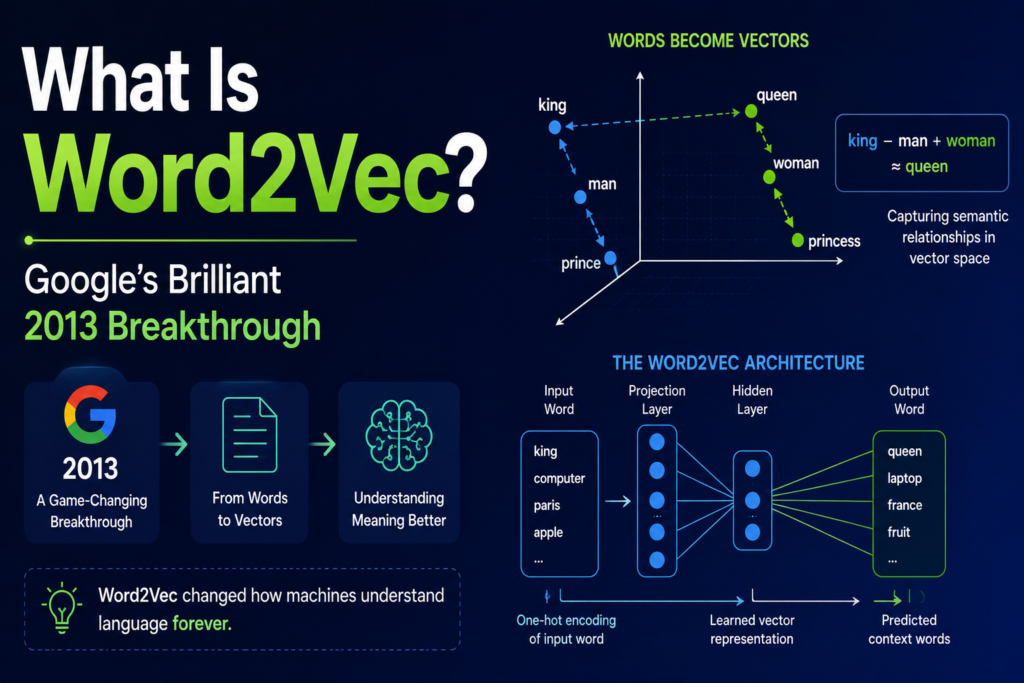
Released by a team at Google in 2013, Word2Vec did something that had never been done so cleanly before. It taught a computer to represent words as numbers in a way that actually preserved meaning. Words that were used in similar contexts ended up close together in a high-dimensional space. Suddenly, “king” minus “man” plus “woman” equaled something remarkably close to “queen.” Machines were not just counting words anymore. They were learning relationships.
Understanding what is word2vec means understanding the spark that eventually ignited the large language model revolution. This article covers that full journey.
The Problem Word2Vec Was Built to Solve
Before Word2Vec arrived, the standard approach to representing words in machine learning was one-hot encoding. Each word in the vocabulary was assigned a vector of zeros with a single one at that word’s position. A vocabulary of 50,000 words meant vectors with 50,000 dimensions, nearly all of them empty.
One-hot encoding comparison with modern embeddings reveals an obvious weakness: these vectors carried no meaning. The words “dog” and “puppy” had vectors that were exactly as different from each other as “dog” and “skyscraper.” There was no semantic similarity, no structure, no relationship. Every word was an isolated island.
Earlier researchers had proposed distributed representations as an alternative. Rather than placing a single one in a massive empty vector, the idea was to represent each word as a dense, low-dimensional vector where each dimension captured some aspect of meaning. The challenge was figuring out how to learn those dimensions from real data, efficiently and at scale.
The history of word embeddings stretches back to Bengio et al.’s 2003 neural language model, which showed that distributed representations could dramatically improve language modeling. But training was slow and the scale was modest. The field needed a faster method. That is exactly what Tomas Mikolov and his colleagues built.
Who Built Word2Vec and Why (2013)
In 2013, Tomas Mikolov, along with Kai Chen, Greg Corrado, and Jeffrey Dean at Google, published two papers that introduced what is word2vec to the world. The first described the architectures. The second demonstrated the results on analogy tasks using the Google News dataset, a corpus of roughly 100 billion words.
Mikolov’s insight was elegant. Instead of training a full language model with many layers, you could train a shallow neural network with a single hidden layer to predict either a word from its context or a context from its word. The word vectors that emerged from this training were the real product. The prediction task was just the mechanism.
The team released the Word2Vec toolkit as open source software, and within months, researchers and developers around the world were using it to build smarter systems. For anyone tracing the history of natural language processing, this moment is as significant as the introduction of the transistor was to hardware.
The Two Architectures: CBOW and Skip-Gram
Word2Vec was not a single algorithm. It offered two distinct architectures, each approaching the learning problem from a different angle.
The first was Continuous Bag of Words, or CBOW. In this model, the network takes the surrounding context words within a defined contextual window size and tries to predict the central word. If the sentence is “the cat sat on the mat” and the window is two words on each side, the network might take “the,” “cat,” “on,” and “the” and try to predict “sat.” CBOW is fast and works well for larger datasets.
The second architecture was the Skip-gram model. Here the logic is reversed. The network takes a single target word and tries to predict the surrounding context words. Skip-gram tends to perform better on small datasets and does a better job capturing rare words, making it the preferred choice for many research applications.
Both architectures used embedding layers as their core mechanism. The weights of these layers, after training, became the word vectors that researchers used downstream. Every word in the vocabulary ended up represented as a point in a vector space, and the geometry of that space encoded genuine natural language understanding.
How Word2Vec Actually Learns Meaning
The training process behind what is word2vec is a form of unsupervised learning. The model is never told what any word means. It learns purely from exposure to text, by observing which words tend to appear near each other.
This reflects a powerful idea in lexical semantics known as the distributional hypothesis: words that appear in similar contexts tend to have similar meanings. If “hospital” and “clinic” both frequently appear near words like “doctor,” “patient,” and “treatment,” the model will push their vectors close together in the embedding space.
During training, the model adjusts vectors using gradient descent, nudging words that co-occur closer together and pushing unrelated words apart. Two key techniques made this computationally practical at scale. Hierarchical softmax used a binary tree structure to make computing output probabilities much faster. Negative sampling simplified training further by only updating a small random subset of word vectors on each step rather than the entire vocabulary.
The result was a form of feature extraction that no one had to engineer by hand. Meaning emerged automatically from the raw statistics of language.
The Famous Analogy Results That Shocked the Field
When Mikolov’s team published their analogy test results, the AI research community took notice. Using cosine similarity to measure distances between vectors, they showed that the vector space learned by Word2Vec captured meaningful relationships with startling precision.
Vector arithmetic worked in semantically intuitive ways. “Paris” minus “France” plus “Italy” pointed toward “Rome.” “Bigger” minus “big” plus “small” pointed toward “smaller.” These were not hand-coded rules. They emerged spontaneously from training on raw text.
For researchers asking what is word2vec and whether it was a genuine advance, these results were hard to dismiss. Dimensionality reduction techniques like PCA could even project the vectors into two dimensions, revealing visible clusters of related words. Countries grouped together. Job titles clustered. Verb tenses formed their own neighborhoods.
This was the first time many researchers felt that machines were doing something that genuinely resembled understanding, rather than simply pattern-matching on surface features.
Why Word2Vec Was a Turning Point in AI
The significance of Word2Vec extends far beyond its analogy results. It established a template that every subsequent generation of AI researchers built on.
Before Word2Vec, most NLP systems used sparse, hand-crafted features. After Word2Vec, dense word embeddings became the default starting point for nearly every natural language task. Sentiment analysis, named entity recognition, machine translation, question answering: all of them improved substantially when researchers initialized their models with pre-trained word vectors instead of random numbers.
Word2Vec also demonstrated that useful representations could be learned from raw text alone, without any human-labeled data. This was the philosophical foundation for what would later become pre-training in AI, the practice of learning general representations from massive unlabeled corpora before fine-tuning on specific tasks.
If you are tracing the llm timeline, Word2Vec is the moment when the field understood that scale plus self-supervision could substitute for hand-engineered knowledge. That insight, planted in 2013, bloomed into GPT, BERT, and everything that followed.
From Word2Vec to Transformers: The Bridge (2014 – 2017)
Word2Vec was not the end of the embedding story. It was the beginning.
GloVe, published by Stanford in 2014, extended the approach by combining the distributional statistics of the whole corpus with the local context-window learning of Word2Vec. FastText, from Facebook AI Research in 2016, went further by learning embeddings at the character level, allowing the model to handle words it had never seen during training.
But Word2Vec’s deepest legacy was conceptual. It showed the field that neural networks could learn rich semantic representations of language without supervision. This directly motivated the development of deeper sequence models and, eventually, the transformer architecture.
Researchers working on seq2seq models history in 2014 and 2015 routinely initialized their encoder and decoder networks with Word2Vec embeddings. The attention mechanisms developed in 2015 and 2016 built on the same vector space intuition. And when the transformer arrived in 2017, its embedding layers were a direct descendant of the Word2Vec idea: represent each token as a point in a high-dimensional space, then let the model learn how those points should move.
Word2Vec’s Limitations and What Came Next
For all its power, what is word2vec also has a well-known limitation. Each word gets exactly one vector, regardless of context. The word “bank” gets the same representation whether it appears in “river bank” or “investment bank.” There is no mechanism for polysemy, the fact that words carry different meanings in different situations.
This limitation motivated the development of contextualized embeddings. ELMo, introduced in 2018, generated different representations for the same word depending on its surrounding context. BERT, also in 2018, took this further using the transformer’s self-attention mechanism to produce deeply contextualized representations.
Understanding what is word2vec ultimately means understanding both its genius and its ceiling. It solved the problem of static semantic similarity brilliantly. It could not solve the problem of dynamic, context-sensitive meaning. That required the next generation of models.
Readers curious about the full picture of recurrent neural networks history will find that Word2Vec sits at a hinge point, after the era of hand-crafted features and before the era of end-to-end learned representations.
Word2Vec’s Lasting Impact on Modern AI
Even in 2026, the influence of what is word2vec is visible everywhere. Every large language model uses an embedding layer that converts tokens into dense vectors before processing them. The logic behind that layer is the same logic Mikolov and his team formalized in 2013.
The concept of semantic similarity measured by cosine distance is still used in retrieval systems, recommendation engines, and search ranking algorithms. The idea that meaning can be captured geometrically, that related concepts cluster in space, remains one of the most productive ideas in all of applied AI.
Word2Vec also changed how researchers thought about transfer learning. If you could learn a useful representation on one task and apply it to another, you did not need to start from scratch every time. This idea scaled up dramatically with BERT and GPT, but the seed was planted by Word2Vec’s demonstration that pre-trained vectors transferred cleanly across tasks.
For anyone thinking about the future of ai and where language models are headed, Word2Vec is essential reading precisely because it shows how one clean idea, learned from data without labels, can propagate forward through an entire field for over a decade.
Frequently Asked Questions (FAQs)
What exactly is Word2Vec and who made it?
Word2Vec is a group of shallow neural network models developed at Google in 2013 by Tomas Mikolov and colleagues. It learns dense vector representations of words from large text corpora by training on either a word-prediction or context-prediction task. The resulting vectors capture semantic similarity in a measurable, geometric form.
What is the difference between CBOW and Skip-gram in Word2Vec?
CBOW predicts a central word from its surrounding context words, making it faster and suitable for large datasets. Skip-gram predicts surrounding context words from a central word, performing better on smaller datasets and handling rare words more effectively. Both produce word embeddings, but their training dynamics differ in speed and accuracy trade-offs.
Why was Word2Vec such a big deal in 2013?
Before Word2Vec, representing words as meaningful vectors required computationally expensive full language models. Word2Vec produced high-quality embeddings much faster and at larger scale. Its demonstration that vector arithmetic could capture analogies like “king minus man plus woman equals queen” shocked the field and confirmed that neural networks could learn genuine semantic structure from raw text.
How does Word2Vec relate to modern LLMs like GPT and BERT?
Word2Vec established the principle that useful language representations can be learned from unlabeled text using self-supervised objectives. GPT and BERT scaled this idea enormously using transformer architectures and much larger datasets, but the foundational intuition, that pre-training on raw text produces transferable representations, came directly from the Word2Vec era.
Is Word2Vec still used in 2026?
Word2Vec itself is rarely used for state-of-the-art tasks, having been superseded by contextual embeddings from transformer models. However, its core ideas live on in every modern language model’s embedding layer, and it remains widely taught as the conceptual foundation for understanding how neural networks represent language.
Conclusion
The question of what is word2vec has a simple answer and a profound one. Simply: it is a method for turning words into vectors using a shallow neural network. Profoundly: it is the moment when AI researchers discovered that meaning could be learned, not programmed, that scale and self-supervision could replace hand-crafted rules, and that the path to machine understanding of language ran through geometry.
What is word2vec remains one of the cleanest examples in science of a small idea with enormous consequences. Tomas Mikolov and his team did not set out to build the foundation of the LLM era. They set out to make word representations faster and better. They succeeded beyond anyone’s expectations, and the field has never looked back.
From the attention mechanism explained in 2015 to the billion-parameter models of today, the thread runs back to a 2013 paper and a deceptively simple question: what does it mean for two words to be similar? Word2Vec answered that question with vectors, and everything changed.