Introduction
The gpt-4 history is the story of a model that did not just improve on its predecessor but redefined what people expected from artificial intelligence. When OpenAI released GPT-4 in March 2023, it arrived not simply as a larger language model but as a genuinely multimodal system capable of processing both text and images, reasoning across complex professional domains, and passing examinations that most humans find deeply challenging. The gap between GPT-3.5 and GPT-4 was not merely incremental. It was a leap that changed how developers, enterprises, and researchers thought about what frontier AI could actually do.
The gpt-4 history is also a story about secrecy. Unlike the detailed technical papers that accompanied GPT-1, GPT-2, and GPT-3, OpenAI declined to publish the parameter count, the architecture specifics, or the full training details of GPT-4. The organization cited competitive concerns and safety considerations, marking a significant departure from the open research culture that had characterized the early openai history. This shift itself became part of the story, prompting debate about transparency, accountability, and the future of AI research publishing.
Understanding the gpt-4 history means understanding not just one model but the broader moment in AI development it represents: the arrival of large multimodal models as practical, deployable systems with real-world professional capability.
The Road to GPT-4: Lessons From GPT-3 and ChatGPT (2020 – 2022)
The gpt-4 history cannot be understood without starting from what came before it. GPT-3, released in May 2020, demonstrated that scaling a transformer decoder to 175 billion parameters produced qualitatively new capabilities including few-shot learning and zero-shot generalization across a remarkable range of tasks. But GPT-3 also had significant limitations that OpenAI’s teams spent the following years working to address.
The gpt-3 history showed a model that was powerful but unreliable. It hallucinated facts confidently, struggled with complex multi-step reasoning, had no ability to process images, and was prone to generating harmful or biased content without careful prompting and filtering. InstructGPT in 2022 addressed some of these alignment challenges through reinforcement learning from human feedback, producing a model that was more helpful and less harmful. ChatGPT, built on GPT-3.5 and released in November 2022, proved that a well-aligned large language model could become a product that hundreds of millions of people wanted to use.
By the time GPT-3.5 and ChatGPT were deployed, OpenAI was already deep into training what would become GPT-4. The lessons from GPT-3’s limitations and ChatGPT’s success were built into its development. Safety alignment protocols were strengthened. Reasoning capabilities were a priority. And for the first time in the GPT lineage, the team was building a model that could process image and text input together, entering the territory of large multimodal models that researchers had been working toward for years.
The March 2023 Launch: What GPT-4 Could Do
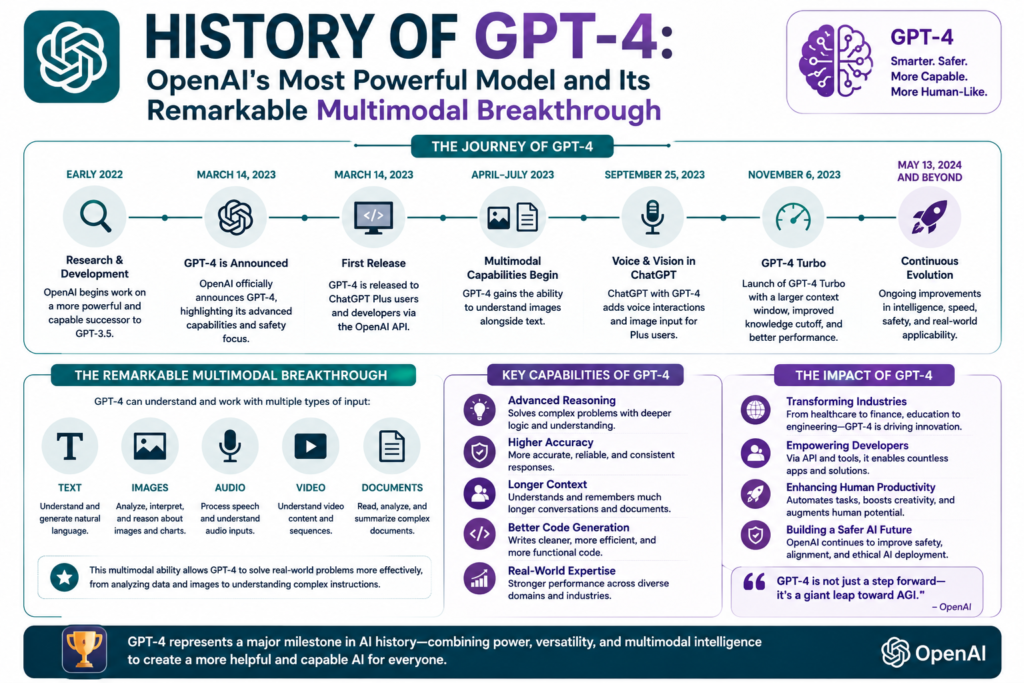
The gpt-4 history reached its first major public milestone on March 14, 2023, when OpenAI released GPT-4 to ChatGPT Plus subscribers and made it available through the API developer deployment program. The launch was accompanied by an extensive technical report, which while declining to reveal architectural specifics, provided detailed benchmark results that immediately established GPT-4’s position at the frontier of AI capability.
The benchmark exam scoring that OpenAI published was striking. GPT-4 scored in approximately the 90th percentile on the Uniform Bar Exam, which tests legal reasoning and knowledge across multiple domains at the level required to practice law in the United States. It scored highly on the LSAT, the GRE, multiple AP subject exams, and a range of other standardized tests. On the Medical Knowledge Self-Assessment Program used by doctors for continuing education, GPT-4 performed at a level that far exceeded what GPT-3.5 could achieve. Academic performance testing across dozens of standardized examinations showed a model that could match or exceed human professional performance on a wide range of knowledge domains.
These results were significant not because standardized exam performance is the only measure of intelligence, but because these exams are specifically designed to assess the kind of complex, multi-step reasoning and domain knowledge that previous AI systems had struggled with consistently. GPT-4’s performance demonstrated that frontier model development had crossed a threshold where the gap between AI capability and human professional-level knowledge on structured tasks had become genuinely narrow.
The advanced reasoning capabilities of GPT-4 were most visible in tasks requiring multiple steps of logical inference, careful integration of information from different parts of a long document, and the ability to apply general knowledge to novel specific situations. These were precisely the areas where GPT-3.5 had been most inconsistent, and the improvement was evident to users immediately upon release.
The Multimodal Breakthrough: Processing Images and Text Together
The single most architecturally significant aspect of the gpt-4 history is its multimodal capability. GPT-4 was the first model in the GPT lineage to accept images as input in addition to text, making it a genuine large multimodal model capable of visual data synthesis and analysis alongside language understanding and generation.
In practice, this meant GPT-4 could look at a photograph and describe what was in it, examine a chart or graph and answer questions about the data it contained, analyze a diagram and explain its components, read handwritten text in an image, or reason about the content of a screenshot. Users could send GPT-4 a picture of a broken piece of code on a whiteboard and ask it to debug the logic. They could show it a meal and ask for nutritional estimates. They could provide it with a graph from a scientific paper and ask for interpretation.
This image and text input processing capability connected the gpt-4 history to the broader multimodal ai history, a line of research that had been developing separately from language-only models for years. Models like CLIP from OpenAI and Florence from Microsoft had already demonstrated that vision and language representations could be aligned in powerful ways. GPT-4 brought multimodal capability into a general-purpose conversational AI for the first time at this scale and level of integration.
The token consumption efficiency of processing images was managed by representing visual inputs as sequences of tokens that the model could attend to alongside text tokens, allowing the same attention mechanisms underlying the language model to operate across both modalities without requiring entirely separate architectural components.
What OpenAI Did Not Reveal: The Architecture Mystery
A distinctive feature of the gpt-4 history compared to earlier GPT models is how little OpenAI disclosed about how it was built. The GPT-4 technical report explicitly declined to state the number of parameters, the size and composition of the training dataset, or the specific architectural choices made in designing the model. OpenAI cited competitive pressures and safety considerations as reasons for this decision, arguing that releasing detailed architectural information could facilitate the creation of harmful AI systems by actors without adequate safety practices.
This decision generated significant controversy in the AI research community. Critics argued that the lack of transparency made it impossible to independently verify OpenAI’s claims about the model, understand its failure modes, or replicate its safety findings. Supporters argued that as AI systems became more capable, the case for limiting disclosure of architectural details with potential for misuse was legitimate.
Reporting and analysis from multiple sources suggested that GPT-4 used a mixture of experts architecture, often abbreviated as MoE, rather than a single dense model. In a mixture of experts approach, the model is composed of multiple specialized sub-networks, and a routing mechanism determines which subset of experts handles each input. This allows proprietary architecture expansion to achieve higher effective capacity than would be possible with a uniformly dense model of similar total parameter count, while reducing the compute required for any single forward pass. Trillion parameter scaling in the aggregate mixture becomes more tractable when only a fraction of parameters are active for each token.
Whether or not these architectural reports were accurate, the gpt-4 history established a new precedent: at the frontier of AI capability, detailed technical disclosure was no longer a given, and the field would need to develop new norms around transparency and accountability for models that were both commercially valuable and potentially powerful enough to pose risks.
GPT-4 Turbo: Longer Context and Lower Cost (November 2023)
The gpt-4 history continued in November 2023 with the announcement of GPT-4 Turbo at OpenAI’s first developer conference. GPT-4 Turbo represented a significant upgrade across several dimensions that mattered enormously for practical deployment.
The most notable change was the expansion of the context window to 128K tokens, one of the largest context windows of any commercially available model at the time. The 128K context window meant GPT-4 Turbo could process documents of up to approximately 96,000 words in a single prompt, equivalent to a short novel or a lengthy legal contract. This was transformative for use cases involving long documents, extended conversations, or complex codebases where previous context limits had been a significant practical constraint.
GPT-4 Turbo also featured a more recent knowledge cutoff, updated system prompt constraints that gave developers more precise control over model behavior, and significantly lower pricing per token compared to the original GPT-4 API, making sophisticated AI integration more economically accessible to a broader range of developers and companies.
GPT-4o: Speed, Efficiency, and Native Multimodality (May 2024)
The gpt-4 history reached another milestone in May 2024 with the release of GPT-4o, where the “o” stood for Omni. GPT-4o was a fundamentally redesigned version of the GPT-4 class of model that addressed some of the practical limitations of the original architecture.
Where the original GPT-4 Turbo processed images as tokenized inputs layered alongside text, GPT-4o was designed with native multimodal processing, handling text, audio, and images within a more unified architectural approach. This produced meaningfully lower latency for multimodal interactions, making voice conversations with the model feel substantially more natural and responsive than had been possible with the original GPT-4.
GPT-4o also maintained GPT-4 level performance on benchmark tasks while being roughly twice as fast and half the price of GPT-4 Turbo through the API. This combination of capability, speed, and cost efficiency represented a significant advance in making frontier AI practically deployable at scale, and it became the default model powering ChatGPT for free users as well as Plus subscribers.
The GPT-4o Omni release expanded the conversation about what frontier AI could do in real-time applications, demonstrating live video understanding, expressive voice interaction, and the ability to reason about visual scenes in real time during conversation.
GPT-4’s Impact on the AI Industry and Competition
The gpt-4 history did not unfold in isolation. Its release in March 2023 intensified the AI arms race among major technology companies and well-funded startups in ways that reshaped the entire competitive landscape. Google accelerated the development of its own frontier models, releasing Gemini Ultra as a direct GPT-4 competitor in late 2023. Anthropic published detailed benchmark comparisons positioning its Claude 3 models against GPT-4. Meta released LLaMA 2 and LLaMA 3 as open-weight alternatives.
The chatgpt history shows how GPT-4 became the engine powering ChatGPT Plus, driving subscription revenue and enterprise adoption at a scale that transformed OpenAI from a research organization into one of the most commercially significant companies in the technology industry.
Microsoft’s integration of GPT-4 into Bing, Office, GitHub Copilot, and its Copilot suite of products demonstrated the breadth of application that a frontier multimodal model enabled across enterprise software. The OpenAI Microsoft partnership converted GPT-4’s capabilities into a commercial product strategy that touched hundreds of millions of Microsoft users.
For the broader landscape of where these developments fit, the llm timeline places gpt-4 history at the point where large multimodal models became the new standard expectation for frontier AI systems rather than a specialized research area.
The future of AI will be measured against the benchmarks that the gpt-4 history established, as subsequent models from OpenAI and its competitors work to push beyond GPT-4’s already remarkable capabilities in reasoning, multimodal understanding, and reliable real-world task completion.
The what is rlhf alignment techniques that OpenAI developed and refined through the GPT-3 to GPT-4 progression remain central to how the field approaches making powerful models safe and useful, and GPT-4’s improved safety profile compared to GPT-3.5 demonstrated that alignment research and capability scaling could advance together rather than in opposition.
Frequently Asked Questions (FAQs)
When was GPT-4 released and what made it different from GPT-3.5?
GPT-4 was released by OpenAI on March 14, 2023. The most significant differences from GPT-3.5 were its ability to process images as well as text, its dramatically improved performance on complex reasoning tasks and professional benchmarks, its longer context window, and its more reliable factual accuracy. GPT-4 also showed meaningfully better safety alignment, with lower rates of harmful content generation compared to earlier models.
Can GPT-4 really pass the Bar Exam?
Yes, GPT-4 scored in approximately the 90th percentile on the Uniform Bar Exam, a standardized test required for legal practice in the United States. This compares to GPT-3.5, which scored around the 10th percentile on the same examination. GPT-4 also performed at high levels on the LSAT, GRE, AP examinations, and multiple medical knowledge assessments. These results reflect genuine improvements in reasoning and domain knowledge, though performance on exams does not capture all dimensions of professional capability.
What is GPT-4 Turbo and how does it differ from the original GPT-4?
GPT-4 Turbo was released in November 2023 and extended the context window to 128K tokens, updated the knowledge cutoff to April 2023, improved instruction following, and significantly reduced the cost per token compared to the original GPT-4 API. It was designed to make GPT-4 level capability more accessible and practical for developers building production applications.
What is GPT-4o and what does the “o” stand for?
GPT-4o was released in May 2024 and the “o” stands for Omni, reflecting the model’s native multimodal design that integrates text, audio, and image processing more deeply than its predecessors. GPT-4o is roughly twice as fast and half the cost of GPT-4 Turbo while maintaining comparable benchmark performance. It also features lower latency voice interaction and real-time video understanding capabilities.
Why did OpenAI not reveal GPT-4’s architecture?
OpenAI declined to publish the parameter count or architectural details of GPT-4, citing competitive concerns and safety considerations. The organization argued that detailed architectural disclosure could enable harmful uses by actors without adequate safety practices. This decision was controversial in the research community, which had benefited from OpenAI’s earlier practice of publishing detailed technical papers for GPT-1, GPT-2, and GPT-3.
Conclusion
The gpt-4 history represents a pivotal chapter in the development of artificial intelligence, marking the arrival of large multimodal models as genuinely capable professional tools rather than impressive but limited research demonstrations. From its March 2023 launch with benchmark-breaking exam performance, through the context window expansion of GPT-4 Turbo, to the native multimodal architecture of GPT-4o, the model has continued to evolve in ways that keep it at or near the frontier of commercially deployed AI capability.
GPT-4 history is also the story of a field maturing in both its technical ambitions and its commercial reality. The secrecy around GPT-4’s architecture, the integration of safety alignment protocols as a genuine engineering priority, and the deployment at scale through Microsoft’s product ecosystem all reflect an industry that has moved beyond proof-of-concept research into the complex territory of deploying powerful AI responsibly in the real world.
Every model that followed GPT-4, whether from OpenAI itself or from competitors racing to match and surpass its capabilities, was built in its shadow. The gpt-4 history set the terms of the conversation about what frontier AI should be able to do, and that conversation continues to drive the most consequential technological race of our generation.