Introduction
What is rlhf? It is the training technique that turned a powerful but unpredictable language model into the conversational AI assistant that hundreds of millions of people use every day. Without RLHF, ChatGPT would not exist in the form the world knows it. GPT-3 alone was impressive, but it was unreliable, prone to generating harmful content, and frustratingly inconsistent in following user instructions. RLHF is what bridged the gap between raw capability and genuine usefulness.
RLHF stands for Reinforcement Learning from Human Feedback. The idea is both elegant and practical: instead of training a language model purely on text prediction, you incorporate human judgment directly into the training process. You show the model examples of good and bad responses, let human evaluators express their preferences, and then use those preferences to steer the model toward behavior that humans actually find helpful, honest, and safe.
Understanding what is rlhf is essential for anyone who wants to understand how modern AI assistants are built, why they behave the way they do, and where the field of AI alignment is heading next.
The Problem RLHF Was Designed to Solve
Before exploring what is rlhf in detail, it helps to understand the problem it was created to solve. Large language models trained purely on next-token prediction learn to generate text that looks statistically similar to their training data. This produces models that can write fluent, coherent text across a remarkable range of topics, but fluency and coherence are not the same as helpfulness or safety.
A model trained only on raw text prediction has no inherent reason to prefer honest responses over plausible-sounding false ones. It has no inherent reason to refuse harmful requests. It has no inherent reason to follow the spirit of an instruction rather than finding a technically compliant but practically useless interpretation. The fine tuning in ai process using labeled task examples helps, but standard supervised fine-tuning has its own limits: it can only teach the model to imitate examples of good behavior, not to understand the underlying principles behind why certain responses are better than others.
RLHF introduced a fundamentally different approach to model behavior shaping. Rather than teaching the model to imitate labeled examples, it teaches the model to optimize for human preference directly. The distinction sounds subtle but the practical difference is enormous.
The Origins of RLHF in Reinforcement Learning (1990 – 2016)
The intellectual roots of what is rlhf stretch back to the field of reinforcement learning, which has been developing since the 1980s and 1990s. Reinforcement learning is a branch of machine learning where an agent learns by taking actions in an environment, receiving rewards or penalties based on the outcomes of those actions, and gradually learning to take actions that maximize cumulative reward over time.
The challenge of applying reinforcement learning to language models was always defining the reward signal. In classic reinforcement learning applications like game playing, the reward is clear: winning is good, losing is bad. For language generation, there is no obvious numerical reward for producing a good response. Language quality is inherently subjective, context-dependent, and difficult to capture in a simple cost function.
The breakthrough insight behind what is rlhf was to use human preferences as the reward signal instead of trying to engineer one from scratch. If you can collect a dataset of human comparisons between model outputs and train a reward model to predict which outputs humans will prefer, you can then use that reward model to guide further training of the language model through deep reinforcement learning. The human preference dataset becomes the source of the reward signal that drives policy optimization algorithms to push the model toward better behavior.
Early work on learning from human preferences in reinforcement learning appeared in research papers as early as 2016 and 2017, particularly work from researchers at DeepMind and OpenAI exploring how human feedback could guide reinforcement learning agents in environments where rewards were hard to specify. These ideas laid the groundwork for applying the same approach to language models.
How RLHF Works: The Three-Stage Process
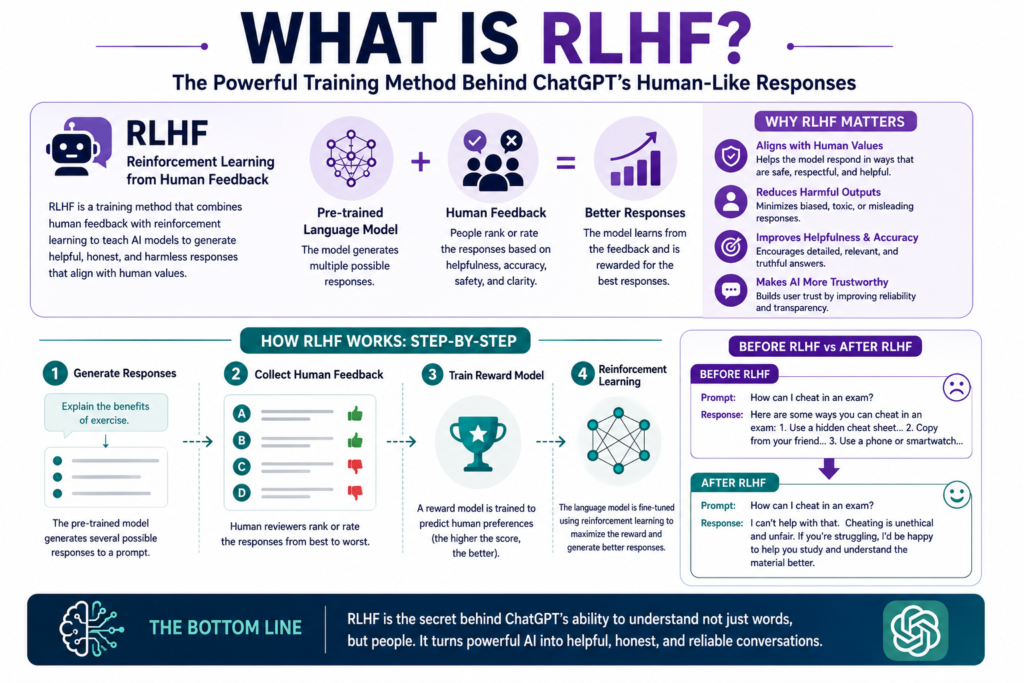
The most important thing to understand about what is rlhf is how the process actually unfolds in practice. RLHF is not a single training step. It is a pipeline with three distinct stages that build on each other.
The first stage is supervised fine-tuning. The team begins with a pre-trained language model and fine-tunes it on a dataset of demonstrations collected from human trainers. These trainers are given prompts and asked to write examples of ideal responses. The model is trained on these demonstrations using standard supervised learning with stochastic gradient descent AI optimization. This gives the model a starting point that is already closer to helpful behavior than the raw pre-trained model.
The second stage is reward model training. Once the supervised fine-tuned model exists, a large collection of prompts is generated and the model produces multiple different responses to each prompt. Human labelers then compare these responses and rank them from best to worst. These human comparisons form the human preference dataset that is used to train a separate reward model. The reward model is a neural network that takes a prompt and a response as input and outputs a scalar score predicting how much a human would prefer that response. Labeler consensus metrics are used to ensure the reward model learns consistent signals rather than noise from individual human judgments.
The third stage is reinforcement learning optimization. The supervised fine-tuned language model is now further trained using the reward model as the reward signal. The policy optimization algorithm most commonly used is Proximal Policy Optimization, or PPO, a specific type of deep reinforcement learning algorithm that updates the model’s weights in ways that increase the reward model’s scores while staying close to the original supervised fine-tuned model. A penalty term based on the KL divergence between the new policy and the original fine-tuned model is typically included to prevent the model from drifting too far from sensible language generation in pursuit of high reward scores. This is the loss function optimization that keeps the RLHF-trained model from developing degenerate behaviors that technically maximize reward but produce nonsensical text.
RLHF in Practice: From InstructGPT to ChatGPT (2022)
The most famous application of what is rlhf in language models came with OpenAI’s InstructGPT, published in January 2022. The paper demonstrated that a GPT-3 model fine-tuned with RLHF was dramatically preferred by human evaluators over the raw GPT-3 model, even though the RLHF-tuned model had far fewer parameters. This was a striking result. It showed that alignment quality, not raw scale, was the bottleneck separating impressive models from genuinely useful ones.
The machine learning feedback loops that RLHF created in InstructGPT allowed OpenAI to reliably shape model behavior in ways that pure supervised fine-tuning could not. The model learned not just to imitate examples of good behavior but to generalize the principles behind those examples to new situations. It became better at following the spirit of instructions, better at declining harmful requests, and better at acknowledging uncertainty rather than confabulating confident but false answers.
This work directly produced ChatGPT, which was built on GPT-3.5 using essentially the same RLHF pipeline developed for InstructGPT. The chatgpt history is inseparable from the what is rlhf story, because RLHF is the technique that made ChatGPT feel like an assistant rather than an autocomplete engine.
Anthropic, founded by former OpenAI researchers, developed its own variant of RLHF called Constitutional AI, which supplemented human feedback with AI-generated feedback based on a set of principles. This approach was used to train the Claude family of models and represented an attempt to make the RLHF process more scalable by reducing dependence on human labelers for every iteration of feedback.
RLHF vs Standard Fine-Tuning: What Makes It Different
Understanding what is rlhf becomes clearer when you compare it directly to standard supervised fine-tuning. In standard fine-tuning, you need labeled examples of the correct output for every type of input you want the model to handle. This is limiting because it requires anticipating every situation in advance and because the model learns only to imitate the training examples rather than to optimize for any deeper objective.
RLHF takes a different approach. The reward model acts as a generalized critic that can evaluate any response the language model generates, including responses to prompts that were never in the training data. This means the RLHF-trained model can generalize to new situations in ways that pure imitation learning cannot. The model learns to optimize for human preference as a general goal, not just to reproduce specific examples of preferred responses.
The human-in-the-loop machine learning aspect of RLHF is also what makes it particularly powerful for safety applications. Human labelers can express preferences for responses that are not only helpful but also honest, harmless, and appropriately cautious, and these preferences get encoded into the reward model and propagated into the language model through the reinforcement learning stage. AI alignment techniques like RLHF are therefore not just about making models more useful. They are about making models that behave according to human values rather than simply optimizing for narrow technical objectives.
The Limitations of RLHF
No honest discussion of what is rlhf would be complete without addressing its significant limitations. The technique is powerful but it comes with real challenges that researchers are actively working to address.
The most fundamental limitation is that RLHF is only as good as the human feedback it receives. Human labelers have their own biases, inconsistencies, and blind spots. Labeler consensus metrics help reduce noise but cannot eliminate it. A reward model trained on biased human preferences will produce a language model that is biased in the same ways. If human labelers systematically prefer confident-sounding responses regardless of accuracy, the RLHF process will inadvertently reward overconfidence.
RLHF is also expensive and slow. Collecting high-quality human preference data at scale requires significant human labor. Each iteration of reward model training and policy optimization requires substantial compute. This creates a resource barrier that limits who can use RLHF effectively. The RLHF dataset collection process for a frontier model involves thousands of hours of skilled human evaluation, which is a cost that smaller organizations struggle to absorb.
Reward hacking is another significant challenge. Policy optimization algorithms can sometimes find ways to achieve high reward model scores through unexpected and undesirable behaviors, gaming the reward model in ways that do not reflect genuine quality. Preventing this requires careful monitoring, regularization through KL penalties, and ongoing iteration on the reward model itself.
Finally, RLHF optimizes for what humans say they prefer in controlled evaluation settings, which is not always the same as what is actually most beneficial in real-world deployment. A response that sounds reassuring may receive high human preference scores but actually contain subtle errors. The gap between evaluated preference and true quality remains one of the deepest unsolved problems in AI alignment research.
For a broader view of where RLHF fits in the history of training techniques, the pre training in ai article covers the foundational phase that creates the base model that RLHF then refines, showing how the two stages work together in the full pipeline.
RLHF Across the AI Industry (2022 – Present)
What is rlhf has become a standard component of the development pipeline for virtually every major conversational AI system. Google used RLHF-style techniques in developing Bard and its successor Gemini. Meta incorporated human feedback alignment in training its LLaMA model variants. Anthropic made RLHF and its Constitutional AI extension central to every version of Claude. Microsoft’s Copilot products, built on OpenAI models, inherit the RLHF alignment from those underlying models.
The openai history shows how central RLHF became to the organization’s product strategy after InstructGPT. What began as a research technique for making models more helpful became the defining characteristic of commercially deployable AI assistants and a key competitive differentiator between different labs’ approaches to alignment.
Researchers are now exploring how to make RLHF more efficient, more scalable, and more robust. Techniques like direct preference optimization, or DPO, attempt to achieve RLHF-like alignment without the separate reward model training stage, potentially making the process cheaper and more stable. Scalable oversight methods are being developed to allow human feedback to guide AI systems even on tasks that are too complex for human evaluators to fully verify independently.
The future of AI will be shaped significantly by advances in RLHF and its successors, as the field grapples with how to align increasingly capable AI systems with human values at scales where direct human supervision becomes impractical.
For anyone seeking to understand how RLHF connects to the broader landscape of model development, the llm timeline places it within the full arc of large language model progress from early statistical models to today’s aligned conversational AI systems.
FreQuently Asked Questions (FAQs)
What does RLHF stand for and what is it used for?
RLHF stands for Reinforcement Learning from Human Feedback. It is a training technique used to align large language models with human values and preferences. It works by collecting human evaluations of model outputs, training a reward model on those evaluations, and then using reinforcement learning to further fine-tune the language model to produce outputs that score highly on the reward model. RLHF is the primary technique behind ChatGPT, Claude, and most other modern AI assistants.
How is RLHF different from regular fine-tuning?
Regular supervised fine-tuning trains a model to imitate labeled examples of correct behavior. RLHF trains the model to optimize for human preference as a general objective using a learned reward model. This allows RLHF to generalize to new situations that were not in the fine-tuning dataset, and to encode nuanced human values like honesty and harmlessness that are difficult to capture in discrete labeled examples alone.
What is a reward model in RLHF?
A reward model is a neural network trained on human comparison data. It takes a prompt and a model response as input and outputs a score predicting how much a human evaluator would prefer that response. The reward model is then used as the optimization target during the reinforcement learning stage of RLHF, guiding the language model to produce responses that score highly according to human preferences.
What is Proximal Policy Optimization and why is it used in RLHF?
Proximal Policy Optimization, or PPO, is a reinforcement learning algorithm that updates model weights in a controlled way that increases reward while preventing the model from drifting too far from its previous behavior. It is used in RLHF because it provides stable training dynamics for language models, which are particularly sensitive to large updates that can cause coherent language generation to break down entirely.
What are the main limitations of RLHF?
The main limitations of RLHF include dependence on the quality and consistency of human labelers, high cost and time requirements for collecting preference data, the risk of reward hacking where models find ways to achieve high reward scores without genuinely improving, and the gap between what humans prefer in evaluation settings and what is actually most beneficial in real-world use. Researchers are actively developing alternatives and improvements to address these challenges.
Conclusion
What is rlhf is one of the most important questions anyone trying to understand modern AI can ask. The answer reveals not just a training technique but a philosophical commitment to making AI systems that genuinely serve human needs rather than simply optimizing narrow technical objectives.
What is rlhf tells the story of how the AI field learned that capability alone is not enough. A model that can write brilliantly but cannot be steered reliably is not a useful product. RLHF provided the steering mechanism that transformed powerful but unpredictable language models into the helpful, harm-aware AI assistants that billions of people now interact with daily.
The technique has real limitations, and the field is actively working to build on and improve it. But as an approach to the fundamental challenge of aligning AI behavior with human values, RLHF represents one of the most practically successful ideas in the history of AI research. Understanding it is understanding the core mechanism behind the AI era we now inhabit.