Introduction
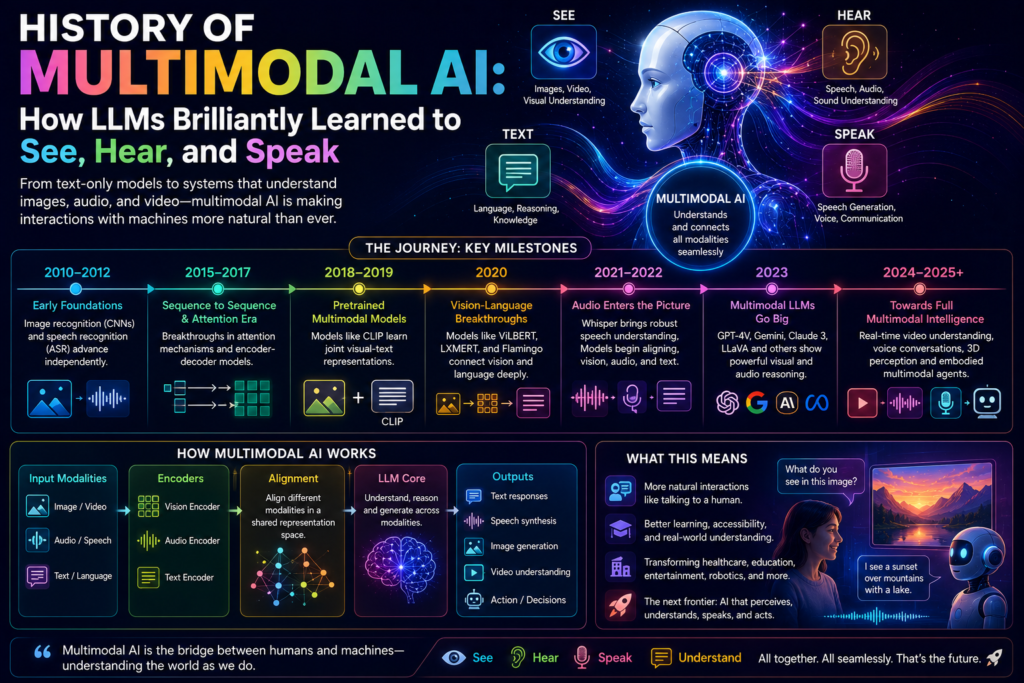
The multimodal ai history is the story of how artificial intelligence grew beyond the boundaries of any single sense. For most of the field’s early decades, AI systems were specialists: one model processed images, another processed speech, another handled text. Each operated in isolation, unable to combine what it knew from one modality with information from another. The multimodal ai history is the account of how that isolation ended, and how modern AI systems learned to see, hear, and speak in ways that more closely resemble how humans naturally experience and understand the world.
The stakes of this transition have been enormous. A language model that can only read text is genuinely useful. A multimodal AI system that can look at a medical scan and describe what it sees, watch a video and answer questions about it, listen to audio and produce a written transcript, or generate images that match a written description is genuinely transformative. The multimodal ai history traces every major step in that progression, from the earliest pioneering work in computer vision and speech processing to the natively multimodal foundation models that define the current frontier.
Understanding the multimodal ai history means understanding not just a series of product launches but the underlying technical challenges that had to be solved to make cross-modal learning possible, and why those solutions, once found, changed the trajectory of AI development permanently.
The Separate Worlds: Computer Vision and Speech Before Multimodal AI (1960 – 2010)
The multimodal ai history begins with parallel histories rather than a single one. Computer vision and speech processing AI each developed largely independently, with separate research communities, separate benchmark datasets, and separate technical approaches that rarely spoke to each other.
Computer vision research dates to the 1960s, when researchers at MIT and Stanford began experimenting with programs that could identify simple objects in images by detecting edges and matching shapes against templates. Progress was slow for decades, constrained by limited compute and the difficulty of representing visual information in ways that algorithms could process reliably. The dominant approaches through the 1980s and 1990s relied on hand-engineered features, mathematical representations of edges, textures, and shapes that human researchers designed based on intuitions about what made images distinctive.
Speech processing AI followed a similar trajectory. Hidden Markov Models became the dominant approach to automatic speech recognition in the 1980s and 1990s, modeling the statistical patterns of phonemes and words in ways that produced functional but limited transcription systems. These systems required enormous amounts of domain-specific tuning and performed poorly outside their training conditions.
Machine perception in both modalities improved gradually through the 2000s, but the fundamental limitation was the same: these systems learned from hand-crafted features that captured only what human researchers thought to look for, not the full richness of the data itself. The multimodal ai history would not begin in earnest until deep learning showed that features could be learned automatically from raw data at scale.
Deep Learning Transforms Computer Vision (2012 – 2015)
The multimodal ai history’s first major inflection point came in 2012 when AlexNet, developed by Alex Krizhevsky, Ilya Sutskever, and Geoffrey Hinton at the University of Toronto, won the ImageNet Large Scale Visual Recognition Challenge by a margin that shocked the computer vision community. AlexNet was a deep convolutional neural network trained end-to-end on raw image pixels rather than hand-crafted features, and it demonstrated that deep learning innovation could replace years of feature engineering with raw learning from data.
The impact was immediate and permanent. Within a few years, deep convolutional networks had replaced hand-engineered approaches as the default architecture for image recognition systems across virtually every computer vision task. Researchers discovered that these networks learned hierarchical representations of visual information, with early layers detecting edges and textures and later layers detecting increasingly complex features like faces, objects, and scenes.
This breakthrough established the template that would underpin the entire subsequent multimodal ai history: learn representations directly from raw data using deep neural networks, and the resulting representations will be richer and more transferable than anything human feature engineering could produce. The same lesson would be applied to speech, to text, and ultimately to combinations of all three.
Speech recognition saw its own deep learning revolution slightly later, with recurrent neural networks replacing Hidden Markov Models as the dominant approach around 2014 and 2015. Audio processing technology was transformed by training deep networks directly on raw audio features, and transcription accuracy improved dramatically across diverse accents, speaking styles, and acoustic conditions.
Word Embeddings and the Bridge Between Vision and Language (2013 – 2017)
A critical component of the multimodal ai history was the development of dense vector representations that could serve as a common mathematical language for different types of information. The history of word embeddings shows how techniques like Word2Vec and GloVe gave language models rich semantic representations of words as dense numerical vectors. Meanwhile, computer vision models were producing dense vector representations of images in their final layers before classification.
Researchers noticed that these two types of vector representations occupied mathematical spaces with interesting structural similarities. Both encoded semantic relationships in geometric form. If you could learn to align the two spaces, you might be able to connect language and vision in ways that neither could achieve independently.
Early work on image captioning systems in 2014 and 2015 demonstrated that convolutional neural network features extracted from images could be fed as input to recurrent language models, which could then generate natural language descriptions of what they saw. These systems were far from perfect, but they were the first genuine demonstrations of cross modal learning between vision and language: a single system that combined image recognition systems with language generation in a meaningful way.
Visual question answering, where a model must answer natural language questions about specific images, became an important benchmark for multimodal machine learning progress during this period. The challenge was considerably harder than captioning because it required the model to selectively attend to relevant parts of an image based on the specific question being asked, a capability that required much more sophisticated integration of visual and language understanding than simple feature concatenation.
CLIP and the Multimodal Alignment Revolution (2021)
The multimodal ai history reached a genuine breakthrough moment in January 2021 when OpenAI published CLIP, which stood for Contrastive Language-Image Pre-training. CLIP was not trained to classify images or to generate captions. It was trained on 400 million image-text pairs scraped from the internet to learn a shared embedding space where images and their corresponding text descriptions would end up geometrically close together.
The training objective was contrastive: for each batch of image-text pairs, train the model so that the image and its matching text end up closer to each other in the shared space than to any other image or text in the batch. This simple but powerful objective, applied at enormous scale, produced a model with remarkable zero-shot capabilities. Given a set of text descriptions of categories, CLIP could classify images into those categories without any task-specific training by simply finding which description’s embedding was closest to the image’s embedding.
CLIP demonstrated that text and image AI could be aligned in a shared semantic space in ways that enabled genuine cross-modal reasoning. Visual language models built on CLIP’s alignment approach became the foundation for many subsequent multimodal systems. The AI image and text models that followed owed much of their capability to the shared representation learning that CLIP had pioneered.
DALL-E, also released by OpenAI in 2021, went further by generating images from text descriptions. Rather than just aligning representations across modalities, DALL-E used a generative model to produce visual content conditioned on language. The multimodal ai history at this point had moved from systems that could describe images to systems that could create images from descriptions, a qualitative expansion of capability that had profound implications for creative industries and content generation.
Vision Transformers: The Architecture Unifies Modalities (2020 – 2022)
The transformer architecture history shows how the transformer, originally developed for language, expanded dramatically into vision and other modalities starting in 2020. Vision Transformers, introduced in a Google paper in October 2020, demonstrated that the self-attention mechanism that had revolutionized NLP could also work extremely well for image recognition when images were divided into fixed-size patches and each patch was treated as a token.
This was a pivotal development in the multimodal ai history because it suggested that the transformer architecture was not inherently a language architecture but a general sequence processing architecture that could be applied to any modality by representing that modality’s information as a sequence of tokens. Images could be tokenized into patches. Audio could be tokenized into spectrograms. Video could be tokenized into frames. And if all modalities could be represented as token sequences, then the same attention mechanisms could process them all, and potentially process combinations of them together within a single unified model.
The multimodal foundation models that began emerging from 2022 onward built directly on this insight. Rather than training separate models for each modality and combining them at the output, these models were trained with tokens from multiple modalities interleaved in the same attention context, allowing the model to attend across modalities and develop genuinely integrated representations of multimodal content.
GPT-4V and the LLM Vision Breakthrough (2023)
The multimodal ai history entered a new phase in September 2023 when OpenAI released GPT-4V, the vision-enabled version of GPT-4 that could accept images as input alongside text. This was the first time that a frontier conversational language model had direct visual perception, and the capabilities it demonstrated were immediately striking.
GPT-4V could describe the content of photographs with nuance and context. It could read text in images, including handwritten text and text on signs or screens. It could analyze charts and graphs and explain the data they contained. It could reason about spatial relationships in images, understand diagrams and schematics, and answer detailed questions about visual content that required genuine visual understanding rather than pattern matching.
The AI multimodal breakthroughs that GPT-4V represented were not just about what the model could do but about how it did it. Previous vision-language models required carefully formatted inputs and specific types of questions. GPT-4V could engage with visual content as part of a natural conversation, with the same flexibility and reasoning capability that GPT-4 applied to text-only inputs. The multimodal data analysis capabilities this unlocked for professional users were immediately apparent.
The gpt-4 history covers the full story of GPT-4’s development and how vision capability was integrated into the model’s architecture. For the multimodal ai history, GPT-4V was the moment that multimodal AI crossed from impressive research demonstration into mainstream consumer and enterprise deployment.
Gemini: Native Multimodal Training From the Ground Up (2023 – 2024)
While GPT-4V added vision capability to an existing language model, Google’s Gemini took a different approach that represented a more fundamental advance in the multimodal ai history. Gemini was designed from the beginning as a natively multimodal model, trained simultaneously on text, images, audio, video, and code rather than having vision capability added to a pre-existing language model.
The multimodal technology history of Gemini’s development reflects a recognition that native training across modalities produces fundamentally different and more integrated capabilities than late-fusion approaches that combine separately trained modality-specific models. When a model trains on interleaved text and image data from the start of training, it develops representations that are inherently cross-modal, where language concepts and visual concepts are entangled in the model’s internal representations from the earliest layers.
Gemini Ultra’s native video processing capability was particularly significant. The model could watch extended video content and answer questions about it, track objects across frames, understand temporal sequences of events, and connect what it saw in specific video segments to surrounding context. This extended the multimodal ai history from still images to the full richness of visual experience as it unfolds over time.
GPT-4o and Real-Time Multimodal Interaction (May 2024)
The multimodal ai history reached another landmark in May 2024 with the release of GPT-4o, where the “o” stood for Omni. GPT-4o was designed not just to process multiple modalities as inputs but to respond across multiple modalities in real time. It could speak naturally in real-time voice conversations, respond to visual inputs with both text and voice, and produce outputs that were appropriate for the modality the user was engaging in.
The real-time voice interaction capability of GPT-4o was qualitatively different from previous voice interfaces that stitched together separate speech recognition, language model processing, and text-to-speech synthesis components. GPT-4o processed audio end-to-end, allowing it to capture emotional nuance, speaking style, and paralinguistic cues in voice input rather than just transcribed text. The resulting conversations felt significantly more natural and responsive than anything that had been publicly available before.
This development in the multimodal ai history showed how multimodal generative AI was not simply adding capabilities to existing models but creating entirely new modes of human-computer interaction that were not possible with any single-modality system.
The Current Multimodal Frontier and What It Enables
The multimodal ai history today encompasses systems that can see, hear, and speak with increasing sophistication across all major AI laboratories. The competitive landscape includes GPT-4o from OpenAI, Gemini from Google, Claude’s vision capabilities from Anthropic, and numerous specialized multimodal systems from research labs and startups around the world.
The multimodal evolution has created capabilities that would have seemed extraordinary even five years ago. Radiologists can use AI systems that look at medical images and describe findings in natural language. Developers can take screenshots of error messages and receive debugging help. Students can photograph handwritten math problems and receive step-by-step solutions. Lawyers can upload scanned documents and receive analysis. The practical applications of multimodal AI span virtually every knowledge domain.
The AI evolution timeline for multimodal systems shows an acceleration that mirrors and often exceeds what happened with language-only models. The llm timeline places multimodal capability as one of the fastest-moving frontiers in AI development, with each successive generation of frontier models showing significant advances in what modalities they can process and how well they integrate information across those modalities.
The future of large language models points toward increasingly seamless multimodal interaction, with AI systems that move fluidly between text, images, audio, and video in ways that match how humans naturally communicate and experience the world.
FAQs
What is multimodal AI and when did it first emerge?
Multimodal AI refers to artificial intelligence systems that can process and generate information across multiple types of data, including text, images, audio, and video. Early multimodal work on image captioning emerged in 2014 and 2015, combining convolutional neural networks with recurrent language models. The field accelerated dramatically with CLIP in 2021, GPT-4V in 2023, and Gemini’s native multimodal training, which brought sophisticated cross-modal reasoning into mainstream AI products.
What was CLIP and why was it important for multimodal AI?
CLIP, Contrastive Language-Image Pre-training, was a model released by OpenAI in January 2021 that trained on 400 million image-text pairs to learn a shared embedding space where images and their text descriptions ended up geometrically close together. This alignment approach gave CLIP remarkable zero-shot classification capabilities and established the shared representation learning framework that underlied many subsequent multimodal AI systems, including DALL-E’s image generation and later vision-language models.
What is the difference between GPT-4V and Gemini’s approach to multimodal AI?
GPT-4V added vision capability to GPT-4, a model that was originally trained on text. Gemini was trained natively across multiple modalities from the beginning, with text, images, audio, video, and code interleaved during pre-training. The native training approach is generally believed to produce more deeply integrated cross-modal representations, while the added-capability approach can be faster to develop by building on an existing strong language model foundation.
What can current multimodal AI systems do that text-only models cannot?
Multimodal AI systems can analyze photographs and describe their content, read text in images, interpret charts and diagrams, answer questions about videos, transcribe and reason about audio content, generate images from text descriptions, and engage in real-time voice conversations. These capabilities enable applications in medical imaging analysis, document processing, educational assistance, accessibility technology, creative content generation, and many other domains that require understanding non-text information.
Where is multimodal AI headed next?
The multimodal ai history points toward increasingly seamless and real-time cross-modal interaction. Current frontiers include improved video understanding across longer content, better audio generation for voice interaction, integration of additional sensor modalities like spatial data and biological signals, and more sophisticated reasoning that connects information across multiple modalities in ways that mirror human perceptual integration. The trend toward native multimodal training from scratch rather than adding modalities to existing models suggests that future systems will have increasingly integrated cross-modal understanding.
Conclusion
The multimodal ai history is one of the most exciting trajectories in all of modern technology. What began as separate research traditions in computer vision, speech processing, and natural language understanding has converged, through deep learning, transformer architectures, and massive scale pre-training, into AI systems that engage with the full richness of human communication across sight, sound, and language simultaneously.
Each milestone in the multimodal ai history, AlexNet’s 2012 revolution in image recognition, CLIP’s 2021 demonstration of vision-language alignment, GPT-4V’s 2023 integration of vision into a frontier language model, GPT-4o’s real-time multimodal interaction, Gemini’s native multimodal training, has expanded what AI can perceive and what it can communicate. The cumulative result is a generation of AI systems whose perceptual capabilities would have seemed science fiction to researchers working just a decade ago.
Multimodal ai history is not complete. The current frontier is impressive but still limited compared to human perceptual integration, and the field continues to advance rapidly. The future of AI will be defined in large part by how well AI systems learn to perceive and reason about the full sensory richness of the world, and the multimodal ai history documented here is the foundation on which that future is being built.