Introduction
The transformer model explained simply is this: a neural network architecture that processes entire sequences of text simultaneously using attention mechanisms, rather than reading words one at a time. That single design decision, replacing sequential processing with parallel attention, made transformers faster to train, better at capturing long-range relationships in language, and dramatically more scalable than anything that had come before. The result is the architecture that now powers GPT-4, Claude, Gemini, LLaMA, and virtually every other major AI system in the world.
The transformer model explained fully, however, requires more than a single sentence. It requires understanding the problem transformers were built to solve, the elegant mechanisms they use to solve it, and why those mechanisms scale so remarkably well as models grow larger. This article walks through all of that, covering the history and context of the architecture, the key components that make it work, and the reason it has become the universal foundation of modern AI language systems.
Whether you are a developer trying to understand the models you are working with, a researcher exploring AI history, or simply a curious reader who wants to understand what is actually happening inside ChatGPT, the transformer model explained here will give you the conceptual foundation you need.
The Problem Transformers Were Built to Solve (1990 – 2016)
To appreciate the transformer model explained in its full significance, you need to understand what came before it and why those prior approaches were not good enough. The challenge of sequence modeling, teaching machines to understand language, had occupied AI researchers for decades before transformers arrived.
The earliest neural approaches to language used recurrent neural networks, which processed text one word at a time, passing information forward from each word to the next through a hidden state vector. The problem was that the information from early words in a sequence tended to fade as the sequence grew longer. By the time the network reached the end of a long sentence or paragraph, the representation of words from the beginning had been diluted or lost entirely. This made it very hard to capture relationships between words that were far apart in a text.
Long Short-Term Memory networks, or LSTMs, addressed this through gating mechanisms that allowed the network to selectively remember and forget information, as described in the what is lstm in ai discussion. LSTMs were a genuine improvement, enabling the seq2seq models used in early machine translation systems to handle longer sequences more reliably. But they still processed text sequentially, which meant they could not be parallelized effectively during training. Every word depended on the processing of every previous word, creating a fundamental bottleneck in computational efficiency.
The recurrent neural networks history shows how researchers recognized these limitations and began adding attention mechanisms as supplements to RNN architectures in 2014 and 2015. These attention mechanisms allowed decoders to look back at all encoder hidden states when generating each output word, rather than relying on a single fixed-length context vector. They worked significantly better, but the recurrent backbone remained, limiting how much the systems could benefit from large-scale parallel computation.
The stage was set for an architecture that would eliminate recurrence entirely.
Attention Is All You Need: The 2017 Breakthrough
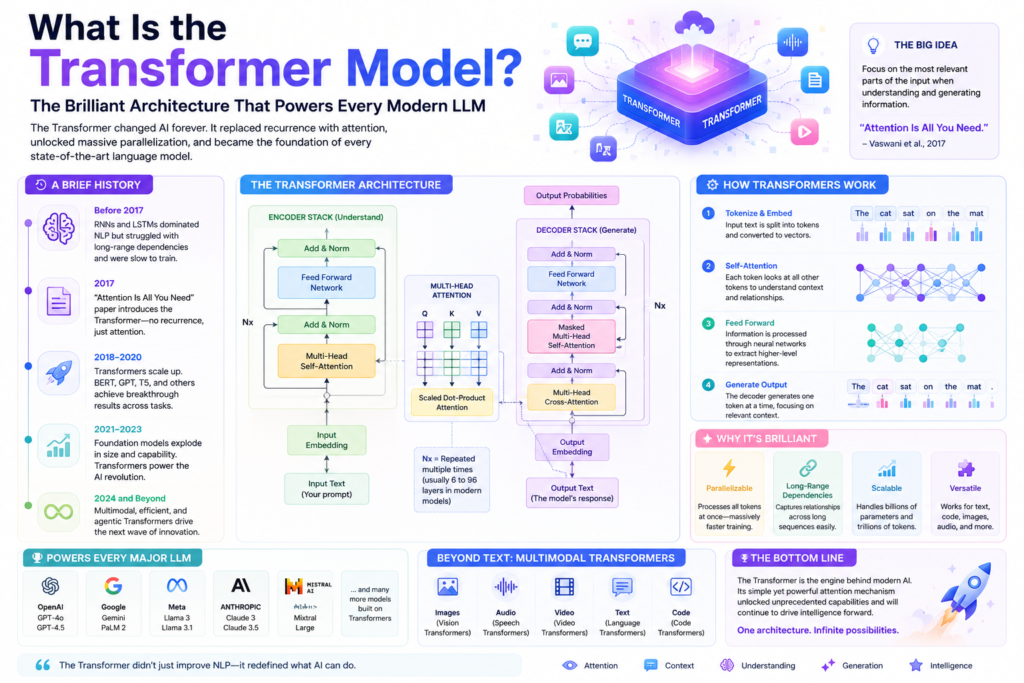
The transformer model explained as a historical event begins on June 12, 2017, when researchers at Google Brain and Google Research submitted the paper “Attention Is All You Need” to arXiv. The paper’s central claim was as radical as its title: you did not need recurrence at all. A model built entirely on attention mechanisms, with no recurrent components whatsoever, could match and exceed the best sequence-to-sequence models on machine translation benchmarks.
The key insight was that if you designed the attention mechanism correctly, you could allow every position in a sequence to attend to every other position simultaneously, in parallel, without needing to process the sequence one step at a time. This eliminated the fundamental computational bottleneck of recurrent models and made the transformer deep learning architecture dramatically more efficient on modern GPU hardware, which is designed for parallel computation rather than sequential processing.
The attention mechanism explained in the paper introduced what the authors called multi-head self-attention, a powerful generalization of the attention concept that would become the defining component of the transformer. Understanding self-attention is the key to getting the transformer model explained at a mechanistic level.
Self-Attention: The Core of the Transformer Model Explained
Self-attention is the mechanism that allows every token in a sequence to directly attend to and incorporate information from every other token in the same sequence. When you get the transformer model explained at the component level, self-attention is what you spend the most time on because it is where most of the model’s power comes from.
Here is how it works. For each token in the input sequence, the model computes three vectors: a query, a key, and a value. These are produced by multiplying the token’s input representation by three separate learned weight matrices. The query from one token is then compared against the keys of all other tokens in the sequence using a dot product, which produces a score indicating how much that token should attend to each other token. These scores are scaled and passed through a softmax function to produce attention weights that sum to one. Finally, the attention weights are used to compute a weighted sum of all value vectors, producing a new representation for the current token that incorporates information from across the entire sequence.
This mechanism is what the transformer model explained concept is really about. Each token’s final representation is shaped not just by the token itself but by all other tokens it has attended to, weighted by how relevant they were deemed to be. The word “bank” in a sentence about river fishing attends strongly to “river” and “fishing,” producing a representation tuned to the geographical meaning. The same word in a sentence about finance attends to “investment” and “deposit,” producing a completely different representation. This contextual learning happens naturally through the attention weights, without any explicit hand-coded rules.
Multi-head attention extends this by running the attention computation multiple times in parallel with different learned weight matrices, called heads, each potentially learning to capture different kinds of relationships in the text. Some heads might learn syntactic dependencies, others semantic associations, others coreference relationships. The outputs of all heads are concatenated and projected back to the model’s hidden dimension, giving each token a rich representation that captures multiple types of contextual information simultaneously.
Positional Encoding: Giving the Model a Sense of Order
A consequence of removing recurrence from the architecture is that the transformer has no inherent sense of word order. Recurrent networks knew that word five came after word four because they processed them in sequence. The transformer processes all tokens in parallel, so it needs an explicit mechanism to represent position.
This is where positional encoding comes in. Before the input token embeddings are fed into the first attention layer, a positional encoding is added to each token’s representation. In the original transformer, these encodings were computed using sine and cosine functions of different frequencies, producing a unique pattern for each position in the sequence that the model could learn to decode. The key requirement is that the encoding for each position must be unique and must vary in a way that allows the model to infer relative positions from absolute ones.
Later transformer variants explored learned positional encodings, where the model learns the positional representation during training rather than using fixed mathematical functions. More recent architectures like RoPE, or Rotary Position Embedding, encode position in a way that naturally generalizes to sequence lengths longer than those seen during training, which is particularly important for models with very long context windows.
The Encoder and Decoder: How Transformer Models Are Structured
The original transformer introduced both an encoder and a decoder, and understanding this encoder decoder architecture is essential for getting the full transformer model explained correctly.
The encoder processes the input sequence and produces a set of contextual representations, one for each input token, that capture the full context of the entire input. Each encoder block consists of a multi-head self-attention layer followed by a feedforward neural network, with layer normalization and residual connections applied around each component. Stacking multiple encoder blocks allows the model to build increasingly abstract representations layer by layer, with each layer’s attention operating on the representations produced by the previous layer.
The decoder generates the output sequence one token at a time, but it does so by attending to two sources of information. First, it attends to its own previously generated tokens through a masked version of self-attention that prevents each position from attending to future positions, maintaining the autoregressive property that makes generation possible. Second, it attends to the encoder’s output through cross-attention, allowing each decoder position to look at all encoder representations and selectively incorporate the most relevant input information.
This original encoder decoder architecture is what T5 and many translation and summarization models use. But modern large language models have taken the architecture in two specialized directions. BERT-style models use only the encoder, optimizing for understanding tasks where the model needs to read and represent text but not generate it. GPT-style models use only the decoder, optimizing for generation tasks where the model produces text autoregressively. This distinction is the heart of the bert vs gpt vs t5 architectural comparison.
Why Transformers Scale So Remarkably Well
One of the most important aspects of the transformer model explained is understanding why this architecture has continued to improve dramatically as models have grown larger. The key is that transformers are genuinely parallelizable in ways that recurrent models were not.
During training, a transformer can process the entire sequence and compute all attention weights in parallel. Every attention head, every layer, and every token position can be computed simultaneously on different parts of the GPU hardware. This means that adding more compute, whether more GPUs or more powerful chips, directly translates into being able to train larger models on more data in reasonable time. The language understanding that emerges from this training at scale has been one of the most consistent and surprising findings in modern AI: capabilities appear to emerge at scale that were not present at smaller sizes.
This is the foundation of the ai scaling laws that have governed large language model development since GPT-3 demonstrated in 2020 that simply scaling transformers up produced qualitative improvements in capability. The relationship between compute, data, model size, and performance has been studied extensively, and transformers follow these relationships remarkably consistently across many orders of magnitude of scale.
The token embeddings that represent each token in the input are another critical component. At the beginning of the model, each token is mapped to a dense vector in the model’s hidden dimension using a learned embedding table. This converts the discrete, symbolic representation of text into continuous numerical vectors that can be processed by the attention and feedforward layers. At the output of the model, the reverse projection maps from hidden representations back to a probability distribution over the vocabulary, from which the next token is sampled or the most likely token is selected.
Transformers Beyond Language: Vision, Audio, and Multimodal AI
One of the most striking aspects of the transformer model explained fully is how far the architecture has traveled beyond its original NLP algorithms application. The self-attention mechanism that was designed for sequences of text tokens turns out to work remarkably well for other types of sequential or structured data.
Vision Transformers, introduced in 2020, applied the transformer to images by dividing images into fixed-size patches and treating each patch as a token, applying self-attention across patches rather than words. This allowed the model to develop a global receptive field across the entire image from early layers rather than building up from local features as convolutional networks do. Vision Transformers achieved state-of-the-art performance on image recognition when trained at sufficient scale.
Audio transformers apply the same principle to audio spectrograms. Multimodal models combine image, text, and sometimes audio tokens in the same attention mechanism, allowing the model to attend across modalities. GPT-4’s image understanding capabilities, Gemini’s native multimodal training, and Claude’s vision features all rely on this extension of the transformer model into multimodal territory.
The multimodal ai history shows how rapidly this expansion happened once the transformer’s fundamental flexibility was recognized. The same architecture that learned to predict the next word in a sentence was adapted to predict the next patch in an image sequence, the next audio frame, and eventually any combination of modalities within a unified attention framework.
The Transformer’s Lasting Impact on AI Development
The transformer model explained across all its components reveals an architecture of remarkable elegance. Self-attention as the core operation. Positional encoding to handle order. Multi-head attention to capture diverse relationship types. Encoder blocks for understanding. Decoder blocks for generation. Layer normalization and residual connections for training stability. Feedforward layers between attention layers to introduce non-linearity. Each component serves a clear purpose, and together they form a system that has scaled from millions to hundreds of billions of parameters while maintaining the same basic architectural principles.
The gpt models history documents how OpenAI applied the decoder-only transformer at increasing scale to produce the GPT family. The bert model history shows how Google applied the encoder-only transformer to achieve breakthroughs in language understanding. Both lineages trace back to the same 2017 paper and the same set of core mechanisms.
FAQs
What is a transformer model in simple terms?
A transformer model is a type of neural network that processes sequences of text by having each word pay attention to every other word simultaneously, rather than reading words one at a time. This attention mechanism lets the model understand context and relationships across an entire sentence or document in parallel, making it both faster to train and better at understanding language than previous sequential approaches. Every major AI language system today, including ChatGPT, Claude, and Gemini, is built on the transformer.
Who invented the transformer model?
The transformer was introduced in the June 2017 paper “Attention Is All You Need” by Ashish Vaswani, Noam Shazeer, Niki Parmar, Jakob Uszkoreit, Llion Jones, Aidan Gomez, Lukasz Kaiser, and Illia Polosukhin, all working at Google at the time. Aidan Gomez later co-founded Cohere. The paper was submitted while the authors were affiliated with Google Brain and Google Research.
What is self-attention and why is it important?
Self-attention is the mechanism that allows each token in a sequence to compute a weighted sum of all other tokens’ representations, weighted by relevance. Each token produces a query vector that is compared against the key vectors of all other tokens to determine how much attention to pay to each one. The resulting representation for each token incorporates context from across the entire sequence. This is important because it allows the model to understand how the meaning of each word is shaped by all surrounding words, capturing both local and long-range dependencies equally well.
What is the difference between the encoder and decoder in a transformer?
The encoder processes the input sequence and produces rich contextual representations for each input token using bidirectional self-attention, meaning each token attends to all others in both directions. The decoder generates output sequences autoregressively, using masked self-attention that prevents each output position from attending to future positions, plus cross-attention that allows it to look at the encoder’s representations. BERT uses only the encoder. GPT uses only the decoder. T5 and the original translation transformer use both.
Why do transformers work so much better than previous language models?
Transformers outperform previous language models for several interconnected reasons. Parallel processing allows much more efficient use of modern hardware during training. The global attention mechanism allows every token to directly relate to every other token regardless of distance, eliminating the vanishing gradient problem that made long-range dependencies difficult for recurrent models. And transformers scale extremely predictably: more compute, more data, and more parameters consistently produce better performance, following smooth power law relationships that have allowed the field to make confident predictions about how much improvement additional investment would produce.
Conclusion
The transformer model explained from its 2017 origins to its current dominance reveals one of the most productive architectural ideas in the history of machine learning. A relatively simple set of mechanisms, self-attention, positional encoding, multi-head attention, encoder and decoder blocks, and layer normalization, combined in a way that eliminated the sequential processing bottleneck that had constrained AI language systems for decades.
The result has been an architecture that scales with remarkable consistency, that generalizes from language to vision to audio and multimodal combinations, that has powered the most capable AI systems ever built, and that continues to be refined and extended with each new generation of models. Understanding the transformer model explained at a conceptual level is no longer optional background knowledge for people working with AI. It is foundational understanding for navigating a technological landscape where transformers are the universal substrate.The future of AI will almost certainly be built on transformer foundations or on architectures that extend and modify them while preserving their core insights about parallel attention-based sequence processing. The 2017 paper that introduced “Attention Is All You Need” was not just a research contribution. It was the beginning of the architectural era that defines AI today.