Introduction
The debate around bert vs gpt vs t5 is one of the most instructive conversations in the history of modern artificial intelligence. These three models did not just compete on benchmark leaderboards. They represented three fundamentally different philosophies about what a language model should be, how it should be trained, and what kinds of problems it should solve best.
Understanding bert vs gpt vs t5 means understanding the architectural trade-offs that shape every large language model being built today. BERT came from Google and bet everything on deep bidirectional understanding. GPT came from OpenAI and bet on autoregressive generation at scale. T5, also from Google, tried to unify both perspectives into a single elegant framework. Each approach had genuine strengths, real limitations, and lasting influence on the field that continues to this day.
This article traces the origins of all three models, explains how they work under the hood, compares their real-world performance across different tasks, and explains why each one still matters in an era of hundred-billion-parameter frontier models.
The Transformer Foundation All Three Share (2017 – 2018)
Before diving into bert vs gpt vs t5 directly, it is worth establishing the common ground. All three models are built on the transformer architecture introduced by Google in 2017 in the paper “Attention Is All You Need.” The transformer architecture history shows how self-attention mechanisms replaced recurrent networks and enabled the parallel processing that made large-scale pre-training economically feasible for the first time.
The original transformer had two components: an encoder that processed the input sequence into a rich set of contextual embeddings, and a decoder that generated an output sequence one token at a time by attending both to the encoder’s output and to the tokens it had already generated. The encoder was optimized for understanding input. The decoder was optimized for generating output.
BERT, GPT, and T5 each made a different choice about which parts of this architecture to keep, which to discard, and how to design the pre-training objective around the resulting structure. Those choices produced three radically different models with radically different strengths.
BERT: The Encoder That Mastered Understanding (2018)
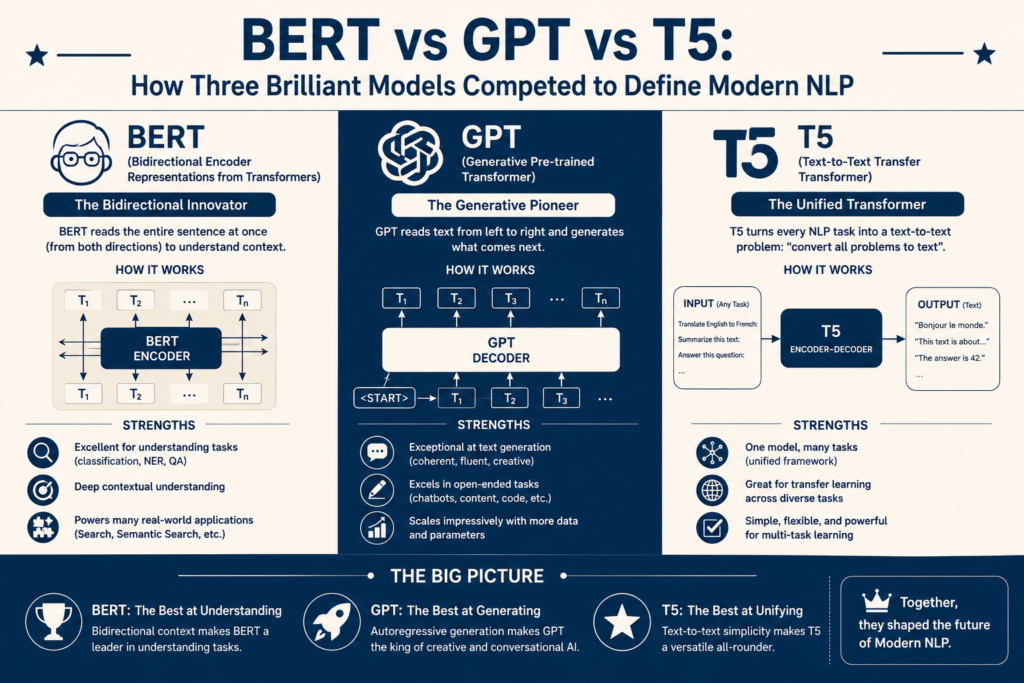
BERT, which stands for Bidirectional Encoder Representations from Transformers, was released by Google in October 2018. In the full bert vs gpt vs t5 comparison, BERT represents the encoder-only side of the architectural spectrum. It uses only the transformer encoder, which means it processes the entire input sequence simultaneously using bidirectional attention. Every token attends to every other token in both directions at every layer.
This encoder-only vs decoder-only distinction is the single most important structural difference between BERT and GPT. Because BERT can attend to both left and right context simultaneously, it develops richer contextual embeddings for each token than any unidirectional model can produce. The word “bank” in a financial context and the word “bank” in a geographical context get genuinely different internal representations because BERT sees the full sentence before producing any representation.
BERT was pre-trained using masked language modeling, or MLM. A portion of input tokens were randomly masked and the model was trained to reconstruct them using surrounding context. This is fundamentally different from causal language modeling used in GPT, where each token can only attend to tokens that came before it. BERT also used next sentence prediction as a secondary pre-training objective, training the model to understand whether two sentences appeared consecutively in the original document.
The result was a model extraordinarily well-suited for natural language understanding tasks: sentiment analysis, named entity recognition, question answering, textual entailment, and coreference resolution. On the GLUE benchmark and SQuAD question answering dataset, BERT set new records that surpassed years of accumulated progress. For tasks that require deeply understanding what a piece of text means, BERT was and in many contexts remains the gold standard approach.
The limitation of BERT in the bert vs gpt vs t5 comparison is equally clear. Because it is an encoder-only architecture with bidirectional attention, BERT cannot generate text autoregressively. It cannot write an essay, continue a story, or produce a translation from scratch. It is a reader, not a writer. For natural language generation tasks, you need a different kind of model.
GPT: The Decoder That Mastered Generation (2018 – 2020)
GPT, developed by OpenAI, made the opposite architectural choice from BERT. In the bert vs gpt vs t5 debate, GPT represents the decoder-only side of the spectrum. It uses only the transformer decoder with causal attention masking, meaning each token can only attend to tokens that appear before it in the sequence. This makes GPT inherently autoregressive: it generates text one token at a time, each new token conditioned on everything that came before.
The gpt models history shows a model family that grew from GPT-1’s 117 million parameters in 2018 to GPT-3’s staggering 175 billion parameters in 2020. The pre-training objective throughout was next token prediction, also called causal language modeling: given a sequence of tokens, minimize loss on predicting what comes next. This objective is simpler than BERT’s masked language modeling and crucially does not require the model to see future tokens, which is what makes autoregressive generation possible.
The strength of this architecture is natural language generation. GPT-style models can write essays, continue stories, generate code, produce dialogue, and complete creative tasks with a fluency that BERT-style models structurally cannot achieve. When GPT-3 demonstrated few-shot learning on generation tasks in 2020, it shocked the research community with outputs that were coherent, stylistically consistent, and contextually appropriate across a remarkable range of domains.
The limitation in the bert vs gpt vs t5 comparison is that GPT’s unidirectional attention means each token only sees its left context during pre-training. This makes GPT somewhat weaker than BERT on pure understanding tasks where seeing the full bidirectional context would help. GPT models also tend to hallucinate facts more readily than BERT-based models on classification tasks, because generation under uncertainty sometimes produces confident but incorrect completions.
The bidirectional vs autoregressive distinction is therefore not just an architectural detail. It reflects a fundamental choice between optimizing for understanding or optimizing for generation, and that choice shapes everything downstream.
T5: The Unified Framework That Refused to Choose (2019 – 2020)
The third major player in the bert vs gpt vs t5 story arrived from Google Research in late 2019 with an ambitious goal: build a single model that could handle any NLP task within a unified framework. T5, which stands for Text-to-Text Transfer Transformer, was the result of a systematic large-scale study of NLP transfer learning approaches.
T5 used an encoder-decoder architecture, keeping both halves of the original transformer. The encoder processed the input sequence using bidirectional attention to produce rich contextual representations. The decoder generated the output sequence autoregressively, attending to both its own previous outputs and to the encoder’s representations. This encoder-decoder architecture gave T5 the understanding capability of BERT and the generation capability of GPT within a single model.
The key innovation in T5 was not the architecture itself but the text-to-text approach to task framing. Every NLP task was reformulated as a sequence-to-sequence problem. For classification, the input was the text and the output was the class label written as text. For translation, the input was the source sentence with a task prefix and the output was the translated sentence. For summarization, the input was the document and the output was the summary. This unified framework approach meant the same model architecture and the same training procedure could handle every task without any task-specific architectural modifications.
T5 was pre-trained on the Colossal Clean Crawled Corpus, a carefully filtered 750 gigabyte subset of Common Crawl web text. Pre-training used a span-level masking objective that was similar to BERT’s masked language modeling but masked consecutive spans of tokens rather than individual tokens, with the decoder tasked with reconstructing those masked spans. This gave T5 strong downstream task flexibility because it trained the decoder to generate coherent text from the very beginning of pre-training, unlike BERT which never generated text during pre-training at all.
In the bert vs gpt vs t5 comparison, T5’s model parameter comparison is interesting. T5 was released in multiple sizes from T5-Small with 60 million parameters to T5-11B with 11 billion parameters, giving practitioners a range of options depending on their compute budget and performance requirements. On comparative model performance across the GLUE and SuperGLUE benchmark leaderboards, T5-11B set new records, demonstrating that the encoder-decoder approach with sufficient scale could match or exceed both pure encoder and pure decoder models.
Head-to-Head: Understanding vs Generation Tasks
The most practically important dimension of bert vs gpt vs t5 is how they perform on different categories of tasks. Understanding this helps practitioners choose the right model for their specific application.
For natural language understanding tasks, BERT-style models have historically been the strongest out of the box. Tasks like sentiment analysis, named entity recognition, question answering over a given passage, textual entailment, and coreference resolution all benefit from the rich bidirectional contextual embeddings that BERT produces. The fine tuning in ai process for BERT-style models on these tasks is straightforward: add a small classification or extraction head on top of the pre-trained encoder and fine-tune all weights on labeled data.
For natural language generation tasks, GPT-style models dominate. Open-ended text generation, creative writing, code generation, dialogue, and instruction following are all areas where the autoregressive decoder architecture gives GPT a structural advantage. The model can generate arbitrarily long sequences while maintaining coherence because generation is literally what it was trained to do.
T5 occupies a genuinely interesting middle position in bert vs gpt vs t5. For tasks that require both understanding input and generating structured output, such as summarization, translation, and complex question answering where the answer is generated rather than extracted, T5’s encoder-decoder design gives it advantages over both pure encoder and pure decoder models. Sequence-to-sequence versatility is T5’s defining characteristic and the reason it remains widely used in research and production settings where the task involves transforming input text into output text in a structured way.
The Influence of Each Model on What Came After (2020 – Present)
Bert vs gpt vs t5 is not just a historical question. The architectural choices made by these three models continue to shape the entire landscape of large language model development today.
The dominance of GPT-style decoder-only architectures in frontier models is striking. GPT-3, GPT-4, LLaMA, Mistral, Claude, Gemini, and most of the largest and most capable models being built today use decoder-only architectures. The scalability of next token prediction as a pre-training objective, combined with the simplicity of the decoder-only design, has proven to be an extraordinarily effective combination at scale. The understanding vs generation tasks dichotomy has largely resolved in favor of generation at the frontier, with researchers finding that sufficiently large decoder-only models can handle understanding tasks through prompting and instruction tuning even without bidirectional attention.
BERT-style encoder models remain dominant in specialized production deployments where efficiency matters more than raw generative capability. Search engines, document classification systems, semantic search, and retrieval systems continue to rely heavily on BERT-style contextual embeddings because they are computationally efficient, well understood, and excellent at producing dense representations of text for downstream retrieval and ranking tasks.
T5 and its successors, including UL2 and Flan-T5, remain influential in research settings and in applications requiring structured transformation of input text to output text. The text-to-text framing has proven durable as a way of unifying diverse NLP tasks under a single training regime.
For anyone trying to understand how these choices connect to the broader sweep of AI development, the llm timeline shows how bert vs gpt vs t5 set the terms of a debate that continues to shape every new model released today.
The future of AI will likely see continued experimentation with all three architectural approaches, as researchers explore whether the apparent advantages of decoder-only scaling hold at even larger scales, and whether hybrid architectures can combine the best properties of all three paradigms.
For context on how BERT specifically developed and what it achieved, the what is bert model deep dive covers the technical details and benchmark performance that established it as one of the most important models in NLP history.
Frequently Asked Questions (FAQs)
What is the main architectural difference between BERT, GPT, and T5?
BERT uses only the transformer encoder with bidirectional attention, meaning each token attends to all other tokens in both directions. GPT uses only the transformer decoder with causal attention masking, meaning each token only attends to previous tokens, enabling autoregressive text generation. T5 uses both the encoder and decoder, combining bidirectional understanding of input with autoregressive generation of output.
Which model is better for text classification tasks?
BERT-style encoder models are generally stronger for text classification, sentiment analysis, and named entity recognition because their bidirectional attention produces richer contextual embeddings for each token. The model sees the full sentence context before generating any representation, which gives it a structural advantage on tasks that require deeply understanding what a piece of text means.
Which model is better for text generation tasks?
GPT-style decoder-only models are stronger for open-ended text generation, creative writing, code generation, and instruction following. Their autoregressive architecture is specifically designed to generate coherent, extended sequences of text, which is structurally impossible for BERT-style encoder-only models.
What makes T5 different from both BERT and GPT?
T5 frames every NLP task as a text-to-text problem, reformulating classification, translation, summarization, and question answering all as sequence-to-sequence tasks with the same model. This unified framework approach allows a single model to handle diverse tasks without task-specific architectural changes. Its encoder-decoder design gives it both understanding capability and generation capability within a single architecture.
Are these models still relevant today given larger frontier models exist?
Yes, all three architectural approaches remain relevant. BERT-style models dominate semantic search, document retrieval, and efficient classification. GPT-style decoder architectures underpin virtually all frontier generative AI models. T5-style encoder-decoder models remain important in research and for structured transformation tasks. Understanding these three models is essential for understanding the full landscape of modern NLP.
Conclusion
The story of bert vs gpt vs t5 is ultimately a story about the power of architectural choices. Three teams made three different decisions about which parts of the transformer to use and how to define the pre-training objective, and those decisions produced three models with fundamentally different strengths, limitations, and areas of enduring influence.
BERT vs GPT vs T5 is not a competition with a single winner. BERT won the understanding game. GPT won the generation game and then scaled to win the frontier model game. T5 built the most elegant unified framework. Each approach was correct for a different set of problems, and the field of NLP is richer for having explored all three seriously and rigorously.
The principles embedded in these three models, bidirectional vs autoregressive attention, encoder-only vs decoder-only vs encoder-decoder architecture, MLM vs next token prediction vs span masking, continue to shape every design decision made in large language model research today. Understanding bert vs gpt vs t5 is understanding the grammar of modern AI.