Introduction
The bert model history is one of the most exciting chapters in the story of artificial intelligence. In October 2018, a team of researchers at Google published a paper that would permanently change how machines read, interpret, and respond to human language. What they created was not just another incremental improvement. It was a genuinely new way of thinking about language understanding at scale.
Before BERT arrived, language models were limited by the direction in which they processed text. After BERT, the entire field shifted. Search engines became smarter, NLP benchmarks were shattered, and a new pre-training paradigm took hold that continues to influence AI development to this day. To truly appreciate the bert model history, you need to understand what came before it, what made it so different, and why its legacy is still felt across virtually every corner of modern AI.
The NLP Landscape Before BERT (2013 – 2017)
The bert model history does not begin in 2018. It begins years earlier, with the gradual recognition that language models needed to do something fundamentally better than they were doing. To understand why BERT mattered so much, it helps to understand the problems researchers were wrestling with before it existed.
The history of natural language processing shows a field that moved from rule-based systems to statistical methods to neural networks over several decades. By the mid-2010s, word embeddings like Word2Vec had given models a powerful way to represent the meaning of individual words as dense numerical vectors. But these representations were static. The word “bank” had one vector regardless of whether it appeared in a sentence about rivers or finance.
Recurrent neural networks, particularly Long Short-Term Memory networks, offered a way to process sequences and carry information from earlier tokens to later ones. But they processed text in one direction at a time and struggled with very long sequences. The transformer architecture history brought a major upgrade in 2017 when Google’s “Attention Is All You Need” paper introduced self-attention as a replacement for recurrence entirely. This was the foundation on which BERT would be built.
Existing approaches to transfer learning in NLP typically pre-trained language models in a left-to-right or right-to-left fashion and then fine-tuned them on labeled data for specific tasks. The problem was that unidirectional training meant the representation of each word was shaped by only one side of its context. This was a significant limitation for tasks that required understanding how words related to both what came before and what came after them simultaneously.
The Google AI Research Team Behind BERT (2018)
In the bert model history, the name Jacob Devlin stands out above all others. Devlin, a research scientist at Google AI Language, led the team that created BERT alongside colleagues Ming-Wei Chang, Kenton Lee, and Kristina Toutanova. Their work, formally titled “BERT: Pre-training of Deep Bidirectional Transformers for Language Understanding,” was submitted to arXiv in October 2018 and presented at the NAACL conference in 2019.
The paper from Devlin et al 2018 built directly on the transformer architecture but made a critical departure from how transformers had been used for language modeling up to that point. Rather than using the decoder portion of the transformer in an autoregressive left-to-right fashion, BERT used the encoder portion and trained it with a masked prediction objective that required reading context from both directions simultaneously. This achieved true deep bidirectional representations in a way that no prior model had managed.
The decision to use encoder-only transformer blocks was deliberate and consequential. An encoder-only architecture is optimized for understanding input sequences deeply rather than generating output sequences autoregressively. This made BERT exceptionally well-suited for tasks that required comprehension, such as question answering, sentiment analysis, and natural language understanding broadly.
How BERT Was Trained: The Pre-Training Objectives
A central part of the bert model history is understanding the self-supervised learning approach the team used to pre-train the model on massive amounts of unlabeled text. Two pre-training objectives worked together to give BERT its remarkable language understanding capabilities.
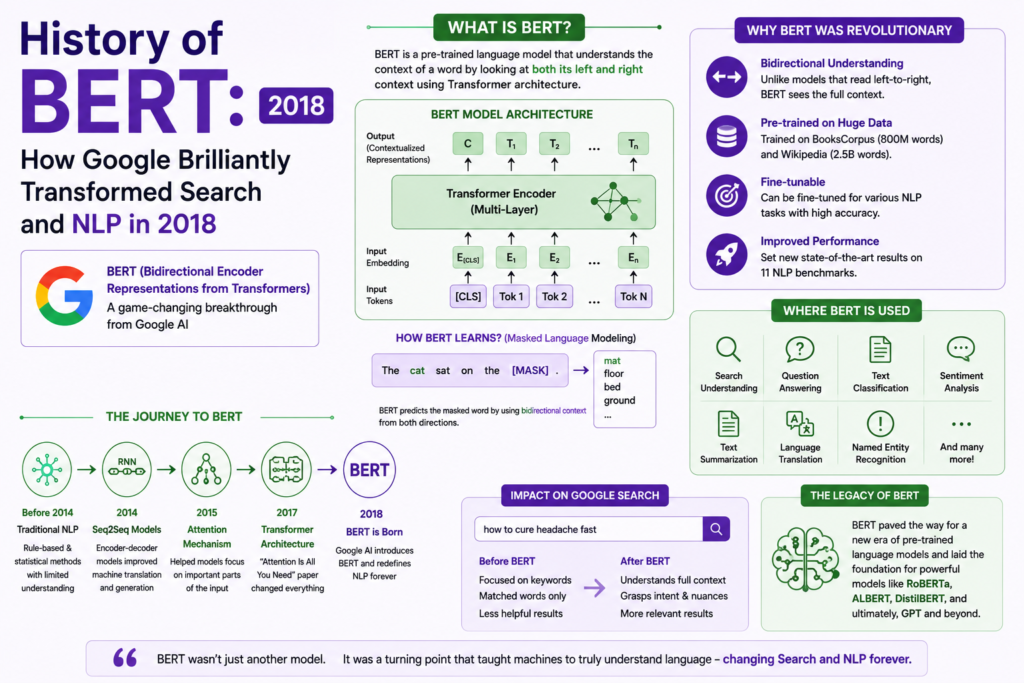
The first was Masked Language Modeling, or MLM. During training, 15 percent of tokens in each input sequence were randomly masked and the model was trained to predict what those masked tokens were using the full surrounding context on both left and right sides. This forced the model to develop truly bidirectional context analysis because it could not cheat by reading tokens in a fixed sequential order.
The second objective was Next Sentence Prediction, or NSP. The model received pairs of text segments and had to predict whether the second segment genuinely followed the first in the original document or was randomly selected from elsewhere. This trained the model to understand sentence-level relationships, which proved particularly valuable for tasks like question answering and natural language inference.
BERT was pre-trained on two massive text corpora: the full English Wikipedia, containing around 2.5 billion words, and the Toronto BookCorpus, a collection of unpublished books containing around 800 million words. Training used WordPiece tokenization, a subword approach that breaks words into smaller pieces to handle rare and unfamiliar vocabulary efficiently while keeping the overall vocabulary size manageable.
The pre-training used large batches and significant compute on Google’s TPU infrastructure. BERT-Base was trained with 12 transformer encoder blocks, 12 attention heads, and 110 million parameters. BERT-Large used 24 transformer encoder blocks, 16 attention heads, and 340 million parameters. Both versions were released publicly under the Apache 2.0 open-source license, which was a major factor in how rapidly the research community adopted and extended the model.
BERT Breaks Every Benchmark It Touches (2018 – 2019)
When the bert model history is written, the benchmark results from late 2018 and early 2019 read almost like a sporting event where one competitor wins every race by a wide margin.
On the GLUE benchmark, a collection of fine-tuning benchmarks designed to evaluate natural language understanding across multiple tasks, BERT-Large achieved a score of 80.4, surpassing the previous state of the art by 7.6 points. On SQuAD 1.1, a question answering dataset where models must locate answers within paragraphs of text, BERT pushed past human-level performance on certain metrics. On SQuAD 2.0, which added unanswerable questions to make the task harder, BERT again set a new record.
The results demonstrated that the pre-training and fine-tuning paradigm worked at scale. A single pre-trained BERT checkpoint, when fine-tuned on a small task-specific labeled dataset, could outperform models that had been designed specifically for each individual task. This changed the workflow for NLP practitioners entirely. Rather than building task-specific architectures from the ground up, teams could now start from a powerful pre-trained foundation and adapt it quickly.
Contextualized word embeddings, the dynamic representations that BERT produces for each token based on its full surrounding context, turned out to be far more useful than the static embeddings that had dominated the field before. The representation of every word was now shaped by the specific sentence it appeared in, which is much closer to how human readers understand language.
Impact on Google Search Algorithms (2019)
Perhaps the most dramatic moment in the bert model history came not from an academic paper but from a product announcement. In October 2019, exactly one year after the original BERT paper was published, Google announced it was deploying BERT in Google Search for English-language queries in the United States.
Google described the impact on search algorithms as one of the biggest leaps forward in the history of search, affecting around one in ten queries. The improvement was most visible for longer, more conversational searches where the relationship between words carried significant meaning. BERT’s bidirectional context analysis allowed the search engine to understand prepositions, negations, and nuanced phrasing in ways that keyword-matching approaches had never managed.
A frequently cited example involved the query “2019 brazil traveler to usa need a visa.” Before BERT, Google might have focused heavily on the word “usa” and returned results about American citizens traveling to Brazil. With BERT, the model correctly understood that the traveler was Brazilian and needed information about US visa requirements. The meaning of the preposition “to” was the key signal, and BERT captured it.
This deployment confirmed what researchers already knew from benchmarks: the bert model history was not just an academic success story. It was a practical breakthrough that changed how billions of people experienced information retrieval every single day.
The Open-Source Release and the Rise of BERTology
When Google released BERT’s weights and code under the Apache 2.0 open-source license, the research community embraced it with extraordinary speed. Within months, hundreds of papers were being published that analyzed, extended, applied, and improved upon BERT. This body of work became informally known as BERTology, a term used to describe the growing field of research into how BERT works, what it learns, and how it can be pushed further.
Researchers probed BERT’s attention heads and found they encoded different types of syntactic and semantic relationships. Some heads appeared to focus on syntactic dependencies, while others captured coreference and entity relationships. This interpretability work was valuable because it helped the community understand not just that BERT worked, but why it worked.
The open-source release also prompted a wave of specialized variants. RoBERTa, from Facebook AI, showed that BERT had been significantly undertrained and that removing the NSP objective and training for longer with more data produced meaningfully better results. DistilBERT compressed BERT into a smaller, faster model using knowledge distillation. ALBERT reduced parameter counts through cross-layer parameter sharing. BioBERT and SciBERT applied BERT pre-training to biomedical and scientific text, demonstrating that the approach generalized powerfully to specialized domains.
For anyone tracing the llm timeline, BERT represents the moment when pre-trained transformer models shifted from interesting research curiosities to the dominant paradigm in NLP.
BERT vs GPT vs T5: Choosing the Right Tool
The bert model history cannot be told without situating BERT alongside the other major models that emerged around the same period. The bert vs gpt vs t5 comparison is one of the most discussed topics in the NLP community because each model reflects a fundamentally different design philosophy.
GPT, developed by OpenAI around the same time, used the transformer decoder and was trained autoregressively to predict the next token given all previous tokens. This made GPT naturally strong at text generation but meant it was only left-to-right in how it processed context. BERT’s bidirectionality gave it a structural advantage for understanding and classification tasks.
T5, introduced by Google in 2019, took a different approach entirely by framing every NLP task as a text-to-text problem. It combined encoder and decoder components and trained on a massive diverse dataset. T5 was more flexible in terms of the tasks it could handle out of the box but required more compute than BERT-Base for fine-tuning.
The key insight is that these models were not competing so much as specializing. BERT became the go-to foundation for teams that needed to understand text deeply. GPT-style models became the foundation for generation-focused applications. Understanding this distinction is central to understanding how the field evolved through fine tuning in ai research and practice in the years that followed.
BERT’s Influence on the Modern AI Era (2020 – Present)
The bert model history did not end with BERT itself. Its influence runs through nearly every major development in AI language models that came afterward. The pre-training and fine-tuning paradigm that BERT demonstrated so powerfully became the default assumption in large-scale language model research. Every major model that followed, from GPT-3 to PaLM to Claude to Gemini, owes something to the framework that BERT helped establish.
Transfer learning in NLP, which BERT proved could work at scale with unlabeled text, is now the foundation of the entire industry. The idea that you could pre-train a model on general language data and then adapt it to specific tasks with minimal labeled data transformed what was economically and technically feasible for organizations of all sizes.
The pre training in ai concept, which BERT demonstrated with such force, is now considered a fundamental principle rather than a novel technique. And the scaling insight that larger models trained on more data produce better results, which the difference between BERT-Base and BERT-Large hinted at, would later be confirmed dramatically by models like GPT-3 and explored systematically through ai scaling laws research.
For a broader view of where all of this is heading, the future of AI continues to be shaped in significant ways by the foundations that the bert model history helped establish in 2018.
Frequently Asked Questions (FAQs)
When was BERT created and by whom?
BERT was created by Jacob Devlin and colleagues at Google AI Language, specifically Ming-Wei Chang, Kenton Lee, and Kristina Toutanova. The paper was published in October 2018 and presented at NAACL 2019. It remains one of the most cited papers in the history of natural language processing.
What made BERT different from previous language models?
BERT was the first model to use deep bidirectional pre-training with transformer encoders at scale. Previous models either processed text left-to-right or right-to-left, or used shallow combinations of two directional models. BERT’s masked language modeling objective forced the model to attend to context from both directions simultaneously at every layer, producing richer and more accurate representations.
How did BERT change Google Search?
Google deployed BERT in its search algorithm in October 2019, one year after the research paper was published. The update affected roughly one in ten English-language queries and significantly improved Google’s ability to understand conversational searches, particularly those where the meaning of prepositions, negations, or word order carried important semantic information.
What is the difference between BERT-Base and BERT-Large?
BERT-Base has 12 transformer encoder layers, 12 attention heads, and 110 million parameters. BERT-Large has 24 layers, 16 attention heads, and 340 million parameters. BERT-Large achieves higher performance on most benchmarks but requires substantially more compute to fine-tune and serve in production. Both were released publicly under the Apache 2.0 license.
Is BERT still relevant today?
Yes, BERT and its many variants remain widely used in real-world applications. While newer and larger models have surpassed BERT on many benchmarks, BERT-style encoder models are still highly practical for classification, named entity recognition, question answering, and other understanding tasks. DistilBERT and RoBERTa in particular remain popular in production environments because they offer strong performance at manageable computational cost.
Conclusion
The bert model history is a story about the right idea arriving at exactly the right moment. Jacob Devlin and the Google AI team took the transformer architecture, combined it with a clever self-supervised learning objective, trained it at scale on unlabeled text, and produced something that surpassed every existing approach to language understanding.
BERT model history marks the moment when pre-trained deep bidirectional representations became the gold standard in NLP, when transfer learning in language finally matched the success it had long enjoyed in computer vision, and when Google Search took a meaningful leap toward understanding what people actually mean rather than just what words they type.
From its open-source release to the explosion of BERTology research to its deployment in one of the world’s most used products, the bert model history is about a genuine breakthrough that reshaped an entire field. Its influence continues to run through every major language model being built today, and that legacy shows no sign of fading anytime soon.