Introduction
The cohere ai history is the story of a company that made a deliberate choice when almost every other AI startup was racing to build consumer chatbots and public-facing AI products. Cohere decided to build for the enterprise. While OpenAI was launching ChatGPT to hundreds of millions of users and Anthropic was developing Claude as a consumer assistant, Cohere was quietly becoming one of the most important AI infrastructure companies in the world, building the language model platform that large organizations needed to integrate AI into their actual business operations.
The cohere ai history is therefore a story about product philosophy as much as technology. It is a story about a founding team that came directly from the most influential academic lab in AI history, about a company that bet on enterprise infrastructure at a moment when the industry’s attention was focused almost entirely on consumer products, and about how that bet paid off as organizations discovered that building reliable, private, governable AI systems required more than API access to a general-purpose chatbot.
Understanding the cohere ai history means understanding both the technical trajectory of the company’s models and the strategic thinking that shaped every major product and partnership decision from founding to today.
The Founding Team: Students of Geoffrey Hinton (2019)
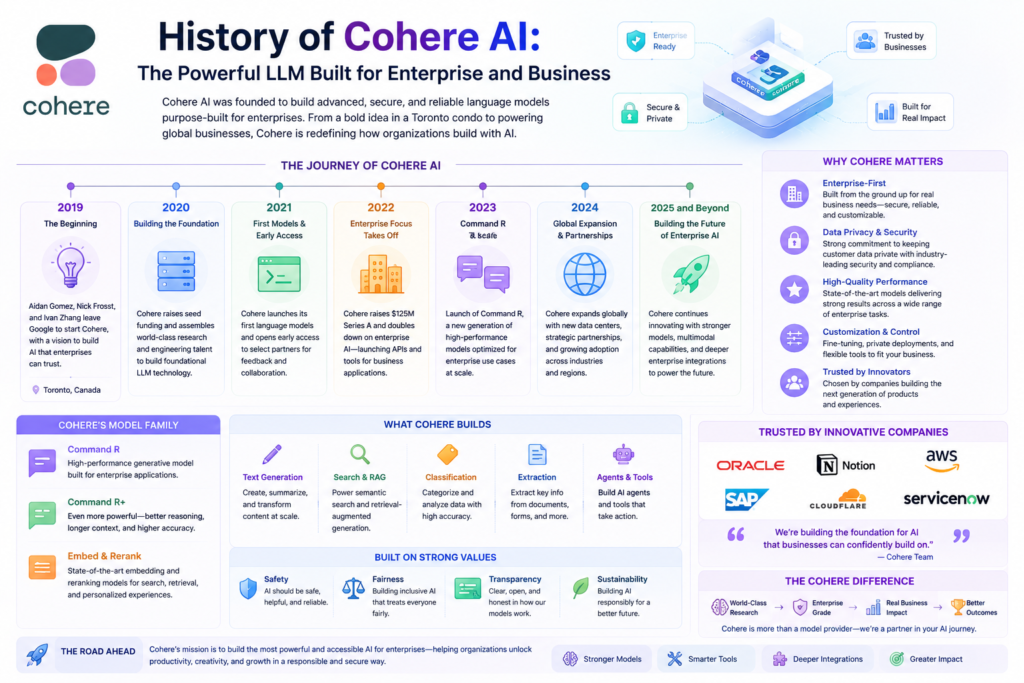
The cohere ai history begins in one of the most important rooms in modern AI research: the lab of Geoffrey Hinton at the University of Toronto. Hinton, who would go on to win the Nobel Prize in Physics in 2024 for his foundational contributions to deep learning, trained many of the researchers who went on to define the transformer era of AI. Among his students and collaborators were the three co-founders of Cohere: Aidan Gomez, Ivan Zhang, and Nick Frosst.
Aidan Gomez is arguably the most directly connected to the transformer revolution itself. He was one of the co-authors of the landmark 2017 paper “Attention Is All You Need,” published while he was an intern at Google Brain, which introduced the transformer architecture that now underlies virtually every major language model in existence. The attention is all you need paper that Gomez co-authored represents one of the most cited and consequential papers in the history of AI research, and having its co-author as Cohere’s CEO gave the company immediate research credibility that was difficult for any competitor to match.
Nick Frosst had also worked at Google Brain as a research scientist before co-founding Cohere. Ivan Zhang brought deep technical expertise in machine learning infrastructure and model deployment. Together, the three founding researchers had the combination of frontier model research experience and practical engineering knowledge that a company building large-scale AI infrastructure would need.
Cohere was founded in 2019, the same year that GPT-2 was generating controversy and the transformer era was just beginning to show its full potential. The founding team’s thesis was specific and clear from the start: enterprises needed access to large language models that they could control, customize, and deploy within their own infrastructure, and no existing provider was building for that market. The cohere ai history was set on its distinctive trajectory from day one.
Early Development and the Enterprise-First Philosophy (2019 – 2021)
The cohere ai history during its first two years was defined by building rather than launching. The team raised its first funding rounds, assembled a research and engineering team, and focused on developing the language model foundation that would underpin all future products. Unlike competitors who rushed to publish research papers or release public demos, Cohere moved deliberately toward building production-grade AI technology that enterprise customers could actually deploy.
The enterprise AI solutions philosophy that shaped Cohere’s early development reflected hard-won insights from the founding team’s time at large technology organizations. They understood that enterprises had requirements that consumer AI products simply did not address: data privacy, deployment flexibility, security compliance, customization depth, and reliability guarantees. Building for these requirements from the start rather than retrofitting them onto a consumer product was a core design principle of the cohere ai history.
The Cohere NLP platform that emerged from this early development phase was built on transformer-based AI from the foundation, leveraging the same architectural insights that Gomez had helped develop while at Google Brain. But the implementation choices reflected enterprise priorities rather than research ambitions: emphasis on reliability, latency, and the ability to fine-tune models on proprietary data within secure environments that kept customer data completely separate from Cohere’s training pipelines.
The AI startup ecosystem that Cohere was operating in during 2020 and 2021 was still dominated by research focus rather than enterprise deployment. OpenAI had released GPT-3 but was primarily offering API access to a general-purpose model with limited customization. Google’s language models were used internally but not yet offered as enterprise products. Cohere identified a genuine gap and moved deliberately to fill it.
The Command Models and Enterprise NLP Products (2021 – 2022)
The cohere ai history reached its first major public milestone with the development and release of its Command model family, designed specifically for enterprise text generation use cases. Unlike research models optimized for benchmark performance, Command was built to follow business instructions reliably and to integrate into enterprise workflows where consistent, predictable behavior mattered more than occasional brilliance.
The Cohere language models that emerged from this period were evaluated not primarily on academic benchmarks but on the practical tasks that enterprise customers needed to automate: document summarization, content generation, customer communication drafting, data extraction from unstructured text, and classification of business documents. These are unglamorous but extraordinarily valuable capabilities for large organizations that handle enormous volumes of text daily.
The Cohere AI development approach to fine-tuning was particularly significant for enterprise adoption. Cohere built fine-tuning as a core capability rather than an afterthought, allowing enterprise customers to adapt Command models to their specific terminology, style, and use cases using their own proprietary data. This approach addressed one of the most common complaints about general-purpose language models: that they produced generic outputs that did not match a company’s specific voice, format requirements, or domain knowledge.
The cohere ai history during this period also saw the development of Cohere’s embedding models, which convert text into dense vector representations that can be used for semantic search, document retrieval, and classification tasks. The Embed model family became one of Cohere’s most commercially successful products because it addressed a fundamental enterprise need: finding relevant information quickly within large document collections. This use case was foundational to what would later be called retrieval-augmented generation, and Cohere was building the infrastructure for it before the term had become widespread.
Cohere AI Funding and Growth to Billion-Dollar Valuation (2022 – 2023)
The cohere ai history in 2022 was marked by significant growth in both commercial traction and investor confidence. Cohere raised a Series B funding round of approximately 125 million dollars in 2022, with investors including Tiger Global, Radical Ventures, and Index Ventures. The Cohere AI funding trajectory reflected growing enterprise recognition that language models were becoming essential infrastructure rather than experimental technology.
The Cohere company growth through this period was driven by a specific commercial model that distinguished it from consumer AI competitors. Rather than pursuing advertising revenue or consumer subscriptions, Cohere focused on API-based pricing for enterprise customers, professional services for custom deployments, and cloud marketplace partnerships that made its models accessible through AWS, Google Cloud, and Azure. This approach aligned Cohere’s revenue directly with the value it delivered to business customers.
The Cohere AI milestones during 2022 and 2023 included partnerships with major enterprise technology companies and significant customer wins across financial services, healthcare, legal technology, and media. These industries shared a common characteristic: enormous volumes of text-based information that required intelligent processing, and regulatory and security requirements that made general-purpose consumer AI products unsuitable without significant additional work.
The Cohere AI timeline through this period shows a company that was consistently choosing depth over breadth, focusing on doing enterprise AI well rather than expanding into consumer markets or competing with OpenAI and Anthropic on benchmark performance headlines. This focus paid off as ChatGPT’s launch in November 2022 paradoxically helped Cohere by making large language model capabilities mainstream knowledge in every enterprise, while also demonstrating why many enterprises needed something more controlled than a public-facing chatbot.
The RAG Pioneer: Cohere’s Retrieval Innovation (2022 – 2023)
One of the most important contributions in the cohere ai history was the company’s early and deep focus on retrieval-augmented generation as a practical enterprise solution. While the concept of combining retrieval with language model generation had academic roots, Cohere was among the first AI companies to build this into a production-ready enterprise product.
The retrieval augmented generation rag approach that Cohere championed addressed the most fundamental challenge of deploying language models in enterprise contexts: the hallucination problem. Language models trained on general internet data had no knowledge of a company’s internal documents, policies, customer history, or proprietary information. And when asked about topics outside their training data, they would generate plausible-sounding but false information with dangerous confidence.
Cohere’s Embed models, combined with its Rerank models for improving retrieval precision, gave enterprise customers a complete stack for building retrieval-augmented systems: embed documents into a searchable vector index, retrieve relevant documents when a query arrives, and pass those documents to a language model as context for generating a grounded response. The Cohere AI evolution toward this RAG-first architecture was prescient, as retrieval-augmented generation became the dominant architecture for enterprise AI deployments across the industry.
The natural language AI infrastructure that Cohere built around RAG, including integrations with vector databases, document processing pipelines, and enterprise search systems, made it increasingly practical for large organizations to build AI systems that could answer questions about their own internal knowledge without the hallucination risks that plagued general-purpose models operating from parametric memory alone.
Command R and Cohere for Enterprise: The Mature Product (2024)
The cohere ai history reached a new level of sophistication in 2024 with the release of Command R and Command R+, models specifically optimized for retrieval-augmented generation at enterprise scale. The Command R models were designed from the ground up to work within RAG pipelines, producing responses that were tightly grounded in retrieved context rather than blending retrieved information with parametric memory in ways that could introduce hallucination.
The Cohere generative AI capabilities in Command R+ represented a significant advance in the company’s model performance, bringing Cohere’s enterprise-focused models into competitive territory with general-purpose frontier models on reasoning and generation tasks while maintaining the reliability and groundedness that enterprise deployments required. Command R+ demonstrated that the enterprise-first philosophy had not required sacrificing raw capability, but had rather forced the development of capabilities that were more practically useful for business applications.
The Cohere company history at this stage also reflected significant expansion in its cloud infrastructure partnerships. The availability of Cohere’s models through AWS Bedrock, Google Vertex AI, and Azure AI Studio gave enterprise customers flexibility in where they deployed AI workloads and allowed Cohere’s models to be embedded within existing enterprise cloud architectures without requiring new vendor relationships or complex integration work. These cloud AI services partnerships dramatically expanded Cohere’s market reach without requiring direct sales relationships with every potential customer.
Cohere’s valuation reached approximately five billion dollars by 2024 following further funding rounds, reflecting the market’s recognition of the genuine and growing demand for enterprise-grade language model infrastructure. The AI technology evolution from consumer chatbot to enterprise intelligence platform that Cohere had anticipated in 2019 had fully materialized, and the company was positioned at its center.
Cohere’s Position in the Broader AI Landscape
The cohere ai history exists within a competitive landscape that has become dramatically more crowded since the company’s founding. The large language models history shows how rapidly the field has expanded, with dozens of organizations now offering language model APIs and enterprise AI platforms. OpenAI, Anthropic, Google, and Meta all offer products that compete with aspects of Cohere’s platform, and the enterprise market that Cohere pioneered has attracted intense competitive attention.
Cohere’s enduring differentiators in this environment remain its enterprise-first design philosophy, its deployment flexibility including on-premises and private cloud options that larger competitors do not offer, its deep focus on retrieval-augmented generation as an enterprise architecture, and its research heritage connecting directly to the transformer architecture through Aidan Gomez’s co-authorship of the foundational 2017 paper.
The fine tuning in ai capabilities that Cohere has built into its platform remain among the most accessible and production-ready in the industry for enterprise customers, giving organizations that need domain-specific models a practical path to customization that does not require frontier model training budgets.
The future of AI in enterprise deployment will continue to be shaped by the tension between capability and control that Cohere has made central to its product philosophy. As AI systems take on more consequential business functions, the governance, reliability, and customization requirements that Cohere has built for will become more rather than less important. The cohere ai history suggests a company that has been on the right side of that trend throughout its development.
The llm timeline places the cohere ai history as one of the clearest examples of how the AI industry has bifurcated between consumer-facing generative AI and enterprise infrastructure AI, and how different the requirements, products, and business models are in each category.
FAQs
When was Cohere AI founded and who are its founders?
Cohere was founded in 2019 by Aidan Gomez, Ivan Zhang, and Nick Frosst, all of whom had backgrounds in deep learning research connected to Geoffrey Hinton’s lab at the University of Toronto. Aidan Gomez, who serves as CEO, was a co-author of the foundational 2017 transformer paper “Attention Is All You Need” while working as an intern at Google Brain. Nick Frosst was also a researcher at Google Brain before co-founding Cohere.
What makes Cohere different from OpenAI and Anthropic?
Cohere was built from the ground up for enterprise deployment rather than consumer use. Its models and platform are designed with enterprise requirements as the primary consideration: deployment flexibility including on-premises and private cloud options, deep fine-tuning capabilities for proprietary data, security and compliance features, and a focus on reliable, predictable behavior over maximum generative creativity. Cohere does not operate a consumer chatbot product and has focused exclusively on the business-to-business market since founding.
What are Cohere’s main products?
Cohere’s main products include the Command model family for text generation tasks, the Embed model family for semantic search and document retrieval, the Rerank model for improving search precision, and the Coral enterprise chat product for internal knowledge management. The company also offers fine-tuning as a service, allowing enterprises to adapt its models to specific domains and use cases using their proprietary data.
What is Cohere’s approach to retrieval-augmented generation?
Cohere has been one of the most committed advocates for retrieval-augmented generation as an enterprise AI architecture. Its Embed and Rerank models are specifically designed to be components of RAG pipelines, and its Command R and Command R+ models were optimized for working within RAG systems. The company argues that grounding language model outputs in retrieved, verifiable documents is essential for enterprise AI deployments where hallucination is unacceptable.
How much has Cohere raised and what is its valuation?
Cohere has raised multiple funding rounds including a Series B of approximately 125 million dollars in 2022 and subsequent rounds that brought the company’s total funding to over one billion dollars. By 2024, Cohere’s valuation was reported at approximately five billion dollars. The company’s investors include Tiger Global, Radical Ventures, Index Ventures, and strategic investors from the enterprise technology ecosystem.
Conclusion
The cohere ai history is a story about the power of a clear and consistent product philosophy held through years of industry turbulence. When the rest of the AI industry was chasing consumer adoption metrics and competing on general benchmark performance, Cohere stayed focused on building the infrastructure that enterprises actually needed to deploy AI reliably and at scale.
Cohere AI history reflects the vision of a founding team with direct roots in the research that created the transformer architecture, who understood from the beginning that frontier research and practical enterprise deployment required different designs, different priorities, and different business models. That insight proved correct. The enterprise AI market that Cohere identified in 2019 has grown dramatically, and the requirements that Cohere built for, reliability, customization, security, and retrieval-grounded generation, have become the standard expectations for enterprise AI deployments across the industry.
The cohere ai history is still being written. The competitive pressure from OpenAI, Anthropic, Google, and dozens of other providers will continue to intensify. But the foundation that Cohere built, enterprise-first design, RAG-optimized models, deployment flexibility, and research credibility that traces back to the transformer paper itself, gives the company a position in the enterprise AI landscape that is meaningful, defensible, and deeply relevant to where the market is heading.