For centuries, agriculture and natural philosophy operated under a heavy cloud of confusion regarding how complex combinations of traits were transmitted across generations. When a farmer crossed a fast growing animal with a disease resistant one, the results were entirely unpredictable. The common assumption of the nineteenth century was that parental characteristics were permanently bound together in fixed, unalterable packages. This deeply flawed understanding completely dissolved when an analytical Augustinian friar brought structured physical and mathematical models into the natural sciences. Through his masterful work, he formulated the law of independent assortment, a profound principle of transmission genetics that proved traits shuffle and recombine with total independence.
By showing that the inheritance of one physical characteristic has absolutely no influence on the inheritance of another, this timeless rule exposed the secret mechanisms of biological variation. The discovery of the law of segregation had already explained how single traits split apart, but it was the law of independent assortment that explained how multiple, distinct traits mix and match to create the endless variety of life. To fully appreciate this triumphant leap in human knowledge, we must examine the brilliant multi-trait experiments, the algebraic probability laws, and the beautiful cellular mechanics that make this principle a true cornerstone of modern biology.
Expanding the Horizons of Multi-Trait Inheritance (1856 – 1863)
Mendel began his scientific journey with a clear, ambitious goal: to map out the exact mathematical rules that govern how multiple distinct variations travel together through living systems. To achieve this, he turned to the mendel pea plant experiments, using a small, sunlit monastery garden plot as his computational laboratory. He spent years tracking single characteristics, but he knew that real organisms are complex matrices of many traits. He needed to find out if different physical characteristics were bound together like standard baggage or if they moved entirely on their own.
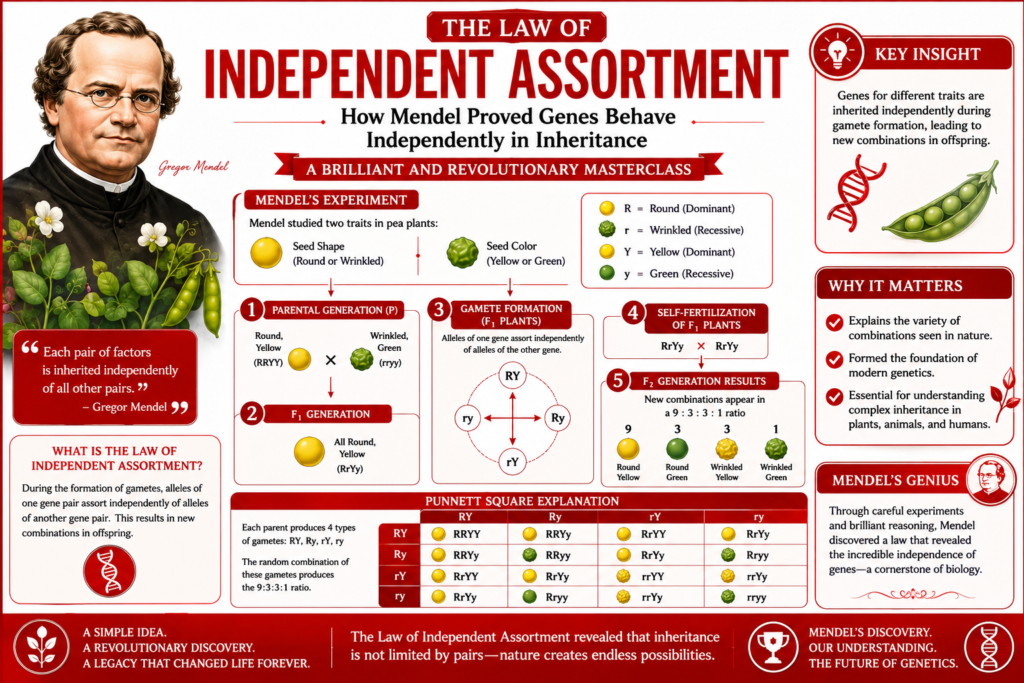
[ Pure Round, Yellow Seed (RRYY) ]  x  [ Pure Wrinkled, Green Seed (rryy) ]
                                    │
                                    ▼
                [ All Offspring Round, Yellow (RrYy) ]
To answer this question, he moved past the simple monohybrid cross and designed a highly structured dihybrid cross. This advanced experimental framework involved tracking two entirely separate pairs of dominant and recessive traits simultaneously across multiple generations. He chose two easily identifiable seed characteristics: seed shape (smooth, round versus rough, wrinkled) and seed color (bright yellow versus pale green). He spent considerable time cultivating pure-breeding lines, ensuring that his starting plants were perfectly homozygous for both chosen characteristics.
The Perfect Uniformity of the First Hybrid Generation
To kickstart his multi-trait tracking, Mendel cross-pollinated a pure-breeding plant that produced smooth, round, yellow seeds with a pure-breeding plant that produced rough, wrinkled, green seeds. Under the popular theories of his time, the traits should have remained permanently locked in their original parental combinations, or they should have blended into a muddy, intermediate form of bumpy, greenish-yellow seeds.
Instead, the results perfectly matched the law of dominance on a larger scale. Every single plant in this first filial generation produced seeds that were completely smooth, round, and yellow. The wrinkled and green variations seemed to have vanished from the lineage altogether. This outcome proved that both dominant traits successfully masked their recessive counterparts when combined in a heterozygous state. However, the real mystery remained unsolved: were the genes for roundness and yellowness now permanently glued together because they came from the same parent, or were they still independent entities operating under separate rules?
The Triumphant Reappearance of Recombinant Phenotypes
To solve this mystery, Mendel allowed the first generation of double-hybrid plants to self-pollinate naturally, raising a large second generation of offspring. When he harvested and sorted the resulting seeds, he discovered something extraordinary that shocked the biological community of his era. He did not just find the original parental combinations of round yellow seeds and wrinkled green seeds. Instead, entirely new variations, known as recombinant phenotypes, emerged from the crop.
First Generation Hybrids (RrYy)  ──► Self-Pollinate
                                      │
                                      ▼
                        Second Generation Breakdown:
                         9 Round, Yellow  : 3 Round, Green
                         3 Wrinkled, Yellow : 1 Wrinkled, Green
He discovered round green seeds and wrinkled yellow seeds growing side by side on the exact same plants. The traits had detached themselves from their original partners and mixed into completely fresh configurations. This critical observation provided the initial proof for the law of independent assortment, demonstrating that individual characteristics are not dragged along by other traits. They are free agents in the grand game of genetic transmission.
Decoding the Mathematical Architecture of the 9:3:3:1 Ratio
To solidify his observations into an enduring scientific law, Mendel turned to his rigorous training in probability theory and the mathematics of heredity. He painstakingly counted a total of 556 seeds from his second generation dihybrid crop, cataloging them into four distinct physical categories. His raw experimental data revealed a highly specific distribution:
- 315 seeds: Smooth, round, and yellow
- 108 seeds: Smooth, round, and green
- 101 seeds: Rough, wrinkled, and yellow
- 32 seeds: Rough, wrinkled, and green
To uncover the hidden order within these large numbers, he divided each count by the smallest population of 32 seeds. This mathematical reduction yielded an elegant phenotypic ratio:
32315≈9.8432108≈3.38
32101≈3.16
3232=1
This breakdown simplifies directly to the famous 9:3:3:1 phenotypic ratio. He realized that this complex multi-trait pattern was actually the mathematical result of two completely separate 3:1 ratios multiplying together. Because the traits segregated independently, he could use the product rule of probability to calculate the combined outcomes. By multiplying the independent probabilities of seed shape and seed color, the underlying algebraic structure becomes perfectly clear:
(3 Round+1 Wrinkled)×(3 Yellow+1 Green)=9 Round Yellow+3 Round Green+3 Wrinkled Yellow+1 Wrinkled Green
This elegant formula proved that multi-trait breeding rules are governed by the law of independent assortment, showing that the inheritance of one gene is an independent mathematical event that does not impact any other gene.
The Formal Law of Independent Assortment Definition
Based on these flawless statistical patterns, the brilliant friar formulated his second major principle of heredity. The formal law of independent assortment definition states that the alleles for two or more different genes separate completely independently of one another during the formation of reproductive cells. An allele passed down for a specific seed shape has absolutely zero statistical correlation with which allele is passed down for seed color.
When an organism forms its gametic combinations, the distribution of its maternal and paternal genes occurs by random chance. This independent segregation ensures that every individual reproductive cell receives a completely unique, randomized mix of genetic factors. This constant gene shuffling mechanics serves as the primary driver for generating vast genetic variation in gametes, ensuring that no two offspring are ever truly identical unless they share the exact same zygotic origin.
                     Allele Pair 1: R and r
                     Allele Pair 2: Y and y
                               │
            ┌──────────────────┴──────────────────┐
            ▼                                     ▼
   Gamete Combo A: R with Y              Gamete Combo B: R with y
   Gamete Combo C: r with Y              Gamete Combo D: r with y
The Structural Basis of Assortment in Meiosis Dynamics
Mendel derived the law of independent assortment purely through mathematical analysis of pea counts, but twentieth century cellular biology eventually uncovered the physical, structural basis of this law inside the dividing cell. This independent alignment occurs during the elegant dance of meiosis, the specialized process of cell division that reduces diploid chromosome numbers down into haploid gametes.
     Non-Homologous Pairs Align Randomly (Metaphase I)
                            │
                            ▼
     Chromosomes Pull Apart Independently (Anaphase I)
                            │
                            ▼
          [ Randomized Gametic Combinations ]
During the first phase of this division, specifically metaphase I chromosome orientation, non-homologous chromosomes line up along the center of the cell in matching pairs. The physical orientation of these chromosome pairs is completely random. A maternal chromosome might face the left side of the cell for one pair, while facing the right side for another.
When the cell pulls these pairs apart during anaphase, the separation of one set of chromosomes has no physical connection to the separation of any other set. This structural behavior ensures that unlinked genes inheritance behaves exactly like flipping independent coins, matching the mathematical predictions Mendel calculated decades earlier in mendel’s garden.
Modern Exceptions to Mendel’s Second Law
While the law of independent assortment serves as a brilliant baseline for complex inheritance, modern genomics has uncovered important exceptions to Mendel’s second law that occur due to chromosome structure. The most notable exception is a phenomenon known as genetic linkage.
Mendel was incredibly fortunate because the seven traits he tracked were located either on entirely separate chromosomes or far apart on the same chromosome, allowing them to segregate independently. However, when two different genes are located in close locus proximity on the exact same physical chromosome, they tend to travel together during cell division. These linked genes do not assort independently unless a physical break, known as chromosomal crossing over, occurs between them during meiosis.
The crossover frequency between two linked genes depends entirely on how close they are to one another. If they are right next to each other, they will rarely separate, disrupting the classic 9:3:3:1 ratio and producing a higher percentage of original parental combinations over recombinant phenotypes. Discovering these exceptions did not destroy Mendel’s work; instead, it provided the direct gene mapping foundations that allowed modern scientists to locate specific genes across entire chromosomes.
FAQs
What is the simple definition of the law of independent assortment?
The law of independent assortment states that the alleles for different traits separate completely independently of one another during the creation of reproductive cells, meaning the inheritance of one characteristic does not affect another.
What is the main difference between the first and second laws of Mendel?
The first law, the law of segregation, explains how the two alleles of a single gene split apart during reproduction. The second law describes how the alleles of multiple, separate genes separate without influencing each other.
What are the main exceptions to the law of independent assortment?
The primary exception is genetic linkage, which occurs when two genes are located close together on the same chromosome. These genes tend to be inherited together, breaking the standard independent assortment rules.
How does independent assortment contribute to evolution?
It drives evolution by constantly shuffling alleles into completely new combinations during reproduction. This massive genetic variation gives natural selection a diverse pool of traits to act upon, helping species adapt over time.
The Eternal Triumph of Independent Assortment
The rediscovery of Mendel’s work in the year 1900 fundamentally shifted the trajectory of science, bridging the massive gap between raw descriptive biology and modern molecular genomics. By proving that multiple traits split, shuffle, and recombine through clear, independent mathematical rules, his work provided the necessary framework for evolutionary biology basics and the modern synthesis. Today, every advanced discovery in genetics—from tracking complex polygenic traits like height and heart disease to mapping entire genomes—rests on the principles of random assortment he uncovered. Through creative genius, relentless focus, and unmatched experimental discipline, Gregor Mendel predicted modern genetics with breathtaking accuracy, leaving behind an immortal legacy that will guide human discovery for centuries to come.