For thousands of years, humanity viewed the passing of traits from parents to offspring as a mysterious, unpredictable phenomenon. Farmers and naturalists observed patterns, but they lacked the analytical tools to define exactly how specific characteristics were transmitted. This deep biological confusion vanished when a meticulous Augustinian monk turned his attention to the humble pea plant. Through his monohybrid cross experiments, he stripped away the complexities of life to focus on a single variable, effectively decoding the secret language of biology. This elegant approach allowed him to formulate the fundamental laws governing how traits are passed down, providing the bedrock upon which modern genetic science now rests.
By isolating a single characteristic—such as stem length or seed color—and tracking it through multiple generations, he revealed that inheritance is not a chaotic blending process. Instead, it is a highly orderly system driven by distinct, unchangeable units. The monohybrid cross serves as the perfect starting point for anyone seeking to understand the foundational principles of genetics. To fully appreciate this breakthrough, we must examine the experimental steps, the mathematical models, and the clear biological outcomes that demonstrate why his findings remain the most important discovery in the history of life sciences.
The Strategic Planning of Controlled Breeding (1856 – 1858)
The foundation of his success was a deliberate, highly structured experimental design. He understood that to identify a clear rule, he had to eliminate all external variables that might influence the results. He dedicated his initial efforts to selecting pure-breeding ancestors, which are plants that consistently produce offspring identical to themselves generation after generation. This rigorous preparation ensured that any variation observed in his offspring could be traced back to his specific, intentional crosses.
He spent years verifying that his true-breeding strains were stable before ever initiating a formal monohybrid cross. During this time, he carefully avoided any accidental pollination by insects or wind. By physically removing the pollen-producing stamens from the flower buds of his chosen plants, he ensured that he was the only one selecting the parentage of every single seed. This absolute control over cross-pollination mechanics is exactly why mendel pea plant experiments yielded such clean, undeniable empirical data. He was the architect of a new scientific discipline, applying the same precision used by physicists to the living world of botany.
Tracking Traits from the P Generation to F1 (1858 – 1859)
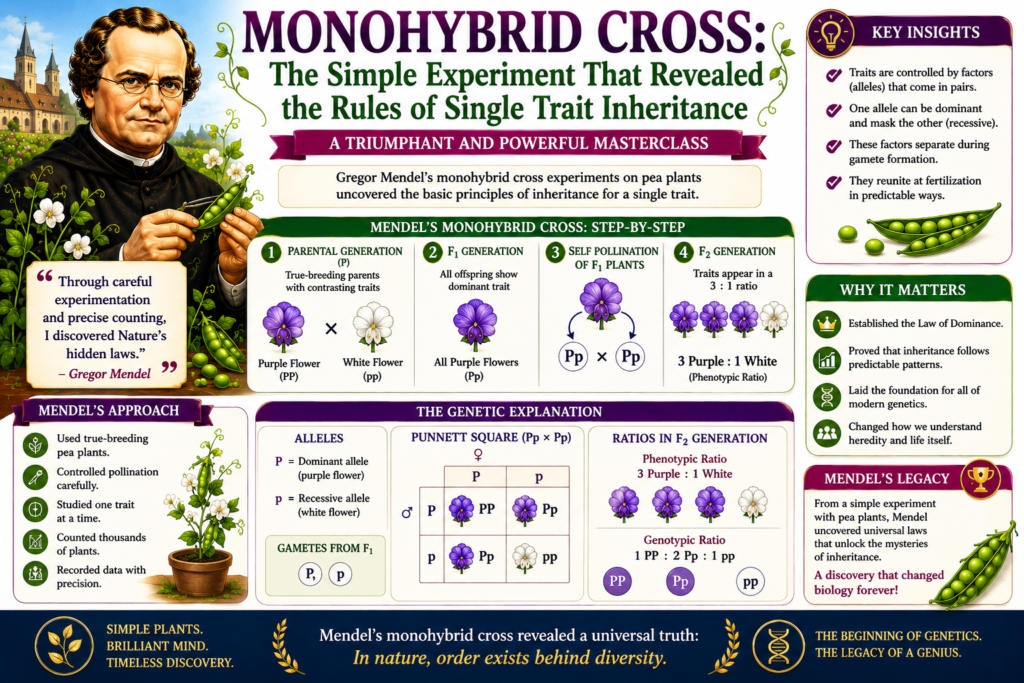
The first step in a monohybrid cross involves mating two pure-breeding individuals that carry contrasting forms of a single trait. In genetic terminology, these parents are known as the P generation, or the parental generation. For example, he crossed a pure-breeding tall plant with a pure-breeding short plant. Under the popular “blending theory” of the 19th century, scientists expected the offspring to grow to an intermediate, medium height.
However, the results were entirely different. Every single plant in the first filial generation, or F1 generation, grew to be perfectly tall. The short characteristic seemed to have completely vanished from the population. This observation was the first piece of evidence for the law of dominance, which explains why some traits take center stage while others remain hidden. In this case, the allele for tallness was dominant, while the allele for shortness was recessive. The F1 hybrids were not a blend of their parents; they were tall plants carrying a hidden instruction for shortness deep within their genetic blueprint.
Unveiling the Second Generation Patterns (1860 – 1863)
The true genius of the monohybrid cross methodology appeared when he allowed the F1 hybrid plants to self-fertilize naturally. If the short trait had truly been destroyed, it would never appear again. Yet, when he grew the second filial generation, or F2 generation, the short characteristic returned perfectly intact. This reappearance proved that the hidden information was neither destroyed nor modified; it was simply waiting for the right allele combination to resurface in the next generation.
To make sense of these physical results, he utilized a formal tracking system for his observations. He counted every single plant and every single seed. He discovered that the visible appearance, or phenotype, consistently followed a predictable mathematical path. Whenever he tracked a trait across a large sample size, he arrived at the famous mendel 3 to 1 ratio. For every three tall plants, there was exactly one short plant. This was not a coincidence; it was a clear sign that inheritance was governed by precise, predictable mathematical laws.
The Mathematical Engine behind the Ratio
To explain why his plants always adhered to this pattern, he developed an algebraic model that stands as a pillar of the mathematics of heredity. He proposed that each plant possesses two alleles for each characteristic. Let T represent the dominant allele for tallness and t represent the recessive allele for shortness. When he crossed his pure-breeding parents, the offspring inherited one T from the tall parent and one t from the short parent, resulting in a genotype of Tt.
When these Tt hybrids self-fertilized, the combination of their gametes could be modeled using a standard binomial expansion:
(T+t)(T+t)=T2+2Tt+t2
This simple algebraic equation perfectly describes the genetic reality hidden beneath the visible appearance:
- 1 part TT (Homozygous Dominant): Visually tall
- 2 parts Tt (Heterozygous): Visually tall, but carrying the hidden short allele
- 1 part tt (Homozygous Recessive): Visually short
This explains why the physical monohybrid cross results in a 3:1 ratio of tall to short, even though the underlying genotypes follow a 1:2:1 ratio. The monohybrid cross was the first time a scientist successfully used simple algebraic rules to predict the outcome of biological reproduction.
Mastering the Punnett Square and Genotypic Ratios
The modern way to visualize a monohybrid cross is through a Punnett square, a simple grid that displays the probability of each allele combination. By placing the gametes of the parents on the top and side of the grid, we can easily see the four potential offspring genotypes.
                  Gametes from Parent 1 (T or t)
                  +-----+-----+
                  |  T  |  t  |
            +-----+-----+-----+
  Gametes   |  T  | TT  | Tt  |
  from      +-----+-----+-----+
  Parent 2  |  t  | Tt  | tt  |
  (T or t)  +-----+-----+-----+
This grid highlights that the chance of any single offspring being TT is 25%, the chance of being Tt is 50%, and the chance of being tt is 25%. Because both TT and Tt look identical as tall plants, the observer only sees the 75% tall and 25% short ratio. This predictability is the hallmark of single trait inheritance, showing how allele combinations dictate the physical appearance of the next generation.
FAQs
What exactly is a monohybrid cross?
A monohybrid cross is a mating experiment between two organisms that differ in only one specific trait. By focusing on a single characteristic, researchers can isolate the inheritance pattern of that specific gene without the confusion of other variables.
What is the difference between a genotype and a phenotype?
The genotype is the internal genetic makeup or the specific combination of alleles, such as Tt or TT. The phenotype is the physical, observable characteristic that results from the genotype, such as being tall or short.
Why do recessive traits skip generations?
Recessive traits skip generations because they are masked by dominant alleles in the heterozygous state. They only become visible in the phenotype when an individual inherits two recessive alleles, one from each parent, effectively removing the dominant influence.
How does this cross relate to the three laws of inheritance?
The monohybrid cross provides the foundational data for the law of segregation, which states that the two alleles for a trait separate into different gametes during reproduction. This separation is what ensures that traits can reappear in later generations with mathematical accuracy.
The Immortal Legacy of the Monohybrid Experiment
The analytical methods developed through his early work transformed biology from a field of descriptive anecdotes into a quantitative science. While the scientific community of his day remained slow to recognize his contributions, the later rediscovery of his work proved that he had accurately mapped the fundamental rules of heredity decades ahead of his time. By stripping away complexity and tracking single traits with total focus, he provided a clear, logical pathway for all future discoveries—from the identification of chromosomes to the complex world of from mendel to DNA.
The clarity of the monohybrid cross remains a standard tool for understanding the basics of transmission genetics. It teaches us that diversity in nature is not the result of random chance, but of elegant, underlying patterns. Through his dedication to collecting and analyzing massive amounts of data, Gregor Mendel predicted modern genetics with breathtaking precision. His work stands as a testament to the power of structured thinking, proving that even the most complex mysteries of life can be decoded by a simple, carefully designed experiment that asks the right questions at the right time.