When Johann Gregor Mendel began working in his modest monastery garden, the scientific community believed that biological inheritance was an completely unpredictable web of blended traits. It was generally assumed that physical characteristics from parents mixed like paints in a cup, making it impossible to separate individual features once they combined. After establishing the groundwork of single trait inheritance using a simple monohybrid cross, Mendel realized he needed to test if different physical characteristics influenced one another during reproduction. To solve this mystery, he designed the dihybrid cross, a sophisticated breeding experiment that simultaneously tracked two completely different characteristics across multiple generations.
This advanced scientific approach was truly revolutionary because it challenged the long held belief that certain traits were permanently linked together. By focusing on non-linked gene tracking, Mendel sought to discover whether the physical shape of a seed had any operational influence over its color. The historical results of this investigative journey forever changed the landscape of modern biology, establishing the universal rules of multi-trait genetic probability. Through an elegant blend of botany and mathematical ratios, his dihybrid cross experiment provided the definitive empirical proof that independent factor pairs segregate with total freedom, delivering an ultimate conceptual breakthrough for biological science.
Moving Beyond Single Trait Inheritance (1860 – 1861)
Before launching into complex plant breeding crosses, Mendel had already achieved massive clarity by tracking one genetic characteristic at a time. His earlier experiments with green and yellow seeds had successfully proven the law of dominance and established that individual genetic factors separate cleanly during the creation of reproductive cells. However, a major critical question remained completely unanswered: did the inheritance of one specific trait automatically dictate the inheritance of another? For instance, were round seeds always bound to be yellow, or could nature separate these two visible characteristics?
To answer this question with total scientific certainty, Mendel initiated a formal dihybrid cross explained step by step through his research logs. He selected two distinct structural features of the garden pea plant to track simultaneously: seed shape and seed color. For his starting materials, he gathered true-breeding strains that displayed completely opposite variations for both chosen traits. One parent strain consistently produced round and wrinkled seeds that were smooth and yellow, while the other parent strain exclusively yielded wrinkled and green seeds. By choosing two completely independent physical characteristics, he constructed a perfect laboratory baseline to observe how multiple genetic factors interact when forced together.
Building the First Hybrid Generation (1861 – 1862)
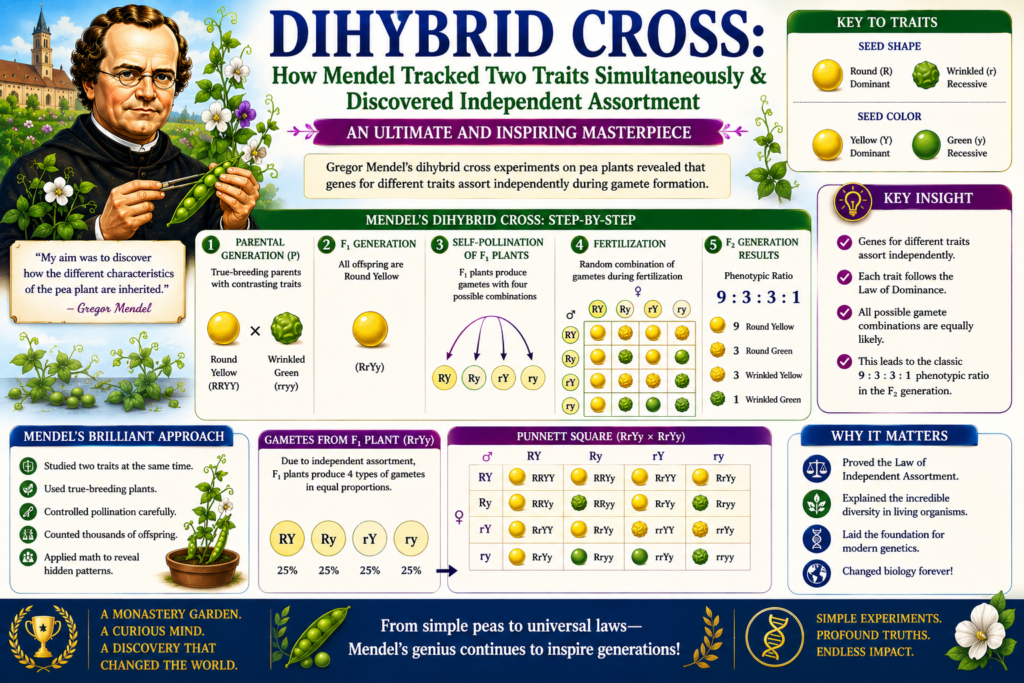
The execution of a proper dihybrid cross begins by cross-pollinating these two pure-breeding parental lines, known to modern geneticists as the P generation. One parent carried the homozygous dominant traits for both features, while the other carried the homozygous recessive traits. Mendel carefully performed the delicate cross-pollination mechanics, transferring pollen by hand from the wrinkled green flowers directly onto the stigmas of the round yellow flowers after removing their immature stamens to prevent any self-fertilization.
[ P Generation Cross ]
Round Yellow Parent (RRYY)  x  Wrinkled Green Parent (rryy)
                               │
                               ▼
                 All F1 Offspring: Round Yellow (RrYy)
When the resulting seeds were harvested and classified, the F1 and F2 generation results began to tell a fascinating story. Every single seed in the first filial generation, or F1 generation, grew to be completely round and yellow. The physical traits of wrinkledness and greenness had completely vanished from sight. This uniform outcome confirmed that round shape (R) is fully dominant over wrinkled shape (r), and yellow color (Y) is fully dominant over green color (y). The resulting F1 plants were all dihybrids, meaning they were heterozygous for both distinct genes, holding the hidden allele combinations (RrYy) within their internal genetic blueprint.
The F2 Generation and the Recombination of Traits
The real magic of the dihybrid cross unfolded when Mendel allowed these round yellow F1 hybrid plants to self-pollinate naturally. If the hidden traits had been permanently modified or linked to their dominant partners, the second filial generation, or F2 generation, would simply repeat the parental patterns. However, when Mendel opened the mature pods of the F2 crops, he discovered a beautiful, complex variety of seeds that completely shattered old biological theories.
The 16-Square Dihybrid Cross Grid. Source: ALI DAMOUH/SCIENCE PHOTO LIBRARY / Getty Images
Instead of just showing the original parental combinations, the F2 population displayed four distinct phenotypes. Alongside the expected round yellow and wrinkled green seeds, Mendel discovered completely new variations that had never existed in the ancestral lines: round green seeds and wrinkled yellow seeds. This surprising recombination of traits proved that the genetic factors controlling seed shape were traveling completely independently from the factors controlling seed color. The two-gene cross analysis demonstrated that nature splits and mixes different physical traits with total freedom during reproduction.
Mapping the 16-Square Punnett Diagram
To systematically organize and understand these multi-trait genetic probability outcomes, modern scientists utilize a 16-square Punnett diagram. This visual grid charts all the potential combinations of gametes that can form when a dihybrid plant reproduces. Because the traits are not linked, each parent plant produces four unique types of reproductive cells with equal frequency: RY, Ry, rY, and ry.
When these four maternal gametes match up against the four paternal gametes across the grid, they generate a total of sixteen dihybrid genotypic combinations. This matrix allows researchers to perform precise genetic variance calculations, mapping exactly how often specific genotypes will translate into visible physical features. As seen in the diagram above, counting the resulting variations reveals an elegant mathematical distribution that forms the core of classical transmission genetics.
The Mathematics of Independent Assortment
Mendel was a master of the mathematics of heredity, and his ability to analyze massive sample sizes allowed him to see past the surface chaos of biological variations. For this specific dual trait experiment, he counted an incredible total of 556 individual F2 seeds from his plant breeding experiments. He systematically sorted his harvest into four clean categories based on their physical appearance:
- Round and Yellow seeds: 315 individuals
- Round and Green seeds: 108 individuals
- Wrinkled and Yellow seeds: 101 individuals
- Wrinkled and Green seeds: 32 individuals
To find the hidden mathematical rule connecting these real-world counts, Mendel divided the number of individuals in each category by the lowest recorded value, which was 32:
32315≈9.8432108≈3.38
32101≈3.16
3232=1
These empirical proportions reveal the legendary 9:3:3:1 formula that defines the dihybrid phenotypic outcomes. Mendel recognized that this distribution was actually the direct result of two independent genetic independent events occurring simultaneously. By treating each characteristic as a separate event, he could apply the mathematical multiplication rule to predict the final multi-trait offspring.
If you analyze seed shape entirely on its own, the ratio of round seeds to wrinkled seeds simplifies back to the classic mendel 3 to 1 ratio:
Round=315+108=423Wrinkled=101+32=133
133423≈3.18≈3:1
Similarly, tracking seed color on its own yields the exact same basic distribution:
Yellow=315+101=416Green=108+32=140
140416≈2.97≈3:1
Because these two characteristics behave independently, the final four distinct phenotypes are simply the mathematical product of monohybrid crosses multiplied together:
(3 Round+1 Wrinkled)×(3 Yellow+1 Green)
Multiplying this algebraic statement step by step yields the full dihybrid distribution:
3×3=9 Round Yellow
3×1=3 Round Green
1×3=3 Wrinkled Yellow
1×1=1 Wrinkled Green
This stunning mathematical harmony led directly to the formulation of the law of independent assortment. It proved with flawless clarity that the inheritance pattern of one gene has absolutely zero structural impact on the inheritance pattern of another gene.
FAQs
What is a dihybrid cross and how does it differ from a monohybrid cross?
A dihybrid cross is a controlled breeding experiment that tracks the inheritance patterns of two completely different traits at the exact same time. It differs from a monohybrid experiment because it studies two genes simultaneously rather than isolating just one single characteristic.
What is the significance of the 9:3:3:1 ratio?
The 9:3:3:1 ratio is the classic phenotypic distribution that appears in the F2 generation of a dihybrid cross when both traits are controlled by non-linked, independently assorting genes. It represents 9 dominant-dominant, 3 dominant-recessive, 3 recessive-dominant, and 1 recessive-recessive individual out of every 16 offspring.
What does the law of independent assortment actually state?
Formulated during the historic three laws of inheritance research era, this law states that alleles for different traits are distributed into reproductive gametes completely independently of one another. In simple terms, inheriting a specific variant for one feature does not increase or decrease the mathematical probability of inheriting a specific variant for another feature.
How can a researcher verify the true genotype of an F2 dihybrid plant?
To confirm the exact internal allele combination of a dominant-looking plant, geneticists use a specialized testcross for two genes. This involves mating the mystery plant back to a homozygous recessive individual (rryy). If any wrinkled or green offspring appear in the resulting clutch, it proves the parent plant was heterozygous rather than homozygous dominant.
The Timeless Scientific Triumph of Mendel’s Dual-Trait Vision
Mendel’s advanced Mendelian crosses did far more than simply explain how pea plants manage the shape and color of their seeds. By applying strict mathematical rules to the tracking of multiple traits at once, he established a complete structural system for predicting multi-trait offspring across all sexually reproducing organisms. His unique ability to look past the superficial variations of his crops and see the underlying algebraic harmonies allowed him to construct a model that continues to form the core of modern genetics.
While the naturalists of the 19th century completely missed the profound value of his work, the dramatic rediscovery of his papers at the turn of the century cemented his place in history. The elegant dihybrid cross remains an essential instructional tool in modern classrooms, beautifully illustrating the mathematical order that governs biological diversity. Through unmatched experimental discipline, flawless quantitative tracking, and brilliant algebraic modeling, Gregor Mendel predicted modern genetics with shocking precision, providing humanity with the foundational keys needed to unlock the deepest secrets of life.