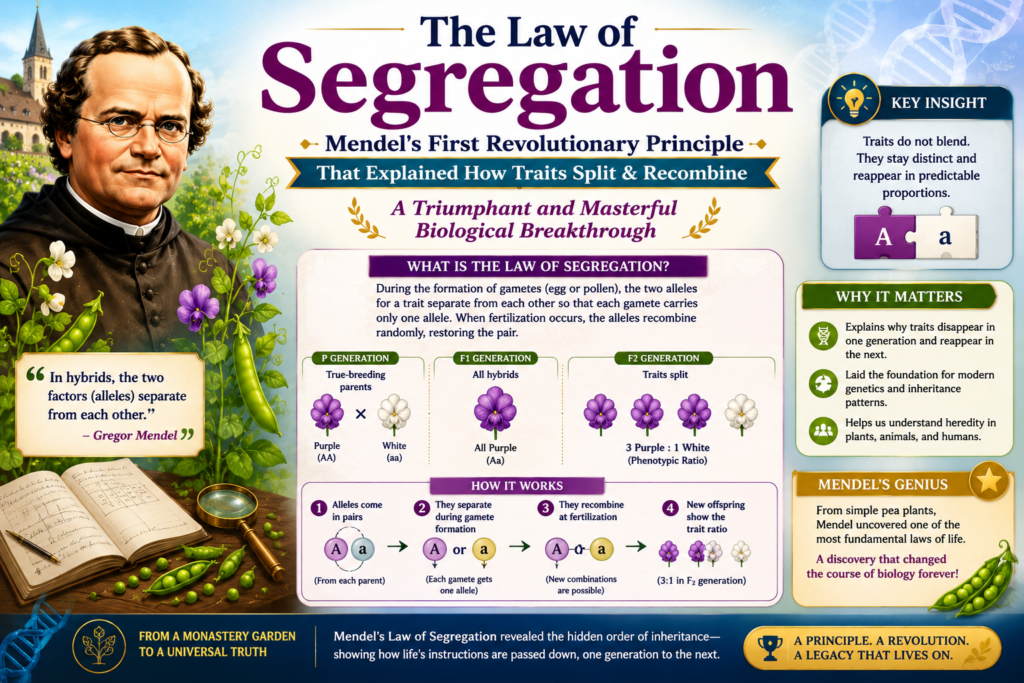
For generations, the mechanism of biological inheritance remained shrouded in deep mystery, leaving ancient farmers and 19th-century biologists alike baffled as to how physical characteristics traveled from parents to offspring. The popular belief of the era was that parental traits blended like liquids, combining smoothly to create an intermediate mix. This unscientific assumption completely collapsed when an analytical Augustinian monk named Gregor Mendel applied strict physical and mathematical models to the natural world. His painstaking observations revealed the law of segregation, the first true pillar of transmission genetics that completely transformed our understanding of how traits split and recombine.
By proving that hereditary factors remain discrete, individual particles rather than blending together, this foundational rule explained how long-lost ancestral traits could suddenly reappear in a later generation completely unaltered. The discovery of the law of segregation marked a major turning point in human knowledge, shifting the study of biology from loose description to precise, mathematical prediction. To fully grasp this magnificent breakthrough, we must examine the brilliant experimental design, algebraic clarity, and cellular mechanisms that make this principle a timeless masterpiece of science.
The Masterful Foundations of Single-Trait Inheritance (1856 – 1863)
Mendel began his investigation with a clear purpose: to find a predictable mathematical pattern in how variations pass down through living things. To achieve this, he initiated the mendel pea plant experiments, transforming a small garden plot at St. Thomas’s Abbey into a cutting-edge laboratory. He chose the garden pea, Pisum sativum, because it allowed for complete experimental control, produced large numbers of offspring, and possessed clear, alternative forms of a gene that were easily tracked.
[ Pure-Breeding Round Seed (RR) ]  x  [ Pure-Breeding Wrinkled Seed (rr) ]
                                   │
                                   ▼
                   [ All Offspring Round (Rr) ]
He focused his attention on single-trait inheritance law, intentionally looking at only one specific pair of contrasting characteristics at a time. He carefully cultivated pure-breeding lines, ensuring that plants with a specific trait, such as round seeds or tall stems, always produced identical offspring across multiple generations. Once these stable lines were established, he performed a structured monohybrid cross, mating two pure-breeding plants with opposing features. His goal was to see exactly what happens to a trait when it encounters its biological opposite.
Tracking the Disappearing Act in the First Generation
The initial results of his cross-pollination experiments directly challenged the popular blending ideas of his time. When he crossed a pure-breeding plant with smooth, round seeds with a plant carrying rough, wrinkled seeds, the resulting offspring did not develop slightly bumpy or intermediate seeds. Instead, every single plant in this first filial generation produced perfectly smooth, round seeds.
First Generation Hybrids (Rr)  ──► Self-Pollinate
                                    │
                                    ▼
                     Second Generation (F2) Breakdown:
                     3 Parts Round  :  1 Part Wrinkled
The wrinkled characteristic appeared to have vanished from existence. To explain this phenomenon, he formulated the law of dominance, which states that when two different internal factors are present, one dominant trait will completely mask a recessive trait. The hidden trait was not ruined or altered; it was simply resting beneath the surface, waiting for the perfect biological conditions to show itself again. He realized that diploid organisms carry two copies of every hereditary factor, even if only one copy is visible in their physical appearance.
The Triumphant Reappearance and the Mathematical Ratio
Mendel did not stop his experiment with the first generation of hybrids. He allowed these smooth-seeded plants to self-pollinate naturally, raising a large second generation to see if the wrinkled trait was gone forever. When he gathered and sorted the seeds of this new generation, he witnessed a biological miracle: the wrinkled trait reappeared perfectly intact, showing no signs of blending or structural degradation.
To understand this unexpected mendel 3 to 1 ratio, he turned to the precise mathematics of heredity. He painstakingly counted every single seed from his crops, compiling a massive amount of experimental data. For seed shape, he recorded 5,474 round seeds and 1,850 wrinkled seeds in the second generation. By dividing the dominant population by the recessive population, he uncovered an elegant mathematical relationship:
18505474=2.96≈3
This calculation yielded a nearly perfect 3:1 ratio. He observed this exact same mathematical consistency across all seven characteristics he studied, such as yellow versus green seeds, which produced 6,022 yellow and 2,001 green seeds:
20016022=3.01≈3
This mathematical consistency proved that the splitting of hereditary factors was guided by precise rules of probability. He realized that the two gene copies separation must occur cleanly and equally during reproduction, allowing individual traits to split up and recombine in predictable patterns.
Formulating the Law of Segregation Definition
Based on these flawless mathematical patterns, Mendel formulated his first revolutionary principle. The law of segregation states that every individual organism contains two distinct alleles for each gene, inheriting one from each parent. During the critical biological process of gamete formation genetics, these two alleles separate, or segregate, completely from each other. As a result, each individual haploid gamete, such as sperm and egg cells, receives only one copy of the gene.
When fertilization occurs, the random fertilization of these gametes brings two alleles back together, forming a new diploid individual. If a heterozygous individual carries two different alleles, those alleles remain independent and pure inside the cell. They do not dilute, change, or influence each other during the lifespan of the organism. This clean, unblended separation of alleles guarantees that genetic variation is preserved across generations, providing a solid genetic blueprint foundation for all complex life.
The Algebraic Equation of Genetic Recombination
To illustrate the mathematical beauty of the law of segregation, we can model the behavior of a monohybrid cross using structured algebraic expressions. Let R represent the dominant allele for a round seed shape, and let r represent the recessive allele for a wrinkled seed shape.
The first generation of hybrids is entirely heterozygous (Rr), meaning every plant carries one dominant allele and one recessive allele. When these hybrid plants self-pollinate, their male and female reproductive cells split up equally. The combination of these gametes during reproduction can be written as a simple polynomial distribution:
(R+r)(R+r)=R2+2Rr+r2
This elegant algebraic expansion shows the exact distribution of underlying genotypes within the second generation:
- 1 part RR (Homozygous Dominant): Visually round seeds
- 2 parts Rr (Heterozygous): Visually round seeds, but acts as a genetic carrier for the wrinkled trait
- 1 part rr (Homozygous Recessive): Visually wrinkled seeds
This mathematical model explains why the visible physical appearance displays a clear 3:1 phenotypic ratio, while the underlying genetic reality is a perfectly balanced 1:2:1 genotypic distribution. This cross can also be visualized using a traditional Punnett square matrix, which maps out the equal probability of each genetic combination.
                  Parent 1 (Rr)
                  +-----+-----+
                  |  R  |  r  |
            +-----+-----+-----+
            |  R  | RR  | Rr  |
  Parent 2  +-----+-----+-----+
    (Rr)    |  r  | Rr  | rr  |
            +-----+-----+-----+
The Structural Basis of Segregation in Cellular Biology
While Mendel discovered the law of segregation entirely through statistical analysis, 20th-century biologists uncovered the physical, structural basis of segregation inside the living cell. This critical process occurs during meiosis, a specialized form of cell division that reduces the chromosome number by half to create reproductive cells.
      Homologous Pairs Align (Metaphase I)
                       │
                       ▼
    Homologous Chromosomes Separate (Anaphase I)
                       │
                       ▼
        [ Alleles Segregate Into Gametes ]
Every diploid organism possesses matching pairs of chromosomes, known as homologous chromosomes. Each specific gene is located at a fixed position called a locus on these chromosomes. During the first stage of meiosis, specifically anaphase I meiosis, these homologous pairs align and are pulled apart to opposite ends of the cell.
This chromosomal reduction ensures that each resulting gamete receives only one chromosome from each pair, causing the allele pairs separation to occur with flawless physical precision. The physical movement of these microscopic structures matches the mathematical probabilities that Mendel calculated decades earlier in his quiet garden plot, beautifully connecting macro-level traits with micro-level cellular mechanics.
Frequently Asked Questions (FAQs)
What is the simple definition of the law of segregation?
The law of segregation definition states that an organism carries two alleles for each gene, and these alleles split apart completely during the formation of reproductive cells, ensuring each gamete receives only one allele.
How does the law of segregation create genetic variation?
It drives variation by ensuring alleles remain distinct units that recombine randomly during fertilization. This allows recessive traits to hide in one generation and reappear later in new genetic combinations.
What is the difference between the first law and the law of independent assortment?
The first law explains how the two alleles of a single gene split apart during reproduction. The law of independent assortment describes how the alleles of multiple, different genes separate without influencing each other.
Why did the scientific community initially ignore Mendel’s first law?
The scientific community ignored his work because his reliance on mathematics and statistics was entirely foreign to the descriptive biology of his era. Additionally, he worked in geographic isolation, away from major European academic centers.
The Universal Impact of Mendel’s First Law
The rediscovery of Mendel’s work in 1900 ignited a massive scientific movement, bridging the gap between descriptive botany and modern molecular biology. By proving that traits split and recombine through clear, mathematical rules, his work provided the necessary framework for the modern evolutionary synthesis, showing how natural selection operates on distinct genetic units. Every modern discovery in genomics, from tracking hereditary diseases in families to advanced gene-editing techniques, relies directly on the principles of allele separation he uncovered. Through creative genius and unmatched experimental discipline, Gregor Mendel predicted modern genetics with absolute precision, uncovering the eternal mathematical language that guides the inheritance of all living things.