For centuries, the basic laws regulating how physical characteristics traveled from parents to offspring remained locked in deep confusion. When individuals with starkly different physical features mated, the resulting offspring often looked identical to only one of the parents, completely erasing the other lineage from visual reality. This bizarre biological vanishing act left nineteenth century naturalists utterly baffled. The mystery was finally solved when an analytical Augustinian monk brought meticulous physical and mathematical models into his small garden plot in Brno. Through his painstaking work, he formulated the law of dominance, a revolutionary principle of transmission genetics that exposed why certain traits take center stage while others retreat into a hidden genetic code.
By proving that hereditary factors do not blend together like liquids, this foundational rule explained how a specific physical trait could be entirely masked in one generation only to return perfectly intact in the next. The discovery of the law of dominance marked a brilliant turning point in human knowledge, shifting biology from simple description to absolute mathematical prediction. To truly understand this magnificent leap forward, we must examine the brilliant plant crosses, the underlying biochemistry, and the elegant mathematics that make this principle a timeless masterpiece of science.
The Masterful Foundations of Multi-Trait Hybridization (1856 – 1863)
Mendel began his scientific journey with a clear, ambitious goal: to map out the exact mathematical rules that govern how contrasting variations travel through living systems. To achieve this, he turned to the mendel pea plant experiments, transforming a quiet monastery garden into a highly structured computational laboratory. He chose the garden pea plant, Pisum sativum, because it allowed for complete experimental control, produced large numbers of offspring, and possessed clear, alternative variations that were easily tracked.
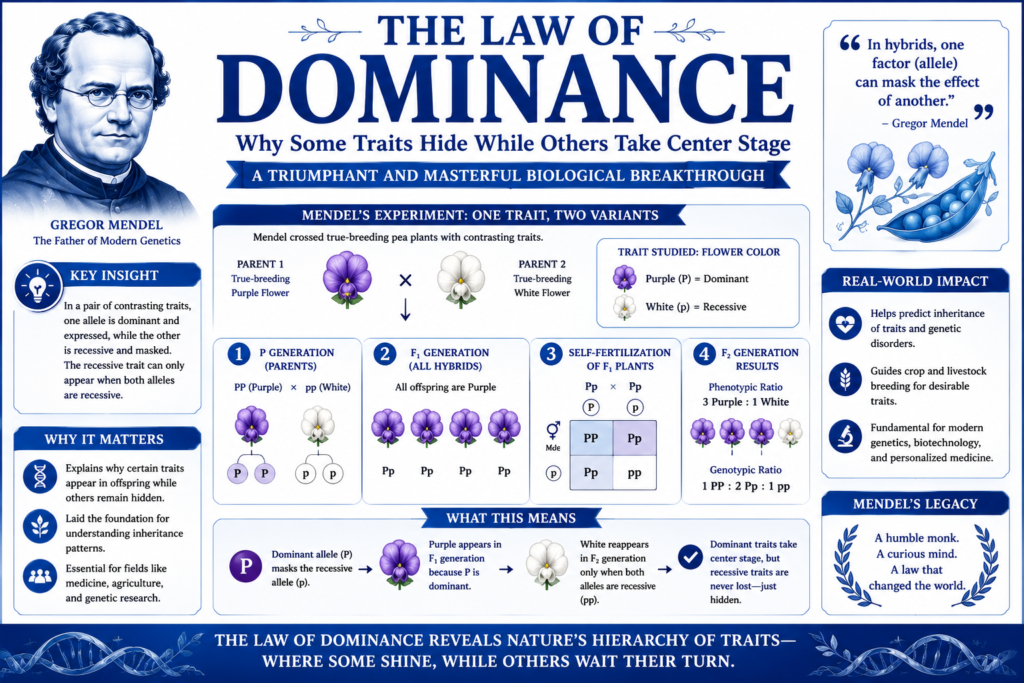
Pure Purple Flower (PP)  x  Pure White Flower (pp)
                         │
                         ▼
             All Offspring Purple (Pp)
He focused his initial efforts on single-trait inheritance, carefully establishing pure-breeding lines where specific characteristics always remained constant across generations. Once these stable lines were secure, he performed a structured monohybrid cross, deliberately mating two pure-breeding plants with opposing features, such as one plant with purple flowers and another with white flowers. He wanted to observe exactly what happens when two completely different physical instructions meet inside the same living organism.
The F1 Hybrid Uniform Appearance and the Genetic Mask
The initial results of his cross-pollination experiments directly challenged the popular blending ideas of his era. Under the old blending theory, crossing purple and white flowers should have produced a muddy, light-pink intermediate blend. Instead, Mendel witnessed absolute structural uniformity. Every single plant in this first filial generation grew to produce brilliant purple flowers. The white characteristic seemed to have vanished from the lineage entirely.
To explain this complete masking of genetic traits, he realized that organisms must carry two separate factors for each characteristic, inheriting one copy from each parent. Even though the hybrid plants carried the instructions for white flowers, that instruction was buried under a powerful biological shield. This critical observation led directly to the formulation of his first major principle, establishing a clear set of trait visibility rules that explained how a dominant phenotype inheritance could completely overpower an alternative variation inside a heterozygous individual.
Formulating the Law of Dominance Genetics
Based on these repeatable patterns, the brilliant friar formulated the law of dominance, which states that in a heterozygous organism, where two different alternative forms of a gene are present, one allele will completely mask or suppress the expression of the other allele. The allele that successfully shows up in the physical appearance is the dominant allele, while the allele that remains hidden is the recessive allele.
This principle proved that non-expressed alleles are not destroyed, modified, or blended during the lifespan of the organism. Instead, they remain completely pure and unchanged, leaving the individual to act as a healthy carrier of a genetic trait. This genetic mask ensures that an organism can harbor massive hidden variation within its internal genotype while displaying a uniform appearance across its visible phenotypes. The law of dominance served as the initial framework showing that physical appearance does not always reveal the complete genetic reality hidden underneath.
The Mathematical Proof of Reappearance
Mendel knew that to prove his theory, he had to demonstrate that the hidden recessive traits were still alive inside the plant cells. He allowed the uniform purple-flowered hybrid plants to self-pollinate naturally, raising a large second generation of offspring. When he harvested and sorted the resulting crops, the white-flowered variation returned perfectly intact, showing no signs of structural damage or dilution.
To decode this behavior, he turned to the precise mathematics of heredity. He painstakingly counted 929 flowers in his second generation crop, recording 705 purple flowers and 224 white flowers. By applying a simple mathematical reduction, he uncovered a striking numerical relationship:
224705=3.15≈3
This calculation yielded the famous mendel 3 to 1 ratio in physical appearance. He observed this exact same mathematical consistency across all seven characteristics he studied. For example, when crossing yellow and green seeds, he recorded 6,022 yellow seeds and 2,001 green seeds in the second generation:
20016022=3.01≈3
This mathematical consistency proved that dominant vs recessive alleles separate and recombine according to precise rules of probability.
The Algebraic Equation of Dominant and Recessive Traits
To illustrate the mathematical beauty of the law of dominance, we can model the behavior of these crosses using clear algebraic expressions. Let P represent the dominant allele for a purple flower, and let p represent the recessive allele for a white flower.
The initial pure-breeding parents are homozygous, meaning the purple parent is PP and the white parent is pp. The first hybrid generation is entirely heterozygous (Pp), displaying only the purple color due to the principles of complete dominance examples. When these hybrid plants self-pollinate, their reproductive cells split up equally. The random combination of these gametes during fertilization can be written as a simple polynomial distribution:
(P+p)(P+p)=P2+2Pp+p2
This elegant algebraic expansion shows the exact distribution of underlying genotypes within the second generation:
- 1 part PP (Homozygous Dominant): Visually purple flowers
- 2 parts Pp (Heterozygous): Visually purple flowers, but carries the hidden white allele
- 1 part pp (Homozygous Recessive): Visually white flowers
Because PP and Pp look identical under the phenotypic expression control of the dominant allele, the physical appearance results in three purple parts to one white part, while the underlying genetic ratio remains a perfectly balanced 1:2:1.
                  Parent 1 (Pp)
                  +-----+-----+
                  |  P  |  p  |
            +-----+-----+-----+
            |  P  | PP  | Pp  |
  Parent 2  +-----+-----+-----+
    (Pp)    |  p  | Pp  | pp  |
            +-----+-----+-----+
The Structural Basis of Dominance in Molecular Biology
While Mendel discovered the law of dominance entirely through statistical analysis of plant numbers, twentieth century molecular biology eventually uncovered the physical, structural basis of dominance inside the living cell. This phenomenon is deeply tied to protein expression in genetics and the complex biochemical pathways that control cell function.
 Wild-Type Allele (P) ──► Active Enzyme Synthesis ──► Purple Pigment Produced
                                                            ▲
                                                            │ (Masks Absence)
 Mutant Allele (p)    ──► Defective Enzyme         ──► No Pigment Produced
A gene is essentially a specific sequence of DNA that serves as the blueprint for protein synthesis, often creating a specific enzyme needed to complete a chemical reaction. In many complete dominance examples, the wild-type allele codes for a fully functional protein, while a mutant allele codes for a defective, nonfunctional protein.
Inside a heterozygous individual, a biological state known as haplosufficiency occurs. This means that a single copy of the dominant, functional allele is completely capable of producing enough enzyme activity to complete the biochemical pathway. The recessive phenotype suppression happens because the single functional gene copy generates enough active protein to meet the cell needs, leaving the nonfunctional allele visually hidden. The phenotypic expression rules are thus governed by the presence or absence of a functional molecular product.
Modern Extensions beyond Complete Dominance
While the law of dominance serves as a brilliant baseline for transmission genetics, modern molecular biology has uncovered important variations where alleles display more complex relationships. These discoveries did not destroy Mendel’s work; instead, they expanded the core laws of biology to cover a wider array of living systems.
Incomplete Dominance
In some cases, a dominant allele cannot completely mask a recessive allele in a heterozygous state. This results in incomplete dominance, where the physical appearance becomes an intermediate blend of both parental traits. For example, crossing a true-breeding red snapdragon flower with a true-breeding white snapdragon produces offspring with completely pink flowers.
Codominance
Another fascinating variation is codominance, where both alleles inside a heterozygous organism are expressed fully and simultaneously in the physical appearance. A classic example of this occurs in human ABO blood typing, where an individual inheriting both the A allele and the B allele expresses both distinct visual phenotypes on their red blood cells, resulting in blood type AB.
FAQs
What is the simple definition of the law of dominance?
The law of dominance states that in a heterozygous individual, one allele can completely mask or hide the expression of another allele for the same trait, causing only the dominant characteristic to be visible.
Does the law of dominance apply to all genetic traits?
No, it serves as a baseline rule, but modern genetics recognizes important extensions such as incomplete dominance and codominance, where traits blend or express simultaneously.
How does a recessive trait reappear after disappearing in the first generation?
A recessive trait reappears because alleles remain completely pure and unblended inside cells. When two heterozygous parents mate, there is a twenty-five percent statistical chance that two recessive alleles will combine, causing the trait to show up again.
What causes an allele to be dominant or recessive at the molecular level?
Dominance is typically caused by protein synthesis. A dominant allele usually codes for a fully functional enzyme, while a recessive allele codes for a nonfunctional protein. If one copy of the functional allele produces enough enzyme to complete a biological pathway, it behaves as a dominant trait.
The Eternal Impact of Mendelian Dominance
The rediscovery of Mendel’s work in the year 1900 ignited a massive scientific revolution, bridging the gap between descriptive botany and modern molecular genomics. By proving that the passing of traits is governed by beautiful, predictable rules of expression, his work provided the necessary foundation for evolutionary biology basics and the modern synthesis. Every advanced discovery in modern genetics, from mapping hereditary disorders in families to engineering resilient agricultural crops, rests directly on the principles of genetic interaction he uncovered. Through sheer creative genius and unmatched experimental discipline, Gregor Mendel predicted modern genetics with breathtaking accuracy, leaving behind an immortal legacy that will guide human discovery for centuries to come.