Before the mid-nineteenth century, the study of biological inheritance was a chaotic discipline dominated by vague observations, folklore, and loose speculation. Naturalists observed that children inherited qualities from their parents, but they could not provide a single structured rule to explain how these characteristics traveled across generations. Most academics accepted the blending theory of inheritance, an unscientific assumption that parental features mixed like liquids, diluting distinct variations over time. This intellectual stagnation completely dissolved when an analytical Augustinian monk brought a rigorous quantitative approach to biology into a small monastery courtyard. Through his meticulous work, he developed a brilliant experimental design that successfully translated the messy complexities of living systems into elegant mathematical laws of nature.
What made his methodology so revolutionary was his decision to treat biological research with the exact same numerical precision that physicists applied to inanimate matter. He was not a lonely amateur casually playing with flowers, but a highly trained investigator who understood the absolute necessity of variable isolation, large sample sizes genetics, and comprehensive statistical analysis in biology. By blending hands-on botany with probability models, his brilliant experimental design allowed him to crack the code of transmission genetics. To fully appreciate this triumphant leap in human knowledge, we must examine the careful choices, the flawless experimental controls, and the mathematical systems that make his work an enduring masterpiece of the scientific method.
The Strategic Choice of Model Organisms (1854 – 1856)
The foundation of any successful scientific investigation rests entirely on selecting the right subject to test. Mendel understood this principle perfectly, spending considerable time researching various options before choosing the common garden pea, Pisum sativum. This deliberate selection explains why mendel chose peas over other available flora, as it provided several unique structural advantages that were absolutely vital for preserving the integrity of his empirical data.
First, pea plants are incredibly easy to cultivate, grow rapidly, and produce large quantities of offspring within a single season. This allowed him to gather massive sample sizes without waiting decades for results. Second, the anatomical structure of the pea flower naturally favors self-pollination. The reproductive organs are tightly enclosed within the petal keel, preventing stray pollen carried by the wind or wandering insects from contaminating the reproductive cycle.
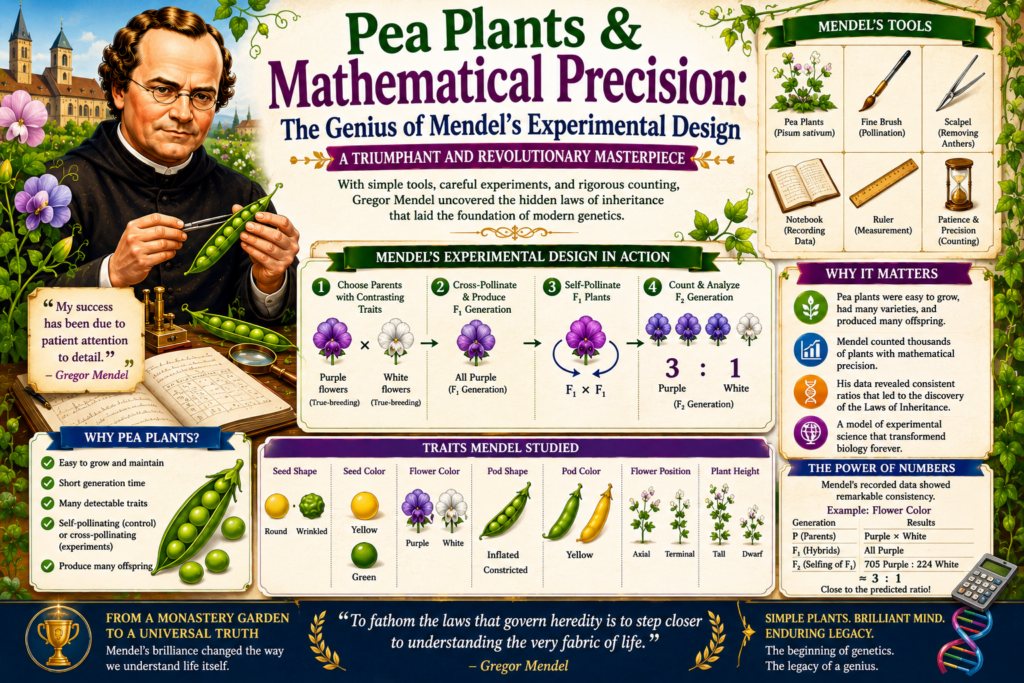
Most importantly, the garden pea possessed distinct, easily identifiable variations that showed no intermediate or blended forms. He systematically evaluated thirty-four separate varieties of peas, eventually narrowing his research down to seven highly specific characteristics, including seed shape (smooth versus wrinkled), seed color (yellow versus green), and stem length (tall versus short). By focusing on these clear, non-overlapping features, his brilliant experimental design completely eliminated human subjectivity from data collection, allowing him to track variations with absolute, flawless clarity.
       [ Controlled Cross-Pollination Technique ]
       1. Remove immature stamens from a purple flower (prevents selfing)
       2. Transfer pollen from a white flower stamen to the purple carpel
       3. Enclose the flower in a protective bag (avoids experimental bias)
Establishing Absolute Baselines and True-Breeding Strains
A common fatal flaw in early plant hybridization methodology was the use of parent plants with unknown, mixed ancestral lineages. Mendel completely bypassed this trap by dedicating two full years to cultivating and verifying true-breeding strains before running any actual breeding trials.
He allowed his selected pea varieties to self-pollinate naturally for multiple generations, carefully checking every single plant to ensure that tall lines exclusively produced tall offspring, and round-seeded lines exclusively produced round seeds. This exhaustive process confirmed that his starting materials were genetically uniform and free from hidden variation. By taking the time to establish these absolute baselines, his brilliant experimental design guaranteed that any changes observed in later hybrid generations were the direct result of his deliberate crosses, rather than the sudden emergence of unexpected ancestral traits.
The Monohybrid Cross and Variable Isolation
Once his true-breeding lines were fully secure, he initiated his formal cross-pollination techniques. He knew that tracking too many moving pieces simultaneously would result in analytical confusion, so he utilized a strict system of variable isolation. He began with a highly structured monohybrid cross, deliberately mating two true-breeding plants that differed in only one specific characteristic while remaining identical in every other possible way.
Pure Tall Parent (TT)  x  Pure Short Parent (tt)
                       │
                       ▼
            All F1 Offspring Tall (Tt)
To cross a true-breeding tall plant with a true-breeding short plant, he had to perform delicate surgical procedures on the flowers. Before the pollen-producing stamens could mature, he carefully snipped them away from the tall flower, preventing it from self-pollinating. He then gathered mature pollen from a short plant and carefully dusted it onto the female stigma of the altered tall flower.
Finally, he enclosed each cross-pollinated flower in a small, protective bag to shield it from external environmental factors. This rigorous application of experimental controls effectively eliminated any chance of stray pollen interference, completely avoiding experimental bias and ensuring that his parentage records remained perfectly clean.
The Mathematical Breakthrough of Systematic Data Documentation
The true brilliance of his method emerged when he evaluated the offspring of his initial crosses. In the first filial generation, every single plant grew to be completely tall, making it appear as though the short characteristic had been permanently wiped out of the lineage. Rather than stopping his experiment or assuming the trait was gone, his brilliant experimental design directed him to let this new generation self-pollinate naturally, raising a large second generation to observe the long-term results.
When he harvested the seeds of the second generation, the short variation returned perfectly intact, displaying no signs of structural blending or degradation. To unlock the meaning behind this reappearance, he abandoned the purely descriptive summaries common to the naturalists of his era and implemented a system of meticulous data collection and quantitative tracking. He treated every single pea seed and flower as an independent unit of empirical evidence, counting every single individual across his entire crop.
Unveiling the Masterful Three to One Ratio
By gathering massive sample sizes across multiple experimental replicates, he successfully brought the clear laws of statistical significance into botany. For his stem length experiment, he counted a total of 1,064 second-generation plants, recording 787 tall individuals and 277 short individuals. To find the structural pattern hidden within these raw numbers, he converted his counts into simplified mathematical ratios:
277787=2.84≈3
When he analyzed seed color, he counted 6,022 yellow seeds and 2,001 green seeds:
20016022=3.01≈3
Across all seven distinct traits, the numerical relationship between the dominant visible trait and the hidden recessive trait always simplified to the exact same mendel 3 to 1 ratio. He realized that these consistent results were not random flukes of nature, but the direct product of clear mathematical laws.
To explain this mathematical consistency, he developed a sophisticated algebraic model. He proposed that each plant carried two distinct hereditary factors, one inherited from each parent. Let A represent the dominant unit and a represent the recessive unit. When hybrid plants (Aa) self-pollinate, the combination of their reproductive cells can be mathematically modeled using a standard polynomial expansion:
(A+a)(A+a)=A2+2Aa+a2
This algebraic equation exposes the hidden genotypic distribution within his crops:
- 1 part AA (Homozygous Dominant): Physically tall appearance
- 2 parts Aa (Heterozygous): Physically tall appearance, acting as a healthy genetic carrier
- 1 part aa (Homozygous Recessive): Physically short appearance
This brilliant model perfectly explained how a trait could hide for an entire generation and return later with absolute mathematical predictability, providing an unbreakable foundation for the mathematics of heredity.
                  Parent 1 (Aa)
                  +-----+-----+
                  |  A  |  a  |
            +-----+-----+-----+
            |  A  | AA  | Aa  |
  Parent 2  +-----+-----+-----+
    (Aa)    |  a  | Aa  | aa  |
            +-----+-----+-----+
Expanding the Model through Multi-Trait Tracking
To test if his mathematical models could handle more complex biological scenarios, he expanded his brilliant experimental design to track multiple characteristics simultaneously. He initiated a highly sophisticated dihybrid cross, breeding plants that differed in two separate features at the exact same time, such as seed shape (round versus wrinkled) and seed color (yellow versus green).
Many naturalists of his era believed that traits from the same parent were permanently bound together in fixed, unalterable packages. However, his multi-trait tracking revealed completely new combinations, such as round green seeds and wrinkled yellow seeds, growing together on the exact same pods.
Because his brilliant experimental design relied heavily on large sample sizes, he harvested and categorized 556 individual seeds for this cross. His systematic classification revealed a highly specific distribution of 315 round yellow seeds, 108 round green seeds, 101 wrinkled yellow seeds, and 32 wrinkled green seeds. By dividing each number by the lowest common value of 32, he uncovered an elegant phenotypic ratio:
32315≈9.8432108≈3.38
32101≈3.16
3232=1
This distribution simplifies directly to the famous 9:3:3:1 phenotypic ratio. He realized this complex pattern was the mathematical result of multiplying two independent 3:1 ratios together, proving that different characteristics segregate and recombine with total independence. This masterful multi-trait tracking led directly to the formulation of the law of independent assortment, demonstrating that his experimental model could accurately predict the behavior of complex living systems.
FAQs
Why was Mendel’s experimental design superior to previous inheritance studies?
His brilliant experimental design was superior because it introduced strict variable isolation, large sample sizes, and quantitative tracking into biological research. Instead of recording vague summaries, he treated every plant as a source of empirical data, using statistics to uncover hidden laws of nature.
How did Mendel ensure that his pea plants did not accidentally cross-pollinate?
He maintained absolute control over his crops by surgically removing the pollen-producing stamens from immature flowers before they could self-pollinate. He then hand-delivered selected pollen using fine brushes and sealed each flower inside a protective cloth bag to prevent any contamination from wind or insects.
Why did Mendel spend two full years testing his plants before starting his main crosses?
He spent two years cultivating his lines to guarantee he was working with completely true-breeding strains. This exhaustive step ensured that his starting plants were genetically uniform, ensuring that any variations that showed up in later generations were the direct result of his deliberate crosses.
What role did mathematics play in Mendel’s discoveries?
Mathematics allowed him to see clear, orderly patterns within large amounts of raw biological data. By converting his plant counts into simplified ratios, he could apply the laws of probability and algebraic expansion to explain how traits hide, split apart, and recombine across generations.
The Immortal Triumph of Quantitative Biology
When Johann Gregor Mendel presented his groundbreaking paper to the Natural History Society of Brünn in 1865, the scientific community met his discoveries with total silence. This frustrating period of isolation occurred because 19th-century biologists lacked the statistical background required to comprehend his mathematical probability models. It took more than three decades for the world to finally catch up to his genius. When independent researchers rediscovered his original paper in the year 1900, they realized his brilliant experimental design had already solved the deepest mysteries of inheritance decades earlier.
His decision to combine strict physical precision with hands-on botany successfully bridged the massive gap between descriptive natural history and modern molecular genomics. Every major breakthrough in modern medicine, gene therapy, and agricultural biotechnology rests firmly on the foundations of quantitative research he established in his small garden plots. Through absolute creative genius, relentless focus, and unmatched analytical discipline, Gregor Mendel predicted modern genetics with breathtaking accuracy, leaving behind a triumphant intellectual legacy that will continue to guide human discovery for centuries to come.