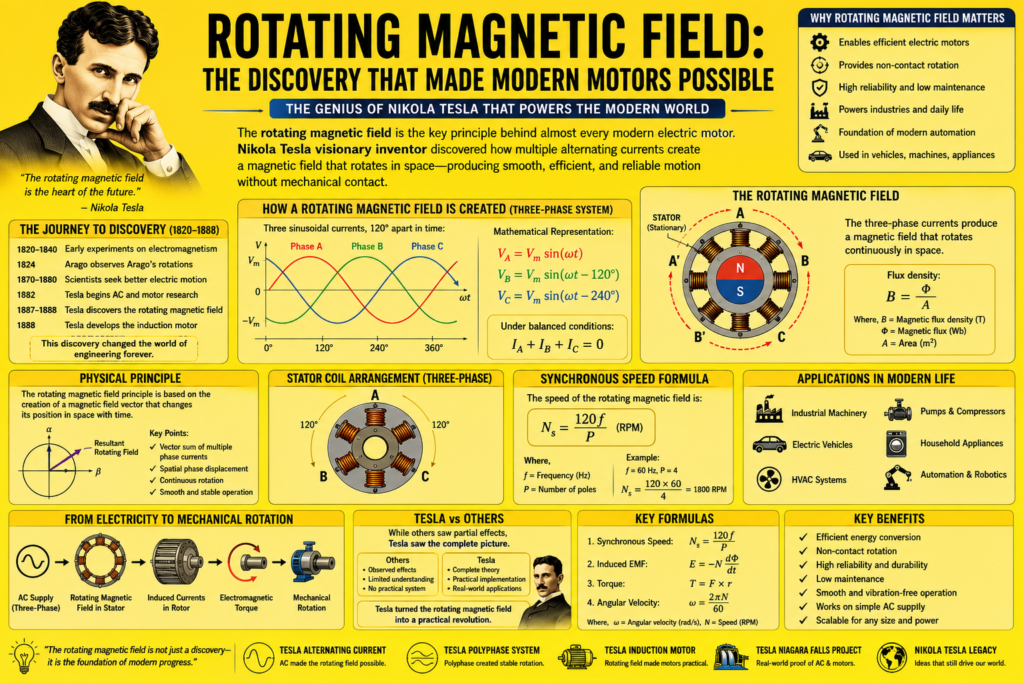
The rotating magnetic field is one of the most important discoveries in the history of electrical engineering. Without it, modern electric motors would not exist in their current form. Factories, elevators, pumps, electric vehicles, household appliances, and industrial automation systems all depend on a principle first developed during the late nineteenth century.
Today, billions of electric motors operate worldwide using the concept of the rotating magnetic field. Although most people never see this invisible phenomenon, it remains one of the fundamental technologies powering modern civilization.
The discovery transformed electrical engineering by providing a practical method for converting electrical energy into mechanical motion. More importantly, it enabled efficient motors that could operate without brushes, commutators, or excessive maintenance.
Understanding the rotating magnetic field means understanding one of Nikola Tesla’s greatest scientific achievements.
The Search for Electrical Motion (1820 – 1880)
Scientists spent decades trying to convert electricity into useful mechanical movement.
Early electrical machines often relied on direct current systems and complicated mechanical switching mechanisms.
While these machines worked, they suffered from several problems:
- High maintenance
- Excessive wear
- Poor efficiency
- Limited reliability
Researchers recognized that a better method was needed.
The challenge was creating continuous rotational force without direct mechanical switching.
The breakthrough eventually came through electromagnetic rotation.
Early Discoveries and Arago’s Rotations (1824)
Long before Tesla’s work, French scientist François Arago observed an unusual phenomenon.
When a rotating metal disk moved near a magnetic needle, the needle appeared to follow the motion.
This effect became known as Arago’s rotations.
Scientists later discovered that eddy current torque generated within conductive materials caused the behavior.
Although Arago did not create a practical motor, his observations provided important clues about electromagnetic linkage and rotational force.
These early experiments laid the foundation for the eventual discovery of the rotating magnetic field.
What Is a Rotating Magnetic Field?
A rotating magnetic field is a magnetic field whose direction changes continuously in a circular pattern.
Unlike a stationary magnetic field, which points in a fixed direction, a rotating field moves around an axis.
The field behaves like an invisible rotating magnet.
This motion creates electromagnetic torque that can drive mechanical systems.
The concept may seem simple, but it revolutionized electrical engineering and motor design.
The entire operation of the modern rotating magnetic field depends on carefully coordinated alternating currents.
Nikola Tesla’s Vision (1882 – 1888)
The discovery of the rotating magnetic field is closely linked to the genius of Nikola Tesla visionary inventor.
While working in Europe, Tesla became frustrated by the limitations of direct current motors.
He imagined a motor that could operate without brushes and mechanical commutators.
According to Tesla’s own accounts, the idea came to him while walking and visualizing electrical systems mentally.
His extraordinary imagination enabled him to picture invisible magnetic forces moving through space.
This vision eventually led to one of the most important discoveries in electrical engineering.
Anyone studying the Nikola Tesla biography quickly recognizes the significance of this breakthrough.
Tesla Alternating Current and the Birth of the Rotating Field
The discovery relied heavily on tesla alternating current technology.
Alternating current naturally changes direction over time.
A simple AC voltage can be represented as:
V(t) = Vₘ sin(ωt)
Where:
- V(t) = voltage at time t
- Vₘ = maximum voltage
- ω = angular frequency
- t = time
Tesla realized that multiple AC currents operating with specific phase differences could create a moving magnetic field.
This insight became the foundation of the rotating magnetic field principle.
The Mathematics Behind the Rotating Magnetic Field
The operation of a rotating field requires multiple waveforms.
For a two-phase system:
Phase A = Vₘ sin(ωt)
Phase B = Vₘ sin(ωt + 90°)
For a three-phase system:
Phase A = Vₘ sin(ωt)
Phase B = Vₘ sin(ωt − 120°)
Phase C = Vₘ sin(ωt − 240°)
Because each phase reaches its maximum value at a different time, the resulting magnetic field continuously rotates.
This phenomenon creates smooth electromagnetic rotation without mechanical contact.
The mathematical elegance of the rotating magnetic field remains one of Tesla’s greatest achievements.
Spatial Phase Displacement and Field Geometry
A key feature of the rotating magnetic field is spatial phase displacement.
Motor windings are positioned physically around the stator.
These windings are separated by specific angles.
For example, in a three-phase motor:
360° ÷ 3 = 120°
Each winding occupies a different spatial orientation.
Combined with electrical phase differences, this arrangement creates a continuously rotating magnetic field vector.
The interaction between electrical phase angle and physical positioning produces the rotating effect.
Understanding Magnetic Flux Density
Magnetic fields are described using magnetic flux density.
The basic relationship is:
B = Φ/A
Where:
- B = magnetic flux density
- Φ = magnetic flux
- A = area
As alternating currents flow through motor windings, magnetic flux density changes continuously.
These changing magnetic forces contribute directly to the creation of the rotating magnetic field.
The process forms the foundation of modern motor technology.
The Role of the Tesla Polyphase System
The tesla polyphase system played a crucial role in implementing rotating magnetic fields.
Polyphase systems use multiple AC waveforms operating together.
This arrangement creates smooth magnetic motion.
Without polyphase currents, generating a practical rotating field becomes difficult.
Tesla recognized that combining alternating current with polyphase transmission created a complete solution for motor operation.
His invention transformed electrical engineering forever.
How the Rotating Magnetic Field Creates Motion
The primary purpose of the rotating magnetic field is generating motion.
The process occurs in several steps:
- AC current enters stator coils.
- Magnetic fields are generated.
- Phase differences create field rotation.
- Conductors experience changing magnetic flux.
- Electromotive force is induced.
- Rotor currents develop.
- Torque is produced.
- Mechanical rotation begins.
This process converts electrical energy into kinetic energy conversion efficiently and reliably.
Electromagnetic Torque and Motor Operation
Torque is the turning force that causes rotation.
The torque equation is:
T = F × r
Where:
- T = torque
- F = force
- r = radius
The rotating magnetic field generates electromagnetic torque by interacting with conductive rotor components.
As magnetic forces move through the rotor, electrical currents develop.
These currents create their own magnetic fields.
The interaction between fields produces continuous rotation.
This principle powers countless machines worldwide.
The Tesla Induction Motor (1888)
The most famous application of the rotating magnetic field is the tesla induction motor.
The motor contains:
- Stator windings
- Rotor conductors
- Magnetic core
- Bearings
When AC power enters the stator, the rotating field induces currents inside the rotor.
No direct electrical connection is required.
The result is non-contact rotation.
This remarkable design eliminated many problems associated with earlier motor technologies.
Synchronous Speed Formula
The speed of the rotating field depends on frequency and pole count.
The synchronous speed formula is:
Ns = (120f)/P
Where:
- Ns = synchronous speed (RPM)
- f = frequency (Hz)
- P = number of poles
Example:
f = 60 Hz
P = 4
Ns = (120 × 60)/4
Ns = 1800 RPM
This equation remains essential in motor engineering.
The speed of the rotating magnetic field determines motor performance characteristics.
Magnetic Poles and Stator Coil Arrangement
Motor designers carefully arrange magnetic poles around the stator.
The stator coil arrangement determines field geometry and operating characteristics.
Increasing the number of poles reduces rotational speed.
For example:
- 2 poles = 3600 RPM
- 4 poles = 1800 RPM
- 6 poles = 1200 RPM
This flexibility allows engineers to design motors for specific applications.
Ferrari vs Tesla Dispute
One historical controversy involves the Ferrari vs Tesla dispute.
Italian engineer Galileo Ferraris independently studied rotating magnetic field concepts around the same period.
Both researchers contributed important ideas.
However, Tesla’s work focused heavily on practical implementation, motor design, patents, and commercial applications.
His inventions directly enabled widespread industrial adoption.
The debate remains a fascinating chapter in electrical engineering history.
Edison vs Tesla and Industrial Adoption
The famous edison vs tesla rivalry also influenced the success of rotating magnetic field technology.
Edison supported direct current systems.
Tesla promoted alternating current.
Because rotating magnetic fields depend on AC phase relationships, alternating current offered clear advantages.
As AC systems expanded, Tesla’s motor technologies became increasingly valuable.
Industry rapidly embraced the new approach.
Niagara Falls and Large Scale Demonstration (1895 – 1896)
The tesla niagara falls project provided dramatic proof of Tesla’s ideas.
The hydroelectric facility generated alternating current on a massive scale.
Motors operating through rotating magnetic field principles demonstrated exceptional performance.
The success of Niagara Falls accelerated worldwide electrification.
It also established Tesla’s motor technologies as practical industrial solutions.
Applications in Modern Technology
Today, the rotating magnetic field appears in countless technologies.
Applications include:
Industrial Automation
Factories rely on motors driven by rotating magnetic fields.
Electric Vehicles
Modern electric vehicles use advanced motor designs based on Tesla’s principles.
HVAC Systems
Heating and cooling systems depend on electric motors.
Pumps and Compressors
Industrial pumps use electromagnetic rotation for reliable operation.
Household Appliances
Washing machines, refrigerators, and air conditioners all benefit from this technology.
Modern civilization depends heavily on the discovery of the rotating magnetic field.
Why the Discovery Remains Important Today
The rotating magnetic field remains essential because it provides:
- High efficiency
- Reliable operation
- Minimal maintenance
- Smooth performance
- Long service life
- Scalable applications
Few scientific discoveries have had such a broad impact on everyday life.
Its influence extends across nearly every sector of modern industry.
FAQs
What is a rotating magnetic field?
A rotating magnetic field is a magnetic field that continuously changes direction in a circular pattern, creating motion in electric motors.
Who discovered the rotating magnetic field?
Nikola Tesla is widely credited with developing and commercializing the rotating magnetic field principle used in modern motors.
Why is the rotating magnetic field important?
It enables efficient motor operation without brushes or mechanical commutators.
How does a rotating magnetic field create motion?
The field induces currents in rotor conductors, producing electromagnetic torque that causes rotation.
What devices use rotating magnetic fields?
Electric motors, industrial machines, HVAC systems, pumps, compressors, and electric vehicles all use rotating magnetic field principles.
Conclusion
The rotating magnetic field stands among the most transformative discoveries in electrical engineering. By combining alternating current, phase displacement, and magnetic field geometry, Nikola Tesla created a principle that enabled practical electric motors and modern industrial automation.
From the first induction motors to today’s advanced electric vehicles, the rotating magnetic field continues driving technological progress. Its ability to convert electrical energy into smooth mechanical motion has made it indispensable to modern civilization.
More than a century after its discovery, the rotating magnetic field remains a shining example of scientific creativity, engineering brilliance, and the enduring impact of Tesla’s vision.