The polyphase system stands among the most important innovations in the history of electrical engineering. While many people recognize Nikola Tesla for his work with alternating current, it was the polyphase system that truly enabled modern electrical networks to operate efficiently on a massive scale. Today, every major electrical energy grid relies on principles first developed by Tesla during the late nineteenth century.
Before Tesla’s breakthrough, electrical transmission faced serious limitations. Power could not be transported efficiently over long distances, motors lacked reliability, and industrial electrification remained difficult. Tesla solved these challenges by developing a revolutionary system based on multiple alternating currents operating together.
The polyphase system transformed electricity from a local utility into a global infrastructure capable of powering cities, industries, transportation systems, and modern civilization itself.
The Electrical Challenges Before Tesla (1870 – 1888)
In the early days of electricity, engineers struggled with distribution problems.
Most systems relied on single phase or direct current designs. These approaches worked for limited applications but were inefficient for large scale electrical transmission.
Factories required increasing amounts of energy. Cities demanded lighting systems. Industrial growth created new challenges.
Electrical engineers needed a method capable of:
- Delivering continuous power
- Reducing transmission losses
- Supporting electric motors
- Improving power distribution efficiency
The solution emerged through the extraordinary work of Nikola Tesla visionary inventor.
What Is a Polyphase System?
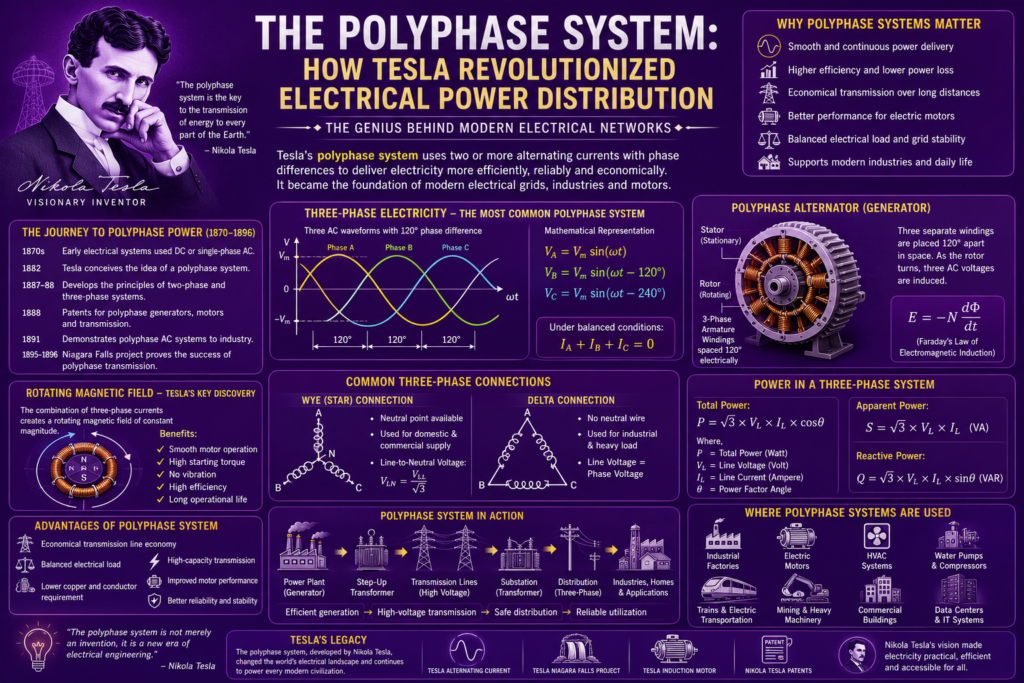
A polyphase system is an electrical system that uses two or more alternating currents with specific phase differences.
The most common version is three-phase electricity.
Instead of one AC waveform, multiple waveforms operate simultaneously.
For a three-phase system:
Phase A = Vₘ sin(ωt)
Phase B = Vₘ sin(ωt − 120°)
Phase C = Vₘ sin(ωt − 240°)
Each phase is separated by 120 degrees.
This arrangement creates phased electrical currents that work together to provide smoother and more efficient energy delivery.
The concept may appear simple, but it fundamentally changed electrical engineering.
Tesla’s Vision for a Better Electrical Network (1888)
Tesla recognized that alternating current offered enormous advantages over direct current.
However, he also understood that AC systems needed a more advanced structure to achieve maximum efficiency.
His solution was the polyphase system, which combined multiple AC phases into a coordinated electrical network.
Anyone studying the Nikola Tesla biography quickly discovers that this invention became one of Tesla’s most significant achievements.
The design enabled efficient transmission, improved motor operation, and greater electrical load distribution across large networks.
The Mathematics Behind the Polyphase System
Understanding the polyphase system requires examining the mathematics of AC waveforms.
For a three-phase network:
Phase A = Vₘ sin(ωt)
Phase B = Vₘ sin(ωt − 120°)
Phase C = Vₘ sin(ωt − 240°)
Because the waves are evenly displaced, current vector summation creates remarkable stability.
At any moment:
IA + IB + IC = 0
Under balanced conditions.
This balance reduces fluctuations and creates continuous power delivery.
The principle remains one of the greatest engineering achievements in electrical science.
Wave Displacement and Electrical Phase Angle
A key concept in the polyphase system is wave displacement.
Each electrical waveform is separated by a specific electrical phase angle.
In three-phase systems:
360° ÷ 3 = 120°
Therefore:
- Phase A = 0°
- Phase B = 120°
- Phase C = 240°
Because the peaks occur at different times, power delivery becomes much smoother than single-phase systems.
This overlapping cycles arrangement greatly improves efficiency.
How Three Phase Electricity Improves Performance
Three-phase electricity provides significant advantages over single-phase systems.
Benefits include:
- Greater efficiency
- Reduced vibration
- Continuous power transfer
- Lower conductor requirements
- Better motor performance
Industrial users quickly adopted the polyphase system because it provided the reliability needed for large manufacturing operations.
Today, heavy industry power applications depend heavily on three-phase networks.
Generator Synchronization and Polyphase Alternators
Electricity generation depends on rotating machines called alternators.
A polyphase alternator produces multiple AC voltages simultaneously.
The voltage generated follows:
E = Eₘ sin(ωt)
Generator synchronization ensures all generators operate at the same frequency and phase sequence.
Without synchronization, electrical networks would become unstable.
Modern electrical energy grid systems rely on precise synchronization across thousands of generators.
Tesla’s ideas helped establish the foundations of these systems.
The Rotating Magnetic Field Breakthrough
One of Tesla’s greatest discoveries was the rotating magnetic field.
By combining multiple phases, Tesla created magnetic fields that appeared to rotate continuously.
This concept directly enabled the operation of the tesla induction motor.
The rotating field is produced through spatial distribution of magnetic forces inside motor windings.
The result is smooth mechanical motion without brushes or commutators.
This innovation transformed industrial machinery and manufacturing.
The Polyphase System and Electric Motors
Before Tesla’s inventions, motors were inefficient and difficult to maintain.
The polyphase system solved these problems.
Multiple phases generated rotating magnetic fields naturally.
Motors became:
- More efficient
- More reliable
- Easier to maintain
- More powerful
Factories rapidly adopted polyphase powered motors because they improved productivity and reduced operating costs.
Modern industrial automation still depends heavily on these principles.
Tesla Alternating Current and Polyphase Power
The success of the polyphase system depended on tesla alternating current technology.
Alternating current made phase shifting possible.
Direct current could not easily support rotating magnetic fields or multi-phase circuitry.
Tesla’s AC innovations and polyphase concepts worked together as a complete electrical solution.
This combination revolutionized the entire electrical industry.
Wye Connection System and Delta Connections
Modern three-phase systems commonly use two wiring configurations.
Wye Connection System
The wye connection system connects one end of each phase to a common neutral point.
Advantages include:
- Neutral wire balancing
- Multiple voltage levels
- Improved flexibility
Line-to-neutral voltage is:
V_LN = V_LL / √3
Where:
- V_LN = line-to-neutral voltage
- V_LL = line-to-line voltage
Delta Connection Transformer
The delta connection transformer connects phases in a triangular loop.
Advantages include:
- High power capability
- Better heavy load performance
- Enhanced reliability
Both configurations remain fundamental to modern power systems.
Transmission Line Economy and Conductor Savings
One major benefit of the polyphase system is transmission line economy.
For equivalent power delivery, three-phase systems require less conductor material.
Power in a three-phase network is:
P = √3 × V × I × cosθ
Where:
- P = power
- V = voltage
- I = current
- cosθ = power factor
This equation demonstrates why polyphase transmission became economically attractive.
Conductor material savings significantly reduced infrastructure costs.
Electrical Load Distribution and Grid Stability
A major challenge in electrical networks is maintaining balanced electrical load conditions.
The polyphase system naturally distributes energy across multiple conductors.
Benefits include:
- Reduced voltage fluctuations
- Better stability
- Improved reliability
- Enhanced power quality
Modern utilities rely on these principles for electrical load distribution throughout cities and industries.
Without balanced operation, network efficiency would decline dramatically.
The War of Currents (1888 – 1896)
The famous edison vs tesla conflict influenced the adoption of the polyphase system.
Thomas Edison favored direct current systems.
Tesla and George Westinghouse supported alternating current.
The success of polyphase transmission demonstrated clear technical advantages.
AC systems could:
- Travel farther
- Operate motors efficiently
- Reduce losses
- Support industrial growth
Eventually, the engineering superiority of Tesla’s approach became undeniable.
Niagara Falls and Large Scale Demonstration (1895 – 1896)
The tesla niagara falls project became one of the greatest demonstrations of the polyphase system.
The hydroelectric plant generated enormous amounts of electricity using Tesla’s concepts.
Power traveled long distances to Buffalo, New York.
The project proved that large scale AC transmission was practical and economically viable.
This achievement accelerated worldwide adoption of polyphase electrical networks.
Electrical Substations and Modern Grid Topology
Modern electrical systems rely heavily on substations.
Substation transformers perform several functions:
- Voltage conversion
- Power routing
- Grid protection
- Load balancing
The polyphase system allows electricity to move efficiently through complex grid topology structures.
Today, electrical networks span entire continents while maintaining remarkable reliability.
High Capacity Transmission and Modern Electrification
Modern civilization depends on high-capacity transmission networks.
Three-phase systems support:
- Urban power networks
- Industrial complexes
- Transportation infrastructure
- Data centers
- Manufacturing facilities
The polyphase system remains the foundation of modern electrification.
Without it, contemporary society could not sustain current energy demands.
The Legacy of Tesla’s Polyphase Innovation
Tesla’s contribution extended far beyond a single invention.
His polyphase concepts created the framework for modern electrical engineering.
Many technologies associated with nikola tesla patents ultimately depended upon efficient AC distribution systems.
The principles Tesla developed continue operating inside virtually every power grid on Earth.
His innovation transformed electricity into a practical global resource.
FAQs
What is a polyphase system?
A polyphase system uses multiple alternating current waveforms operating with specific phase differences to improve efficiency and power delivery.
Why is three-phase electricity important?
Three-phase electricity provides smoother power delivery, higher efficiency, and better support for industrial equipment.
How many phases are commonly used?
Most modern power systems use three phases separated by 120 degrees.
What is the advantage of a rotating magnetic field?
A rotating magnetic field enables efficient motor operation without brushes or commutators.
Why did Tesla develop the polyphase system?
Tesla developed the system to improve electrical transmission, support efficient motors, and create reliable large-scale power networks.
Conclusion
The polyphase system remains one of the most important achievements in electrical engineering history. By combining multiple alternating current phases into a coordinated network, Nikola Tesla solved some of the greatest challenges facing electricity distribution.
His innovations enabled efficient transmission, reliable motors, balanced electrical loads, and large-scale electrification. From power plants and substations to factories and cities, the modern world continues to rely on the principles Tesla introduced more than a century ago.
Today, every major electrical grid benefits from the remarkable ideas behind the polyphase system, proving that Tesla’s vision helped build the foundation of modern electrical infrastructure.