The story of AC electricity explained is one of the most important chapters in the history of technology. Every time you switch on a light, charge a device, or use an appliance, you benefit from a system that transformed civilization. This revolutionary system was developed and perfected through the vision of Nikola Tesla and his supporters, who believed electricity could travel efficiently across entire nations.
Before alternating current became the global standard, electricity faced serious limitations. Power stations could only serve nearby areas, and energy losses were extremely high. Tesla’s innovations solved these challenges and created the foundation of the modern electrical grid infrastructure that powers our world today.
Understanding ac electricity explained means understanding how electrical energy moves from power plants to homes, businesses, hospitals, factories, and cities. It also means appreciating the scientific genius that enabled modern electrification on a global scale.
What Is Alternating Current Electricity?
Alternating current, commonly called AC electricity, is a form of electric current that periodically changes direction.
Unlike direct current (DC), where electrons flow continuously in one direction, AC causes electron oscillation back and forth within a conductor.
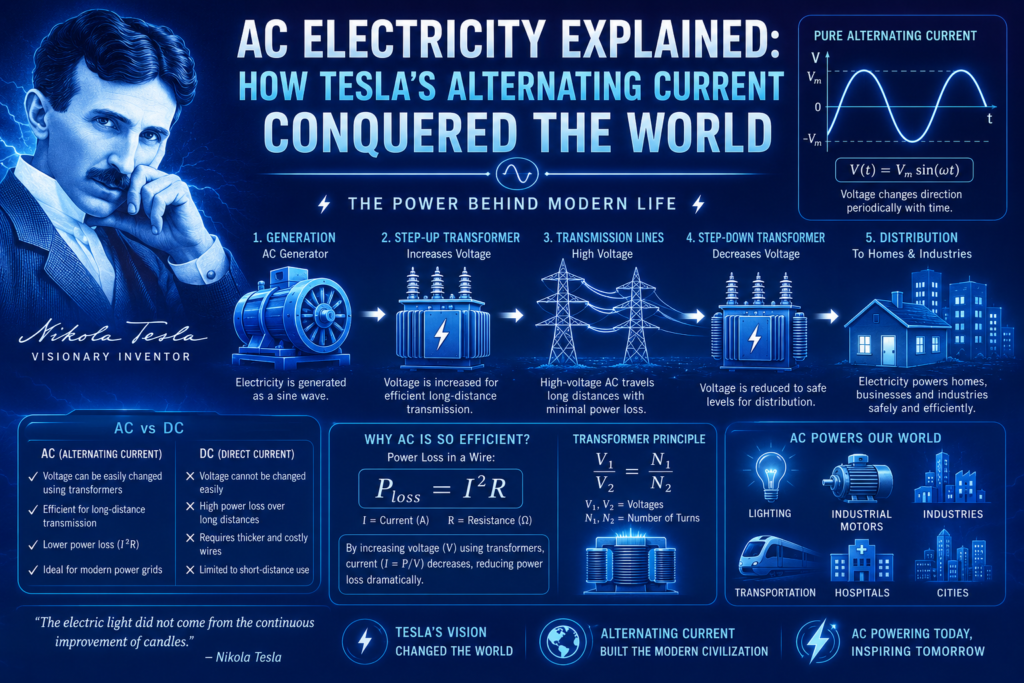
A simplified mathematical representation of AC voltage is:
V(t) = Vₘ sin(ωt)
Where:
- V(t) = instantaneous voltage
- Vₘ = maximum voltage
- ω = angular frequency
- t = time
This sinusoidal pattern creates what engineers call sine wave electricity.
The ability to generate and transform this wave efficiently is the primary reason alternating current became dominant worldwide.
When discussing AC electricity explained, this sine wave behavior is the fundamental concept that makes the entire system possible.
The Electricity Problem Before Tesla (1870 – 1888)
Before Tesla’s breakthroughs, electrical systems relied heavily on direct current networks.
Direct current worked well over short distances but faced major challenges when transmitting power far from generating stations.
As electricity traveled through wires, energy was lost as heat.
The power loss equation is:
P_loss = I²R
Where:
- P_loss = power lost as heat
- I = current
- R = wire resistance
This phenomenon is known as Joule heating losses.
Because copper wire resistance causes electrical energy to become heat, power companies needed numerous local generating stations.
Large scale electrification was difficult and expensive.
The world needed a better solution.
Nikola Tesla’s Vision (1888)
The breakthrough arrived through the genius of Nikola Tesla visionary inventor.
Tesla recognized that alternating current could be transformed to higher voltages, significantly reducing transmission losses.
His inventions revolutionized electrical engineering history and created the foundation for modern power distribution.
Anyone studying the Nikola Tesla biography quickly discovers that AC power was among his greatest achievements.
Tesla understood that efficient long-distance power lines required a system capable of minimizing energy loss while maximizing electrical efficiency.
This insight changed the world forever.
How AC Electricity Actually Works
To understand AC electricity explained, imagine a wave continuously moving upward and downward.
Instead of flowing in a single direction, the voltage repeatedly reverses polarity.
A standard AC waveform appears mathematically as:
I(t) = Iₘ sin(ωt)
Where:
- I(t) = current at time t
- Iₘ = peak current
- ω = angular frequency
In many countries, AC completes 50 cycles every second.
In the United States and several other regions, the frequency is 60 cycles per second.
This frequency 60Hz standard became widely adopted because it balances efficiency and equipment performance.
The oscillating nature of AC enables transformers to function, which is the key reason AC conquered the world.
AC Generator Physics and Magnetic Flux
Electricity generation depends on electromagnetic induction.
When a conductor moves through a magnetic field, voltage is induced.
Faraday’s law is:
E = -N(dΦ/dt)
Where:
- E = induced voltage
- N = number of turns
- Φ = magnetic flux
This principle forms the basis of AC generator physics.
Power plants rotate large generators using:
- Water turbines
- Steam turbines
- Gas turbines
- Wind turbines
As the generator spins, magnetic flux changes continuously, producing alternating current.
This process remains at the heart of modern electricity production.
Step-Up Transformers and the Secret of AC Success
One of the greatest advantages discussed in AC electricity explained is the use of transformers.
Transformers change voltage levels efficiently.
The transformer equation is:
V₁/V₂ = N₁/N₂
Where:
- V₁ = primary voltage
- V₂ = secondary voltage
- N₁ = primary coil turns
- N₂ = secondary coil turns
Step-up transformers increase voltage dramatically.
For example:
1000 V → 100,000 V
Because electrical power equals:
P = VI
Current becomes:
I = P/V
As voltage increases, current decreases.
Since power losses depend on I²R, reducing current dramatically lowers transmission losses.
This innovation made high-voltage AC transmission economically practical.
High Voltage Transmission Lines and Grid Expansion
After voltage is increased, electricity travels through voltage transmission lines.
These high tension wires stretch across cities, mountains, deserts, and countries.
Modern power systems commonly use voltages such as:
- 132 kV
- 220 kV
- 400 kV
- 765 kV
At these levels, energy can travel hundreds of kilometers efficiently.
This capability allowed nations to build interconnected electrical grid infrastructure serving millions of people simultaneously.
Without AC transmission technology, modern civilization would look completely different.
The Role of the Tesla Polyphase System (1888 – 1895)
Tesla’s greatest achievement was not a single machine.
It was the tesla polyphase system.
Polyphase transmission uses multiple alternating currents operating out of phase with one another.
Three phase power remains the dominant industrial standard today.
A three phase system can be represented as:
Phase A = Vₘ sin(ωt)
Phase B = Vₘ sin(ωt − 120°)
Phase C = Vₘ sin(ωt − 240°)
This arrangement provides:
- Smooth power delivery
- Greater efficiency
- Reduced vibration
- Better motor performance
The polyphase system remains one of the most important developments in electrical engineering history.
Rotating Magnetic Fields and Electric Motors
Another revolutionary Tesla innovation involved the rotating magnetic field.
By combining multiple AC phases, Tesla created magnetic fields that appear to rotate continuously.
This discovery enabled efficient electric motors.
The famous tesla induction motor works using this principle.
Industrial equipment, pumps, elevators, manufacturing systems, and countless machines rely on induction motors.
Today, billions of electric motors operate worldwide based on concepts pioneered by Tesla.
Their reliability and efficiency contributed significantly to the global adoption of alternating current systems.
Edison vs Tesla and the War of Currents (1888 – 1896)
One of the most famous conflicts in technology history was edison vs tesla.
Thomas Edison strongly promoted direct current.
Tesla and George Westinghouse championed alternating current.
Edison argued AC was dangerous.
Westinghouse and Tesla demonstrated its practicality and efficiency.
The debate became known as the War of Currents.
Ultimately, mathematics, engineering, and economics favored alternating current.
The ability to use transformers and transmit electricity over long distances gave AC a decisive advantage.
History eventually proved Tesla correct.
Niagara Falls and the Global Victory of AC (1895 – 1896)
A major turning point occurred with the tesla niagara falls project.
Niagara Falls offered enormous hydroelectric potential.
The challenge was transmitting power efficiently to distant consumers.
Tesla’s AC technology provided the solution.
Electricity generated at Niagara Falls successfully reached Buffalo, New York.
This achievement demonstrated that alternating current could support large cities and industrial centers.
The project became a global symbol of modern electrification.
It convinced many governments and utilities to adopt AC systems.
Electrical Substations and Distribution Networks
Electricity cannot remain at extremely high voltages when entering homes.
Electrical substations solve this challenge.
These facilities use step-down transformers to reduce voltage levels safely.
A typical process looks like:
400,000 V → 132,000 V → 33,000 V → 11,000 V → 230 V
This step-down conversion ensures power grid safety and efficient delivery.
Distribution networks then route electricity to consumers.
This layered system forms the backbone of modern electrical infrastructure.
Grid Stabilization and Load Balancing
Modern power systems require constant monitoring.
Electricity demand changes every second.
Grid stabilization keeps frequency and voltage within acceptable limits.
Electrical load balancing ensures supply matches demand.
Engineers monitor:
- Power consumption
- Generator output
- Frequency fluctuations
- Voltage regulation
Maintaining frequency near 50 Hz or frequency 60Hz is essential for reliable operation.
Sophisticated control systems continuously adjust generation levels to preserve stability.
Why AC Still Dominates Today
Some modern systems use high voltage direct current for specialized applications.
However, alternating current remains dominant worldwide because it offers:
- Easy voltage transformation
- Efficient transmission
- Reliable generation
- Proven infrastructure
- Cost effectiveness
- Scalable distribution
The combination of transformers, polyphase transmission, and mature technology keeps AC at the center of global power systems.
This reality confirms the enduring importance of AC electricity explained in understanding modern energy networks.
Tesla’s Lasting Legacy
Tesla’s influence extends far beyond electrical engineering.
His innovations shaped transportation, manufacturing, communication, and energy systems.
His ideas continue inspiring scientists, engineers, and inventors worldwide.
The success of alternating current validates his extraordinary vision.
The foundations he established more than a century ago still power modern civilization.
His contributions transformed electricity from a local convenience into a global utility.
FAQs
What is alternating current?
Alternating current is an electrical current that periodically reverses direction, usually following a sinusoidal waveform.
Why did Tesla support AC instead of DC?
Tesla supported AC because it could be transformed to higher voltages, reducing transmission losses and enabling efficient long distance power distribution.
What is the main advantage of AC electricity?
The biggest advantage is the ability to use transformers for efficient voltage conversion and long distance transmission.
What is a transformer?
A transformer is an electrical device that increases or decreases voltage using electromagnetic induction.
Why was the Niagara Falls project important?
It proved that alternating current could transmit electricity over long distances efficiently, helping establish AC as the global standard.
Conclusion
The story of AC electricity explained is ultimately the story of how one revolutionary idea transformed civilization. Before Tesla’s innovations, electricity was limited, inefficient, and difficult to distribute. Through alternating current, transformers, polyphase transmission, and efficient grid design, power could finally reach entire nations.
From the success of the Westinghouse AC system to the triumph of the Niagara Falls project, Tesla’s inventions demonstrated the unmatched advantages of alternating current. Today, every major electrical grid relies on principles he helped develop.
More than a century later, homes, industries, transportation systems, and modern cities continue benefiting from Tesla’s vision. His alternating current system did not merely win the War of Currents. It electrified the world and became one of the greatest engineering achievements in human history.