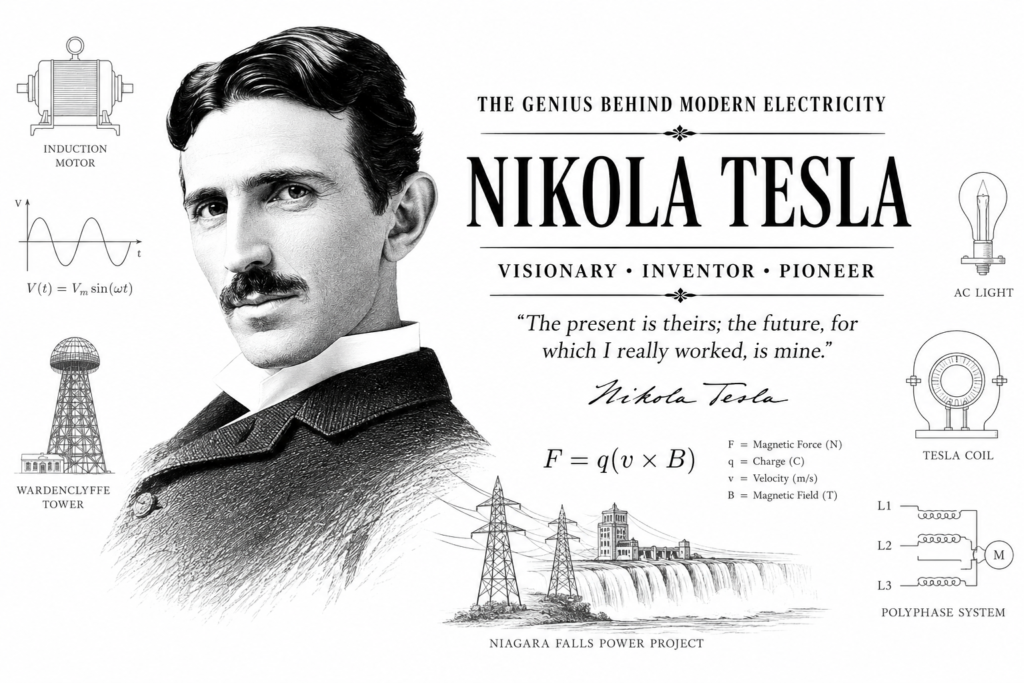
The nikola tesla biography is one of the most fascinating stories in the history of science and technology. Few individuals have influenced the modern world as deeply as Nikola Tesla, yet for decades his contributions remained overshadowed by others. He was a brilliant inventor, a physics pioneer, an engineer, and a visionary thinker whose ideas were often decades ahead of his time.
When we turn on lights, use electric motors, or benefit from large power grids, we are experiencing the impact of Tesla’s revolutionary work. His remarkable life was filled with triumphs, failures, financial struggles, scientific breakthroughs, and extraordinary predictions about the future.
This nikola tesla biography explores his early life, personality, achievements, eccentric habits, scientific contributions, and why he deserves far greater recognition as one of humanity’s greatest inventors.
Early Life and Smiljan Birth (1856)
Nikola Tesla was born on July 10, 1856, in Smiljan, a village that was then part of the Austrian Empire and is now located in Croatia. His Smiljan birth occurred during a violent thunderstorm, a fact that later became part of the legend surrounding his life.
Tesla’s father, Milutin Tesla, was a Serbian Orthodox priest, while his mother, Georgina Đuka Tesla, possessed exceptional practical intelligence and created household tools despite having no formal education.
From childhood, Tesla displayed extraordinary mental abilities. He possessed a photographic memory and could perform complex calculations entirely in his mind. These talents contributed significantly to the future success described throughout this nikola tesla biography.
Childhood Imagination and Early Childhood Visions
Tesla often described experiencing vivid mental images and flashes of light. These early childhood visions allowed him to visualize machines with incredible precision before building them.
Unlike many inventors who relied heavily on sketches, Tesla could construct entire devices mentally, test them, identify flaws, and refine designs before creating physical prototypes.
This unique creative process became one of the defining features of his genius mindset.
His remarkable hyper-focus enabled him to dedicate extraordinary amounts of mental energy to solving scientific problems.
Education and the Birth of a Scientific Dream (1870 – 1881)
Tesla studied engineering and mathematics in Europe. During his university years, he became fascinated by electricity and began thinking about ways to improve existing electrical systems.
At the time, direct current systems dominated electrical engineering. Tesla believed a better solution existed.
While studying electrical machines, he conceived the revolutionary idea of using alternating current. This concept would eventually transform the history of electricity and become the foundation of modern power systems.
Although Tesla never formally completed a university degree, his knowledge often surpassed that of many professionally trained engineers.
Arrival in America and the Edison Era (1884)
In 1884, Tesla arrived in New York with little money but enormous ambition.
He soon found employment under Thomas Edison, one of the most famous inventors in the world.
Initially, Tesla admired Edison. However, significant disagreements emerged regarding electrical systems.
This period eventually led to the famous edison vs tesla rivalry that would become one of the greatest scientific competitions in history.
Edison strongly supported direct current (DC), while Tesla believed alternating current (AC) was vastly superior for transmitting electricity across long distances.
The Mathematics Behind Alternating Current
One reason Tesla’s system succeeded was mathematical efficiency.
Alternating current can be represented as:
V(t) = Vₘ sin(ωt)
Where:
- V(t) = voltage at time t
- Vₘ = maximum voltage
- ω = angular frequency
- t = time
Electrical power is calculated as:
P = VI
Where:
- P = power
- V = voltage
- I = current
For the same power:
I = P/V
Increasing voltage reduces current.
Energy loss in transmission lines is:
Loss = I²R
Where:
- I = current
- R = resistance
Because alternating current can easily increase voltage using transformers, current decreases dramatically and transmission losses become much smaller.
This mathematical advantage helped make tesla alternating current the global standard.
Partnership with Westinghouse and Global Recognition (1888 – 1895)
Tesla’s fortunes changed when he partnered with George Westinghouse.
The Westinghouse association became one of the most important collaborations in technological history.
Westinghouse recognized Tesla’s genius and purchased many of his patents.
Together they developed practical alternating current systems that challenged Edison’s direct current networks.
This partnership transformed Tesla from an unknown inventor into a major scientific figure.
The Revolutionary Invention of the Induction Motor
One of Tesla’s greatest achievements was the creation of the tesla induction motor.
Traditional motors faced significant limitations.
Tesla’s design utilized a rotating magnetic field to generate motion efficiently.
The principle behind a magnetic field can be represented by:
F = q(v × B)
Where:
- F = magnetic force
- q = electric charge
- v = velocity
- B = magnetic field
The induction motor became one of the most influential inventions in industrial history and remains widely used today.
Its success demonstrated Tesla’s extraordinary understanding of physics and engineering.
The Polyphase System and Electrifying the World
Tesla did not merely invent individual machines.
He developed the tesla polyphase system, a complete electrical infrastructure capable of generating, transmitting, and distributing power efficiently.
This breakthrough changed civilization.
Factories became more productive.
Cities gained reliable electricity.
Economic growth accelerated.
The modern electrical grid traces much of its foundation to Tesla’s work.
The importance of this innovation cannot be overstated when discussing any serious nikola tesla biography.
Niagara Falls Project (1895 – 1896)
One of Tesla’s greatest public victories was the tesla niagara falls project.
Engineers sought to harness the immense power of Niagara Falls and distribute electricity over long distances.
Tesla’s alternating current technology provided the solution.
The power generated at Niagara Falls successfully reached Buffalo, New York.
This achievement proved the superiority of alternating current beyond doubt.
It marked a turning point in the history of electricity and established Tesla as one of the leading Gilded Age scientists.
Tesla Coil and Scientific Fame
Tesla became famous for creating spectacular demonstrations involving electricity.
His most recognizable invention remains the tesla coil explained through its ability to produce dramatic high voltage discharges.
The Tesla Coil operates using resonant circuits and electromagnetic induction.
Resonance occurs when:
f = 1 / (2π√LC)
Where:
- f = resonant frequency
- L = inductance
- C = capacitance
The device remains important in electrical engineering education and scientific demonstrations.
A Polyglot Inventor with Extraordinary Abilities
Tesla spoke multiple languages fluently, making him a true polyglot inventor.
He reportedly understood or spoke:
- Serbian
- English
- German
- French
- Italian
- Czech
- Hungarian
- Latin
His linguistic abilities allowed him to study scientific literature from across Europe and communicate with leading researchers worldwide.
Combined with his photographic memory, these skills amplified his intellectual power.
Eccentric Habits and Obsession with Number Three
Tesla’s brilliance was accompanied by unusual behavior.
His eccentric habits fascinated journalists and colleagues alike.
Among the most famous was his obsession with number three.
He often:
- Walked around buildings three times.
- Preferred hotel rooms divisible by three.
- Repeated actions in sets of three.
Some historians connect these behaviors to obsessive tendencies.
While unusual, they formed part of the unique personality that fueled his extraordinary creativity.
Celibacy and Focus on Invention
Tesla never married.
He believed romantic relationships could distract him from scientific work.
His commitment to celibacy and focus became a central element of his life philosophy.
Tesla often stated that his inventions required complete dedication.
This relentless commitment helped produce hundreds of innovations but may also have contributed to his loneliness during later years.
Wireless Dreams and Technological Prophecy (1900 – 1915)
Tesla’s imagination extended far beyond contemporary science.
He envisioned:
- Wireless communication
- Portable devices
- Global information networks
- Wireless energy transfer
His experiments in tesla wireless power transmission sought to deliver electricity without wires across vast distances.
Although these ambitions were never fully realized, many of his predictions resemble modern technologies such as smartphones, wireless communication systems, and the internet.
These remarkable forecasts contributed greatly to Tesla’s reputation as a Nikola Tesla visionary inventor.
Financial Ruin and the Wardenclyffe Tower Project
Tesla’s greatest dream became his greatest disappointment.
The wardenclyffe tower project aimed to transmit information and energy globally.
Financing initially came from influential investors.
However, costs increased dramatically.
Funding disappeared.
Construction stopped.
The tower was eventually demolished.
This failure contributed significantly to Tesla’s financial ruin.
Many historians consider Wardenclyffe one of the most ambitious projects ever attempted by a single inventor.
Uncredited Discoveries and Legal Battles
Tesla frequently struggled to receive recognition for his work.
Several inventions became subjects of legal battles and patent disputes.
His extensive collection of nikola tesla patents demonstrated his enormous creative output.
Yet many of his discoveries generated wealth for others rather than for Tesla himself.
These uncredited discoveries contributed to his image as an unsung inventor hero whose contributions were not fully appreciated during his lifetime.
Pigeon Obsession and Twilight Years (1920 – 1943)
During his later years, Tesla lived largely alone in New York hotels.
He developed a famous pigeon obsession and spent considerable time feeding birds.
Many observers viewed this behavior as unusual, but it reflected his deep emotional attachment to living creatures.
The twilight years of Tesla’s life were marked by declining finances and reduced public attention.
Despite these hardships, he continued developing ideas and making technological predictions.
Tesla Death Hotel New Yorker (1943)
Nikola Tesla died on January 7, 1943, in Room 3327 of the Hotel New Yorker.
The Tesla death hotel New Yorker story symbolizes the tragic contrast between his achievements and his circumstances at death.
Although he passed away with limited financial resources, his influence on technology continued growing long after his death.
Today, historians increasingly recognize him as one of the greatest inventors in human history.
Why Tesla Deserves More Recognition
Many people know Edison’s name but remain unfamiliar with Tesla’s achievements.
Yet Tesla’s contributions include:
- Modern AC power systems
- Induction motors
- Polyphase electrical networks
- Wireless communication concepts
- Advanced electrical engineering principles
His visionary thinking helped shape technologies that define modern civilization.
The enduring importance of his work makes the nikola tesla biography essential reading for anyone interested in science, innovation, and human creativity.
FAQs
Who was Nikola Tesla?
Nikola Tesla was a Serbian American inventor, electrical engineer, and visionary scientist best known for developing alternating current power systems and numerous electrical inventions.
Why is Nikola Tesla famous?
He is famous for pioneering alternating current electricity, inventing the induction motor, developing the polyphase system, and predicting future wireless technologies.
Did Tesla really invent radio?
Tesla contributed significantly to radio technology and held important patents related to wireless communication. Historians continue discussing the extent of his role compared with other inventors.
Why was Tesla considered eccentric?
Tesla displayed unusual habits, including an obsession with number three, strict routines, extraordinary cleanliness, and strong emotional attachment to pigeons.
Was Nikola Tesla rich?
No. Despite his revolutionary inventions, Tesla experienced financial difficulties and died with limited personal wealth.
Conclusion
The nikola tesla biography reveals far more than the story of an inventor. It is the story of a visionary whose imagination exceeded the limits of his era. Tesla transformed the history of electricity, revolutionized power generation, inspired future technologies, and demonstrated what relentless curiosity can achieve.
His life combined brilliance, sacrifice, scientific romanticism, triumph, disappointment, and technological prophecy. Although he endured financial hardship, legal disputes, and periods of neglect, his legacy ultimately prevailed.
Today, the world increasingly recognizes Nikola Tesla not merely as an inventor, but as one of the greatest minds in human history. His achievements continue powering our homes, industries, and technologies, ensuring that his genius will illuminate the future for generations to come.