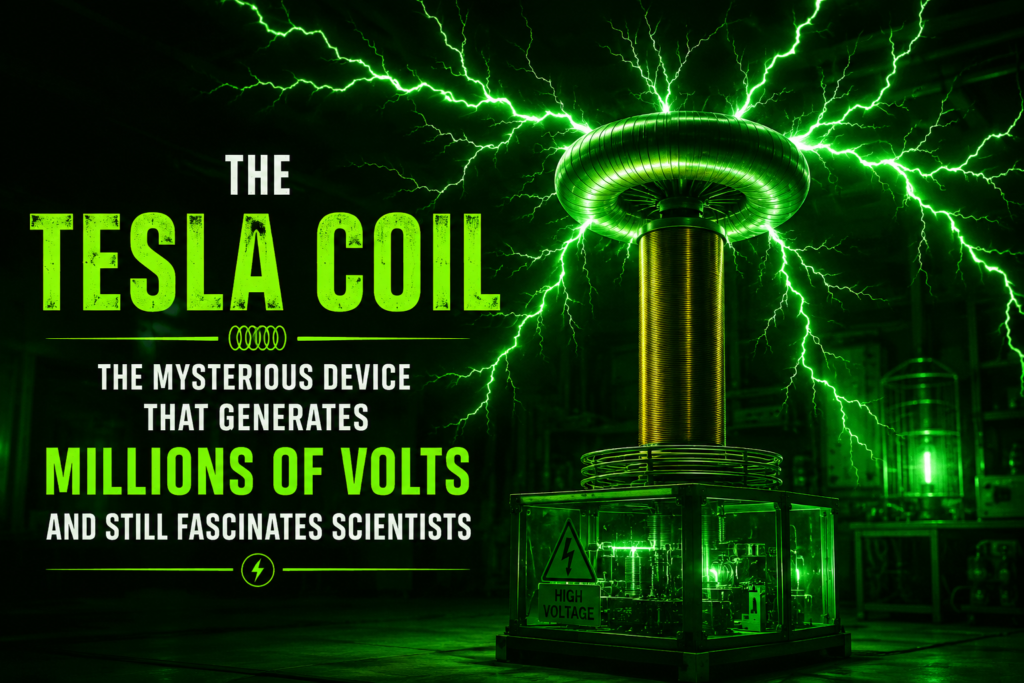
The tesla coil remains one of the most recognizable inventions in the history of electrical engineering. More than a century after its creation, this remarkable machine continues to amaze scientists, engineers, students, and technology enthusiasts. With its spectacular lightning like discharges, glowing plasma streamers, and ability to generate extremely high voltages, the tesla coil stands as a symbol of scientific creativity and innovation.
Invented by Nikola Tesla visionary inventor, the tesla coil was originally developed to explore wireless energy transmission and high frequency electrical phenomena. Although modern technology has evolved far beyond Tesla’s original experiments, the principles behind the tesla coil continue to influence radio technology, medical equipment, scientific demonstrations, and high voltage research.
Today, the tesla coil is studied not only for its historical importance but also for its role in understanding electrical resonance, wireless energy transfer, and high-frequency oscillator systems. Its fascinating operation provides valuable insights into some of the most fundamental concepts of high-voltage physics.
Nikola Tesla and the Birth of the Tesla Coil (1891)
The tesla coil was invented in 1891 by Nikola Tesla while conducting experiments involving high frequency alternating currents. Tesla was searching for better methods of transmitting electrical energy and investigating the possibilities of wireless communication.
Many historians connect the invention of the tesla coil with Tesla’s broader work on tesla alternating current, which revolutionized electrical power distribution across the world.
Tesla’s experiments demonstrated that electrical energy could be transformed into extremely high voltages while maintaining relatively low current levels. This breakthrough laid the foundation for numerous future discoveries in electrical engineering.
What Is a Tesla Coil?
A tesla coil is a specialized resonant transformer circuit designed to generate very high voltage, low current, and high frequency alternating current electricity.
Unlike conventional transformers that use iron cores, a tesla coil functions as an air-core transformer. This design enables efficient operation at extremely high frequencies.
The primary purpose of a tesla coil is to create dramatic electrical discharges through resonance. Under the right conditions, it can produce electrical arcs measuring several feet in length.
The main components include:
- Primary coil
- Secondary coil
- Spark gap transmitter
- Capacitor bank
- Top load capacitor
- Toroidal terminal
- Power supply
Together, these elements create a powerful system capable of producing millions of volts.
Main Components of a Tesla Coil
Primary Coil
The primary coil consists of a small number of thick wire turns. It carries high current and forms part of the primary tank circuit.
Secondary Coil
The secondary coil contains hundreds or thousands of turns of fine wire. This large step-up turns ratio allows enormous voltage amplification.
Spark Gap
The spark gap transmitter acts as a switch. When voltage reaches a certain level, the air breaks down and allows current to flow.
Capacitor
The capacitor stores electrical energy before releasing it rapidly into the primary circuit.
Toroidal Terminal
The toroidal terminal serves as a top load capacitor. It helps control the electric field and improves voltage performance.
Air Core Structure
Unlike conventional transformers, the tesla coil uses an air-core transformer, reducing losses at high frequencies.
How Does a Tesla Coil Work?
The operation of a tesla coil relies on electrical resonance.
First, energy is stored inside the capacitor. When the spark gap fires, the stored energy flows into the primary coil.
This creates oscillations within the primary tank circuit.
The resonant frequency can be calculated using:
f = 1 / (2π√LC)
Where:
- f = Resonant frequency (Hz)
- L = Inductance (H)
- C = Capacitance (F)
When the primary and secondary circuits are tuned to the same resonant frequency through resonant frequency tuning, energy transfers efficiently between them.
This process is similar to pushing a swing at exactly the right moment. Small inputs build into large oscillations.
The result is an enormous voltage increase within the secondary coil.
The Mathematics Behind Voltage Amplification
A transformer generally follows:
V₂ / V₁ = N₂ / N₁
Where:
- V₁ = Primary voltage
- V₂ = Secondary voltage
- N₁ = Primary turns
- N₂ = Secondary turns
Example:
If:
- Primary turns = 10
- Secondary turns = 1000
- Input voltage = 10,000 V
Then:
V₂ = (1000 ÷ 10) × 10,000
V₂ = 1,000,000 V
This simplified calculation demonstrates how a tesla coil can theoretically produce one million volts or more.
In practice, resonance further boosts the voltage beyond simple transformer action.
Why Does the Tesla Coil Generate Millions of Volts?
Several factors contribute to the extraordinary voltage output:
Resonance
Electrical resonance allows energy accumulation over many oscillation cycles.
High Frequency Oscillation
A high-frequency oscillator generates rapid current reversals, improving energy transfer.
Large Turns Ratio
The secondary coil contains far more turns than the primary coil.
Capacitance Matching
Proper capacitance matching improves resonance efficiency.
Magnetic Coupling
The magnetic coupling coefficient between coils affects performance and power transfer.
These combined effects enable voltage outputs reaching millions of volts.
The Science of Lightning Like Discharges
One of the most exciting features of a tesla coil is its ability to create visible lightning.
As voltage rises, the surrounding air begins experiencing ionization of air. Molecules become electrically charged, turning the air into a conductive plasma.
Eventually, dielectric breakdown occurs.
The breakdown voltage of dry air is approximately:
3,000,000 V/m
This means roughly three million volts are required to force electricity through one meter of air under ideal conditions.
Once breakdown occurs, electric arc discharge pathways form, producing brilliant plasma streamers.
These streamers are often mistaken for natural lightning but are controlled laboratory discharges.
Plasma Streamers and Coronal Discharge
The glowing tendrils extending from a tesla coil are known as plasma streamers.
They occur because high voltage electricity ionizes nearby air.
Coronal discharge often appears before full arc formation. It creates a faint glow around conductive surfaces.
Scientists study plasma streamers to better understand:
- Atmospheric electricity
- Lightning physics
- Plasma behavior
- Electrical insulation systems
This makes the tesla coil a valuable lightning generation device for educational research.
The Skin Effect and Human Safety
Many tesla coil demonstrations show performers safely interacting with electrical discharges.
This is partly explained by skin effect electricity.
The skin depth equation is:
δ = √(2ρ / ωμ)
Where:
- δ = Skin depth
- ρ = Resistivity
- ω = Angular frequency
- μ = Magnetic permeability
At high frequencies, current tends to flow near the outer surface of conductors.
Because tesla coils produce high voltage low current electricity, the risk differs significantly from conventional power systems.
However, tesla coils remain dangerous and should only be operated by trained individuals following proper safety procedures.
Wireless Energy Experiments
Tesla envisioned transmitting electrical power without wires.
The tesla coil became the foundation for his investigations into tesla wireless power transmission.
By creating intense electromagnetic fields, Tesla demonstrated wireless gas discharge lighting. Lamps could glow without direct electrical connections.
Although large scale wireless power systems remain challenging, modern wireless charging technologies continue to draw inspiration from Tesla’s pioneering work.
Tesla Coil Applications in Science and Technology
Radio Research
Tesla coil technology contributed to early radio development and influenced work related to tesla and marconi radio invention.
Medical Research
Early researchers explored high frequency electrical currents for therapeutic applications.
Education
Universities use tesla coils for scientific demonstration and electrical engineering instruction.
Entertainment
Large tesla coils frequently appear in museums, science centers, and laboratory entertainment exhibits.
High Voltage Testing
Engineers use similar principles to test insulation systems and electrical equipment.
The Tesla Coil and Modern Physics
Modern researchers continue studying tesla coil phenomena because they demonstrate:
- RF radiation
- Electrostatic discharge
- Electrical resonance
- Inductive reactance
- High-frequency transients
- Plasma dissipation
The device remains a practical example of multiple advanced physics concepts working together.
The Legacy of Tesla’s Electrical Vision
Tesla’s broader achievements extended well beyond the tesla coil.
His innovations included the tesla induction motor, the tesla polyphase system, and the discovery of the rotating magnetic field principle.
These breakthroughs transformed global electricity generation and distribution.
The tesla coil represents just one chapter in Tesla’s extraordinary scientific journey.
Why Scientists Still Study the Tesla Coil Today
More than 130 years after its invention, the tesla coil remains relevant because it provides a simple yet powerful demonstration of complex physical principles.
Researchers use it to investigate:
- High-voltage physics
- Plasma science
- Resonant transformer circuit behavior
- Wireless energy concepts
- Electromagnetic field interactions
Its visual nature makes it one of the most effective educational tools in electrical engineering.
Frequently Asked Questions
What voltage can a tesla coil produce?
Small tesla coils may generate tens of thousands of volts, while large systems can exceed several million volts.
Is a tesla coil a transformer?
Yes. It is a specialized resonant transformer circuit that uses air core construction and operates at high frequencies.
Why does a tesla coil create lightning?
The high voltage causes ionization of air and dielectric breakdown, producing visible plasma streamers and electrical arcs.
Can a tesla coil transmit electricity wirelessly?
It can transfer energy wirelessly over short distances and was central to Tesla’s wireless power experiments.
Are tesla coils still used today?
Yes. They are widely used in education, scientific demonstrations, research laboratories, and high voltage testing.
Conclusion
The tesla coil remains one of the most fascinating inventions ever created. By combining resonance, electromagnetic induction, and high frequency electrical oscillations, it can generate millions of volts and create spectacular displays of artificial lightning.
More importantly, the tesla coil serves as a gateway to understanding advanced concepts such as electrical resonance, plasma physics, wireless energy transfer, and high-voltage engineering. Its influence can still be seen in modern technology, scientific research, and educational demonstrations worldwide.
More than a century after Nikola Tesla introduced this remarkable invention, the tesla coil continues to inspire curiosity, innovation, and scientific exploration. Its enduring legacy proves that great ideas can transcend generations and remain relevant long after their creation.