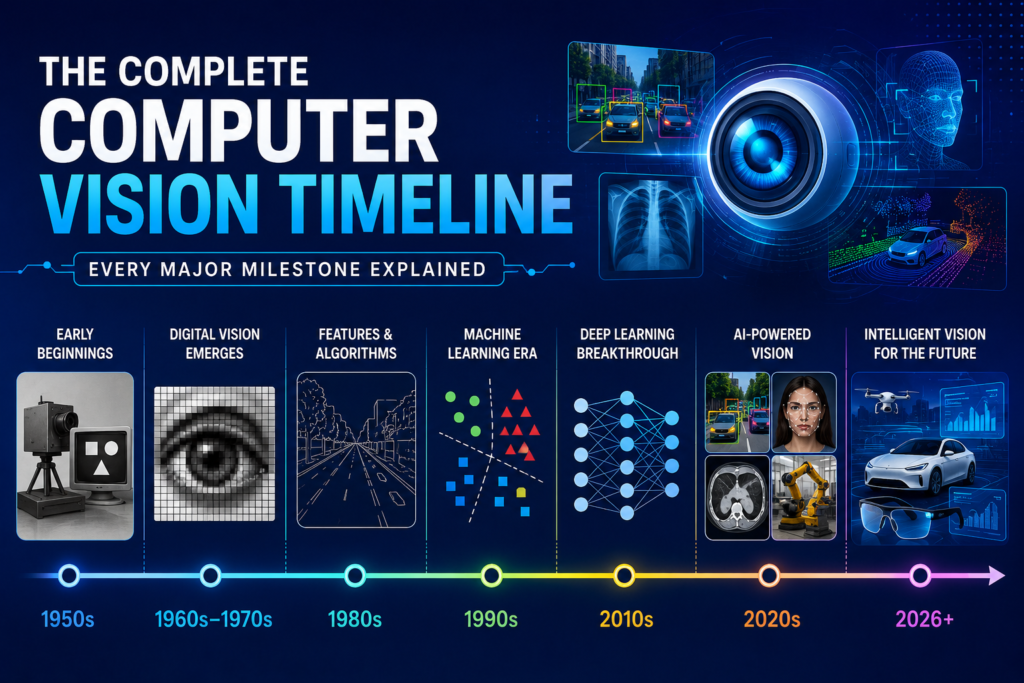
If you want to truly understand where artificial intelligence is headed, you need to understand where it came from. The computer vision timeline stretches from hand-drawn diagrams of wooden blocks in the early 1960s to systems that can generate photorealistic images, diagnose cancer, and drive cars without human input. Every step forward built on the last, and the pace has only accelerated.
This article traces the computer vision timeline decade by decade, covering the experiments, the people, the papers, and the technologies that shaped the modern era of visual AI.
Why the Computer Vision Timeline Matters
Computer vision is not just an academic discipline. It is the technology behind your phone unlocking when it sees your face, the system that flags suspicious luggage at airport security, and the algorithm that helps radiologists catch tumors earlier. Understanding the computer vision timeline gives you a clearer picture of how these tools actually work and why they work the way they do.
The field has moved in bursts rather than a straight line. Long periods of gradual progress were followed by sudden breakthroughs that made previous approaches obsolete almost overnight. Knowing when and why those shifts happened makes the current moment in visual AI much easier to understand.
The First Experiments (1950 – 1960)
The computer vision timeline does not start with a single invention. It begins with a question: can a machine learn to recognize patterns from visual input?
Frank Rosenblatt’s Perceptron, introduced in 1957, was the first serious answer. The Perceptron was an early neural network that could learn to classify simple inputs, including visual patterns, by adjusting weighted connections between nodes. It was nowhere near capable of recognizing complex images, but it proved that a machine could learn from data rather than being programmed with fixed rules. That insight would not bear full fruit for another fifty years, but the seed was planted.
Early optical character recognition systems also appeared during this decade, using template matching to identify printed letters. The history of optical character recognition in these years was slow and brittle, limited to specific fonts under controlled conditions, but it was the first attempt to make machines read.
Larry Roberts and the Block World (1960 – 1970)
The 1960s are where the computer vision timeline truly begins as a formal research discipline. Larry Roberts published his landmark MIT dissertation in 1963 titled “Machine Perception of Three-Dimensional Solids.” Using simple geometric objects in controlled lighting, Roberts showed that a computer could extract 3D structure from a 2D image by identifying edges and applying geometric reasoning.
His block world experiments are now a foundational reference point on every computer vision timeline. They established the basic workflow of visual analysis: find edges, identify shapes, infer structure. That pipeline, refined and extended almost beyond recognition, still underpins many modern systems.
The history of edge detection began here. Roberts developed one of the first edge detection operators, and the idea of finding meaningful boundaries within an image became a central problem for the next two decades.
In 1966, Seymour Papert and Marvin Minsky launched the MIT Summer Vision Project with the goal of solving computer vision over a single summer. This famously underestimated the problem. The project revealed how deeply complex visual perception really is, setting research priorities that lasted for decades.
Image Processing and Pattern Recognition (1970 – 1980)
The 1970s brought a wave of mathematical rigor to the computer vision timeline. Researchers developed systematic image processing algorithms for filtering, enhancing, and analyzing images. The focus shifted toward building a theoretical foundation for what the field was actually trying to do.
David Marr at MIT proposed one of the most influential frameworks in the history of visual AI during the late 1970s. He argued that vision should be understood at three levels: the computational goal, the algorithm, and the physical implementation. His layered model of visual processing from raw edges to full 3D scene understanding gave researchers a roadmap that guided work for a generation.
The history of pattern recognition matured significantly during this period. Statistical classifiers, decision trees, and early probabilistic models were applied to visual classification problems. Hidden Markov models, originally developed for speech, were adapted for visual sequences.
Spatial pyramid matching, while not formalized until later, had its conceptual roots in 1970s research into hierarchical image representations. The idea of analyzing an image at multiple scales simultaneously became a recurring theme across the computer vision timeline.
Neural Architectures Arrive (1980 – 1990)
The 1980s are often underappreciated on the computer vision timeline, but they contain some of its most important developments. Kunihiko Fukushima introduced the Neocognitron by Fukushima in 1980. It was a hierarchical, multilayered neural network specifically designed for visual pattern recognition, inspired directly by the structure of the mammalian visual cortex. Simple cells detected local features, and complex cells combined them into increasingly abstract representations.
The history of the Neocognitron is essential context for understanding modern convolutional networks. Yann LeCun took Fukushima’s architecture and combined it with backpropagation training to create LeNet in the late 1980s. LeNet could reliably read handwritten digits and was deployed in actual bank check processing systems, making it one of the first practical applications of neural networks to visual tasks.
The history of image processing during the 1980s also saw the development of the Canny edge detector, published in 1986, which remains one of the most widely used tools in the field. Its combination of noise reduction, gradient detection, and edge thinning gave researchers a reliable and principled method for extracting boundaries from images.
OpenCV, SIFT, and the Feature Era (1990 – 2005)
The 1990s and early 2000s mark a critical stretch of the computer vision timeline. The AI funding winters had created pressure to build systems that actually worked, and researchers responded with a wave of practical, engineered solutions.
The Viola-Jones object detection framework, published in 2001, was a milestone. It used simple Haar-like features and a cascade of classifiers to detect faces in real time on standard hardware. It was fast, robust, and deployable, representing the kind of engineering breakthrough that makes a technology go from laboratory to product.
SIFT, or Scale-Invariant Feature Transform, introduced by David Lowe in 1999 and published in full in 2004, became one of the most important feature extraction methods ever developed. SIFT could identify distinctive keypoints in images that remained stable across changes in scale, rotation, and lighting. It powered object recognition, image stitching, and 3D reconstruction for the better part of a decade.
The history of OpenCV is a key chapter in this part of the computer vision timeline. Intel began developing the open-source library in 1999 and released version 1.0 in 2006. OpenCV gave the entire research and developer community a shared toolkit, lowering the barrier to entry dramatically and accelerating experimentation across the globe.
The Computer Vision Timeline Turns: ImageNet and Deep Learning (2006 – 2012)
This is the pivot point of the entire computer vision timeline. Fei-Fei Li at Stanford began building ImageNet in 2006, eventually assembling over 14 million labeled images across more than 20,000 categories. The ImageNet Large Scale Visual Recognition Challenge, launched in 2010, gave researchers a standardized benchmark to measure progress against year by year.
Geoffrey Hinton and his students at the University of Toronto were quietly building deep neural networks that nobody in the mainstream believed could work. The prevailing view was that gradient-based training of deep networks was fundamentally broken. Hinton showed it was not, using improved weight initialization, rectified linear units, and dropout regularization.
Then came 2012. AlexNet (2012) entered the ImageNet challenge and cut the top-5 error rate from 26 percent to 15 percent in a single year. Nothing in the history of the competition had ever produced a jump that large. Alex Krizhevsky, Ilya Sutskever, and Geoffrey Hinton had used a deep convolutional network trained on two GPUs in parallel. Every serious researcher in computer vision changed direction almost immediately.
From AlexNet to ResNet: The Architecture Race (2012 – 2016)
The years immediately following AlexNet are among the most productive on the computer vision timeline. Researchers competed to build deeper, more accurate, and more efficient architectures.
VGGNet, developed at Oxford in 2014, showed that depth through small 3×3 convolutional filters was a key ingredient in high accuracy. GoogLeNet introduced the Inception module the same year, enabling very deep networks to be built without an explosion in computational cost. ResNet, published by Microsoft Research in 2015, solved the vanishing gradient problem for very deep networks using skip connections, enabling architectures with over 100 layers and achieving accuracy that surpassed average human performance on ImageNet.
Transfer learning in computer vision became a dominant paradigm during this period. Because large networks trained on ImageNet had learned rich and general visual representations, researchers found they could fine-tune them on specialized datasets with far fewer examples and get excellent results. This made powerful computer vision accessible to any research group or company with a modest dataset and a GPU.
Object Detection Gets Fast and Accurate (2013 – 2018)
Classification tells you what is in an image. Detection tells you where. The history of object detection evolved rapidly through this part of the computer vision timeline.
The history of R-CNN began in 2013 with Ross Girshick’s proposal to combine selective region proposals with convolutional features. The history of Faster R-CNN in 2015 merged the proposal and detection networks, making the system dramatically quicker while maintaining accuracy. Anchor boxes in object detection were introduced as part of this system, providing a principled way to predict bounding boxes of varying sizes and aspect ratios.
The history of YOLO brought a completely different philosophy. Rather than running a network multiple times over candidate regions, YOLO treated detection as a single regression problem, predicting all boxes in one pass. The speed gains were remarkable. The single shot detector, or SSD, offered another take on fast detection that became widely adopted in mobile and embedded applications.
Faces, Generation, and Ethics (2014 – 2022)
The computer vision timeline after 2014 branches in multiple directions simultaneously. Facial recognition reached human-level accuracy for the first time. Generative Adversarial Networks, introduced by Ian Goodfellow in 2014, taught machines to create images rather than just analyze them. Deepfakes emerged around 2017 using these generative techniques to swap faces in video with disturbing realism, triggering urgent conversations about manipulation and trust.
The history of DALL-E, released by OpenAI in 2021, showed that vision and language could be tightly fused, allowing users to generate images from text descriptions. The history of Stable Diffusion in 2022 made high-quality image generation available to anyone with a consumer GPU. The history of Midjourney brought artistic generation to a mass audience through a simple chat interface.
Medical imaging AI, self-driving cars and computer vision, and computer vision in manufacturing all matured during this period into large commercial industries, applying the same underlying deep learning tools to wildly different domains.
Vision Transformers and Multimodal AI (2020 – 2026)
The most recent chapter of the computer vision timeline is defined by transformers. Vision transformers, or ViT, published in 2020, applied the self-attention mechanism from language models to sequences of image patches, achieving state-of-the-art results on major benchmarks and challenging the decade-long dominance of convolutional networks.
The history of multimodal AI represents where the computer vision timeline meets the language model timeline. Systems like GPT-4V, Gemini, and Claude can process both text and images together, enabling visual question answering, document analysis, chart reading, and complex reasoning over images. Video understanding in AI has also advanced rapidly, with models now capable of describing and summarizing video content at scale.
The history of pose estimation has produced real-time skeleton tracking from single cameras. The history of depth estimation has advanced through self-supervised learning. The history of image segmentation has moved from pixel-level labeling to interactive and open-vocabulary approaches. Every branch of the computer vision timeline is active and accelerating.
Frequently Asked Questions
What is the most important milestone on the computer vision timeline?
Most researchers point to AlexNet in 2012 as the single most transformative event on the computer vision timeline. It demonstrated that deep convolutional networks trained on large labeled datasets could dramatically outperform all previous approaches, triggering the shift to deep learning that defines the field today.
Who are the key figures in the computer vision timeline?
Larry Roberts laid the groundwork in the 1960s. David Marr provided the theoretical framework in the 1970s. Kunihiko Fukushima and Yann LeCun built the neural architectures in the 1980s. Geoffrey Hinton revived deep learning in the 2000s. Fei-Fei Li created the dataset that made modern benchmarking possible. Each of them represents a different era of the computer vision timeline.
When did real-time computer vision become possible?
Real-time computer vision for specific tasks like face detection became possible in the early 2000s with the Viola-Jones algorithm. Real-time deep learning-based detection became practical around 2015 with the introduction of YOLO. Real-time neural processing on mobile devices became widespread by 2017 to 2019 with the spread of dedicated neural processing units in smartphones.
What is the difference between computer vision and image processing?
Image processing transforms or enhances images without necessarily understanding them. Computer vision attempts to extract semantic meaning from images, such as identifying objects, understanding scenes, and interpreting context. The computer vision timeline shows how the field progressively moved from the former toward the latter.
What comes next on the computer vision timeline?
The frontier today is multimodal reasoning, where vision is combined with language and action. Systems that can not just see and describe but plan and act based on visual input represent the next major step. Embodied AI, which places vision models in robots and physical agents, is an area of intense current research.
Conclusion
The computer vision timeline is a story of patient science interrupted by sudden revolution. Decades of foundational work in edge detection, pattern recognition, and neural architectures made the explosive progress of the 2010s possible. The breakthroughs of those years then enabled the multimodal and generative systems transforming industries today.
Understanding this timeline is not just a history lesson. It is a way of reading the present moment clearly. Every tool, every product, and every application built on computer vision technology today stands on the shoulders of researchers who worked for sixty years on problems that seemed impossibly hard. The timeline is not finished. The next chapter is being written right now.