The question of who invented computer vision does not have a single clean answer. Unlike the telephone or the light bulb, computer vision was not the product of one eureka moment in one laboratory. It was built slowly, over decades, by a remarkable group of scientists, engineers, and theorists who each added a critical piece to a puzzle that nobody fully understood. This article answers the question of who invented computer vision by tracing the real people behind the ideas, from the earliest academic experiments to the deep learning revolution that transformed the field forever.
Why Asking Who Invented Computer Vision Is Complicated
Most transformative technologies have origin stories that get simplified over time. The reality of who invented computer vision is genuinely complicated because the field draws from neuroscience, mathematics, electrical engineering, linguistics, and computer science simultaneously. Progress came in waves, with different researchers dominating different decades, and many foundational ideas were developed independently by people who had never met.
The question of who invented computer vision also depends on what you mean by the term. If you mean the first person to analyze images with a machine, the answer points to the late 1950s. If you mean the first person to build a complete visual recognition system, the answer shifts to the early 1960s. If you mean the first person to make computer vision practically useful at scale, the answer lands somewhere in the 2010s.
With that context in mind, here is the real story.
The Neuroscientists Who Made It Possible: Hubel and Wiesel (1959 – 1962)
Before anyone built a computer vision system, two neuroscientists named David Hubel and Torsten Wiesel figured out how biological vision actually works. Working at Harvard in the late 1950s and early 1960s, they inserted microelectrodes into the visual cortex of cats and mapped exactly which neurons fired in response to different visual stimuli.
Their discovery of simple cells, which respond to edges at specific orientations, and complex cells, which combine signals from simple cells to detect more abstract features, was a landmark in neuroscience. Hubel and Wiesel won the Nobel Prize in 1981 for this work. More importantly for the history of artificial vision, their findings gave engineers a biological blueprint. If the brain processes vision hierarchically, from edges to features to objects, maybe a machine could too. The entire architecture of modern convolutional neural networks echoes this discovery.
Understanding biological vision emulation is essential to answering who invented computer vision, because the most successful approaches were all, in some sense, attempts to replicate what Hubel and Wiesel had described.
Lawrence Roberts and the Block World (1963)
If one person deserves the title of inventor of computer vision as a formal discipline, it is Lawrence Roberts. His 1963 Ph.D. thesis at Massachusetts Institute of Technology, titled “Machine Perception of Three-Dimensional Solids,” is the founding document of the field.
Roberts built a system that could take a two-dimensional photograph of simple geometric objects and infer the three-dimensional structure behind it. He identified edges in the image, matched them to known shapes, and reconstructed the spatial layout of the objects. The system worked only on a narrow class of images, what researchers called the block world, but that was not the point. The point was that it worked at all.
His contribution to the history of edge detection is foundational. Roberts developed one of the first edge detection operators, a mathematical filter still referred to in textbooks today. He showed that meaningful visual information could be extracted from pixels using mathematical operations, which was the conceptual leap the whole field needed.
Roberts went on to make major contributions to the ARPANET, the precursor to the internet, but his 1963 thesis remains his most lasting scientific legacy. When people ask who invented computer vision, his name should always come first.
Seymour Papert, Marvin Minsky, and the Summer Vision Project (1966)
In 1966, two giants of artificial intelligence at Massachusetts Institute of Technology organized what is now one of the most famous failed experiments in computer science. Seymour Papert and Marvin Minsky launched the MIT Summer Vision Project, assigning an undergraduate student to solve computer vision as a summer project. The assumption was that the core of visual perception could be cracked in a few months.
It could not. The project ran for years and exposed just how hard the problem really was. Papert and Minsky are crucial figures in the story of who invented computer vision not because they solved it but because they forced the scientific community to confront its complexity honestly.
Marvin Minsky was one of the founders of the MIT Artificial Intelligence Laboratory, later the Machine Intelligence Laboratory, and spent decades pushing the field forward through both theoretical work and practical projects. Seymour Papert contributed landmark ideas about how children and machines learn, influencing both education and cybernetics. Together, they created the institutional framework at MIT that would support computer vision research for the next four decades.
David Marr and the Theory of Vision (1970s – 1980)
One of the most intellectually ambitious contributors to the question of who invented computer vision was David Marr, a British neuroscientist and psychologist at MIT who died tragically young in 1980 at the age of 35. His posthumously published book “Vision” laid out a complete theoretical framework for how visual perception works, at every level from the retina to conscious recognition.
Marr proposed that vision should be understood at three separate levels: the computational level, which asks what problem is being solved; the algorithmic level, which asks how it is solved; and the implementational level, which asks what physical system carries it out. This three-level framework became one of the most cited ideas in cognitive science and gave computer vision researchers a principled way to think about their work.
His concept of the primal sketch, a representation of the raw edges and boundaries in an image, was a direct precursor to modern feature extraction techniques. David Marr did not build the systems that eventually solved computer vision, but he told researchers what they should be trying to build and why. That contribution is impossible to overstate.
Kunihiko Fukushima and the Neural Blueprint (1980)
Yann LeCun is the name most associated with convolutional neural networks today, but the architecture he built on was invented by Kunihiko Fukushima, a Japanese researcher who introduced the Neocognitron in 1980. Fukushima explicitly designed his network around the findings of Hubel and Wiesel, creating simple cells that detected local features and complex cells that combined them hierarchically.
The Neocognitron was a direct answer to the question of who invented computer vision in neural network terms. Fukushima showed that a layered network modeled on the visual cortex could learn to recognize handwritten characters, a task that had resisted purely rule-based approaches. His work proved that the biological blueprint could be translated into a working computational system.
The history of the Neocognitron is often skipped in popular accounts because Fukushima did not have backpropagation as a training method, which limited what his networks could learn. But without the Neocognitron, the convolutional networks that followed would have looked very different.
Yann LeCun: Making Neural Networks Work (1989 – 1998)
Yann LeCun took Fukushima’s architecture and made it trainable. Working at Bell Labs in the late 1980s and early 1990s, LeCun applied backpropagation to a convolutional network to create LeNet, a system that could reliably recognize handwritten digits. LeNet was deployed in real bank check processing systems, making it one of the first practical applications of neural networks to visual tasks in history.
LeCun’s contribution to who invented computer vision spans multiple decades. He spent years in the wilderness defending neural networks during the periods when the broader research community had moved on to support vector machines and other methods. He never gave up on the idea that deep architectures trained end-to-end on data were the right path.
His advocacy, his architecture designs, and his public influence on the field are foundational. LeCun later became Chief AI Scientist at Meta, where he continues to push the boundaries of visual learning. He is one of the three recipients of the 2018 Turing Award alongside Geoffrey Hinton and Yoshua Bengio, an honor widely seen as the Nobel Prize of computing.
Geoffrey Hinton and the Deep Learning Revival (2006 – 2012)
Geoffrey Hinton and computer vision share one of the most important relationships in the history of artificial intelligence. Hinton spent decades at the University of Toronto working on deep neural networks during a long period when the mainstream research community considered them a dead end. Gradient descent through deep networks was thought to be broken by the vanishing gradient problem. Hinton proved the mainstream wrong.
His contributions to pre-training deep networks using restricted Boltzmann machines, along with improved training techniques like dropout and better weight initialization, showed that deep networks could in fact be trained effectively. The payoff came at the 2012 ImageNet competition, where his student Alex Krizhevsky’s AlexNet cut the error rate by a margin nobody thought possible.
That result changed the direction of the entire field. Within two years, virtually every major computer vision laboratory had abandoned traditional feature engineering in favor of deep learning. Hinton’s patience across decades of skepticism and his technical contributions at every stage make him one of the essential answers to who invented computer vision as it exists today. He shared the 2024 Nobel Prize in Physics for his foundational work on neural networks.
Fei-Fei Li and the Data Revolution (2006 – 2012)
No account of who invented computer vision is complete without Fei-Fei Li. While others were building architectures, Li recognized that the bottleneck was data. In 2006, she began assembling ImageNet, a dataset that would eventually contain over 14 million labeled images across more than 20,000 categories. It took years and thousands of contributors to build.
The ImageNet Large Scale Visual Recognition Challenge, launched in 2010, created the competitive benchmark that drove rapid progress through the early 2010s. Without ImageNet, AlexNet would have had nothing to train on. Without the challenge, there would have been no annual competition to force the pace of improvement.
Li’s contribution to andrew ng and computer vision intersects here as well. Andrew Ng, who had worked on large-scale neural network training through the Google Brain project, helped demonstrate that scale itself was a key ingredient in visual AI. His collaboration with colleagues at Google to train networks on millions of YouTube thumbnails in 2012 reinforced the lesson that data volume was as important as architecture.
Frequently Asked Questions
Who is considered the father of computer vision?
Lawrence Roberts is most commonly credited as the father of computer vision for his 1963 MIT Ph.D. thesis, which was the first formal attempt to build a machine that could interpret visual structure from two-dimensional images. Seymour Papert and Marvin Minsky are also foundational figures, as is David Marr for his theoretical contributions.
Did one person invent computer vision?
No. Computer vision was built by dozens of researchers across multiple countries and decades. It draws on neuroscience, mathematics, computer science, and engineering. The question of who invented computer vision is best answered by listing the key contributors from each era rather than pointing to a single inventor.
What role did MIT play in inventing computer vision?
Massachusetts Institute of Technology was the dominant institution in the early history of computer vision. Lawrence Roberts, Seymour Papert, Marvin Minsky, and David Marr all worked there at critical moments. The MIT AI Laboratory and its successors incubated many of the foundational ideas and trained generations of researchers who went on to lead the field elsewhere.
Why did it take so long to make computer vision work well?
The core problem was the combination of insufficient computing power, limited training data, and incomplete theoretical understanding. Hubel and Wiesel’s neuroscience gave a blueprint in 1959, and Roberts demonstrated a proof of concept in 1963, but it took five more decades to assemble the hardware, datasets, and algorithmic insights needed to make vision systems practically powerful. The deep learning breakthrough required modern GPUs, millions of labeled images, and training techniques that were only developed in the 2000s.
Who invented facial recognition?
The earliest facial recognition research was conducted in the 1960s by Woodrow Bledsoe, who manually marked facial features to build a recognition system. Modern automated facial recognition began in earnest with Turk and Pentland’s Eigenfaces paper in 1991 and accelerated sharply when deep learning was applied to the problem after 2012.
Conclusion
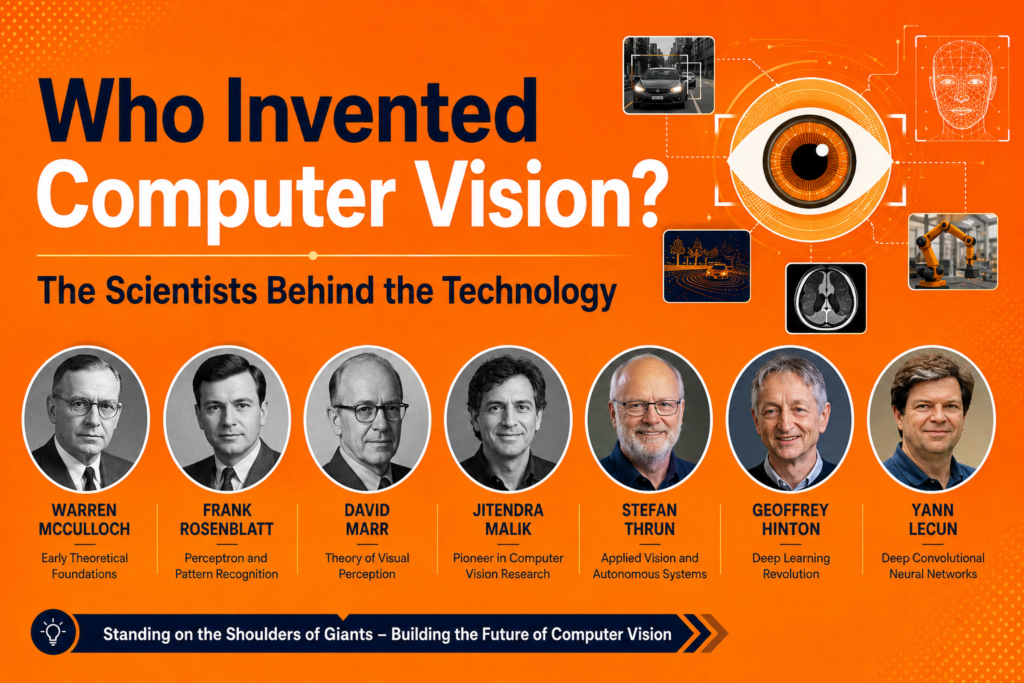
The answer to who invented computer vision is a constellation of names rather than one. Lawrence Roberts gave it its beginning. Seymour Papert and Marvin Minsky gave it its institutional home and exposed its true difficulty. David Marr gave it its theoretical foundations. Kunihiko Fukushima gave it its neural architecture. Yann LeCun made that architecture trainable. Geoffrey Hinton gave it the deep learning revolution. Fei-Fei Li gave it the data it needed to grow.
Every product and application built on computer vision technology today, from the smartphone in your pocket to the diagnostic AI in a hospital radiology department, owes a debt to each of these figures. The story of who invented computer vision is ultimately a story about what sustained scientific curiosity across generations can produce, even when the goal seems impossibly far away.