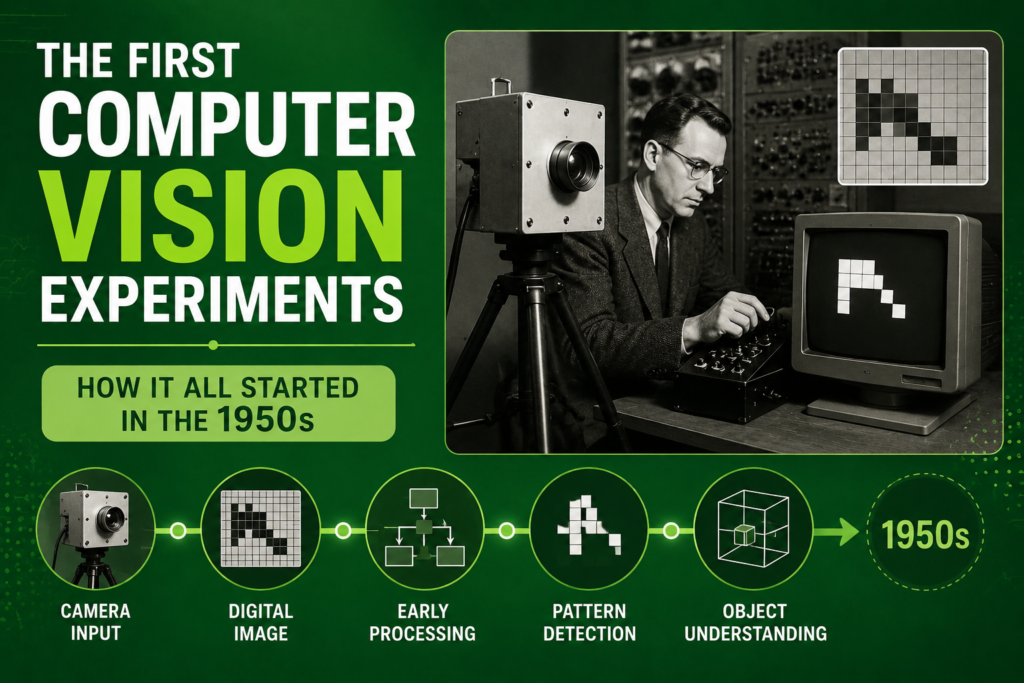
Long before neural networks, GPUs, or massive labeled datasets, a small group of researchers attempted something that sounded almost absurd at the time: teaching a computer to see. The first computer vision experiments were conducted on machines that had less processing power than a modern calculator, using cameras the size of small refrigerators, and yet they laid the conceptual groundwork for everything that followed. This article explores those early experiments in detail, the people behind them, the hardware they used, and why their work still matters today.
Why the First Computer Vision Experiments Even Happened
In the late 1950s, computers were room-sized machines used primarily for numerical calculations, code breaking, and scientific research. The idea of feeding a computer an image and having it understand that image was not an obvious next step. It required someone to ask a strange question: what if a photograph could be treated as data, just like a column of numbers?
The first computer vision experiments emerged from a combination of curiosity, military funding, and the broader excitement around early cybernetics, the study of control and communication in animals and machines. Researchers were already exploring how machines could mimic aspects of biological intelligence. Vision, being one of the most powerful tools biological organisms have, was a natural target.
The technical obstacles were enormous. Computers of the era had extremely limited memory. Storing even a small image as a grid of numbers consumed a significant fraction of available memory. Input and output devices capable of capturing and displaying images barely existed. Anyone attempting the first computer vision experiments had to build much of their own hardware before they could even begin the software work.
Getting an Image Into a Computer (1957 – 1960)
Before any first computer vision experiments could happen, researchers needed a way to get a photograph into a machine in digital form. This problem was solved, in part, at the National Bureau of Standards in 1957, when Russell Kirsch and his team built a device that could scan a photograph and convert it into a grid of numbers representing brightness values.
The famous result was a scanned image of Kirsch’s infant son, captured at a resolution of 176 by 176 pixels using grayscale scanning resolution that seems laughably small today but was a genuine technical triumph at the time. This image is often cited as the first digital image ever created, and it represents one of the true first computer vision experiments in the sense that it was the first time a photograph existed as data a computer could process.
Vidicon camera tubes, originally developed for television broadcasting, became the standard image capture technology for early vision research. These tubes converted light into an electrical signal that could be digitized, line by line, into a grid of brightness values. Computer-controlled cameras built around vidicon tubes allowed researchers to capture images directly into computer memory for the first time, opening the door to genuine experimentation.
Frank Rosenblatt and the Perceptron (1957 – 1962)
While Kirsch was solving the hardware problem, Frank Rosenblatt at the Cornell Aeronautical Laboratory was working on something different: could a machine learn to recognize patterns by adjusting its own internal parameters based on examples?
His Perceptron, introduced in 1957 and demonstrated on specialized hardware called the Mark I Perceptron in 1960, was designed to classify simple visual patterns using an array of photocells connected to adjustable weights. It was not, by modern standards, a vision system in any complete sense. But it represented one of the first computer vision experiments built around the principle of learning from data rather than following fixed instructions.
The Mark I Perceptron used a 20 by 20 grid of photocells, giving it 400 inputs, connected through potentiometers that represented adjustable weights. When the system made an error, an electric motor physically adjusted the potentiometers to correct it. The mechanical nature of this learning process is almost charming by today’s standards, but the underlying mathematical principle, adjusting weights to reduce error, is exactly what powers deep neural networks decades later.
The history of pattern recognition owes an enormous debt to Rosenblatt’s work, even though the limitations of single-layer perceptrons would later be famously criticized by Marvin Minsky and Seymour Papert in their 1969 book “Perceptrons,” which contributed to a temporary decline in neural network research.
Lawrence Roberts and the Block World (1960 – 1963)
The most important and most frequently cited of the first computer vision experiments came from Lawrence Roberts, a graduate student at MIT working on the TX-2 computer MIT, one of the most powerful computers in the world at the time.
Roberts’s 1963 Ph.D. thesis 1963, titled “Machine Perception of Three-Dimensional Solids,” tackled a problem nobody had seriously attempted before: given a single two-dimensional photograph of simple polyhedral objects, blocks, wedges, and other geometric shapes, could a computer determine the three-dimensional structure of the scene?
His approach involved several stages that would become a template for visual processing research for decades. First, the system performed line drawing extraction, identifying the edges in the photograph using mathematical operators that detected sharp changes in brightness. Second, it grouped these lines into junctions and regions corresponding to the faces of the objects. Third, it matched these regions against a library of known polyhedral shapes. Finally, it computed 3D solid coordinates for each object, effectively reconstructing the scene in three dimensions from a single 2D image.
This was an extraordinary achievement for its time. Roberts had to write edge extraction programs from scratch, working with image data that occupied a significant fraction of the TX-2’s available memory. The block world, controlled environments with simple geometric shapes under predictable lighting, was a deliberate simplification that made the problem tractable while still demonstrating the core principles.
The first computer vision experiments conducted by Roberts proved something profound: that a computer could go from raw pixels to a structured, three-dimensional understanding of a scene. Every subsequent advance in computer vision, from edge detection to object recognition to 3D reconstruction, can trace its conceptual lineage back to this work.
Optical Character Recognition Joins the Story (1950s – 1960s)
Parallel to the work on geometric shapes, another branch of the first computer vision experiments focused on reading text. The history of optical character recognition began with systems designed to read specific fonts for tasks like processing bank checks and postal mail.
Early OCR systems used template matching, comparing the shape of a character against a library of stored templates and selecting the closest match. These systems worked only under tightly controlled conditions: specific fonts, specific sizes, and clean printed text with no handwriting or noise. Despite these limitations, OCR became one of the first commercially viable applications of automated visual analysis, processing millions of checks and documents by the 1960s.
The contrast between OCR and the block world experiments illustrates an important theme that runs through the entire history of computer vision: narrow, well-defined problems with controlled inputs could be solved decades before general-purpose visual understanding became possible.
The MIT Summer Vision Project Builds on Early Work (1966)
By 1966, the foundational work of the first computer vision experiments had convinced Seymour Papert and Marvin Minsky at MIT that visual perception was a problem worth tackling head-on. They organized the now-famous Summer Vision Project, assigning the task of building a working visual perception system to an undergraduate student over a single summer.
The project assumed that the techniques developed in experiments like Roberts’s block world could be extended relatively quickly to handle more general scenes. This assumption proved badly wrong. The Summer Vision Project ran for years, and many of the problems it identified, segmenting complex natural scenes, recognizing objects under variable lighting, and handling occlusion, remained open research challenges for decades.
Even so, the Summer Vision Project is best understood as a direct continuation of the spirit of the first computer vision experiments: ambitious, optimistic, and willing to attempt something that had never been done before, even with wildly inadequate tools by modern standards.
What Made These Early Experiments So Hard
Looking back at the first computer vision experiments, it is worth appreciating just how primitive the available tools were. Memory was measured in kilobytes, not gigabytes. A single image at modest resolution could consume a meaningful fraction of an entire computer’s storage. There were no programming languages designed for image manipulation. Researchers often had to write code in assembly language or early high-level languages that had no concept of arrays large enough to represent an image efficiently.
Display technology was equally primitive. Visualizing the results of an experiment often meant printing out grids of numbers or using oscilloscopes to display rough approximations of processed images. Debugging a vision algorithm under these conditions required enormous patience and ingenuity.
Despite these constraints, the first computer vision experiments established principles that remain valid today: images can be represented as numerical data, meaningful information can be extracted through mathematical operations, and learning from examples can be more powerful than hand-coded rules. Every one of these principles underlies the deep learning systems used in computer vision today.
Frequently Asked Questions
What was the very first computer vision experiment?
The earliest candidate is Russell Kirsch’s 1957 digitization of a photograph at the National Bureau of Standards, which created the first digital image. In terms of analyzing and interpreting an image computationally, Lawrence Roberts’s 1963 block world experiments at MIT are generally considered the first true computer vision experiment, since they involved extracting structure and meaning from an image rather than just storing it digitally.
What hardware was used in early computer vision research?
Early researchers used vidicon camera tubes adapted from television technology to capture images, room-sized mainframe computers like the TX-2 at MIT for processing, and custom-built devices like the scanning apparatus Russell Kirsch used at the National Bureau of Standards. Memory and processing power were extremely limited compared to modern standards, often measured in kilobytes rather than gigabytes.
Why is Larry Roberts important to the first computer vision experiments?
Lawrence Roberts demonstrated for the first time that a computer could take a two-dimensional photograph and reconstruct a three-dimensional understanding of the scene. His block world experiments established a processing pipeline, edge extraction, region grouping, shape matching, and 3D reconstruction, that influenced computer vision research for decades afterward.
Were the first computer vision experiments successful?
They were successful in a narrow but important sense. They proved that the core ideas worked on simple, controlled inputs. They were not successful in the sense of producing general-purpose vision systems, which remained far out of reach. The gap between these early controlled successes and general visual understanding took roughly fifty more years to close.
How do early experiments connect to modern AI?
The conceptual foundations laid by the first computer vision experiments, representing images as numerical arrays, extracting edges and features, and learning from examples, remain at the core of modern deep learning systems. Convolutional neural networks essentially automate and scale up the kind of feature extraction that early researchers performed by hand, using vastly more data and computational power.
Conclusion
The first computer vision experiments were conducted under conditions that seem almost impossibly limiting today. Researchers worked with kilobytes of memory, hand-built cameras, and computers that filled entire rooms. Yet within those constraints, they proved the central ideas that would eventually grow into one of the most transformative technologies of the modern era.
From Russell Kirsch’s first digital photograph to Lawrence Roberts’s reconstruction of three-dimensional shapes from a single image, these early efforts established that vision was a problem computers could, in principle, solve. It would take decades of additional research, vastly more powerful hardware, and enormous datasets to turn that principle into practical reality. Every modern application built on computer vision technology, from medical scanners to self-driving cars, exists because a small group of researchers in the late 1950s and early 1960s were willing to try something that had never been done before.