The debate around computer vision vs human vision is one of the most fascinating questions in modern science and technology. For decades, researchers have tried to build machines that see the world the way humans do. They have succeeded in some breathtaking ways and failed in equally surprising ones. Understanding computer vision vs human vision means looking honestly at both what artificial systems can do that humans cannot, and what the human eye and brain can do that no machine has yet replicated.
This article breaks down the comparison carefully, covering biology, architecture, performance, limitations, and the remarkable ways the two systems are converging.
How Human Vision Actually Works
To understand computer vision vs human vision properly, you need to understand the biological system first. The human eye is a remarkable optical instrument that has been refined by millions of years of evolution.
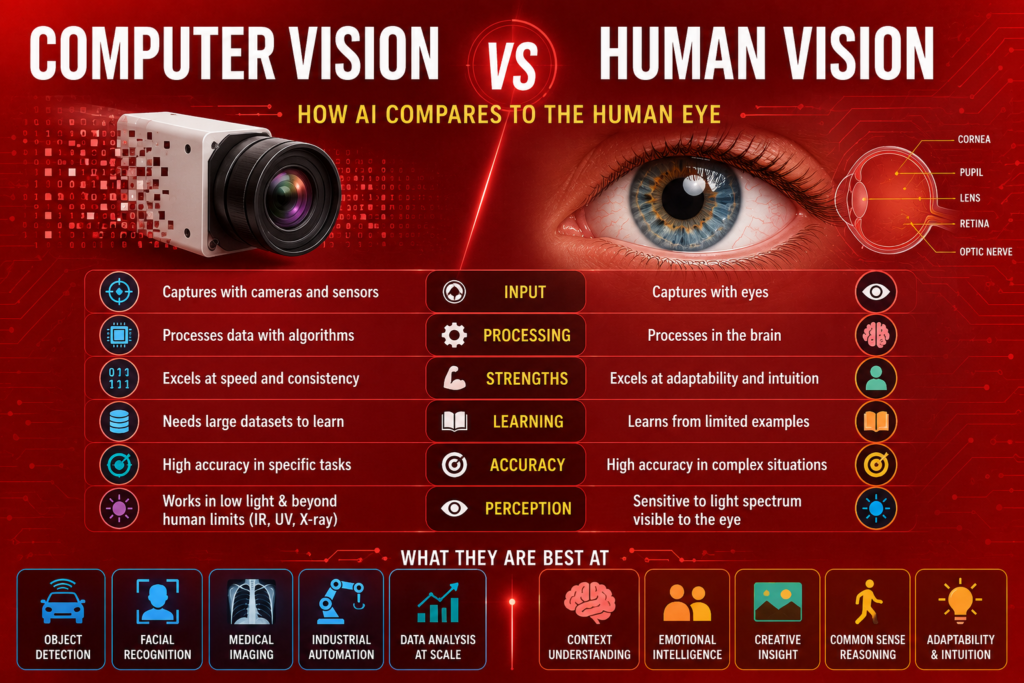
Light enters through the cornea and is focused by the lens onto the retina at the back of the eye. The retina contains around 120 million photoreceptors split into two types: rods, which handle low-light and peripheral vision, and cones, which handle color and fine detail. These photoreceptors convert light into electrical signals that travel through the optic nerve to the visual cortex at the back of the brain.
What happens next is where human vision becomes truly extraordinary. The brain does not simply receive a picture. It reconstructs a scene using contextual awareness built from a lifetime of experience. You recognize a partially hidden chair as a chair. You understand that a shadow is not a hole. You read emotion in a face you have never seen before. This visual cognitive processing happens automatically, instantly, and with almost no conscious effort.
Stereoscopic depth perception is another powerful capability. Because human eyes are set apart, each eye sees a slightly different view of the world. The brain combines these two images to extract depth information with remarkable precision, allowing you to judge distances, catch objects in flight, and navigate complex environments without thinking about it.
How Computer Vision Works
A camera captures an image as a grid of pixels, each represented by three numerical values for red, green, and blue light intensity, the RGB channels. A computer vision system then applies a series of mathematical operations to those numbers to extract information.
Modern computer vision systems are almost all based on deep neural networks, specifically convolutional neural networks that apply learned filters to detect features at increasing levels of abstraction. At the lowest layers, networks detect edges and gradients. In the middle layers, they detect textures and shapes. At the highest layers, they recognize objects, scenes, and concepts.
Unlike human vision, which is continuous and takes in the full visual field simultaneously, computer vision typically processes discrete images or video frames. The frame rate vs human persistence of vision comparison is instructive here: cameras can capture thousands of frames per second, far beyond the roughly 24 to 30 frames per second that appear smooth to the human eye. In terms of raw data throughput, cameras can easily exceed biological limits.
Semantic understanding, the ability to grasp what a scene means rather than just what it contains, has been one of the hardest problems in computer vision. For decades, machines could identify pixels belonging to an object without any understanding of what that object was doing, why it was there, or how it related to everything else in the frame.
Where Computer Vision Beats Human Vision
The comparison of computer vision vs human vision is not simply a story of machines catching up to biology. In specific domains, machines surpassed humans years ago and now operate at levels no human could sustain.
Speed is the most obvious advantage. A computer vision system can process thousands of high-resolution images per second without fatigue, distraction, or boredom. A human quality inspector examining products on a factory line will miss defects after hours of repetitive work. A machine running computer vision in manufacturing will catch the same class of defect reliably on the ten-thousandth item as on the first.
Precision is another area where machines lead. Industrial vision systems can measure dimensions to tolerances far beyond what the human eye can discern. Cameras equipped with specialized sensors can detect wavelengths of light outside the visible spectrum, including infrared, ultraviolet, and X-ray. Humans are entirely blind to these ranges. Medical imaging AI systems use this capability to interpret scans that would be invisible to the naked eye.
Consistency is a third advantage. Human perception is affected by fatigue, mood, lighting conditions, and cognitive biases. A well-trained computer vision model applies exactly the same logic to every image it processes. In high-stakes contexts like medical diagnosis, this consistency has genuine clinical value.
Scale is perhaps the most dramatic advantage. Surveillance systems powered by computer vision can monitor hundreds of cameras simultaneously. A single human cannot. A radiologist can examine dozens of scans in a day. A computer vision system can process millions.
Where Human Vision Still Dominates
Despite these impressive capabilities, the comparison of computer vision vs human vision reveals deep and persistent limitations on the machine side.
Contextual awareness is where humans maintain the clearest lead. When a person sees a shopping bag left unattended in an airport, they instantly understand the potential significance of that observation based on a complex web of prior knowledge, social understanding, and situational context. A computer vision system identifies a bag. It does not understand why that bag being there might matter unless it has been specifically trained on exactly that scenario.
Edge cases and ambiguity reveal the brittleness of current systems in stark terms. Humans handle unusual viewpoints, extreme lighting conditions, partial occlusion, and novel objects with ease. Machines trained on standard datasets often fail dramatically when conditions deviate from their training distribution. This is one of the most serious limitations in self-driving cars and computer vision applications, where the real world presents an essentially infinite variety of situations the training data cannot fully anticipate.
Deep learning bias is another significant problem with no easy solution. Because machine learning models learn from their training datasets, they inherit whatever biases those datasets contain. If a facial recognition system is trained primarily on images of light-skinned faces, it will perform worse on darker-skinned faces. Human vision is not free of bias either, but the mechanisms are different and the consequences in automated systems can be more systematic and harder to detect.
Spatial awareness in humans extends far beyond what a single camera can capture. Humans have peripheral vision covering roughly 180 degrees, integrate inputs from both eyes for depth, and combine visual information with vestibular signals, touch, and proprioception to build a rich model of physical space. Most computer vision systems see only what a camera points at, with no inherent understanding of their own position in space.
Optical illusions present a curious case in the computer vision vs human vision debate. Humans are reliably fooled by visual illusions because the brain uses shortcuts and assumptions that usually work but can be exploited. AI systems process raw pixel values and are not fooled by most classical human illusions. However, researchers have found that adversarial examples, tiny perturbations to an image invisible to humans, can completely fool neural networks in ways that seem bizarre to human observers. Both systems have their own exploitable weaknesses, just in different places.
The Historical Race: When Did Machines Start Catching Up? (2012 – 2020)
For most of the history of visual AI, the gap between computer vision vs human vision was enormous and obvious. Early systems could barely recognize geometric shapes. The idea of matching human performance on complex visual tasks seemed decades away.
The shift began in earnest with the deep learning revolution of 2012. The history of AlexNet is the story of the first moment researchers could credibly claim that a machine was approaching human-level performance on a benchmark visual task. When AlexNet won the ImageNet competition that year, it crossed the threshold where machines learned to see objects in natural images with something approaching the accuracy of a trained human annotator.
By 2015, deep learning systems surpassed average human performance on the ImageNet top-5 classification task, meaning they were better than humans at identifying the correct label from five choices for a million images of 1,000 categories. The history of ResNet achieved a top-5 error rate of 3.57 percent, compared to the roughly 5 percent typically attributed to human performance on the same task.
But classification performance on a curated benchmark is very different from general visual intelligence. The benchmark measures a narrow slice of vision. The broader comparison of computer vision vs human vision shows that the gap in general understanding, commonsense reasoning, and real-world adaptability remains wide.
Specialized Comparisons: Face Recognition, Medical Imaging, and Driving
Face recognition is a domain where the computer vision vs human vision comparison has become practically and politically significant. Deep learning systems trained on millions of face images can match faces with accuracy that exceeds trained forensic examiners under controlled conditions. The history of DeepFace from Facebook, released in 2014, achieved 97.35 percent accuracy on the LFW benchmark, matching human performance for the first time. Systems today are considerably more accurate.
Medical imaging is another domain where machines have achieved parity or better in specific tasks. Studies have shown that AI systems can detect diabetic retinopathy from retinal photographs and identify certain skin cancers from clinical images at accuracy levels matching dermatologists. The machines are not generally better across all medical imaging tasks, but they are demonstrably better on some specific ones.
Driving is perhaps the most complex real-world test of computer vision vs human vision. Human drivers make roughly one fatal crash per 100 million miles. Early self-driving systems struggled far more than that with edge cases and unusual scenarios. Progress has been dramatic, and some systems operating in constrained geographic areas have accumulated strong safety records. But full general autonomy across all weather conditions, road types, and edge cases remains unsolved.
Frequently Asked Questions
Can computer vision surpass human vision?
In specific, well-defined tasks, computer vision already surpasses human vision in speed, consistency, scale, and sometimes accuracy. In terms of general visual intelligence, contextual understanding, and handling of novel situations, human vision still leads by a significant margin. Whether general machine vision will ever fully match human visual cognition is an open question.
What is the main difference between computer vision and human vision?
Human vision is biological, contextual, continuous, and shaped by decades of embodied experience in the physical world. Computer vision is mathematical, data-driven, and limited to what its training distribution covers. Human vision integrates all senses automatically. Computer vision processes the specific input it is given without inherent awareness of anything beyond the frame.
Why do AI systems fail at things humans find easy?
AI systems learn statistical patterns from training data. When they encounter situations that fall outside those patterns, they fail in ways that humans do not, because humans reason from general principles and commonsense knowledge rather than memorized patterns. Edge cases, unusual lighting, partial occlusion, and novel object combinations all expose the brittleness that deep learning bias and limited training data create.
Are cameras better than human eyes?
In some specific respects, yes. Cameras can capture far more frames per second, see outside the visible light spectrum, measure distances with extreme precision, and operate in complete darkness with the right sensors. But cameras do not understand what they see. The full human visual system, including the brain, vastly outperforms any camera plus processing system when it comes to flexible, intelligent interpretation of complex scenes.
What is stereoscopic depth perception and do machines have it?
Stereoscopic depth perception is the brain’s ability to combine slightly different images from two eyes to compute depth. Machines can replicate this using stereo camera rigs, and depth estimation from single cameras using deep learning has also become highly capable. However, human stereoscopic depth perception is integrated with motor control, proprioception, and predictive modeling in ways that pure visual depth estimation systems have not matched.
Conclusion
The comparison of computer vision vs human vision is not a simple race with a single finishing line. It is a multi-dimensional comparison across speed, accuracy, generalization, contextual understanding, and real-world robustness. Machines win some of those dimensions convincingly. Humans win others by a margin that has barely narrowed despite decades of progress.
What makes this comparison so valuable is not identifying a winner but understanding the strengths and weaknesses of each system. Engineers who understand where machine vision fails can design safer and more reliable systems. Researchers who understand what makes human vision extraordinary can find new directions for improving artificial vision.
Every product and system built on computer vision technology today exists in the space between these two systems, trying to capture as much of human visual capability as possible while leveraging the unique advantages that machines bring. The gap is narrowing. The story of computer vision vs human vision is still being written, and the next chapters will be extraordinary.