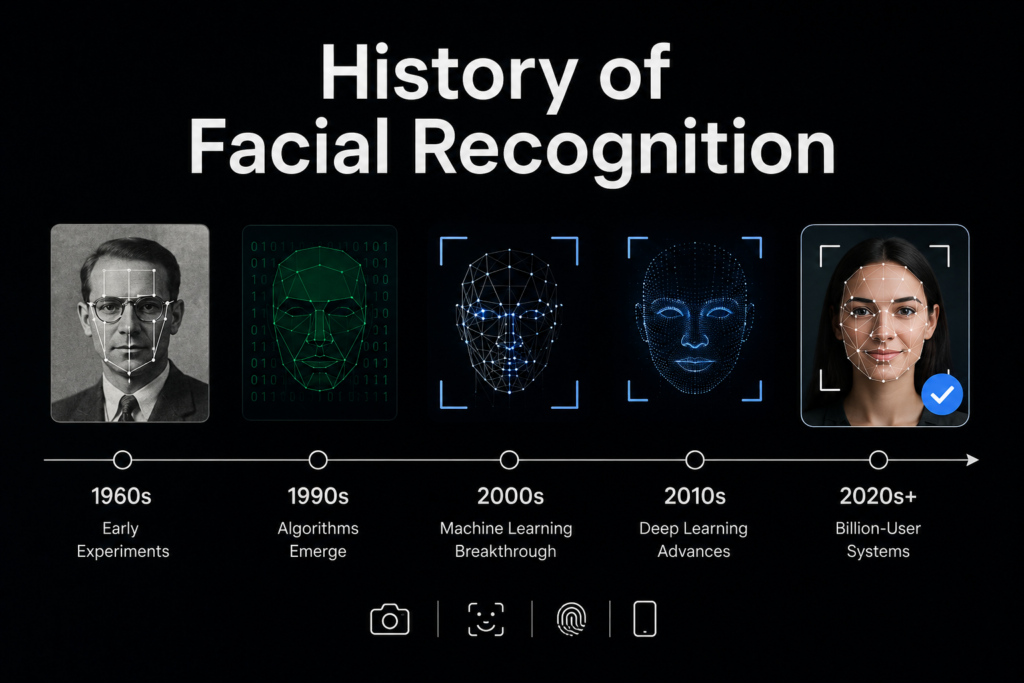
Few technologies have moved as quickly from research curiosity to global infrastructure as facial recognition. The history of facial recognition spans more than sixty years, beginning with researchers manually measuring photographs in the 1960s and ending with systems that unlock billions of smartphones every single day. This article traces that entire journey, covering the key people, technical breakthroughs, and ethical debates that have shaped facial recognition into one of the most powerful, and most controversial, applications of computer vision.
The Earliest Attempts at Automated Face Recognition (1960 – 1970)
The history of facial recognition begins, somewhat surprisingly, in the early 1960s, well before computers had any meaningful ability to process images independently. Woodrow Wilson Bledsoe, working at a research institute in Texas, conducted some of the earliest documented work on what would become Pioneers of computerized face recognition.
Early 1960s semi automated facial recognition under Bledsoe’s approach worked very differently from anything modern. Human operators would manually mark Facial geometric landmarks on photographs, identifying specific points like the corners of the eyes, the tip of the nose, and the edges of the mouth, using a device that recorded the coordinates of these points. The computer’s role was limited to comparing these manually recorded Facial feature coordinates between different photographs, calculating Distances between eyes (interpupillary) and other ratios, to determine whether two photographs likely depicted the same person.
This semi-automated approach reflected the broader state of the first computer vision experiments happening around the same period. Computers in the 1960s simply could not process raw image data well enough to identify facial features on their own, so human judgment remained an essential part of the pipeline. Even so, this work established the core idea that would define facial recognition for decades: a face could be represented as a set of measurements, and those measurements could be compared mathematically.
From Manual Measurements to Mathematical Models (1970 – 1990)
Throughout the 1970s and 1980s, the history of facial recognition progressed slowly, constrained by the same computational limitations affecting the broader history of pattern recognition during this period. Researchers continued refining the idea of representing faces through geometric measurements, exploring different sets of facial landmarks and different mathematical approaches for comparing them.
This period also overlapped with significant developments in the history of image processing, as techniques for normalizing lighting conditions, aligning images, and reducing noise became increasingly relevant to facial recognition specifically. A face photographed under different lighting conditions, from different angles, or at different distances presented significant challenges for any system relying on precise geometric measurements, and much of the research during this period focused on making these measurements more robust to such variations.
Eigenfaces: A Mathematical Breakthrough (1991)
The history of facial recognition experienced its first major mathematical breakthrough in 1991, when Matthew Turk and Alex Pentland introduced the Eigenfaces approach (Turk and Pentland) at MIT. This represented a fundamentally different way of thinking about facial recognition compared to the geometric landmark approaches that had dominated previous decades.
Rather than measuring specific facial features individually, Eigenfaces treated an entire face image as a single high-dimensional data point and used Principal Component Analysis (PCA), a statistical technique, to identify the directions of greatest variation across a collection of face images. These directions, called eigenfaces, could be thought of as a set of “ghostly” template faces that, when combined in different proportions, could approximate any individual face in the dataset.
Subspace projection models became the core idea: a new face could be represented not as a set of measured distances, but as a set of coefficients describing how much each eigenface contributed to reconstructing that face. Comparing two faces then became a matter of comparing these coefficient sets, a much more compact and computationally efficient representation than working with raw pixel values directly.
History of biometric face identification owes an enormous debt to Eigenfaces, as it demonstrated that statistical, data-driven approaches could outperform purely geometric methods, foreshadowing the much larger shift toward data-driven approaches that would eventually transform the entire field through deep learning.
Real Time Detection Arrives: Viola-Jones (2001)
While Eigenfaces addressed the question of how to compare faces once they had been located within an image, a separate and equally important question remained: how do you find a face within an image in the first place, quickly enough for practical use? The viola-jones algorithm, introduced by Paul Viola and Michael Jones in 2001, answered this question decisively.
The Viola-Jones algorithm used simple rectangular features, computed extremely efficiently using a technique called integral images, combined into a cascade of classifiers. Early stages of the cascade could quickly reject regions of an image that clearly did not contain a face, while later, more computationally expensive stages were only applied to regions that had passed earlier checks. This cascade structure allowed the algorithm to run in real time on the consumer hardware of the early 2000s, a major breakthrough for the broader history of object detection.
Major breakthroughs in biometric history timeline often cite Viola-Jones as the moment face detection, finding where faces are located within an image, became fast enough to be embedded in consumer products. Digital cameras throughout the 2000s widely adopted Viola-Jones-based face detection for autofocus and exposure adjustment, representing one of the first instances of facial recognition technology, or more precisely face detection technology, reaching mass consumer markets.
Commercial Software and Early Deployments (2000 – 2010)
History of commercial facial recognition software accelerated significantly during the 2000s, building on both the Eigenfaces approach for recognition and Viola-Jones for detection. Security surveillance implementation became an early and significant application area, with law enforcement agencies and government bodies beginning to explore facial recognition for identifying individuals from surveillance footage and watchlists.
Law enforcement facial recognition history during this period was characterized by systems that, while groundbreaking for their time, had significant accuracy limitations, particularly when dealing with variations in lighting, pose, expression, and image quality typical of real-world surveillance footage rather than controlled photographs. Biometric authentication standards began to develop during this period as well, as facial recognition started to be considered alongside fingerprint recognition and other biometric modalities for identity verification applications.
Deep Learning Transforms Facial Recognition (2014)
The most dramatic chapter in the history of facial recognition arrived in 2014, when Facebook introduced the history of deepface. DeepFace represented From geometric markers to deep learning vectors in its most complete form, replacing both the geometric and statistical approaches of previous decades with a deep convolutional neural network trained on millions of face images.
DeepFace achieved 97.35 percent accuracy on the Labeled Faces in the Wild benchmark, a result that matched human-level performance on this benchmark for the first time. This result reflected the broader deep learning transformed computer vision narrative that was reshaping the entire field following the success of the history of AlexNet two years earlier.
The shift to deep learning fundamentally changed how faces were represented. Rather than relying on hand-measured landmarks or statistically derived eigenfaces, deep learning systems learned to produce a compact numerical representation, often called a face embedding, directly from raw pixel data. Two face embeddings that were close together in this high-dimensional space were considered likely to represent the same person, while embeddings far apart represented different people. This approach proved dramatically more robust to variations in lighting, pose, and expression than any previous method.
Facial Recognition Goes Mainstream: Apple Face ID (2017)
Chronological history of digital face verification reaches a major consumer milestone with the history of apple face id, introduced alongside the iPhone X in 2017. Face ID represented one of the largest single deployments of facial recognition technology in history, instantly placing biometric facial authentication into the hands of hundreds of millions of users.
History of 2D vs 3D facial scanning technology is particularly relevant to understanding Face ID’s design. Unlike earlier facial recognition systems that relied primarily on 2D photographs, Face ID used a structured infrared light projector combined with an infrared camera to capture a detailed 3D map of a user’s face. This 3D approach provided significant security advantages over 2D systems, which could sometimes be fooled by photographs, since a 3D depth map is far more difficult to replicate without a genuine physical face present.
The success of Face ID demonstrated that facial recognition technology had matured to the point where it could be deployed reliably, securely, and at massive scale, directly on consumer devices, processing locally rather than requiring a connection to remote servers, addressing some though certainly not all of the privacy concerns that had begun to emerge around the technology.
Facial Recognition and Privacy Concerns (2015 – 2026)
As facial recognition technology became more accurate and more widely deployed, facial recognition and privacy concerns grew correspondingly. Database index scaling became both a technical challenge and a policy concern, as systems capable of searching through millions or even billions of face embeddings to identify a match raised questions about surveillance, consent, and the appropriate limits of biometric data collection.
Cities, schools, retailers, and government agencies around the world have grappled with these questions, with some jurisdictions banning or restricting certain uses of facial recognition technology, particularly by law enforcement, while others have continued to expand its use. The history of surveillance technology more broadly intersects heavily with facial recognition, as the same deep learning advances that made facial recognition more accurate also made large-scale, automated surveillance more technically feasible than ever before.
Evolution of automated facial recognition systems continues today, with ongoing research into improving accuracy across different demographic groups, developing privacy-preserving approaches to facial recognition, and establishing clearer legal and ethical frameworks for how the technology should and should not be used.
Frequently Asked Questions
Who invented facial recognition?
Woodrow Wilson Bledsoe is often credited with some of the earliest documented work on automated facial recognition in the early 1960s, using a semi-automated system involving manually marked facial landmarks. The field progressed significantly with the Eigenfaces approach introduced by Turk and Pentland in 1991, and was transformed again by deep learning approaches beginning with DeepFace in 2014.
What was the first major breakthrough in facial recognition?
The Eigenfaces approach, introduced by Turk and Pentland in 1991, is widely considered the first major mathematical breakthrough in facial recognition, using Principal Component Analysis to represent faces as combinations of statistically derived template images, a significant advance over earlier purely geometric approaches.
How did deep learning change facial recognition?
Deep learning, beginning prominently with DeepFace in 2014, replaced hand-measured facial landmarks and statistical approaches like Eigenfaces with neural networks trained on millions of images to produce compact numerical representations called face embeddings. This approach proved dramatically more accurate and robust to variations in lighting, pose, and expression than previous methods.
Is facial recognition technology accurate for everyone?
Accuracy has improved dramatically with deep learning, but studies have shown that facial recognition systems can perform differently across demographic groups, often due to imbalances in the training data used to develop them. This remains an active area of research and a significant concern within the broader facial recognition and privacy debate.
What is the difference between 2D and 3D facial recognition?
2D facial recognition analyzes a standard photograph of a face, while 3D facial recognition, used in systems like Apple Face ID, captures a depth map of the face’s contours using infrared sensors. 3D approaches generally provide stronger security, since they are more difficult to fool using photographs, and can be more robust to variations in lighting and angle.
Conclusion
The history of facial recognition is a story of steady, sometimes dramatic, progress, from researchers manually measuring photographs in the early 1960s to systems that authenticate billions of smartphone unlocks every day. Each major breakthrough, the Eigenfaces approach, the Viola-Jones algorithm, and the deep learning revolution exemplified by DeepFace and Apple Face ID, addressed a different piece of the puzzle, representation, detection speed, and accuracy, eventually combining into the powerful systems used today.
As facial recognition continues to advance, its history also serves as a reminder that powerful computer vision technology brings powerful responsibilities. Understanding the history of facial recognition means understanding not just how the technology became so capable, but also why ongoing conversations about privacy, fairness, and appropriate use remain just as important as the technical achievements themselves.