The story of history of alexnet represents one of the greatest turning points in artificial intelligence history. Before 2012, neural networks were still viewed by many researchers as interesting but limited technologies. Deep learning existed, but it had not yet fully transformed the world.
Then everything changed.
A neural network called AlexNet shocked the AI community by dominating the ImageNet competition and dramatically outperforming traditional computer vision systems.
The breakthrough launched the modern deep learning revolution.
The rise of history of alexnet changed:
- Artificial intelligence research
- Computer vision
- Big tech investment
- GPU computing
- Neural network development
Today, modern AI systems such as image generators, self-driving cars, facial recognition systems, and large language models all exist partly because of AlexNet’s success.
In this article, we will explore the complete history of alexnet, how it worked, why it became revolutionary, and how it launched the modern era of deep learning.
Neural Networks Before AlexNet (1943 – 2011)
Before understanding history of alexnet, we must first examine earlier neural network development.
The first artificial neuron model appeared in 1943 through Warren McCulloch and Walter Pitts.
Their work became connected to:
Later, Frank Rosenblatt introduced the perceptron during the 1950s.
This breakthrough became linked to:
Although neural networks showed promise, researchers struggled for decades with:
- Limited hardware
- Small datasets
- Slow computation
- Training instability
Neural networks entered periods such as the:
Many scientists doubted deep learning would ever become practical.
The Rise of Convolutional Neural Networks
The foundations of history of alexnet came from earlier convolutional neural networks.
Important milestones included:
Researchers such as Yann LeCun developed convolutional neural architectures capable of image recognition.
LeNet successfully read handwritten digits during the 1990s.
However, CNNs still struggled because hardware remained too weak for large-scale deep learning.
Geoffrey Hinton and Deep Learning Persistence
One of the most important people behind history of alexnet was Geoffrey Hinton.
The geoffrey hinton biography became deeply connected to neural network revival.
While many researchers abandoned deep learning during the 1990s, Hinton continued researching:
- Neural architectures
- Distributed representations
- Deep learning systems
- Backpropagation optimization
Hinton believed neural networks would eventually succeed once computing power improved.
His persistence became critical to the success of AlexNet.
The ImageNet Challenge (2009 – 2012)
Another essential part of history of alexnet involved ImageNet.
ImageNet became a massive dataset containing millions of labeled images.
This breakthrough became central to:
Researchers finally had enough visual data to train large neural systems effectively.
The ImageNet Large Scale Visual Recognition Challenge (ILSVRC) became one of the most important AI competitions in the world.
The challenge required systems capable of recognizing thousands of object categories accurately.
Alex Krizhevsky and the Birth of AlexNet
The defining breakthrough in history of alexnet came through Alex Krizhevsky.
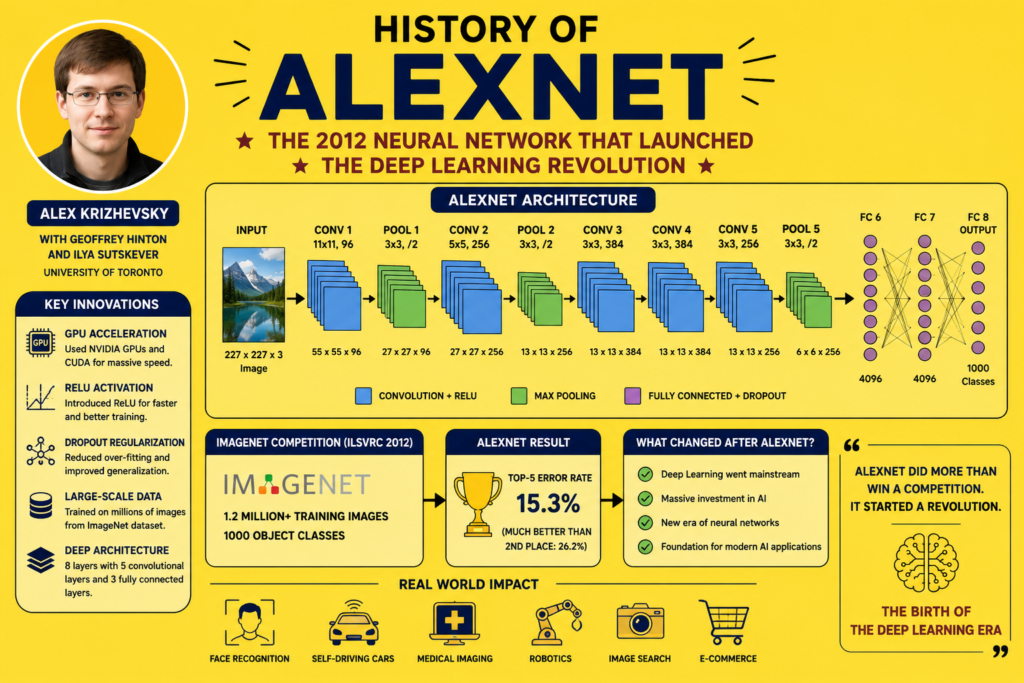
Working with Geoffrey Hinton and Ilya Sutskever at the University of Toronto, Krizhevsky developed AlexNet.
The neural architecture became revolutionary because it combined:
- Deep CNN layers
- GPU acceleration
- ReLU activation
- Dropout regularization
- Massive dataset training
AlexNet dramatically outperformed all competing systems during the 2012 ImageNet competition.
The AlexNet Architecture
To fully understand history of alexnet, we must examine how the system worked.
AlexNet contained:
- 8 neural layers
- 5 convolution layers
- 3 fully connected layers
The network processed images hierarchically.
Earlier layers detected:
- Edges
- Colors
- Textures
Deeper layers detected:
- Shapes
- Objects
- Complex visual patterns
This layered feature extraction became central to deep learning success.
GPU Acceleration Changes Everything
One major reason behind history of alexnet involved GPU computing.
Traditional CPUs were too slow for deep neural training.
AlexNet used NVIDIA GPUs and CUDA cores for massive parallel computation.
This breakthrough strongly connected to:
GPU acceleration dramatically reduced training time.
Without GPUs, AlexNet would likely have been impossible.
This moment transformed both AI research and hardware industries forever.
ReLU Activation and Faster Learning
Another important innovation in history of alexnet involved ReLU activation functions.
Earlier neural systems often used sigmoid functions, which caused slow training and vanishing gradients.
AlexNet introduced Rectified Linear Units (ReLU):
ReLU allowed:
- Faster convergence
- Better gradient flow
- Improved deep learning stability
This breakthrough strongly influenced modern neural architectures.
Dropout Regularization
AlexNet also introduced Dropout regularization.
Dropout randomly disabled neurons during training.
This reduced over-fitting and improved generalization performance.
The idea became connected to:
Dropout became one of the most widely used techniques in deep learning.
AlexNet Dominates ImageNet (2012)
The defining moment in history of alexnet occurred during ILSVRC 2012.
AlexNet achieved dramatically better top-5 accuracy than competing systems.
Its error rate shocked the AI community.
The neural network outperformed traditional computer vision approaches by a huge margin.
Researchers suddenly realized:
Deep learning actually worked.
This victory launched the modern AI revolution.
The Deep Learning Explosion
After the success of AlexNet, deep learning spread rapidly across the world.
Big technology companies began investing heavily in AI.
This explosion strongly connected to:
Research shifted toward:
- Deep CNNs
- GPU clusters
- Massive datasets
- Neural optimization
The entire AI industry transformed after AlexNet’s success.
AlexNet’s Influence on Modern AI
The impact of history of alexnet can now be seen everywhere.
AlexNet influenced:
- Facial recognition
- Autonomous vehicles
- Medical imaging
- Robotics
- AI image generation
This progress strongly connects to:
Modern deep learning systems evolved directly from ideas proven successful by AlexNet.
ResNet and Later CNN Architectures
After AlexNet, researchers created even deeper neural systems.
This evolution became connected to:
Architectures such as:
- VGGNet
- GoogLeNet
- ResNet
continued improving CNN performance.
AlexNet opened the door for these later breakthroughs.
The Industry Shift After AlexNet
The success of history of alexnet created a massive technology industry shift.
Major companies invested heavily in:
- AI infrastructure
- GPU hardware
- Neural research
- Deep learning applications
Modern AI companies emerged partly because AlexNet proved deep learning commercially viable.
Even modern best free ai tools rely heavily on deep learning methods inspired by AlexNet.
Why AlexNet Became Revolutionary
Several factors made AlexNet revolutionary:
Massive Dataset Training
ImageNet provided millions of images.
Deep CNN Architecture
Multiple convolution layers improved feature learning.
GPU Computing
Parallel hardware accelerated training dramatically.
ReLU Activation
Training became faster and more stable.
Dropout
Reduced over-fitting effectively.
Together, these breakthroughs launched the deep learning revolution.
Frequently Asked Questions (FAQs)
What was AlexNet?
AlexNet was a deep convolutional neural network that won the 2012 ImageNet competition.
Who created AlexNet?
Alex Krizhevsky developed AlexNet with Geoffrey Hinton and Ilya Sutskever.
Why was AlexNet important?
It proved deep learning could outperform traditional computer vision methods.
What technologies made AlexNet successful?
GPU acceleration, ReLU activation, dropout regularization, and large datasets.
Did AlexNet start the deep learning revolution?
Yes. AlexNet’s success in 2012 launched modern deep learning research worldwide.
Conclusion
The story of history of alexnet represents one of the most important breakthroughs in artificial intelligence history. By combining deep convolutional neural networks, GPU acceleration, ReLU activation, and massive datasets, AlexNet transformed deep learning from a niche research area into the dominant force in modern AI.
Its success during the 2012 ImageNet competition shocked the scientific world and triggered enormous investment in neural networks and deep learning research. Modern AI systems, from self-driving cars and medical imaging to generative AI and computer vision platforms, all owe part of their success to AlexNet’s revolutionary breakthrough.
Today, the legacy of history of alexnet continues shaping the future of artificial intelligence across the world.