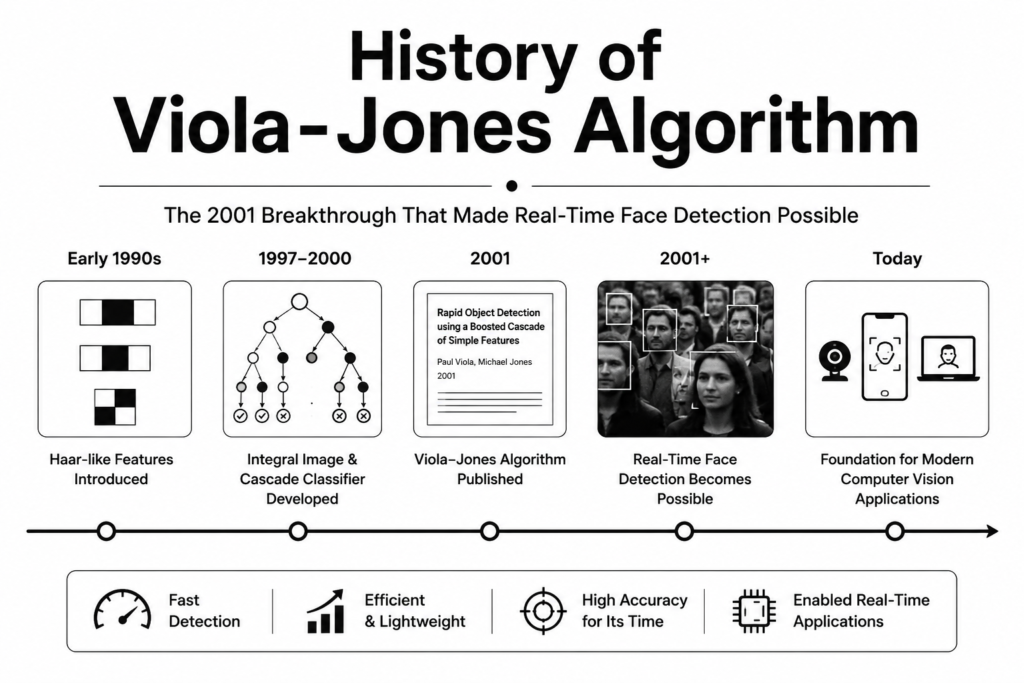
For most of the history of computer vision, finding a face within an image was simply too slow to be useful in real time. Then, in 2001, two researchers introduced an algorithm so efficient that it could detect faces in live video on the consumer hardware of its day. The viola-jones algorithm became one of the most widely deployed computer vision techniques ever created, embedded in digital cameras, security systems, and countless software applications for more than a decade. This article tells the complete story of how it worked, why it mattered, and the legacy it left behind even in the deep learning era.
The Problem: Face Detection Was Too Slow
Why Viola-Jones was a breakthrough for computer vision becomes clear once you understand what face detection looked like before 2001. Earlier approaches to finding faces within images often relied on techniques that, while accurate under controlled conditions, were computationally expensive. Scanning an image at multiple scales and positions, checking each location for the presence of a face, required an enormous number of calculations, especially when using complex features or classifiers at every position.
Computational efficiency limits meant that real-time face detection, processing live video at usable frame rates, was simply out of reach for most systems. This was a significant gap, because the broader history of facial recognition depended on first being able to locate a face within an image before any recognition could take place. Without fast face detection, facial recognition systems could only operate on carefully cropped photographs, severely limiting their practical usefulness.
Paul Viola and Michael Jones (2001)
Paul Viola Michael Jones face detection 2001 marks the publication of a paper that would become one of the most cited and most practically influential works in the entire history of computer vision. Paul Viola and Michael Jones introduced an algorithm specifically designed around the constraint that mattered most for real-world deployment: speed.
Viola-Jones object detection framework history shows that the algorithm was designed from the ground up with computational efficiency as a primary goal, not an afterthought. Rather than starting with the most accurate possible approach and then trying to speed it up, Viola and Jones built an architecture where every component was chosen specifically because it could be computed extremely quickly, even if individual components were, on their own, relatively weak.
Haar-Like Features: Simple but Powerful
History of Haar-like features in computer vision begins with the core building block of the viola-jones algorithm. Haar-like rectangular features are simple patterns, rectangles divided into two or more regions, where the feature value is calculated as the difference in average pixel intensity between these regions.
For example, a simple Haar-like feature might consist of two adjacent rectangles, one placed over what might be the eye region of a face and another placed over what might be the cheek region. Since eyes tend to be darker than cheeks, this feature would produce a large value when placed correctly over a real face, and a smaller, less consistent value when placed over a random region of an image.
Pixel intensity difference evaluations like this are extremely simple to compute individually, but a face detector needs to consider thousands of such features at different positions, scales, and orientations to be useful. Computing each of these features by summing pixel values directly, for every position and scale, would still be far too slow for real-time use, which is where the next major innovation came in.
The Integral Image: Making Computation Fast
Evolution of the Integral Image technique represents one of the most elegant pieces of the viola-jones algorithm. An integral image is a precomputed representation of an image where each pixel stores the sum of all pixel values above and to the left of it in the original image, including itself.
Integral Image computation technique allows the sum of pixel values within any rectangular region of the original image to be calculated using just four lookups into the integral image, regardless of how large that rectangle is. This is a dramatic improvement over summing every pixel within the rectangle directly, especially for larger rectangles, since the integral image approach takes the same small, constant amount of computation no matter the size of the region.
Because Haar-like features are defined in terms of differences between sums of pixel values within rectangles, the integral image made it possible to compute any Haar-like feature, at any scale, at any position, in essentially constant time. This single innovation was responsible for much of the dramatic speed improvement the viola-jones algorithm achieved over previous approaches.
AdaBoost: Choosing the Right Features
Even with the integral image making individual feature computation fast, there remained a problem: there are an enormous number of possible Haar-like features that could be evaluated at every position and scale within an image, far too many to check all of them for every window during detection.
AdaBoost classifier in Viola-Jones history addresses this problem directly. AdaBoost feature selection algorithm is a machine learning technique that combines many simple, individually weak classifiers into a single strong classifier, while simultaneously selecting which features are most useful for the task at hand.
During training, AdaBoost was used to select a small subset of Haar-like features from the enormous pool of possibilities, specifically choosing features that, even individually, did a reasonably good job of distinguishing face regions from non-face regions. Each selected feature, combined with a simple threshold, became what is called a weak classifier. AdaBoost then combined these weak classifiers, each weighted according to how useful it had proven during training, into a single strong classifier capable of making much more accurate predictions than any individual feature alone.
The Cascade: Speed Through Early Rejection
Cascade classifier architecture breakdown describes perhaps the most important architectural decision in the viola-jones algorithm, and the one most directly responsible for its real-time performance. Rather than applying the full strong classifier, with all of its selected features, to every position and scale in an image, Viola and Jones organized their classifiers into an Attentional Cascade architecture.
The cascade consisted of multiple stages, ordered from simplest and fastest to most complex and accurate. The very first stage of the cascade used only a handful of Haar-like features and was designed to be extremely fast, while still being able to correctly reject the vast majority of non-face regions, the windows of an image that clearly did not contain a face.
Only regions that passed this first stage, regions that the simple first-stage classifier could not confidently reject, were passed on to the second stage, which used more features and was somewhat more computationally expensive, but only needed to process a much smaller number of candidate regions. This pattern continued through subsequent stages, each more accurate and more expensive than the last, but each operating on an increasingly small set of remaining candidates.
False positive rejection rates at each stage were tuned so that the vast majority of clearly non-face regions, which represent the overwhelming majority of all possible regions in a typical image, were eliminated in the first one or two stages, using only a tiny fraction of the total computation that would be required to evaluate the full classifier everywhere.
Sliding Window Detection in Practice
Sliding window scanning speed describes how the viola-jones algorithm was applied to an actual image during detection. The algorithm considered windows of various sizes, sliding across the entire image at each scale, checking each window position against the cascade of classifiers.
Because most windows were rejected at the very first stage of the cascade, using only a small number of fast Haar-like feature computations made possible by the integral image, the overall algorithm could process an entire image, at multiple scales, in a small fraction of a second on the hardware available in the early 2000s. This combination, fast feature computation through the integral image, intelligent feature selection through AdaBoost, and early rejection through the cascade architecture, together produced something that had not existed before: face detection fast enough for real-time video.
Frontal face detection bias was a notable characteristic of the original Viola-Jones implementation. The algorithm was primarily trained and tuned for detecting faces viewed from the front, and performed less reliably on faces viewed from significant angles or in profile. This limitation reflected the training data and feature design choices made at the time, and addressing it required either training separate cascades for different orientations or accepting reduced accuracy for non-frontal faces.
Legacy of Viola-Jones in Digital Cameras and Beyond (2001 – 2012)
Legacy of Viola-Jones in digital cameras represents one of the most visible real-world impacts of this algorithm. Throughout the 2000s, digital cameras and later smartphone cameras widely adopted Viola-Jones-based face detection for features like autofocus targeting and exposure adjustment, allowing cameras to automatically identify and prioritize faces within a scene.
Pre-deep learning benchmark standard status describes the Viola-Jones algorithm’s role within the research community as well. For years, it served as a standard baseline against which new face detection methods were compared, and its core architectural ideas, particularly the cascade structure for early rejection, influenced the design of other detection systems well beyond face detection specifically.
The broader history of object detection absorbed many lessons from Viola-Jones, even as the field moved toward different techniques. The fundamental idea that detection systems should be designed to quickly reject the overwhelming majority of non-object regions, rather than carefully analyzing every possible location, remained relevant even as the specific techniques used to achieve this evolved significantly.
Traditional Face Detection vs Deep Learning (2012 – 2026)
Traditional face detection vs deep learning history reflects how the viola-jones algorithm has been largely, though not entirely, superseded since the deep learning transformed computer vision revolution beginning around 2012. Deep learning based face detection systems, often built on architectures related to the history of object detection more broadly, including approaches descended from the history of r-cnn and the single shot detector, generally achieve higher accuracy than Viola-Jones, particularly for faces viewed from difficult angles, in poor lighting, or partially occluded.
Despite this, the viola-jones algorithm remains relevant in certain contexts. Its extremely low computational requirements make it attractive for applications running on very limited hardware, where the computational cost of a deep neural network may simply not be feasible. It also remains a valuable teaching tool, since its architecture, Haar-like features, the integral image, AdaBoost, and the cascade structure, illustrates clearly how careful algorithmic design, rather than simply more computation, can produce dramatic practical improvements.
The connection between Viola-Jones and modern facial recognition extends into the broader history of facial recognition, where Viola-Jones solved the detection half of the problem, finding where a face is, while approaches like Eigenfaces and later the history of deepface addressed the recognition half, determining whose face it is.
Frequently Asked Questions
Who created the Viola-Jones algorithm?
The Viola-Jones algorithm was created by Paul Viola and Michael Jones, who published their work in 2001. It introduced a combination of Haar-like features, the integral image technique, AdaBoost for feature selection, and a cascade classifier architecture, together enabling real-time face detection for the first time.
What is an integral image and why is it important?
An integral image is a precomputed representation of an image where each pixel stores the sum of all pixel values above and to the left of it. This allows the sum of pixel values within any rectangular region to be calculated using just four lookups, making it possible to compute Haar-like features at any scale and position extremely quickly, which was essential to the speed of the Viola-Jones algorithm.
How does the cascade classifier in Viola-Jones work?
The cascade classifier organizes a series of increasingly complex classifiers, with the simplest and fastest classifier applied first. Most regions of an image, which clearly do not contain a face, are rejected at this first stage using minimal computation. Only the small number of regions that pass each stage are evaluated by subsequent, more complex stages, dramatically reducing the overall computation required.
Is the Viola-Jones algorithm still used today?
While deep learning based methods have generally surpassed Viola-Jones in accuracy, particularly for non-frontal faces and challenging conditions, it remains in use for applications with very limited computational resources, where its extremely low processing requirements are valuable. It also remains an important reference point for understanding the history of object detection and face detection techniques.
What were the main limitations of the Viola-Jones algorithm?
The main limitations of the Viola-Jones algorithm included a frontal face detection bias, meaning it performed best on faces viewed directly from the front and less reliably on faces viewed from significant angles, as well as reduced accuracy in poor lighting conditions or with partial occlusion, areas where later deep learning based approaches have shown significant improvements.
Conclusion
The viola-jones algorithm represents a defining moment in the history of computer vision, demonstrating that thoughtful algorithmic design, combining simple features, an efficient computation technique, intelligent feature selection, and a cascade architecture for early rejection, could solve a problem that brute-force approaches simply could not handle within the constraints of early 2000s hardware. For over a decade, it powered face detection in countless devices and applications around the world.
While deep learning has since taken over much of the territory the Viola-Jones algorithm once dominated, its influence on computer vision technology remains significant, both as a practical tool in resource-constrained settings and as a foundational case study in how to design systems that are fast enough to matter in the real world. Understanding the history of the viola-jones algorithm is understanding a moment when computer vision first became truly real time.