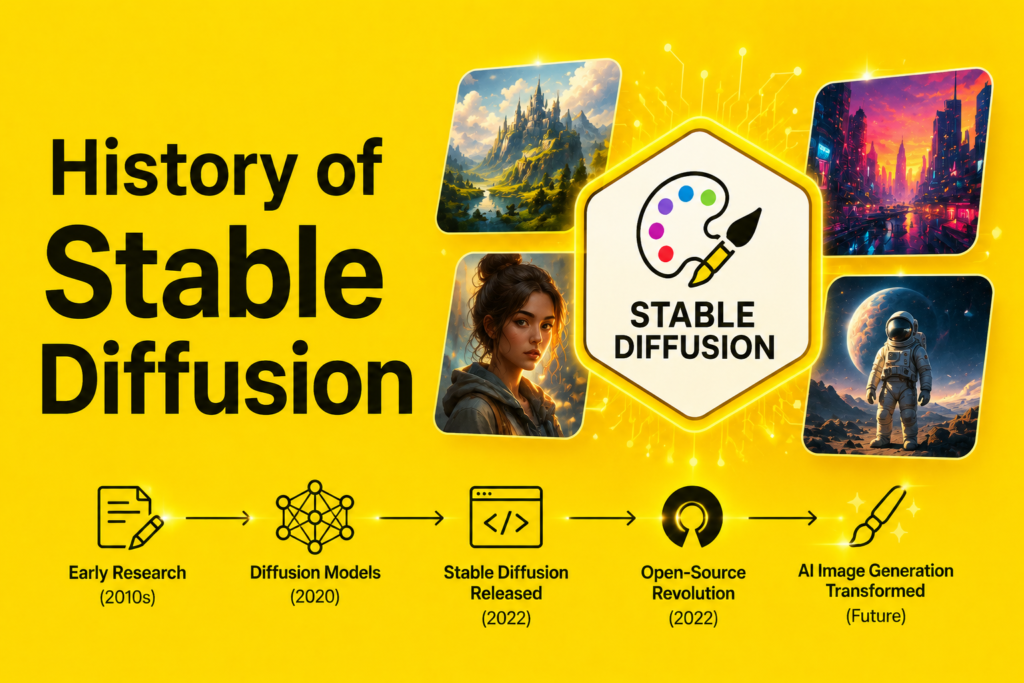
In August 2022, something unusual happened in the world of artificial intelligence. A powerful AI image generation model, capable of producing results comparable to systems that required massive cloud computing resources, was released to the public as open source software that could run on a personal computer. The history of stable diffusion is the story of that release and everything that followed, a story that fundamentally reshaped who could access, modify, and build upon AI image generation technology.
The Research Behind Stable Diffusion
Before Stable Diffusion existed as a product, it existed as research. CompVis LMU Munich latent diffusion research history traces back to a research group at Ludwig Maximilian University of Munich, working on an approach called Latent Diffusion Models (LDM). The foundational research, published as Robin Rombach paper (2021), described a technique for performing the diffusion process, the gradual removal of noise to generate an image, within a compressed latent space rather than directly on full-resolution pixel data.
This latent space approach was significant because it dramatically reduced the computational requirements of diffusion-based image generation. Earlier diffusion approaches, while capable of impressive results, often required substantial computational resources because the noise removal process operated on the full pixel grid of an image at every step. By performing this process in a compressed latent representation instead, the latent diffusion approach made high-quality image generation achievable with far less computation.
Stability AI and the Path to Public Release
Stability AI Stable Diffusion history begins when Stability AI, a company founded with the goal of making AI image generation broadly accessible, partnered with the CompVis research group and other collaborators to develop and release a version of the latent diffusion model trained on a large dataset of images and text descriptions.
RunwayML and Stability AI collaboration history reflects the broader ecosystem of organizations involved in bringing Stable Diffusion to the public. This collaborative effort combined research expertise, training infrastructure, and a shared commitment to releasing the resulting model openly, a significant departure from how some other major AI image generation systems, including the history of dall·e, had been deployed up to that point.
The Public Release: Stable Diffusion v1.4 (2022)
Public release of Stable Diffusion v1.4 timeline marks the moment the history of stable diffusion became a public phenomenon. Released in August 2022, Stable Diffusion v1.4 made a capable text-to-image generation model available as open weights, meaning the actual trained parameters of the model were published and could be downloaded, inspected, modified, and run by anyone with appropriate hardware.
History of local AI image generation hardware changed dramatically as a result. Before this release, generating high-quality AI images typically required access to cloud-based services with significant computational resources. Stable Diffusion v1.4 could run on consumer graphics cards with a reasonable amount of video memory, putting AI image generation directly into the hands of individual hobbyists, researchers, and developers without requiring ongoing subscription costs or cloud infrastructure.
OpenRAIL license architecture accompanied this release, representing an attempt to balance open access with responsible use considerations. The license allowed broad use, modification, and redistribution of the model while including certain restrictions intended to discourage clearly harmful applications, an approach that became an important reference point for subsequent open weights model transformation history across the broader AI industry.
How Stable Diffusion Actually Works
At the technical core of Stable Diffusion is a U-Net denoising architecture operating within the compressed latent space described earlier. The generation process begins with random noise in this latent space. Through a series of steps, the U-Net predicts and removes a portion of this noise at each step, gradually transforming pure randomness into a coherent latent representation that can then be decoded into a full image.
Gaussian noise inversion describes this process from another angle: rather than directly generating an image, the model is trained to reverse a process of progressively adding Gaussian noise to real images during training. By learning to reverse this noising process step by step, the model effectively learns how to construct realistic images from noise.
Classifier-Free Guidance (CFG) became an important technique for controlling how closely generated images followed a given text prompt. By comparing predictions made with and without the text conditioning during the generation process, CFG allows users to adjust how strongly the model adheres to the prompt versus how much creative freedom it exercises, giving users meaningful control over the balance between prompt fidelity and visual variety.
DreamStudio cloud platform was Stability AI’s own hosted service, offering access to Stable Diffusion through a web interface for users who preferred not to run the model locally, providing an alternative to the open weights approach for users without access to suitable hardware.
The Open Source Ecosystem Explodes (2022 – 2023)
History of open source AI image generators experienced an unprecedented surge of activity following Stable Diffusion’s release. Because the model weights were publicly available, developers around the world began building tools, interfaces, and extensions, creating an ecosystem that grew far beyond anything Stability AI itself had built.
Checkpoint files (.safetensors) became a standard format within this ecosystem, representing trained model weights that could be shared, downloaded, and loaded into various interfaces. Communities formed around sharing and discussing different checkpoint files, each potentially fine-tuned for different artistic styles, subjects, or quality characteristics.
History of fine tuning tools for Stable Diffusion developed rapidly during this period. LoRA (Low-Rank Adaptation) weights emerged as a particularly important technique, allowing users to fine-tune the model toward specific styles, characters, or concepts using relatively small additional files, without needing to retrain or redistribute the entire multi-gigabyte base model. This made customization dramatically more accessible, since LoRA files were often only a few megabytes in size compared to the gigabytes required for a full model checkpoint.
This explosion of community development connects to the broader history of ai image generation in an important way: Stable Diffusion’s open approach meant that innovation was no longer limited to a single organization’s research team, but instead emerged from a global, distributed community of contributors.
Evolution of Stable Diffusion Models (2022 – 2024)
Evolution of Stable Diffusion models to SD3.5 reflects continued development by Stability AI following the initial v1.4 release. Development of Stable Diffusion XL (SDXL) represented a significant upgrade, introducing a larger model architecture capable of producing higher resolution images with improved detail and composition compared to earlier versions.
Each successive version of Stable Diffusion generally brought improvements in image quality, prompt understanding, and the range of subjects and styles the model could handle effectively. Multimodal Diffusion Transformers (MMDiT) represent a more recent architectural direction, incorporating transformer-based architectures, similar in spirit to those used in vision transformers and large language models, into the diffusion process itself, reflecting a broader trend across AI research toward transformer architectures as a unifying framework across different types of tasks.
This continued evolution placed Stable Diffusion within a broader competitive landscape alongside the history of dall·e and the history of midjourney, each representing different approaches, open versus closed, and different organizational philosophies, toward the same underlying goal of high-quality text-to-image generation.
Stable Diffusion’s Impact Beyond Image Generation
The influence of the history of stable diffusion extends into related areas of computer vision technology. The latent diffusion approach popularized by Stable Diffusion has influenced research into other generative tasks, including video generation, 3D content generation, and even applications in medical imaging ai, where diffusion-based approaches have been explored for tasks like image reconstruction and enhancement.
The open weights approach pioneered at scale by Stable Diffusion also influenced broader conversations about open source AI more generally, demonstrating that powerful generative models could be released openly without immediately resulting in the most extreme predicted misuse scenarios, while also generating ongoing debates about the appropriate balance between open access and responsible deployment that continue to shape policy discussions around AI more broadly.
Frequently Asked Questions
When was Stable Diffusion released?
Stable Diffusion v1.4 was publicly released in August 2022 by Stability AI, in collaboration with the CompVis research group at LMU Munich and other partners, based on latent diffusion model research published in 2021.
What makes Stable Diffusion different from DALL-E?
The most significant difference is that Stable Diffusion was released as open weights, meaning the trained model itself could be downloaded and run locally on consumer hardware, while DALL-E has generally been accessed through OpenAI’s hosted services and APIs. This openness allowed a large community to build tools, fine-tunes, and extensions for Stable Diffusion in ways that were not possible with closed systems.
What is latent diffusion?
Latent diffusion is a technique where the image generation process, gradually removing noise to produce a coherent image, takes place within a compressed latent representation of the image rather than on the full pixel grid. This significantly reduces the computational requirements of the generation process while maintaining high image quality.
What is LoRA and why is it important for Stable Diffusion?
LoRA, or Low-Rank Adaptation, is a fine-tuning technique that allows a model to be adapted toward specific styles, subjects, or characters using small additional files, often just a few megabytes, rather than retraining the entire model. This made customization of Stable Diffusion dramatically more accessible to individual users and small communities.
Can Stable Diffusion run on a personal computer?
Yes. One of the most significant aspects of Stable Diffusion’s release was that it could run on consumer graphics cards with sufficient video memory, allowing individuals to generate AI images locally without relying on cloud services, a meaningful shift in the history of local AI image generation hardware.
Conclusion
The history of stable diffusion represents a pivotal moment in the broader history of ai image generation, not primarily because of a single technical breakthrough, but because of a deliberate choice to release powerful technology openly. From the latent diffusion research published in 2021, through the public release of v1.4 in 2022, to the ongoing development of SDXL and beyond, Stable Diffusion demonstrated that high-quality AI image generation did not need to remain locked behind closed APIs and cloud services.
The open ecosystem that emerged around Stable Diffusion, including fine-tuning techniques like LoRA and a vast community of shared checkpoints and tools, fundamentally changed how computer vision technology in this space develops, shifting significant innovation from centralized organizations to a distributed global community. Understanding the history of stable diffusion means understanding how openness itself became one of the most consequential design decisions in modern AI.