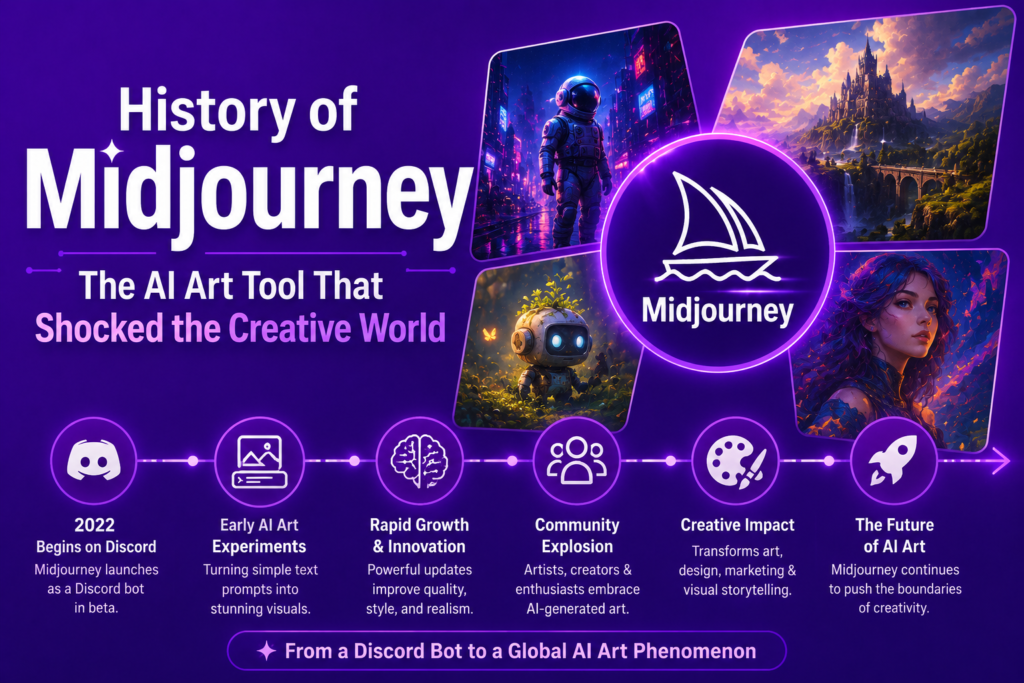
When AI image generation tools first reached the public, most people expected technical demos, interesting but rough, more proof of concept than genuinely usable creative tool. The history of midjourney tells a different story. From its earliest releases, Midjourney distinguished itself with a distinctive, often strikingly beautiful aesthetic that felt less like a research output and more like the work of a skilled illustrator, quickly becoming one of the most talked-about tools in the broader history of ai image generation.
David Holz and the Origins of Midjourney
David Holz Midjourney history begins with its founder, who had previously co-founded Leap Motion, a company known for motion-sensing hardware technology. Leap Motion founder experience gave Holz a background in building technology products focused on intuitive, natural interaction, an interesting foundation for a company that would go on to build one of the most widely used AI image generation tools.
Midjourney was founded as an independent research lab, distinct from larger organizations like OpenAI, which was developing the history of dall·e, and Stability AI, which would later release the history of stable diffusion. This independent status shaped Midjourney’s development path, allowing the company to pursue its own approach to both the underlying technology and how it would be delivered to users.
Launching Through Discord (2022)
Midjourney Discord server launch timeline represents one of the more unusual distribution decisions in the history of midjourney. Rather than launching through a dedicated website or application, Midjourney initially made its image generation tool available through Discord, a chat and community platform popular among gamers and online communities.
From Discord bot to standalone web platform history reflects how this choice shaped the early Midjourney experience. Users would type commands into Discord channels, including text prompts describing the image they wanted, and the Midjourney bot would respond with generated images directly within the chat. This created an inherently social and communal experience, since users could see not just their own generations but those of everyone else active in the same channel, creating a kind of public gallery of AI-generated art updating in real time.
Midjourney alpha model training history on Google TPUs reflects some of the technical infrastructure decisions made during this early period, with Midjourney’s models trained using specialized hardware designed for machine learning workloads, allowing the company to iterate on its models relatively quickly even as an independent lab without the resources of larger organizations.
The Distinctive Midjourney Aesthetic
History of cinematic photorealism in AI art is closely associated with Midjourney’s early reputation. From its first widely available versions, Midjourney images often had a particular quality, dramatic lighting, rich color palettes, and compositions that felt deliberately artistic rather than simply photographic, that distinguished them from outputs of other systems at the time.
This aesthetic quality became something of a signature for Midjourney, with many users specifically choosing the platform because of the particular look its models tended to produce, even when other tools might offer comparable technical capabilities in terms of resolution or prompt accuracy. This distinction matters within the broader history of ai image generation, illustrating how different organizations training similar underlying architectures, often diffusion-based approaches related to those used in the history of stable diffusion, could produce noticeably different stylistic outputs based on training data choices and fine-tuning decisions.
Evolution Through Major Versions (2022 – 2025)
Evolution of Midjourney models V1 to V8 reflects a rapid pace of development following the initial alpha release. V1 to V8.1 version updates each brought improvements in image quality, resolution, prompt understanding, and the range of styles and subjects the models could handle effectively.
Each major version generally improved upon the last in terms of coherence, particularly for complex scenes involving multiple subjects, accurate hands and faces, which had been a persistent challenge for AI image generators generally, and increasingly sophisticated lighting and composition. High-definition 2K rendering became achievable in later versions, a significant improvement over the more limited resolutions of early releases.
Text rendering engine integration addressed another long-standing challenge for AI image generators. Earlier versions of Midjourney, like many contemporaneous systems, struggled to generate readable, accurate text within images, often producing garbled or nonsensical characters when a prompt called for visible text, such as a sign or a label. Later versions made significant improvements in this area, an important practical capability for commercial and design applications.
Niji: A Dedicated Anime Model
Midjourney anime model Niji development timeline represents a notable branch in Midjourney’s model lineup. Niji was developed as a model specifically tuned for anime and illustration styles, reflecting the significant overlap between AI image generation communities and anime, manga, and illustration art communities.
This specialization illustrates a broader pattern that emerged across the history of ai image generation: rather than a single model attempting to excel at every possible style, different specialized models or fine-tunes could be developed to serve specific creative communities particularly well, an approach conceptually related to the fine-tuning ecosystem that developed around open models like Stable Diffusion, though implemented differently within Midjourney’s more centralized model offerings.
Creative Controls and Parameters
Aspect ratio controls (–ar) and Stylize parameters (–s) became essential tools for users seeking precise control over Midjourney’s output. Aspect ratio controls allowed users to specify the dimensions of generated images, important for different use cases, from social media graphics requiring specific proportions to cinematic widescreen compositions.
Stylize parameters allowed users to adjust how strongly Midjourney’s distinctive artistic tendencies influenced a given generation, with lower stylize values producing results that adhered more literally to the prompt, and higher values allowing the model’s characteristic aesthetic preferences to play a larger role.
Style references (–sref) introduced a further level of control, allowing users to reference existing images as style guides for new generations, helping maintain visual consistency across a series of images or apply a particular aesthetic from a reference image to new subjects. Seed locked image generation allowed users to reproduce specific results or generate controlled variations by fixing the random seed used in the generation process, an important capability for iterative creative workflows where consistency matters.
Vibe and aesthetic tuning more broadly describes Midjourney’s ongoing emphasis on giving users tools to shape not just what appears in an image, but how it feels, the mood, atmosphere, and artistic sensibility of the result, an emphasis that reflects the platform’s positioning within the creative, rather than purely technical, end of the history of ai image generation.
Moving Beyond Discord: The Web Platform
History of Midjourney web UI alpha release marks a significant shift in how users accessed Midjourney. While the Discord-based interface had been central to Midjourney’s early identity and community, the company eventually introduced a dedicated web interface, providing an alternative for users who preferred a more traditional application experience over the chat-based workflow.
This transition reflects a broader maturation common across the history of ai image generation, as tools that began as community-oriented experiments, often with somewhat unconventional interfaces, evolved toward more polished, standalone products as user bases grew and use cases expanded beyond early adopter communities into broader professional and commercial contexts.
In-painting (Vary Region) tool capabilities were introduced as part of this broader feature expansion, allowing users to select specific portions of a generated image and regenerate just that region, similar in spirit to inpainting capabilities found in other major image generation tools, giving users more granular control over iterative refinement of their images.
Content Moderation and Responsible Use
History of Midjourney content moderation upgrades reflects ongoing efforts to address concerns common across the history of ai image generation, including preventing generation of certain categories of harmful content and addressing concerns related to the history of deepfakes and the depiction of real people without consent.
These moderation efforts connect to broader industry-wide conversations about responsible AI image generation, conversations that intersect with facial recognition and privacy discussions regarding the depiction of real individuals, and with ongoing debates about appropriate content policies across AI image generation platforms generally.
Expanding Beyond Still Images
Midjourney image to video generation history represents Midjourney’s expansion beyond static image generation into video, reflecting a broader trend across the history of ai image generation toward generative video capabilities. This expansion connects Midjourney’s work to the broader video understanding in ai landscape, as generating coherent video requires not just producing realistic individual frames but maintaining consistency, motion, and temporal coherence across a sequence of frames, a substantially more complex challenge than still image generation.
Frequently Asked Questions
Who founded Midjourney?
Midjourney was founded by David Holz, who had previously co-founded Leap Motion, a company known for motion-sensing hardware. Midjourney operates as an independent research lab, distinct from larger organizations developing competing AI image generation tools.
Why did Midjourney launch through Discord?
Midjourney initially launched through Discord, allowing users to generate images by typing commands into chat channels. This created a social, communal experience where users could see images generated by others in real time, helping build an early community around the tool even before a dedicated web platform was introduced.
What makes Midjourney’s style different from other AI image generators?
Midjourney has been known since its early versions for a distinctive aesthetic, often featuring dramatic lighting, rich color palettes, and artistic compositions, which many users specifically seek out. This stylistic signature emerged from training data and fine-tuning choices, illustrating how different organizations can produce noticeably different visual outputs even when using broadly similar underlying diffusion-based architectures.
What is Niji in Midjourney?
Niji is a model within the Midjourney lineup specifically tuned for anime, manga, and illustration styles, reflecting the significant overlap between AI image generation users and communities focused on these art forms. It represents an example of specialized models being developed to serve particular creative communities especially well.
How do parameters like –ar and –s affect Midjourney images?
The –ar parameter controls the aspect ratio, or dimensions, of generated images, useful for different formats and use cases. The –s, or stylize, parameter controls how strongly Midjourney’s characteristic aesthetic tendencies influence the result, with lower values producing outputs closer to a literal interpretation of the prompt and higher values allowing more of the model’s artistic style to come through.
Conclusion
The history of midjourney is a story of an independent lab carving out a distinct identity within the rapidly evolving landscape of AI image generation. From its unconventional Discord launch through rapid iteration across multiple model versions, the development of specialized offerings like Niji, and an eventual expansion into video, Midjourney consistently distinguished itself through a combination of distinctive aesthetic quality and a strong sense of creative community.
Within the broader story of computer vision technology, Midjourney represents a particularly clear example of how the same underlying technical foundations, diffusion-based generative models, can produce dramatically different products and creative communities depending on the choices made by the teams building them. Understanding the history of midjourney means understanding how technology, aesthetics, and community can combine to create something that genuinely shocked, and delighted, the creative world.