
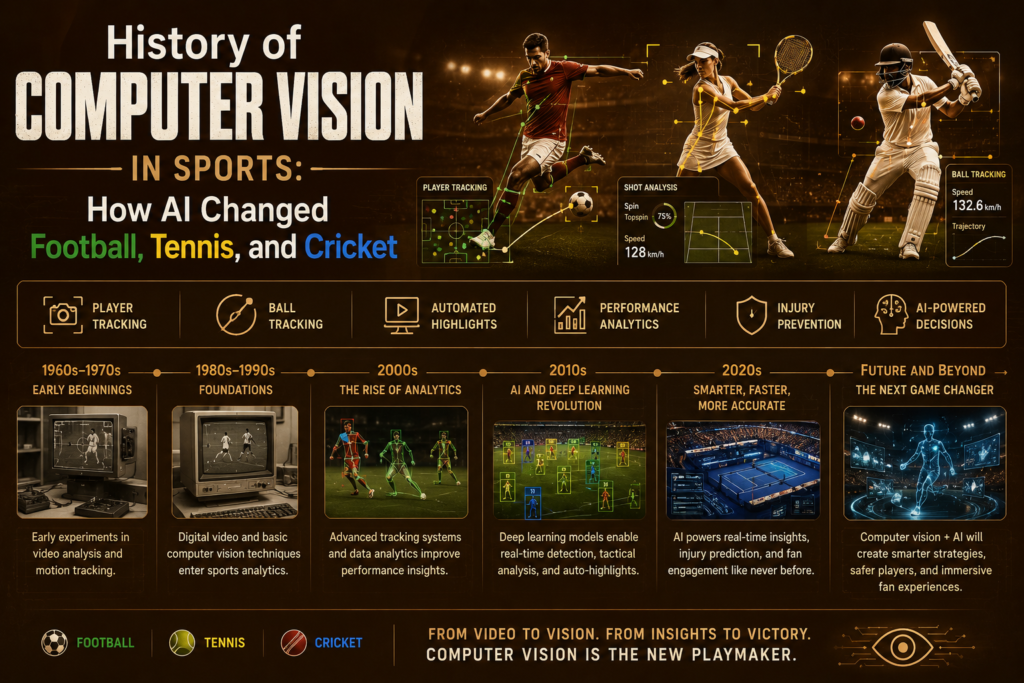
The history of computer vision in sports is a thrilling saga of precision, innovation, and technological triumph. For decades, fans and officials alike relied on the fallible human eye to make split-second decisions that could determine the fate of championships. Today, the landscape is entirely different. Artificial intelligence has fundamentally transformed the athletic arena, turning once-controversial calls into objective, data-driven certainties. Through the evolution of computer vision in sports, we have witnessed machines master the art of tracking high-speed objects, analyzing complex human movements, and ensuring fairness on the world’s biggest stages. From the early experiments in university laboratories to the sophisticated multi-camera setups now standard in stadiums, this journey highlights how technology has redefined excellence. By understanding these milestones, we can appreciate the immense engineering feats that make modern sports more accurate, engaging, and safer than ever before.
The Early Days of Vision (1960 – 1980)
The origins of automated visual analysis date back to the same era that birthed modern computing. During the nineteen sixties and seventies, researchers were obsessed with teaching machines to perceive basic shapes and patterns. While these initial first computer vision experiments were far removed from today’s professional leagues, they laid the essential groundwork for everything to follow. Scientists at institutions like MIT began exploring how to identify edges and recognize simple objects within a frame. The famous Summer Vision Project in nineteen sixty-six sought to enable computers to describe what they saw in a scene, a visionary goal that would eventually pave the way for real-time match analysis.
During this period, the technology was limited by massive hardware requirements and a total lack of specialized sports datasets. Processing a single frame of data could take significant time, making real-time applications impossible. However, the intellectual curiosity surrounding machine perception was infectious. Researchers began to theorize about how these mathematical models could eventually be applied to human motion. Although these early systems could only recognize simple black-and-white patterns, they proved that a machine could identify the difference between an object and its background. This simple capability was the critical spark that would one day power the advanced systems we see on the pitch today.
The Rise of Pattern Recognition (1980 – 2000)
As microprocessors became more powerful, the field began to embrace more robust mathematical frameworks. The nineteen nineties were a pivotal decade where history of edge detection and pattern recognition techniques became standardized. Researchers started moving away from hand-crafted rules toward systems that could learn from data. During this era, the sports industry remained largely traditional, but the seeds of digital innovation were being sown in research labs. Computer vision started borrowing from machine learning, allowing for better identification of objects even when lighting or camera angles were less than ideal.
This era saw the invention of algorithms like SIFT, which helped computers identify and match local features within images. These methods were essential for early tracking experiments. Engineers began to realize that if a computer could identify a ball or a player’s jersey, it could theoretically track their position over time. The transition from static image recognition to dynamic motion analysis began to take hold. While we were still years away from automated refereeing, the ability to process sequences of images meant that the foundational technology for player tracking and trajectory estimation was finally emerging. This period bridged the gap between basic pattern recognition and the sophisticated AI-driven systems that would eventually dominate global sports.
The Hawk-Eye Revolution (2000 – 2010)
The turn of the millennium marked the beginning of a true paradigm shift in sports officiating. The invention of the Hawk-Eye system in two thousand, developed by British engineer Paul Hawkins, remains a landmark achievement in the history of computer vision in sports. Initially applied to cricket, this technology used multiple high-speed cameras to track the trajectory of a ball with incredible precision. It could predict the ball’s path, allowing officials to determine if a delivery would have struck the stumps. This was the first time that automated technology offered an objective, indisputable answer to a contentious on-field question.
Tennis quickly followed, with Hawk-Eye becoming the gold standard for line-calling. Before this, players were at the mercy of human line judges. By combining multiple camera feeds and using homography coordinate transformation, the system could produce a three-dimensional representation of the ball’s impact point. The Nasdaq-100 Open in two thousand six became the first professional tournament to officially use the system for player challenges. This innovation fundamentally changed the sport, shifting the focus from subjective human opinion to measurable, scientific truth. It proved that computer vision in sports could enhance the integrity of a game without disrupting its flow.
The Era of Deep Learning (2010 – 2026)
The last fifteen years have witnessed an explosion in performance, thanks to the arrival of deep learning. When deep learning transformed computer vision, everything in sports analytics changed. Modern systems now utilize massive neural networks to track players, identify actions, and even assess injury risks. The introduction of the Video Assistant Referee (VAR) system in football is the ultimate example of this. By using semi-automated offside technology, systems now track twenty-nine data points on every player’s body to make split-second decisions that are far beyond the speed of human perception.
Beyond officiating, teams now use AI-powered pose estimation to track player biometrics and biomechanics. Coaches can analyze the skeletal structure of a player during a sprint, identifying fatigue or potential injury risks before they occur. We now see computer vision in sports being used to generate automated highlights, providing fans with personalized content in real-time. By leveraging low latency processing frames, these systems can provide actionable insights for tactical adjustments mid-game. Every jump, pass, shot, and maneuver is now captured, structured, and analyzed to provide a level of tactical depth that was once reserved only for the coaching elite.
FAQs:
How does computer vision improve the fairness of sports?
It provides an objective, data-driven perspective on close calls. By using high-speed cameras and trajectory estimation, systems like Hawk-Eye or VAR can determine outcomes—such as offside or ball-in-play—with millimeter accuracy, effectively removing human bias or error from the equation.
Will AI eventually replace human referees and umpires?
The current goal is to augment rather than replace humans. AI acts as a “second pair of eyes” to handle high-speed decisions, while human officials remain necessary to manage the flow of the game, interpret context, and handle complex interactions that go beyond simple geometry.
How does player tracking help with injury prevention?
By monitoring body positions and movement patterns, pose estimation algorithms can detect subtle signs of physical stress or fatigue. If an athlete’s mechanics begin to deviate from their healthy baseline, coaches can proactively rest them to prevent more serious muscle or ligament injuries.
What is the impact of this technology on the fan experience?
It has completely revolutionized broadcasting. Real-time graphics, interactive statistics, and augmented reality overlays keep fans engaged by providing context-rich data. Fans can now see live heatmaps, player speeds, and predictive trajectories, making the game feel more immersive and technically profound.
Conclusion
The history of computer vision in sports is a testament to the power of technological integration. From the early experiments in edge detection to the complex neural networks now overseeing the most important games in the world, the journey has been nothing short of spectacular. We have seen how high-speed cameras, combined with advanced computer vision technology, have moved sports officiating from the realm of “gut feeling” into the realm of absolute certainty. This evolution has not only increased fairness but also deepened our tactical understanding of how games are won and lost. As we move forward, the role of AI will only grow, potentially leading to even more immersive experiences and deeper insights into human potential. The future of athletics is clearly a digital one, where the precision of the machine complements the passion of the player, creating a fairer and more exciting spectacle for everyone involved.