The history of opencv is an essential subject for anyone exploring artificial intelligence. When exploring the vast landscape of artificial intelligence and machine learning, understanding the history of opencv is absolutely essential. This powerful software tool fundamentally shifted how developers approached visual data processing. Before its creation, coding software that could interpret images was an incredibly tedious, expensive, and fragmented process. Every research laboratory and university had to build their own internal tools from scratch, which meant there was very little collaboration across the industry. The history of opencv is not just a straightforward timeline of software updates; it is the comprehensive story of how advanced mathematical algorithms became accessible to everyone around the globe. By providing a unified infrastructure, this library completely changed the game. Whether you are tracking high speed objects, analyzing complex medical scans, or building autonomous robotics, the library has played a crucial, foundational role. This extensive article dives deep into the major milestones, technical transitions, and community efforts that shaped this remarkable project into what it is today.
The Origins of the history of opencv (1999 – 2006)
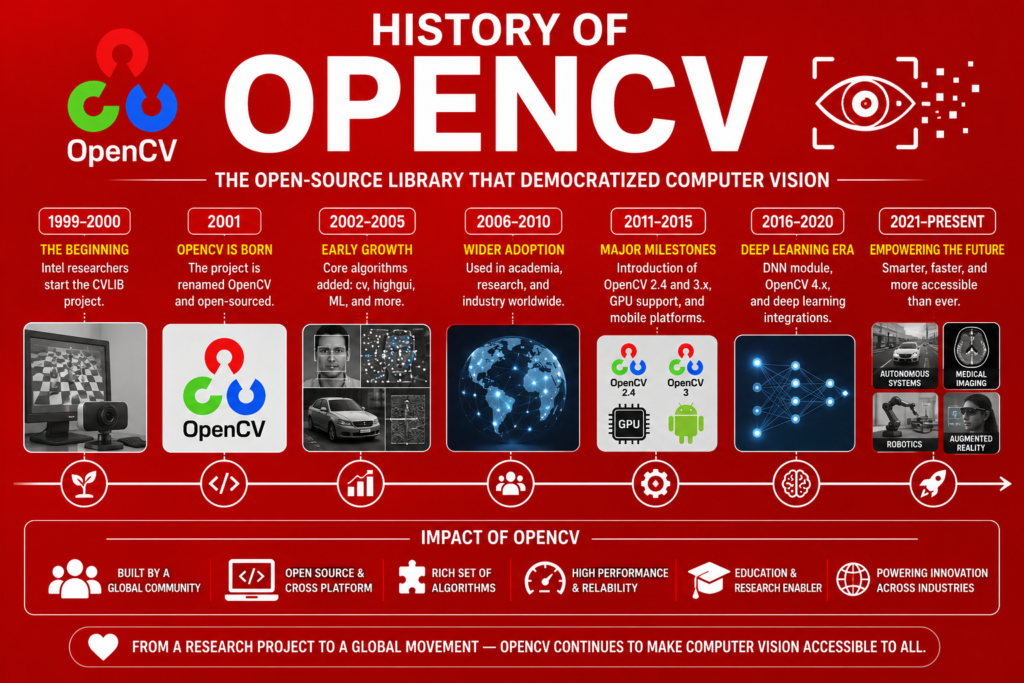
The true history of opencv begins at the turn of the millennium, during an era when computing power was just starting to become capable of handling complex visual streams. The Intel OpenCV launch history and timeline started in 1999 when a group of researchers recognized a glaring problem in the tech industry. At the time, universities and tech companies were all writing their own custom code for basic visual tasks. There was absolutely no standard foundation to rely on. The Gary Bradski history of OpenCV library efforts changed this fragmented landscape by introducing a unified framework designed for performance. Bradski, working as a researcher at Intel, spearheaded the project to advance CPU intensive applications and showcase the power of modern processors. To make this vision a reality, a highly skilled Intel Russian research team was instrumental in writing the initial highly optimized code. They implemented classical image filtering algorithms and basic tracking functions that could run exceptionally fast on Intel processors.
When looking at the broader history of computer vision, the introduction of this library was a major turning point for researchers everywhere. The very first alpha version was proudly presented to the public at the IEEE Conference on Computer Vision and Pattern Recognition in the year 2000. It provided a common infrastructure that developers could build on without reinventing the wheel every single time they started a new project. The early focus of the software was on real time human computer interaction and mobile robotics. Crucially, the project adopted a BSD license architecture, which was vital because it allowed both academic and commercial use without requiring the resulting software to be strictly open source itself. This liberal and forward thinking licensing approach was a massive catalyst for its early adoption across various industries.
The Evolution and the history of opencv Repository (2006 – 2008)
After several beta versions and years of testing, the first official major milestone was reached. In 2006, version 1.0 was officially released, marking a very mature step in the history of opencv. This version brought a massive wealth of new features, highly improved performance, and much better user documentation. The Evolution of open source computer vision repository had truly begun, completely transforming it from a niche research tool into a widely adopted industry standard that companies could rely on. During this exciting period, the history of image processing was actively being rewritten as developers gained unprecedented access to over five hundred optimized functions straight out of the box.
In 2008, the project received another massive boost that secured its future. The Willow Garage role in OpenCV history became highly significant when this prominent robotics research lab took over active support and ongoing development. Willow Garage recognized the immense value of the software and provided the critical financial and engineering resources needed to modernize the sprawling codebase. This fruitful partnership eventually led to the release of version 2.0 in 2009. This specific era introduced major architectural changes that laid the solid groundwork for modern, complex applications. The library was slowly transitioning from its original C implementation to a much more robust C++ architecture.
Transition and Growth in the history of opencv (2009 – 2015)
The OpenCV 1.0 to OpenCV 5.0 development updates show a very clear and deliberate trajectory of continuous modernization. The highly anticipated release of version 2.0 was firmly defined by the History of OpenCV C++ API transition. The original C structures were unfortunately prone to memory leaks if developers were not extremely careful with their memory management. The new C++ API introduced the revolutionary cv::Mat structure to solve this. These new Image matrix data layouts automatically handled memory allocation and deallocation, drastically reducing hidden bugs and making the code much easier to write, read, and maintain.
This critical transition period also heavily included the C wrapper conversion history, where hundreds of old functions were meticulously wrapped or completely rewritten to perfectly fit the new object oriented programming paradigm. As machines learned to see with far greater accuracy, the library had to keep pace with significantly more complex algorithms. In 2012, active support transitioned yet again, this time being driven by a newly formed nonprofit foundation. The establishment of the Open Source Vision Foundation (OSVF) ensured that the project remained completely independent, well funded, and heavily community focused.
In 2015, version 3.0 was successfully launched to the public. This release brilliantly brought modularity to the forefront of the architecture. It separated the core stable modules from the experimental contributions repository. This smart design choice allowed researchers to share cutting edge algorithms without compromising the strict stability of the main library. The VideoCapture API framework was also heavily refined during these specific years, allowing developers to easily ingest high definition video streams from various cameras and complex video files with minimal friction.
Advanced Acceleration and the history of opencv (2015 – 2020)
As deep learning models began to heavily dominate the scientific field, the history of opencv had to quickly adapt to entirely new hardware realities. Processing complex neural networks inherently required massive parallel computation that standard CPUs struggled with. This urgent need led to a significant focus on hardware acceleration techniques. The OpenCV CUDA module GPU acceleration history is a powerful testament to this major shift in focus. By deeply integrating CUDA support, the library allowed developers to seamlessly offload heavy, intensive computations directly to powerful graphics processing units. This critical capability made real time analysis of multiple high definition video streams entirely possible. The History of real time vision processing software is deeply intertwined with these relentless optimization efforts.
When we consider the vast history of object detection, the seamless integration of deep neural network modules into the core library was absolutely revolutionary. Developers could now easily load pre trained artificial intelligence models directly into their custom applications. In 2018, version 4.0 was officially released to eager developers. It mandated strict C++11 compliance and aggressively cleaned up a massive amount of outdated legacy code. It also significantly expanded Cross-platform optimization hooks, ensuring that the library ran impeccably smooth across Windows, Linux, Android, and iOS environments. Furthermore, the transition to a modern source code management system was finally completed. The GitHub repository transition made it exponentially easier for developers worldwide to submit bug fixes and propose new features, greatly expanding the OpenCV library contributor community milestones in the process.
OpenCV 5.0 and the Modern Era of the history of opencv (2020 – 2026)
The most recent chapters in the history of opencv are arguably the most exciting and transformative. The role of OpenCV in modern computer vision has dramatically shifted from purely focusing on classical algorithms to acting as a vital bridge between traditional processing techniques and modern artificial intelligence models. Embedded system implementation bindings have been highly optimized by the community, allowing incredibly complex models to run flawlessly on tiny devices and specialized edge AI chips.
In June 2026, the highly anticipated version 5.0 was officially released to the public. This release marked another major generational shift for the entire ecosystem. The old legacy C APIs were completely and finally removed, strongly enforcing modern C++17 standards across the board. Furthermore, outdated Python 2 support was permanently dropped in favor of Python 3. The deep neural network module received a massive, structural overhaul, impressively expanding ONNX operator support from roughly twenty two percent to over eighty percent. This incredible upgrade allowed for dynamic shapes, complex transformer architectures, and vision language models to run completely natively. The history of facial recognition and other highly advanced biometric tasks benefited hugely from these native AI software upgrades. Developers no longer needed bulky external runtimes to execute state of the art models; they could now do it all directly within the unified OpenCV framework.
FAQs:
What is the primary purpose of this powerful visual library?
It is a robust open source library meticulously designed to provide a common infrastructure for visual processing. It includes hundreds of highly optimized algorithms for tasks ranging from basic image filtering to advanced machine learning and real time tracking.
When did the history of opencv officially begin?
The visionary project was officially launched in 1999 as an Intel Research initiative, passionately led by Gary Bradski, to heavily advance CPU intensive applications and showcase processing capabilities.
What was the most significant architectural change in its lifetime?
The massive shift from a C based API to a C++ API during the highly anticipated version 2.0 release was a truly monumental change. It introduced automated memory management for complex image matrices, which permanently eliminated a massive source of frustrating programming errors.
How has the software adapted to the modern deep learning boom?
By constantly and aggressively updating its dedicated neural network module. The recent 5.0 release in June 2026 massively expanded native support for modern AI architectures, allowing developers to efficiently run complex neural networks directly without needing heavy, cumbersome external dependencies.
Is it strictly meant for standard desktop environments?
Not at all. A massive part of its global success comes from its incredible portability. It runs seamlessly on Windows, Linux, macOS, Android, and iOS, with heavy, dedicated optimizations specifically built for embedded edge devices and low power mobile processors.
Conclusion
Reflecting on the history of opencv, it is overwhelmingly clear that this open source project has been the resilient backbone of visual intelligence for well over two decades. From its humble and ambitious beginnings at Intel to the massive, community driven global powerhouse it is today, it has consistently adapted to the rapidly changing tides of technology. The incredible journey from version 1.0 to the highly advanced 5.0 release demonstrates an unwavering commitment to high performance, widespread accessibility, and relentless innovation. By effectively democratizing access to complex mathematical algorithms, the library has empowered countless students, dedicated researchers, and professional engineers to build robust systems that can accurately interpret the visual world. As we look forward to the future, the solid foundation laid by this remarkable project will undoubtedly continue to drive the next generation of computer vision technology, making our machines significantly smarter and our daily interactions with them far more intuitive.