Imagine building a beautiful mathematical theory, testing it carefully, and watching it predict something utterly impossible: infinite energy pouring out of an ordinary glowing object. This was not science fiction. It was the real, embarrassing crisis facing physicists in the late nineteenth century. Scientists called it the ultraviolet catastrophe, and it exposed a fatal flaw buried deep within classical physics.
The ultraviolet catastrophe was not a minor technical glitch. It was proof that something fundamental about how physicists understood energy was completely wrong. Solving it required abandoning centuries of assumptions, and the physicist who finally cracked the problem, Max Planck, ended up launching an entirely new era of science in the process.
What Is the Ultraviolet Catastrophe?
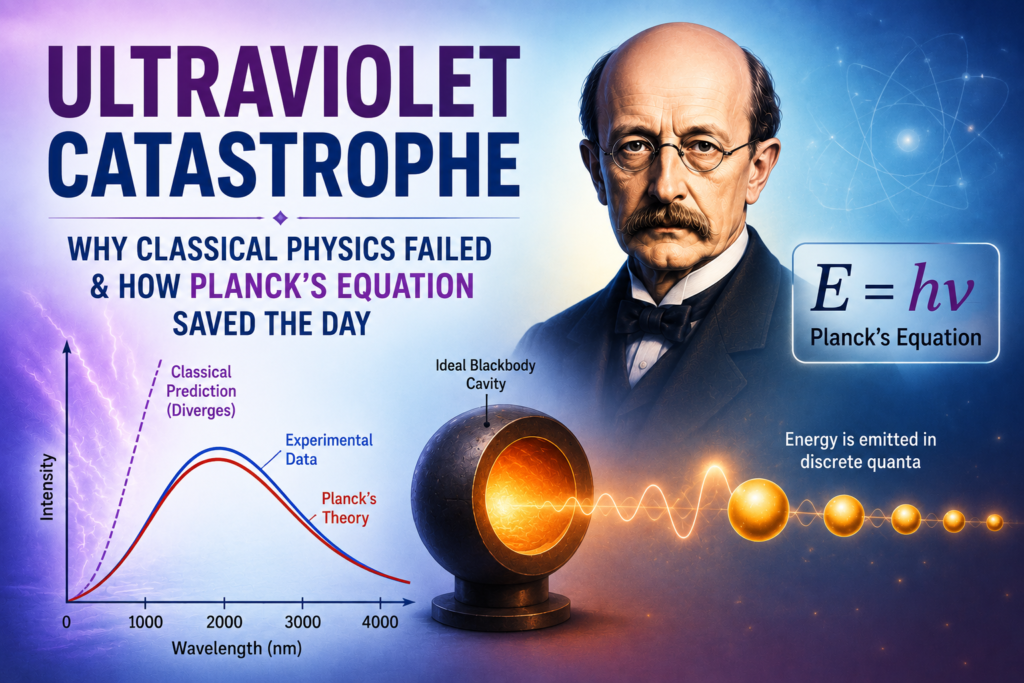
The ultraviolet catastrophe refers to a dramatic failure in classical physics predictions regarding blackbody radiation, the thermal energy emitted by an idealized object based purely on its temperature. According to classical theory, as wavelength decreased toward the ultraviolet end of the electromagnetic spectrum, the energy emitted by a black body should increase without limit, approaching infinity.
Real experiments showed nothing of the sort. Emitted energy actually decreased at short wavelengths, forming a smooth, well-behaved blackbody curve. The stark contradiction between theory and observation is exactly what physicists began calling the ultraviolet catastrophe, a term that captured both the severity and the strangeness of the failure.
The Classical Theory Behind the Problem
To understand why classical physics failed so badly, you need to understand the theoretical tools scientists were using. Physicists Lord Rayleigh and James Jeans developed a formula, now known as the Rayleigh-Jeans law, based on classical electromagnetic theory and statistical physics. Their equation relied heavily on the equipartition theorem, a principle stating that energy should be distributed equally among all available vibrational modes within a system at thermal equilibrium.
The Rayleigh-Jeans law can be expressed as:
B(ν, T) = (2ν²kT) / c²
Where B(ν, T) represents spectral radiance at frequency ν and temperature T, k is the Boltzmann constant, and c is the speed of light. At long wavelengths, this formula matched experimental data reasonably well. The problem emerged at short wavelengths, where the formula predicted a high frequency divergence, meaning emitted energy would increase indefinitely as frequency rose, producing the impossible infinite result central to the ultraviolet catastrophe.
Why Classical Physics Failed So Badly
The root cause of why classical physics failed lies in the equipartition theorem itself. Classical theory assumed that electromagnetic radiation within a cavity could vibrate at infinitely many possible frequencies, and that each of these vibrational modes, no matter how high the frequency, should receive an equal share of thermal energy.
Since there is no upper limit to how many high frequency vibrational modes exist, classical physics predicted that increasingly higher frequencies, especially toward the ultraviolet range, should carry increasingly more combined energy, spiraling toward infinity. This assumption, reasonable within classical statistical physics, simply did not match physical reality, exposing a genuine paradox that classical thermodynamics could not resolve on its own.
Wien’s Partial Solution and Its Limits
Before Planck’s involvement, physicist Wilhelm Wien had already developed a formula that worked well at short wavelengths but failed at longer ones, essentially the mirror image of the Rayleigh-Jeans problem. Wien’s approach, sometimes discussed alongside early lorenz law approximations, provided only a partial fix rather than a complete solution to the underlying paradox.
Neither Wien’s formula nor the Rayleigh-Jeans law could accurately describe the entire blackbody curve across all wavelengths. Physicists needed a completely new approach, one that could seamlessly connect both extremes of the electromagnetic spectrum without breaking down at either end.
Planck’s Interpolation: Bridging Two Failed Theories (1900)
In 1900, Max Planck approached the ultraviolet catastrophe through an ingenious mathematical strategy sometimes referred to as planck interpolation. Rather than starting from pure theory, Planck worked backward from experimental blackbody curve data, searching for a formula that could smoothly connect Wien’s short wavelength success with the Rayleigh-Jeans long wavelength accuracy.
Planck discovered that this could only be achieved by assuming energy is exchanged in discrete packets, or quanta, rather than continuously. This became known as the quantum hypothesis, formally expressed through the equation:
E = hν
Where E is the energy of a single quantum, ν (nu) represents frequency, and h is planck’s constant, approximately equal to 6.626 × 10⁻³⁴ joule seconds. This single assumption fundamentally changed how energy distribution across vibrational modes could be calculated.
Planck’s Law of Radiation: The Mathematics That Ended the Catastrophe
Using this quantum assumption, Planck derived a new formula, now known as planck’s law of radiation, capable of accurately describing spectral radiance across the entire electromagnetic spectrum:
B(ν, T) = (2hν³ / c²) × 1 / (e^(hν / kT) − 1)
At low frequencies, this equation mathematically reduces to match the Rayleigh-Jeans law almost exactly. However, at high frequencies, the exponential term in the denominator grows extremely rapidly, causing predicted energy to decrease toward zero rather than diverge toward infinity. This elegant behavior eliminated the ultraviolet catastrophe completely, matching experimental blackbody data with remarkable precision.
Why Quantization Solved What Classical Physics Could Not
The key insight behind Planck’s solution was that quantized energy naturally restricts how many high frequency vibrational modes can be meaningfully excited at a given temperature. Since each quantum at a high frequency requires a proportionally larger minimum energy of hν, fewer of these high energy quanta are available under normal thermal conditions.
This restriction directly countered the runaway prediction created by the classical equipartition theorem, effectively taming the high frequency divergence that had caused the entire crisis. It was a subtle but profound shift, one that revealed classical physics had reached a genuine boundary it could never cross using its existing assumptions.
The Broader Impact: Birth of a New Physics
Resolving the ultraviolet catastrophe did far more than fix a single equation. It marked the beginning of what became known as the birth of quantum mechanics. Albert Einstein later extended these same quantum principles in 1905 to explain the photoelectric effect, reinforcing the emerging concept of wave-particle duality and confirming that energy quantization reflected genuine physical reality, not merely a convenient mathematical trick.
Together, Planck and Einstein’s combined insights transformed a narrow, technical failure in radiation theory into the foundation of an entirely new scientific era, often described as the quantum revolution.
Lasting Lessons From the Ultraviolet Catastrophe
The ultraviolet catastrophe remains one of the most important cautionary tales in the history of science. It demonstrates how even a well-established, mathematically consistent theory can fail catastrophically when applied beyond its true limits. Classical statistical physics, built on assumptions of continuous energy distribution, simply could not survive contact with high frequency electromagnetic radiation.
The Legacy: Max Planck Quantum Universe
The resolution of the ultraviolet catastrophe opened the door to what is now known as the Max Planck Quantum Universe, a reality built on discrete, quantized energy rather than smooth classical assumptions. This breakthrough continues to shape modern physics, influencing everything from semiconductor design to ongoing quantum computing research.
Frequently Asked Questions
What is the ultraviolet catastrophe in simple terms?
The ultraviolet catastrophe refers to the failed classical physics prediction that a black body should emit infinite energy at short, ultraviolet wavelengths, a result contradicted by real experiments.
Why did classical physics fail to explain blackbody radiation?
Classical physics relied on the equipartition theorem, which assumed energy should be distributed equally across infinitely many vibrational modes, leading to an impossible high frequency divergence.
How did Planck’s equation solve the ultraviolet catastrophe?
Planck introduced the idea that energy is emitted in discrete quanta rather than continuously, deriving a formula that matched experimental data across all wavelengths and eliminated the infinite energy prediction.
What is the Rayleigh-Jeans law?
The Rayleigh-Jeans law is a classical formula that accurately predicted blackbody radiation at long wavelengths but failed catastrophically at short wavelengths, directly causing the ultraviolet catastrophe.
Why is the ultraviolet catastrophe important in physics history?
Solving the ultraviolet catastrophe marked the beginning of quantum mechanics, fundamentally transforming how scientists understand energy and radiation at the smallest scales.
Conclusion
The ultraviolet catastrophe stands as one of the most striking failures in the history of classical physics, a moment when trusted mathematical theory collided head-on with experimental reality and lost. It took Max Planck’s radical assumption of quantized energy to finally resolve the paradox, an insight that not only fixed a broken equation but permanently reshaped scientific understanding of energy itself. What began as an embarrassing theoretical failure ultimately became the spark that ignited the entire quantum revolution.