For nearly three decades, some of the finest scientific minds in Europe stared at the same stubborn puzzle and failed to solve it. The blackbody radiation problem was not an obscure academic curiosity. It was a fundamental crack in the foundation of classical physics, one that no amount of clever mathematics seemed capable of repairing. Every equation physicists threw at it produced impossible, nonsensical results.
Then, in 1900, Max Planck offered a solution so strange that it required abandoning centuries of assumptions about how energy behaves. Understanding the blackbody radiation problem means understanding the exact moment classical physics reached its breaking point, and quantum physics was born to fill the gap.
What Is a Black Body? Defining the Mystery
Before diving into the blackbody radiation problem itself, it helps to understand what a black body actually is. In physics, a black body is a theoretical, idealized object that absorbs all electromagnetic radiation that strikes it, reflecting none of it whatsoever. Because it absorbs everything, a true black body appears perfectly black at room temperature.
However, when heated, a black body does not stay dark. It begins to glow, emitting thermal radiation across the electromagnetic spectrum based purely on its temperature, not on what material it is made from. This predictable relationship between temperature and emitted radiation is what made black bodies such an attractive and important subject of study for nineteenth century physicists.
The Cavity Radiation Experiment
Since a perfect black body does not exist in nature, physicists studied blackbody behavior using a clever setup called a cavity radiation experiment. This involved a hollow container with a small opening, heated to a specific temperature. Because radiation entering the tiny hole would bounce around internally and eventually be absorbed, the light emerging from the opening closely approximated true blackbody radiation.
By measuring the intensity of radiation emitted at each wavelength under controlled thermodynamic equilibrium, scientists could study exactly how blackbody radiation physics behaved and compare it against theoretical predictions, a comparison that would soon reveal a devastating flaw in classical physics.
Kirchhoff’s Law and Early Understanding (1859 – 1900)
The scientific study of thermal radiation absorption began decades before Planck’s involvement. In 1859, physicist Gustav Kirchhoff formulated what became known as Kirchhoff’s law of radiation, stating that a good absorber of radiation is also a good emitter, and that the emission spectrum of a black body depends only on its temperature and frequency, not on the material’s composition.
This law established the theoretical importance of black bodies and set the stage for decades of experimental and mathematical investigation, as physicists worked to derive a formula that could accurately predict how much energy a black body emits at every wavelength.
Wien’s Displacement Law: A Partial Success
Progress came in 1893, when physicist Wilhelm Wien discovered a relationship now known as wien’s displacement law, which accurately predicted how the peak wavelength of blackbody radiation shifts as temperature changes. As an object gets hotter, the wavelength at which it emits the most energy shifts toward shorter, bluer wavelengths.
While wien’s displacement law worked well for shorter wavelengths, it failed dramatically at longer wavelengths, unable to accurately describe the full emission spectrum across the entire electromagnetic spectrum. This partial success highlighted just how incomplete classical understanding of the blackbody radiation problem truly was.
The Rayleigh-Jeans Law and the Ultraviolet Catastrophe
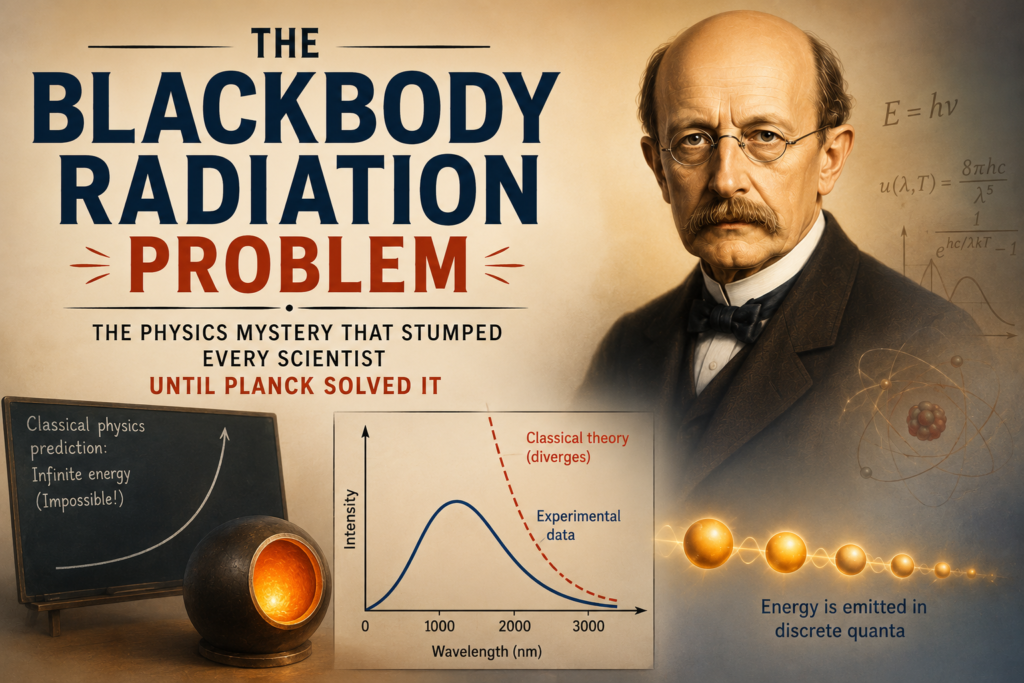
Around the same period, physicists Lord Rayleigh and James Jeans developed an alternative formula based purely on classical thermodynamics and electromagnetic wave theory. Their equation matched experimental results well at long wavelengths, but produced an absurd, physically impossible prediction at short, ultraviolet wavelengths, forecasting that a black body should emit infinite energy as wavelength approached zero.
This glaring failure became infamously known as the ultraviolet catastrophe, a term that captured just how badly classical physics had failed to explain the blackbody radiation problem. Real world experiments showed emitted energy actually decreasing at short wavelengths, the exact opposite of what classical equations predicted. Something was fundamentally wrong with how physicists understood energy itself.
Planck’s Solution: A Radical New Idea (1900)
In December 1900, Max Planck presented a solution that would ultimately resolve the blackbody radiation problem completely. Rather than assuming energy could be emitted in any continuous amount, as classical thermodynamics required, Planck proposed that energy is emitted and absorbed only in fixed, discrete packets called quanta.
This became known as the quantum hypothesis, expressed through the now famous equation:
E = hν
Here, E represents the energy of a single quantum, ν (nu) represents frequency, and h is a new fundamental constant, planck’s constant, with an approximate value of 6.626 × 10⁻³⁴ joule seconds. This small but powerful assumption would completely reshape how physicists understood radiation and energy.
Planck’s Law of Radiation: The Mathematics That Solved the Mystery
Using this quantum assumption, Planck derived a formula now known as planck’s law of radiation, which finally described blackbody emission accurately across the entire electromagnetic spectrum:
B(ν, T) = (2hν³ / c²) × 1 / (e^(hν / kT) − 1)
Where:
- B(ν, T) is the spectral radiance at frequency ν and temperature T
- h is planck’s constant
- c is the speed of light
- k is the Boltzmann constant
- T is the absolute temperature
At low frequencies, this equation naturally reduces to match the results of the Rayleigh-Jeans law, but crucially, it avoids the ultraviolet catastrophe entirely at high frequencies, where the exponential term in the denominator causes emitted energy to decrease rather than diverge toward infinity. This elegant mathematical behavior was the key breakthrough that finally solved the blackbody radiation problem.
Why Classical Thermodynamics Could Never Solve This Alone
Classical thermodynamics assumed that energy could take on any continuous value, allowing an unlimited number of ways for energy to be distributed among electromagnetic wave modes, particularly at high frequencies. This assumption is precisely what caused the ultraviolet catastrophe in the first place.
By introducing quantized energy, Planck effectively limited how energy could be distributed at high frequencies, since each quantum required a minimum energy of hν, an amount that becomes increasingly difficult to supply as frequency rises, especially near absolute zero conditions. This restriction naturally suppressed the runaway energy predictions that had plagued classical models for decades.
Confirming the Theory: Einstein and Beyond (1905 onward)
Although Planck’s equation solved the blackbody radiation problem mathematically, it was Albert Einstein who helped confirm that energy quantization reflected genuine physical reality. In 1905, Einstein applied the same quantum principles to explain the photoelectric effect, demonstrating that light itself behaves as discrete photon particles, reinforcing the emerging concept of wave-particle duality.
This growing body of evidence transformed Planck’s original mathematical solution into a foundational pillar of modern physics, launching what historians now call the quantum revolution.
Real World Applications of Blackbody Radiation Physics
Understanding blackbody radiation physics extends far beyond theoretical curiosity. It explains why heating elements glow red, then orange, then white as temperature increases. It underlies astrophysics, allowing scientists to determine the temperature of stars simply by analyzing their emitted light spectrum. It even plays a role in understanding cosmic microwave background radiation, considered strong evidence for the Big Bang.
The Legacy: Max Planck Quantum Universe
Planck’s solution to the blackbody radiation problem opened the door to what is now called the Max Planck Quantum Universe, a reality governed by discrete, quantized energy rather than smooth classical assumptions. This breakthrough continues to influence modern physics, from semiconductor design to quantum computing research being conducted today.
Frequently Asked Questions
What is the blackbody radiation problem?
The blackbody radiation problem refers to the failure of classical physics to correctly predict the energy emitted by a black body across all wavelengths, particularly at short, ultraviolet wavelengths.
What is a black body in physics?
A black body is a theoretical object that absorbs all incoming radiation and emits thermal radiation based solely on its temperature, independent of its material composition.
How did Planck solve the blackbody radiation problem?
Planck solved the problem by proposing that energy is emitted in discrete quanta rather than continuously, introducing planck’s constant and deriving a radiation formula that matched experimental data perfectly.
What is the ultraviolet catastrophe?
The ultraviolet catastrophe refers to the nonsensical classical prediction that a black body should emit infinite energy at short wavelengths, a result contradicted by real world experiments.
Why is the blackbody radiation problem important in physics history?
Solving the blackbody radiation problem marked the beginning of quantum mechanics, fundamentally changing how scientists understand energy, radiation, and the behavior of matter at small scales.
Conclusion
The blackbody radiation problem stumped brilliant scientists for nearly thirty years, exposing a fundamental flaw hidden within classical physics that no one could explain. It took Max Planck’s radical proposal of quantized energy to finally crack the mystery, an idea that not only solved a stubborn thermodynamics puzzle but also launched an entirely new era of physics. What began as a narrow technical problem about glowing objects ultimately reshaped humanity’s understanding of energy, radiation, and reality itself.