Physics rarely produces a moment as dramatic as the one facing scientists in the final years of the nineteenth century. Every trusted classical formula, when pushed to its limits, predicted something absurd: infinite energy radiating from an ordinary heated object. The crisis needed a genuine mathematical rescue, and that rescue arrived in the form of planck’s law of radiation, an equation that did not simply patch the problem but completely reinvented how physicists understood energy itself.
Understanding planck’s law of radiation means understanding one of the most elegant pieces of mathematical physics ever developed, a formula built not from pure theory alone, but from careful interpolation between two failed classical models.
The Crisis That Demanded a New Formula (1859 – 1900)
The story behind planck’s law of radiation begins with the blackbody radiation problem, a puzzle that had frustrated physicists since Gustav Kirchhoff first formalized the concept of an ideal radiating body in 1859. A black body absorbs all incoming radiation and emits thermal energy based purely on temperature, and scientists desperately wanted a formula predicting exactly how much energy it emits at every wavelength.
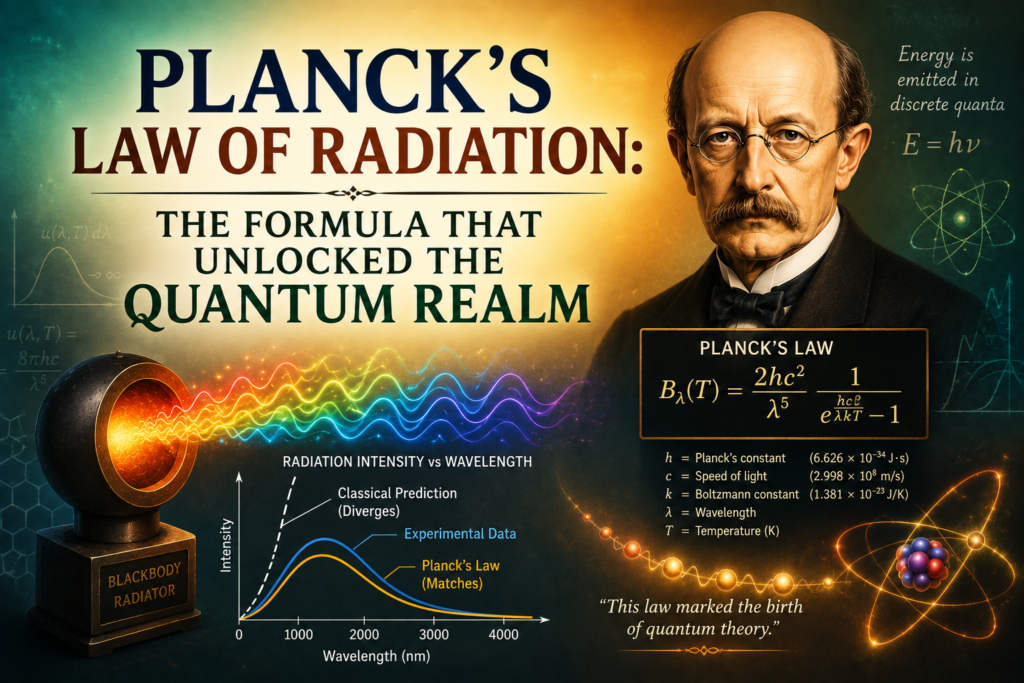
Classical attempts at solving this problem repeatedly failed. The Rayleigh-Jeans law worked at long wavelengths but predicted impossible infinite energy at short, ultraviolet wavelengths, a failure so severe it earned the nickname the ultraviolet catastrophe. Meanwhile, Wien’s formula worked well at short wavelengths but broke down at longer ones. Neither approach could accurately describe the entire experimental data fit across the full spectral radiance curve.
Planck’s Mathematical Interpolation
Rather than starting from a grand new theory, Max Planck approached the problem through careful mathematical interpolation, essentially searching for a formula that could smoothly bridge the gap between Wien’s short wavelength accuracy and the Rayleigh-Jeans long wavelength success. Working through the winter of 1900, Planck adjusted his equations until they matched the experimental blackbody curve across all wavelengths simultaneously.
This interpolation process led him to a crucial realization. The only way to make the mathematics work was to assume that oscillator energy within the radiating cavity could not take on continuous values. Instead, energy needed to exist only in discrete, fixed amounts. This became known as the quantum hypothesis, and it directly gave birth to planck’s law of radiation as we know it today.
Deriving Planck’s Law of Radiation
To derive planck’s law of radiation, Planck began by assuming that the oscillators responsible for emitting radiation within a cavity could only possess energy values that were whole number multiples of a fundamental unit, expressed as:
E = nhν
Where n is a positive integer, h is planck’s constant, and ν (nu) is the frequency of oscillation. Using statistical methods related to the boltzmann distribution, Planck calculated the average energy of these quantized oscillators at a given temperature T, arriving at:
⟨E⟩ = hν / (e^(hν / kT) − 1)
Here, k represents the Boltzmann constant. By combining this average oscillator energy with the known frequency distribution of modes within a cavity, Planck arrived at the complete formula for spectral radiance, written as B_ν(T):
B_ν(T) = (2hν³ / c²) × 1 / (e^(hν / kT) − 1)
This is planck’s law of radiation in its full form, where c represents the speed of light. Every term in this equation plays a specific role in shaping the predicted radiation density across the electromagnetic spectrum.
Why This Equation Succeeded Where Others Failed
The genius of planck’s law of radiation lies in its behavior at both extremes of frequency. At low frequencies, the exponential term in the denominator can be approximated using a simple expansion, causing the equation to naturally reduce to the Rayleigh-Jeans formula, preserving its accuracy at long wavelengths.
At high frequencies, however, the exponential term grows extremely rapidly, causing the entire expression to shrink toward zero rather than diverge toward infinity. This behavior single-handedly eliminated the ultraviolet catastrophe, allowing planck’s law of radiation to match experimental data with remarkable precision across the entire spectrum, something no previous formula had achieved.
The Physical Meaning Behind the Mathematics
What made planck’s law of radiation so revolutionary was not merely its mathematical success, but what it implied about physical reality. The formula only worked if energy truly existed in discrete quanta rather than flowing continuously, as classical thermodynamics had always assumed.
This meant that oscillating particles within the radiating cavity could not gradually increase their energy. They could only jump between fixed, quantized energy levels, absorbing or emitting energy in specific packets. This restriction directly limited how much energy could be distributed among high frequency modes, solving the runaway prediction responsible for the ultraviolet catastrophe.
From Equation to Confirmed Reality
Although planck’s law of radiation matched experimental data beautifully, Planck himself initially treated the quantum assumption behind it as a useful mathematical device rather than literal physical truth. It took several more years, and contributions from other physicists, to confirm that quantization was a genuine feature of nature.
In 1905, Albert Einstein extended these same quantum principles to explain the photoelectric effect, demonstrating that light itself behaves as discrete photons. This discovery reinforced the emerging concept of wave-particle duality and provided strong independent evidence supporting the physical reality behind planck’s law of radiation.
Applications of Planck’s Law Beyond Theoretical Physics
The influence of planck’s law of radiation extends far beyond its original nineteenth century context. Astrophysicists use it today to determine the surface temperature of stars by analyzing their emitted radiation spectrum. Engineers apply it when designing heating elements, thermal cameras, and infrared sensors. Cosmologists rely on principles derived from planck’s law of radiation when studying the cosmic microwave background, one of the strongest pieces of evidence supporting the Big Bang theory.
This remarkable versatility demonstrates how a formula developed to solve one narrow mathematical physics puzzle became a permanent, foundational tool across multiple scientific disciplines.
Why This Discovery Changed Physics Forever
Before planck’s law of radiation, classical physics assumed energy behaved as a smooth, continuous quantity. After it, physicists were forced to accept that nature operates on discrete, quantized principles at its most fundamental level. This shift did not just resolve the blackbody radiation problem, it launched what would eventually become the birth of quantum mechanics, an entirely new framework for understanding reality.
The Legacy: Max Planck Quantum Universe
The success of planck’s law of radiation opened the door to what is now known as the Max Planck Quantum Universe, a reality governed by discrete energy levels rather than smooth classical assumptions. This single equation, born from careful mathematical interpolation, continues to influence modern physics, astronomy, and engineering more than a century after it was first derived.
Frequently Asked Questions
What is planck’s law of radiation?
Planck’s law of radiation is a formula describing how much electromagnetic energy a black body emits at each wavelength and temperature, derived by assuming energy exists in discrete quantized packets.
How was planck’s law of radiation derived?
It was derived through mathematical interpolation between two failed classical formulas, combined with the assumption that oscillator energy is quantized rather than continuous, using statistical methods related to the Boltzmann distribution.
Why did planck’s law of radiation succeed where classical formulas failed?
Unlike classical formulas, planck’s law of radiation naturally avoids predicting infinite energy at high frequencies, matching experimental data accurately across the entire electromagnetic spectrum.
What is the significance of planck’s constant in this formula?
Planck’s constant determines the size of each energy quantum, directly shaping how energy is distributed across different frequencies within planck’s law of radiation.
Where is planck’s law of radiation used today?
It is used in astrophysics to measure star temperatures, in engineering for thermal imaging and heating design, and in cosmology to study the cosmic microwave background radiation.
Conclusion
Planck’s law of radiation stands as one of the most important equations in the history of physics, not simply because it solved a stubborn nineteenth century puzzle, but because of what it revealed about the fundamental nature of energy itself. Born from careful mathematical interpolation rather than pure theoretical speculation, this formula quietly ended the ultraviolet catastrophe while opening the door to an entirely new scientific era. More than a century later, planck’s law of radiation remains a cornerstone of modern physics, proving that sometimes the most profound discoveries begin with simply trying to make the numbers fit.