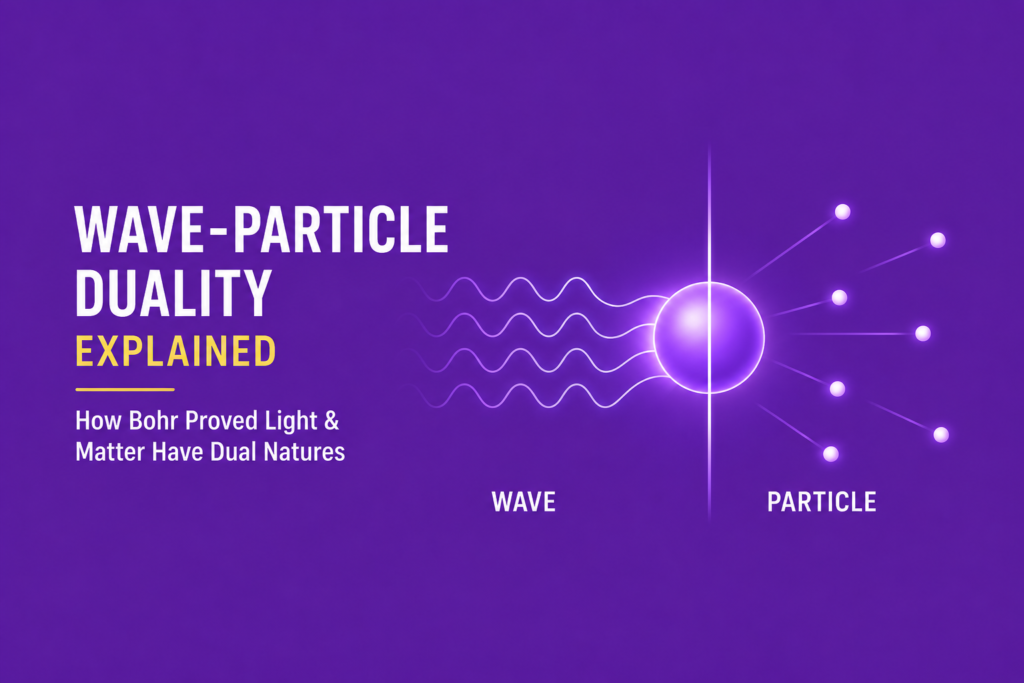
Is light a wave, or is it a particle? Is an electron a tiny solid ball, or a spread-out ripple of probability? For centuries, physicists insisted these questions must have a single, definitive answer. Then experiments throughout the early twentieth century revealed something genuinely astonishing. Wave-particle duality, the strange truth that light and matter both behave as waves and particles depending entirely on circumstance, forced scientists to abandon this either-or thinking entirely, a shift that Niels Bohr helped transform from confusing paradox into a coherent, workable scientific framework.
Understanding wave-particle duality means tracing the experimental discoveries and theoretical breakthroughs that revealed nature’s strangest secret, that the most fundamental building blocks of our universe simply refuse to be described through classical, either-or categories.
The Old Debate: Newton Versus Wave Theory
Long before quantum mechanics existed, physicists were already divided over the true nature of light. Isaac Newton championed a particle-based corpuscular theory, while other scientists favored wave optics explanations, capable of explaining phenomena like diffraction that particle theory alone struggled to account for.
By the nineteenth century, wave theory appeared to have won decisively. The Young double slit experiment demonstrated clear interference fringes, a signature behavior only waves were believed capable of producing. For decades, physicists considered the matter settled entirely. Light was simply a wave, following predictable wave equation mathematics, full stop.
Einstein Reopens the Question (1905)
This confident consensus shattered in 1905, when Albert Einstein proposed his radical light quantum hypothesis to explain the photoelectric effect vs diffraction puzzle. Einstein suggested that light consists of discrete energy packets, later called photons, carrying specific photon momentum and energy values calculated through the equation:
E = hf
Here, E represents photon energy, h represents Planck’s constant, and f represents frequency. This idea successfully explained why light striking a metal surface only ejects electrons above a specific threshold frequency, a phenomenon classical wave theory failure could never adequately account for.
Einstein’s explanation forced physicists to accept something deeply uncomfortable. Light, long assumed to be purely a wave based on decades of interference pattern evidence, now also had to behave as discrete particles under certain experimental conditions. This apparent contradiction became the true beginning of wave-particle duality as a formally recognized physical principle.
De Broglie’s Bold Extension: Matter Waves (1923 – 1924)
If light could behave as both a wave and a particle, French physicist Louis de Broglie wondered whether the reverse might also apply. Could matter itself, including electrons, also exhibit wave nature of matter properties? In 1923 and 1924, de Broglie proposed exactly that through his celebrated De Broglie hypothesis, suggesting every particle possesses an associated de Broglie wavelength, calculated through the equation:
λ = h / p
Here, λ (lambda) represents wavelength, h represents Planck’s constant, and p represents the particle’s momentum. This equation suggested that even solid matter could exhibit wave-like properties under appropriate conditions, dramatically expanding wave-particle duality far beyond its original application to photons alone.
Experimental Proof: The Davisson-Germer Experiment (1927)
De Broglie’s bold hypothesis received direct experimental confirmation in 1927 through the Davisson Germer experiment, conducted by American physicists Clinton Davisson and Lester Germer. By firing electrons at a crystal surface, they observed electron diffraction patterns strikingly similar to those produced by light waves, providing undeniable proof that particles could indeed exhibit genuine electron wave nature.
This landmark experiment cemented wave-particle duality as a fundamental, experimentally verified feature of nature, applying not just to photons and electrons, but potentially to all forms of matter throughout the universe, establishing what many consider a genuine quantum field precursor to later theoretical developments.
The Double Slit Experiment: Duality Made Visible
Perhaps no experiment illustrates wave-particle duality more powerfully than the double slit interference setup. When individual photons or electrons are fired one at a time through two narrow slits, they gradually build up an interference pattern electrons on a detection screen, a pattern only explainable if each particle somehow passes through both slits simultaneously as a wave.
However, if scientists attempt to observe which slit a particle actually passes through, the interference pattern vanishes entirely, replaced by simple particle-like behavior. This bizarre result, sometimes studied through single photon interference experiments, suggests that measurement itself fundamentally alters particle behavior, closely tied to quantum superposition, where particles exist in multiple possible states simultaneously until observed.
Bohr’s Framework: Making Sense of the Paradox
While experiments repeatedly confirmed wave-particle duality, physicists desperately needed a coherent theoretical framework explaining how something could genuinely be both a wave and a particle without logical contradiction. This is precisely where Niels Bohr made his most significant philosophical contribution, developing his complementarity principle to resolve this apparent wave-particle paradox.
According to Bohr, wave and particle descriptions represent complementary properties, meaning they cannot both be observed simultaneously within any single experimental setup, yet both remain equally valid and necessary for a complete understanding of quantum phenomena. Neither description alone tells the whole story, and yet, remarkably, both descriptions together produce a coherent, complete picture of physical duality.
Connecting Duality to Atomic Structure
Bohr’s insights regarding wave-particle duality connected directly to his own earlier foundational work regarding electron orbits and energy levels within atoms. Once physicists accepted that electrons possessed genuine wave nature, this understanding helped explain why only specific, quantized orbital positions were permitted within atoms, since only orbits accommodating whole numbers of electron wavelengths could produce stable, self-reinforcing standing wave patterns rather than destructively interfering with themselves.
This connection helped transform Bohr’s original atomic model from a somewhat ad hoc mathematical postulate into a more physically intuitive picture, directly incorporating the emerging understanding of quantum wave behavior throughout atomic structure.
The Copenhagen Interpretation: A Complete Framework
Bohr’s approach to wave-particle duality became a central pillar supporting the broader copenhagen interpretation of quantum mechanics, developed largely through discussions occurring at his own research institute throughout the 1920s. This interpretation proposed that quantum systems exist in a superposition of multiple possible states, described through their wave packet representation, until measurement forces a definite, particle-like outcome to manifest.
The Historic Debate: Bohr Versus Einstein
Wave-particle duality became a central battleground within the legendary Einstein–Bohr debate, one of history’s most consequential intellectual rivalries. Einstein found Bohr’s philosophical framework deeply unsatisfying, believing physical reality should possess definite properties independent of observation.
This tension crystallized through the EPR paradox, a thought experiment Einstein co-developed specifically challenging quantum mechanics’ completeness, pointing toward what he dismissively called spooky action at a distance. Bohr’s reply to Einstein consistently defended wave-particle duality and complementarity as genuine, irreducible features of quantum reality. This fundamental disagreement between Niels Bohr vs Einstein regarding quantum mechanics’ philosophical implications remained unresolved throughout both physicists’ lifetimes, though subsequent experiments have largely supported Bohr’s original position.
Why Wave-Particle Duality Still Matters Today
Wave-particle duality remains far more than a historical curiosity or philosophical puzzle. It underlies technologies including electron microscopes, which rely on the wave-like properties of electrons to achieve resolution far beyond what visible light allows. It also plays a foundational role in ongoing quantum computing research, where the dual nature of quantum particles enables computational possibilities impossible under classical physics, representing a genuine example of from Bohr model to modern technology development.
The Lasting Legacy
Understanding wave-particle duality remains essential background for Bohr’s philosophical legacy, since this framework fundamentally reshaped how physicists conceptualize physical reality at the quantum scale. More than a century after these initial discoveries, wave-particle duality continues challenging our most basic intuitions about what it means for something to exist as either a wave or a particle.
Frequently Asked Questions
What is wave-particle duality in simple terms?
Wave-particle duality is the principle that light and matter exhibit both wave-like and particle-like properties, depending on how they are observed and measured experimentally.
How did Einstein contribute to wave-particle duality?
In 1905, Einstein proposed that light consists of discrete photons, successfully explaining the photoelectric effect and establishing the particle nature of light alongside its known wave behavior.
What is the de Broglie wavelength?
The de Broglie wavelength describes the wave-like properties associated with any particle, calculated using the particle’s momentum divided into Planck’s constant.
How did Bohr help explain wave-particle duality?
Bohr developed the complementarity principle, proposing that wave and particle descriptions are mutually exclusive within any single experiment, yet both remain necessary for a complete understanding of quantum systems.
Why is wave-particle duality important in modern technology?
Wave-particle duality underlies technologies such as electron microscopes and quantum computing, both of which rely on the dual nature of particles at the quantum scale.
Conclusion
Wave-particle duality stands as one of the most astonishing revelations in the history of science, a mystery that began with Einstein’s bold photon hypothesis and grew into a fundamental challenge to how humanity understands light and matter. Through de Broglie’s matter waves, the haunting results of the double slit experiment, and Bohr’s elegant complementarity framework, this duality continues to defy simple explanation. Yet rather than weakening quantum theory, this paradox has become one of its greatest strengths, revealing a universe far stranger and more fascinating than classical physics ever imagined.