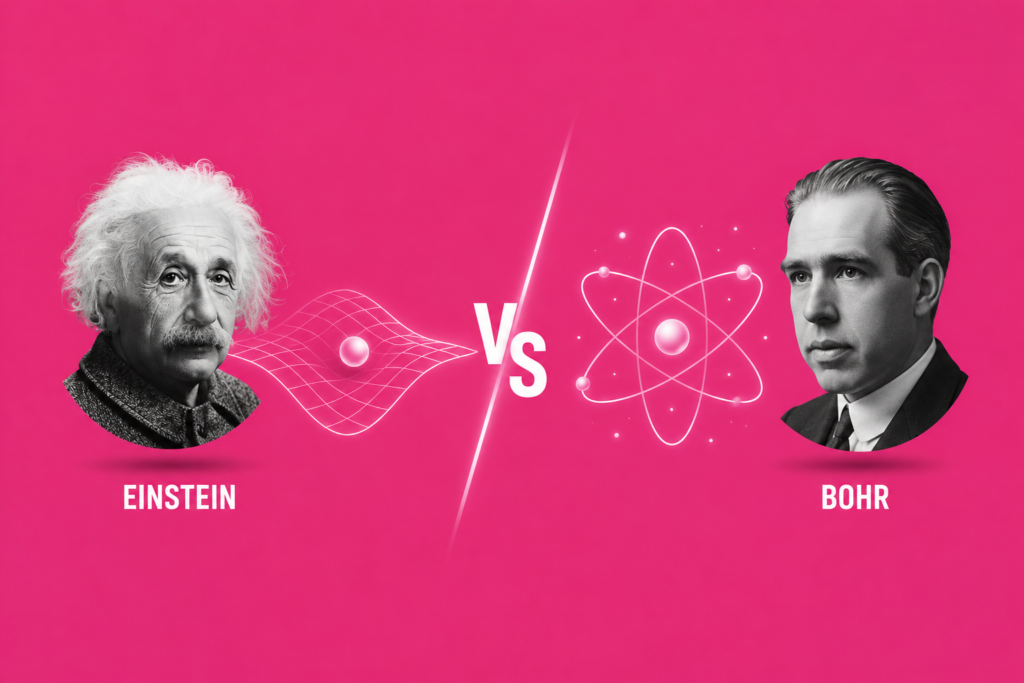
Two of history’s greatest scientific minds spent nearly three decades locked in an intellectual battle over the very nature of reality itself. Einstein vs bohr represents far more than a simple academic disagreement. It stands as perhaps the most consequential scientific debate ever conducted, pitting Albert Einstein’s unwavering faith in a deterministic, knowable universe against Niels Bohr‘s radical vision of a fundamentally probabilistic reality. Remarkably, despite Einstein’s towering genius, subsequent decades of experimental physics would ultimately vindicate Bohr’s position.
Understanding einstein vs bohr means tracing one of science’s most fascinating rivalries, a debate conducted with genuine mutual respect yet fundamental philosophical disagreement, one that ultimately shaped how humanity understands the deepest nature of physical reality.
Setting the Stage: Two Different Worldviews
The roots of einstein vs bohr trace back to fundamentally opposing philosophical commitments regarding what physics should describe. Einstein, despite his own revolutionary contributions to relativity, remained deeply committed to a deterministic worldview, believing that physical reality possessed definite properties existing independently of observation or measurement.
Bohr, meanwhile, had spent years developing his complementarity principle and broader copenhagen interpretation, frameworks suggesting that quantum reality genuinely operates according to probability rather than strict predictability. These represented not merely different scientific opinions, but fundamentally incompatible visions regarding the true nature of physical reality itself.
The First Major Clash: Solvay 1927
The Solvay 1927 debate marked the first major public confrontation in the einstein vs bohr rivalry. During this landmark Solvay conference debates gathering in Brussels, leading physicists assembled to discuss the rapidly developing field of quantum mechanics. Einstein, though not formally presenting a paper, engaged in intense private discussions and public challenges throughout the conference, attempting to expose apparent inconsistencies within the emerging quantum framework.
Einstein’s quantum critique centered on his conviction that quantum mechanics, despite its remarkable predictive success, must be fundamentally incomplete, merely reflecting humanity’s current limited understanding rather than genuine indeterminism inherent within nature itself.
Einstein’s Famous Objection
Throughout this period, Einstein repeatedly voiced his now-famous objection, declaring that “God does not play dice” with the universe. This phrase captured his deep philosophical discomfort with quantum indeterminism, reflecting his belief that beneath quantum mechanics’ probabilistic surface, some deeper, deterministic worldview must ultimately govern physical reality, waiting to be discovered through more complete theoretical understanding.
Bohr defense of quantum mechanics consistently countered these objections, arguing that quantum probability represented a genuine, irreducible feature of nature rather than a temporary theoretical placeholder awaiting future refinement.
The Light Box Experiment: Solvay 1930
The einstein vs bohr rivalry reached a particularly dramatic peak during the Solvay 1930 light box gathering. Einstein proposed an ingenious light box experiment, sometimes called the clock box thought experiment, designed specifically to challenge Heisenberg’s uncertainty principle by seemingly demonstrating that both a photon’s energy and precise timing could theoretically be measured simultaneously with unlimited precision.
Einstein’s clever thought experiment involved a box containing photons, equipped with a precise clock mechanism controlling exactly when a single photon would be released. By carefully weighing the box before and after photon emission, Einstein argued that both the photon energy and the precise emission moment could be determined exactly, seemingly violating quantum uncertainty limits entirely.
Bohr’s Brilliant Counterattack
Bohr initially struggled overnight to formulate an adequate response to this remarkably clever challenge. However, his eventual solution proved genuinely brilliant, ironically using Einstein’s own general relativity counterargument against him. Bohr demonstrated that the very act of weighing the box would cause it to shift slightly within Earth’s gravitational field, and according to Einstein’s own theory of general relativity, this gravitational time dilation defense would introduce exactly enough timing uncertainty to preserve Heisenberg’s uncertainty principle after all.
This elegant refutation, using Einstein’s own theoretical framework against his objection, represented a decisive early victory for Bohr within the ongoing einstein vs bohr debate, demonstrating quantum mechanics’ internal consistency even under Einstein’s most sophisticated challenges.
The EPR Paper: Einstein’s Final Major Challenge (1935)
Einstein’s most sophisticated and lasting challenge arrived through the EPR paradox, developed alongside colleagues Podolsky and Rosen in 1935. This EPR paper precursor argument proposed that if quantum mechanics were truly complete, measuring one particle within an entangled pair should not instantaneously affect its distant partner, unless some hidden variables already predetermined both outcomes before measurement occurred.
Einstein dismissively described this apparent instantaneous connection as spooky action at a distance, arguing this violated fundamental principles of local realism, the classical assumption that objects can only be influenced by their immediate surroundings, not instantaneously affected by distant events.
Bohr’s Measured Response
Bohr’s reply to Einstein regarding the EPR paradox proved characteristically nuanced, defending quantum mechanics’ completeness while acknowledging the genuinely strange implications of quantum entanglement. Bohr argued that the EPR thought experiment, rather than revealing incompleteness, actually demonstrated quantum mechanics’ fundamentally non-classical nature, requiring physicists to abandon comfortable assumptions regarding local realism entirely.
This exchange represented perhaps the most philosophically sophisticated moment throughout the entire einstein vs bohr rivalry, forcing both physicists to articulate their deepest assumptions regarding the nature of physical reality with unprecedented clarity.
Why Einstein Ultimately Lost the Debate
For decades following Einstein’s death in 1955, the einstein vs bohr debate remained largely a philosophical disagreement, since no experimental test existed capable of definitively distinguishing between Einstein’s hidden variables hypothesis and Bohr’s genuine quantum indeterminism. This changed dramatically when physicist John Bell developed a mathematical framework, now known as Bell’s theorem, capable of experimentally testing these competing interpretations.
Beginning in the 1970s and continuing through increasingly sophisticated experiments in subsequent decades, physicists consistently found that experimental results violated Bell’s inequalities, providing overwhelming evidence supporting quantum entanglement’s genuine non-locality debate implications over Einstein’s preferred local realism assumptions. These experiments effectively settled the einstein vs bohr rivalry decisively in Bohr’s favor, demonstrating that quantum mechanics’ probabilistic, non-local character represents genuine physical reality rather than incomplete theoretical understanding.
A Rivalry Built on Mutual Respect
Despite their fundamental philosophical disagreements, the einstein vs bohr relationship remained characterized by genuine intellectual respect throughout their decades-long exchange. Both men recognized each other’s extraordinary scientific capabilities, engaging in rigorous, good-faith scientific discourse rather than personal animosity, exemplifying how genuine scientific progress often emerges through vigorous, respectful disagreement between brilliant minds holding fundamentally different worldviews.
The Broader Legacy of Their Debate
The einstein vs bohr rivalry fundamentally shaped modern theoretical physics debates, establishing crucial questions regarding quantum mechanics completeness that continue generating research and philosophical discussion today. Niels Bohr vs Einstein discussions remain foundational to understanding from Bohr model to modern technology developments, since resolving their original disagreements through experimental testing helped establish quantum entanglement’s genuine reality, now foundational to emerging quantum computing and quantum cryptography technologies.
Bohr’s Enduring Philosophical Legacy
Bohr’s quantum contributions, developed substantially through his historic debates with Einstein, established the foundational philosophical framework underlying modern quantum mechanics interpretation. This intellectual legacy, forged through decades of respectful yet uncompromising scientific discourse, continues influencing how physicists and philosophers alike approach fundamental questions regarding measurement, reality, and the true nature of existence throughout the universe.
Frequently Asked Questions
What was the Einstein vs Bohr debate actually about?
The debate centered on whether quantum mechanics’ probabilistic nature reflected genuine physical reality, as Bohr argued, or merely incomplete human understanding of an underlying deterministic universe, as Einstein believed.
What was Einstein’s famous objection to quantum mechanics?
Einstein famously stated that “God does not play dice,” reflecting his belief that quantum indeterminism must eventually be replaced by a more complete, deterministic theory.
How did Bohr respond to Einstein’s light box experiment?
Bohr cleverly used Einstein’s own theory of general relativity, demonstrating that gravitational time dilation effects would preserve Heisenberg’s uncertainty principle even within Einstein’s proposed experiment.
Was the Einstein-Bohr debate ever definitively resolved?
Yes, decades after both physicists had died, experiments testing Bell’s theorem consistently supported Bohr’s probabilistic, non-local interpretation of quantum mechanics over Einstein’s preferred deterministic alternative.
Did Einstein and Bohr remain friends despite their disagreement?
Yes, both physicists maintained genuine mutual respect throughout their decades-long debate, engaging in rigorous scientific discourse rather than personal animosity.
Conclusion
The einstein vs bohr rivalry stands as one of history’s most intellectually significant scientific debates, pitting two towering geniuses against each other over the fundamental nature of physical reality itself. From the dramatic Solvay conference confrontations to Einstein’s ingenious light box challenge and the profound EPR paradox, this decades-long exchange forced both physicists to articulate their deepest assumptions with remarkable clarity. Though Einstein never lived to see it, subsequent experimental physics ultimately vindicated Bohr’s probabilistic vision, confirming that the universe genuinely operates according to quantum uncertainty rather than the comfortable, deterministic reality Einstein spent his life defending.