What if two completely contradictory descriptions of the same thing could both be true, not sometimes, but always, depending entirely on how you chose to look? This is the unsettling, genuinely mind-bending idea at the heart of the complementarity principle, arguably Niels Bohr‘s most radical intellectual contribution to physics. Rather than forcing nature into a single, consistent picture, Bohr proposed that reality itself sometimes requires two mutually exclusive descriptions, each incomplete alone, yet together forming a complete account of physical truth.
Understanding the complementarity principle means confronting one of the deepest philosophical challenges quantum mechanics ever posed, a genuine rethinking of what it even means for something to be true about the physical world.
The Puzzle That Demanded a New Philosophy
The complementarity principle emerged directly from one of quantum physics’ oldest and strangest puzzles, wave-particle duality. Experiments throughout the early twentieth century revealed that light and matter alike sometimes behaved as continuous waves, producing interference patterns, and sometimes behaved as discrete particles, striking detectors at single, localized points.
This created an apparent contradiction that classical concepts limits could not resolve. How could something be both a wave, spread out and continuous, and a particle, localized and discrete, simultaneously? Physicists needed an entirely new way of thinking about physical reality nature itself, one that could accommodate this seemingly impossible duality without simply declaring one description correct and the other false.
Bohr’s Radical Answer (1927)
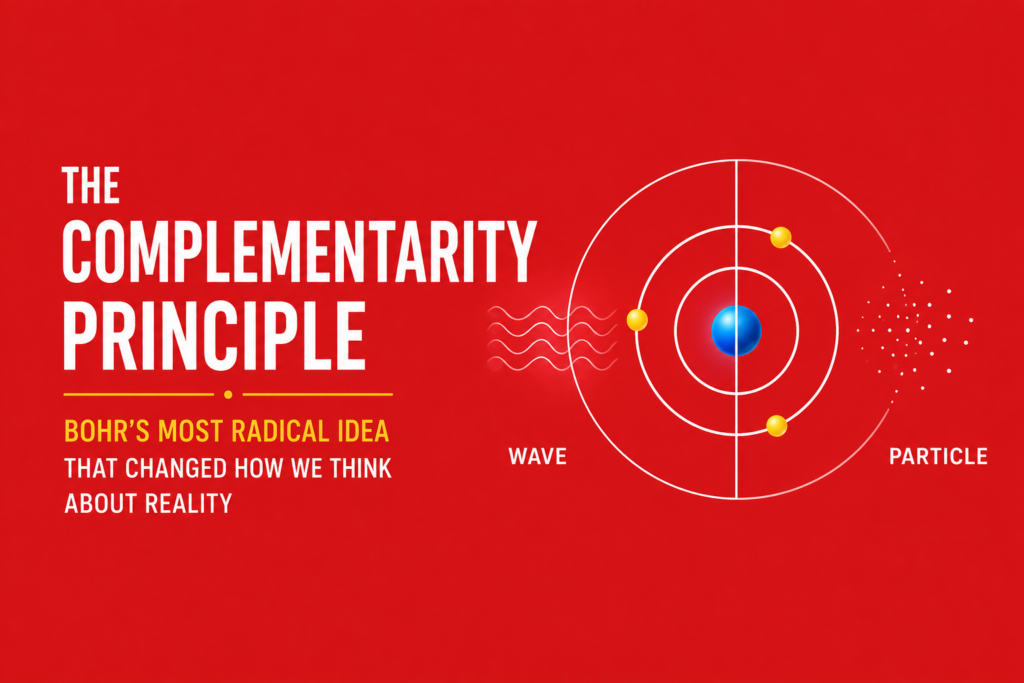
In 1927, Bohr proposed his solution through what became known as the principle of complementarity. Rather than treating wave and particle descriptions as competing, mutually contradictory theories where only one could ultimately be correct, Bohr argued that both descriptions were genuinely necessary, each capturing an essential aspect of quantum reality that the other simply could not express.
According to Bohr complementarity, wave and particle descriptions represent complementary observables, meaning they cannot both be observed simultaneously within a single experimental setup influence, yet both remain equally valid and essential for a complete understanding of quantum phenomena. Neither description alone tells the whole story, and yet, remarkably, both descriptions together produce a coherent, complete picture of quantum reality.
Why You Cannot See Both at Once
Central to understanding the complementarity principle is recognizing precisely why wave and particle aspects never appear simultaneously within any single experiment. According to Bohr, this limitation traces directly to the physical nature of any measuring apparatus itself. An experimental configuration designed to reveal a particle’s wave-like properties, such as detecting interference patterns, is fundamentally incompatible with an experimental configuration designed to reveal its particle aspect, such as precisely tracking individual trajectory paths.
This connects meaningfully to the Heisenberg uncertainty link, since attempting to measure one property with great precision fundamentally disturbs the system’s ability to simultaneously exhibit the complementary property with equal clarity. The mathematics governing quantum observation, expressed through Heisenberg’s uncertainty relation:
Δx × Δp ≥ ℏ/2
Here, Δx represents uncertainty in position, Δp represents uncertainty in momentum, and ℏ represents the reduced Planck’s constant, reinforces this same fundamental limitation, showing precisely why classical concepts of definite position and definite momentum cannot both apply with unlimited precision simultaneously.
The Double Slit Experiment: Complementarity in Action
Perhaps no experiment illustrates the complementarity principle more vividly than the famous double slit setup. When physicists allow particles to pass through two slits without observing which path each particle takes, an interference pattern emerges, clear evidence of wave aspect behavior. Yet the moment scientists introduce any measuring apparatus capable of determining which specific slit a particle passed through, the interference pattern immediately vanishes, replaced instead by simple particle aspect behavior.
This experiment demonstrates precisely what Bohr meant by complementarity. The experimental setup influence itself determines which complementary property becomes observable, wave or particle, but never both simultaneously within the same measurement. Nature does not secretly possess both properties at once, waiting to be revealed. Rather, which property manifests depends entirely on the specific experimental question being asked.
The Copenhagen Interpretation: Building a Complete Framework
The complementarity principle became a central pillar supporting the broader copenhagen interpretation of quantum mechanics, developed largely through discussions occurring at Bohr’s own research institute throughout the 1920s. This interpretation addressed the fundamental measurement problem quantum physicists faced, namely, what actually happens to a quantum system during the act of observation itself.
According to this framework, before measurement occurs, a quantum system exists in a superposition of multiple possible states, described mathematically through its wave function interpretation. Upon measurement, this wave function collapse occurs, with the system settling definitively into one specific, observable outcome. The complementarity principle helps explain why this collapse produces either wave-like or particle-like behavior, depending entirely on precisely what type of measurement was actually performed.
Beyond Physics: A New Epistemology
What makes the complementarity principle so genuinely radical extends beyond pure physics into deeper questions of epistemology of science itself. Bohr argued that complementarity revealed fundamental limits of physical measurement inherent within nature itself, not merely limitations of human technology or experimental cleverness that future scientists might eventually overcome.
This represented a profound shift in quantum ontology, the philosophical study of what genuinely exists within physical reality. Rather than assuming that particles possess definite, pre-existing properties simply waiting to be discovered through sufficiently careful measurement, Bohr suggested that certain properties simply do not exist in any definite form until the specific act of macroscopic observation forces a particular outcome to manifest.
The Historic Clash: Bohr Versus Einstein
The complementarity principle became the central battleground within the legendary Einstein–Bohr debate, one of history’s most consequential intellectual rivalries. Einstein found Bohr’s philosophical framework deeply unsatisfying, famously objecting that physical reality should possess definite properties independent of observation, a position reflecting his broader discomfort with quantum mechanics’ probabilistic implications.
This tension crystallized through the EPR paradox, a thought experiment Einstein co-developed specifically challenging whether quantum mechanics provided a complete description of physical reality. Einstein pointed toward what he dismissively called spooky action at a distance, suggesting quantum entanglement might reveal hidden variables that would restore more classical, deterministic thinking to physics.
Bohr’s reply to Einstein consistently defended complementarity as a genuine, irreducible feature of quantum reality rather than merely an incomplete theoretical placeholder awaiting future refinement. This fundamental disagreement between Niels Bohr vs Einstein regarding the philosophical implications of quantum mechanics remained unresolved throughout both physicists’ lifetimes, though subsequent experimental tests have largely supported Bohr’s original position regarding the genuinely non-classical physics nature of quantum reality.
Connecting to Bohr’s Broader Scientific Legacy
The complementarity principle did not emerge in isolation from Bohr’s other significant contributions. It built directly upon his earlier work regarding electron orbits and energy levels and electron energy jumps, extending his growing recognition that classical intuitions simply failed to adequately describe atomic-scale phenomena. This philosophical framework represents perhaps the most mature expression of Bohr’s quantum contributions, connecting his early atomic model work to the deeper conceptual questions quantum mechanics would eventually raise throughout the twentieth century.
Why This Radical Idea Still Matters
Beyond its historical significance, the complementarity principle continues influencing modern quantum computing research, quantum cryptography, and ongoing theoretical physics investigations into the fundamental nature of reality. Understanding this framework remains essential background for from Bohr model to modern technology developments, since many contemporary quantum technologies rely directly on principles first articulated through Bohr’s original complementarity framework.
The Legacy: A Permanent Shift in Scientific Thinking
Bohr’s philosophical legacy surrounding the complementarity principle extends far beyond physics itself, influencing broader philosophical discussions regarding the limits of human knowledge, the nature of scientific truth, and the relationship between observer and observed throughout physical reality. This intellectual legacy, developed and refined at Bohr’s influential research institute in Copenhagen, continues shaping how physicists and philosophers alike approach fundamental questions about the true nature of existence.
Frequently Asked Questions
What is the complementarity principle in simple terms?
The complementarity principle states that certain properties of quantum systems, like wave and particle behavior, are mutually exclusive within any single experiment, yet both remain equally necessary for a complete understanding of reality.
Why can’t we observe wave and particle behavior simultaneously?
According to Bohr, the type of experimental apparatus used fundamentally determines which property becomes observable, since measuring one complementary property disturbs the system’s ability to exhibit the other with equal clarity.
How does the complementarity principle relate to the Copenhagen interpretation?
The complementarity principle forms a central pillar of the Copenhagen interpretation, helping explain why quantum systems display either wave-like or particle-like behavior depending on the specific measurement performed.
Did Einstein agree with Bohr’s complementarity principle?
No, Einstein remained skeptical throughout his life, believing physical reality should possess definite properties independent of observation, leading to significant philosophical disagreements with Bohr.
Is the complementarity principle still relevant in modern physics?
Yes, this framework continues influencing quantum computing, quantum cryptography, and ongoing theoretical research into the fundamental nature of quantum reality today.
Conclusion
The complementarity principle stands as perhaps Niels Bohr’s most philosophically radical contribution to modern physics, a genuine reimagining of what it means for something to be true about physical reality. By proposing that wave and particle descriptions represent complementary, mutually exclusive yet equally necessary aspects of quantum systems, Bohr fundamentally challenged classical assumptions about objective, observer-independent reality. This framework, forged partly through his historic debates with Einstein, continues shaping not just physics but our broader philosophical understanding of knowledge, measurement, and the true nature of existence itself, more than a century after Bohr first proposed this genuinely revolutionary idea.