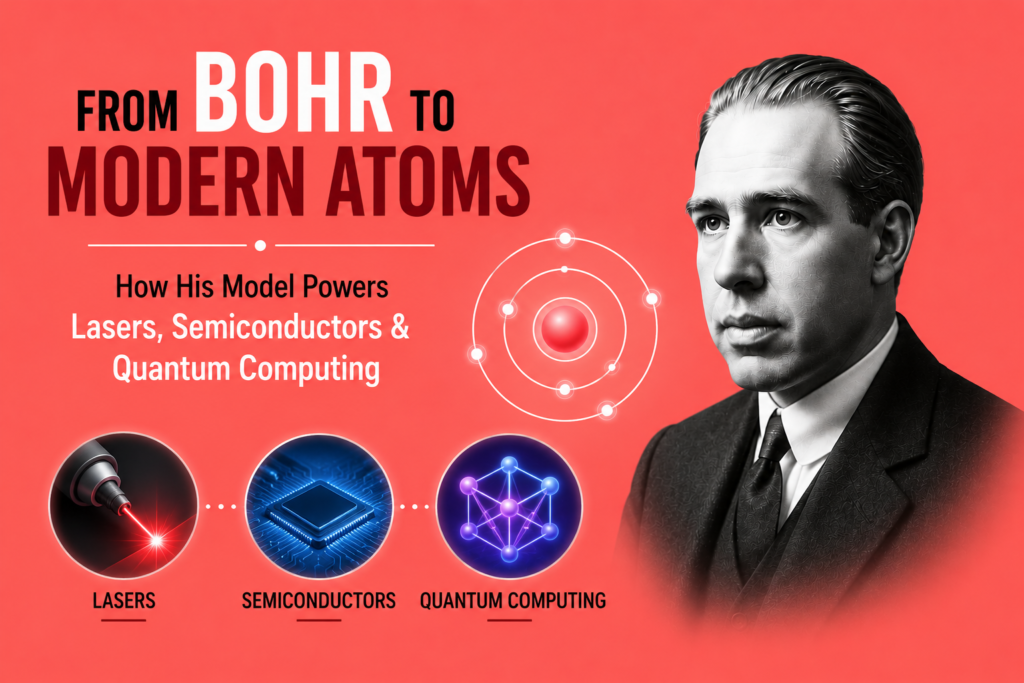
Every time you scan a barcode with a laser, unlock your phone using a fingerprint sensor, or simply switch on an LED light, you are witnessing modern quantum technology built directly upon a theoretical framework Niels Bohr first proposed in 1913. Bohr could never have imagined smartphones or fiber optic internet cables, yet his quantized atomic model became the essential theoretical foundation underlying nearly every significant technological advancement of the past century.
Understanding how modern quantum technology emerged from Bohr’s original atomic theory means tracing a remarkable journey from abstract theoretical physics through practical engineering breakthroughs, revealing just how thoroughly a century-old scientific insight continues shaping contemporary life.
The Foundational Insight: Quantized Energy Levels
The story of modern quantum technology begins with Bohr’s original 1913 proposal that electrons occupy specific, quantized electron orbits and energy levels rather than any arbitrary continuous distance from the nucleus. This quantization, expressed through Bohr’s formula:
E_n = -13.6 eV / n²
established that atomic energy exists only in discrete, calculable amounts, never smoothly continuous values. This single insight, though originally developed simply to explain hydrogen’s spectral lines, eventually became the essential theoretical building block underlying countless practical applications of Bohr model real world applications developed throughout the twentieth century.
Lasers: Stimulated Emission in Action
Perhaps the most direct technological descendant of Bohr’s atomic model involves laser physics Bohr model applications. Lasers rely fundamentally on a phenomenon called stimulated emission, where an incoming photon triggers an already excited electron to release its own matching photon, rather than waiting for random, spontaneous decay to occur naturally.
This process depends directly on Bohr’s frequency condition, expressed through the equation:
ΔE = hf
Here, ΔE represents the precise energy difference between two atomic energy levels, h represents Planck’s constant, and f represents the resulting photon frequency. Laser technology quantum base engineering exploits this relationship by achieving what physicists call population inversion, artificially creating conditions where more electrons occupy higher energy states than lower ones, dramatically amplifying stimulated emission and producing the coherent, single-frequency light characteristic of laser beams.
This technology, built entirely upon Bohr’s original quantized energy level concept, now powers everything from surgical instruments and fiber optic communication systems to the barcode scanners found in nearly every retail store worldwide.
Semiconductors: Energy Bands and Modern Electronics
Modern quantum technology extends deeply into semiconductor physics quantum applications, the foundation underlying virtually all contemporary electronics. While individual atoms possess discrete energy levels as Bohr originally described, when countless atoms combine together within a solid material, these individual energy levels merge into continuous ranges called energy bands, specifically the valence band and conduction band.
The semiconductor band gap, the energy difference separating these two bands, directly determines a material’s electrical properties. Materials with very small band gaps conduct electricity easily, functioning as metals, while materials with very large band gaps resist electrical current entirely, functioning as insulators. Semiconductors occupy a crucial middle ground, possessing band gaps small enough to allow controlled electrical conductivity under specific conditions.
This band structure theory, directly descended from Bohr’s original atomic energy level concept, underlies every semiconductor diode, transistor, and integrated circuit powering modern silicon chips found in smartphones, computers, and countless other electronic devices throughout daily life.
LED Lighting and the Photovoltaic Effect
The same fundamental principles underlying semiconductor physics also explain LED light physics technology. When electrons within a semiconductor material transition from the conduction band down to the valence band, they release energy as photons, precisely following the same quantum principles Bohr originally established through his frequency condition. By carefully engineering semiconductor materials with specific band gap energies, manufacturers can produce LEDs emitting precisely controlled colors of light.
This same underlying physics operates in reverse through the photovoltaic effect, where incoming photons striking a semiconductor material excite electrons across the band gap, generating usable electrical current. This principle directly powers solar panel technology, converting sunlight into electricity through processes fundamentally rooted in Bohr’s original quantum theory of atomic energy levels.
Quantum Computing: Building on Bohr’s Foundation
Perhaps the most cutting-edge application of modern quantum technology involves quantum computing foundations, where researchers exploit quantum mechanical properties to perform calculations impossible for classical computers. Central to this technology is the qubit, the fundamental unit of quantum information, which relies directly on qubit state excitation between precisely controlled quantum energy levels, conceptually descended from Bohr’s original atomic model framework.
Many physical implementations of quantum computing hardware directly manipulate atomic or artificial atomic systems, carefully controlling electron energy jumps between specific quantum states to encode and process information. This quantum information hardware represents perhaps the most direct modern descendant of Bohr’s original theoretical framework, applying his century-old insights toward genuinely revolutionary computational technology.
Optical Pumping and Atomic Clocks
Modern quantum technology also encompasses atomic clock technology, the most precise timekeeping devices ever created. These remarkable instruments rely on optical pumping techniques, using carefully controlled light to manipulate atoms into specific, well-defined quantum energy states, then measuring the extremely precise frequency of radiation emitted during subsequent electron transitions.
This technology directly applies Bohr’s frequency condition with extraordinary precision, using atomic transitions as an incredibly stable, universal timekeeping reference. Atomic clocks now underlie GPS satellite navigation systems, telecommunications infrastructure, and countless scientific applications requiring extraordinarily precise timing measurements.
Quantum Dots: Engineering Artificial Atoms
Researchers have also developed quantum dot physics technology, tiny semiconductor particles engineered to exhibit quantized energy levels similar to those Bohr originally described for individual atoms. By precisely controlling a quantum dot’s physical size, scientists can engineer specific, customized energy level spacing, effectively creating artificial atoms with tailored optical and electronic properties.
This technology finds applications throughout modern display screens, biological imaging systems, and emerging photonics origin research, demonstrating how thoroughly Bohr’s original atomic theory continues inspiring genuinely novel technological applications more than a century after its initial development.
The Philosophical Foundation Behind the Technology
Beyond these direct practical applications, modern quantum technology also relies conceptually upon Bohr’s broader theoretical contributions, including his complementarity principle and the philosophical framework established through the historic Niels Bohr vs Einstein debates. Quantum computing, in particular, directly exploits wave-particle duality and quantum superposition principles that emerged from these deeper theoretical discussions regarding the fundamental nature of quantum reality.
Understanding Bohr’s quantum contributions in their entirety, encompassing both his practical atomic model and his philosophical framework for interpreting quantum mechanics, remains essential for appreciating exactly how thoroughly modern quantum technology depends upon this foundational theoretical work developed throughout the early twentieth century.
Why This Century-Old Theory Still Matters
The remarkable persistence of Bohr’s original theoretical insights within modern quantum technology demonstrates something profound about scientific progress itself. Rather than becoming obsolete as physics advanced, Bohr’s fundamental insight regarding quantized atomic energy levels became increasingly relevant as engineers learned to precisely manipulate and exploit these quantum properties for practical technological purposes.
This ongoing technological relevance reflects the genuine, lasting value of fundamental theoretical research, showing how abstract scientific insights, seemingly disconnected from practical application when first proposed, can eventually become the essential foundation underlying transformative technologies decades or even a century later.
Frequently Asked Questions
How does Bohr’s model relate to modern lasers?
Laser technology relies on stimulated emission between quantized atomic energy levels, directly applying Bohr’s frequency condition to produce coherent, single-frequency light through population inversion techniques.
What role does Bohr’s model play in semiconductor technology?
Semiconductor physics builds upon Bohr’s quantized energy level concept, describing how energy bands form when atoms combine in solid materials, determining electrical conductivity properties essential to modern electronics.
How is Bohr’s atomic model connected to quantum computing?
Quantum computing relies on qubits, which exploit precisely controlled quantum energy level transitions conceptually descended from Bohr’s original atomic model framework, enabling revolutionary computational capabilities.
What are quantum dots and how do they relate to Bohr’s theory?
Quantum dots are engineered semiconductor particles exhibiting quantized energy levels similar to Bohr’s atomic model, allowing scientists to create artificial atoms with customized optical and electronic properties.
Why does a century-old atomic theory still matter for modern technology?
Bohr’s fundamental insights regarding quantized energy levels became increasingly valuable as engineers developed methods to precisely manipulate these quantum properties, demonstrating how foundational research often finds unexpected practical applications decades later.
Conclusion
The journey from Bohr’s original 1913 atomic model to today’s sophisticated modern quantum technology represents one of science’s most remarkable examples of theoretical insight transforming into practical innovation. From laser systems and semiconductor electronics to emerging quantum computing research, Bohr’s fundamental insight regarding quantized atomic energy levels continues powering technologies he could never have imagined during his own lifetime. More than a century after his groundbreaking theoretical work, modern quantum technology stands as permanent testament to how foundational scientific research, however abstract it initially appears, can eventually reshape virtually every aspect of contemporary human life.