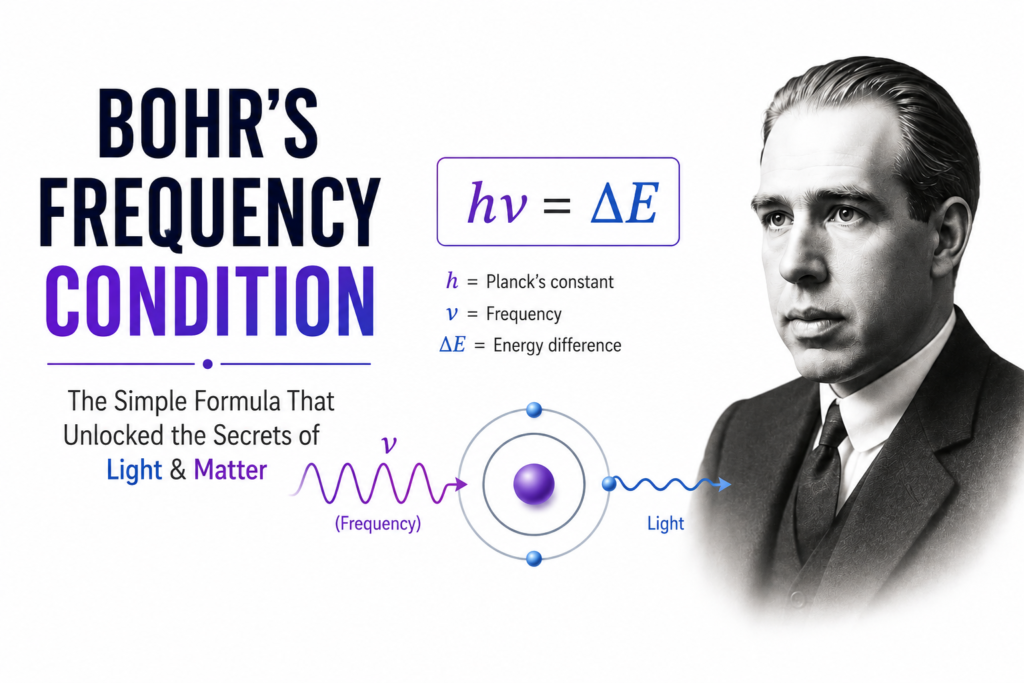
Sometimes the most profound scientific discoveries come down to remarkably simple equations. Bohr’s frequency condition is exactly this kind of formula, a short, elegant relationship that connected two seemingly unrelated phenomena, the internal quantized structure of atoms and the specific colors of light they produce. When Danish physicist Niels Bohr introduced this equation in 1913, he provided the missing mathematical link explaining why atoms glow with such precise, predictable colors rather than a random, continuous spread of light.
Understanding Bohr’s frequency condition means grasping one of atomic physics’ most genuinely elegant formulas, a deceptively simple relationship that unlocked decades of previously unexplained spectroscopic mysteries and became foundational to virtually all subsequent quantum theory.
The Puzzle This Formula Needed to Solve
Before appreciating Bohr’s frequency condition, it helps to understand the mystery it resolved. Scientists throughout the nineteenth century had observed that energized gases, when passed through a prism, produced light only at specific, sharply defined wavelengths rather than a smooth, continuous spectrum. This atomic spectroscopy math puzzle had frustrated physicists for decades, since nobody could explain precisely why atoms would only emit light at these particular, discrete frequencies.
Compounding the mystery, Bohr had already proposed in 1913 that electrons within atoms occupy specific, quantized electron orbits and energy levels, rather than any arbitrary continuous distance from the nucleus. This raised an obvious follow-up question. If electrons could only exist within fixed energy levels, how exactly did this quantization connect to the observed pattern of atomic emission equation results scientists had been measuring in laboratories for years?
Introducing the Formula (1913)
Bohr’s frequency condition provided the answer through an elegantly simple mathematical relationship, expressed as:
ΔE = hf
Here, ΔE represents the energy difference formula between two allowed electron orbital levels, h represents Planck constant formula value, approximately 6.626 × 10⁻³⁴ joule seconds, and f represents the frequency of light either emitted or absorbed during the transition. This deceptively simple equation, sometimes written using the Greek letter nu as delta E equals h nu, directly connected the internal quantized structure of atoms to observable light frequencies.
Breaking Down What Each Term Means
To fully appreciate Bohr’s frequency condition, examining each component individually proves helpful. The term ΔE represents an energy differential calculation, specifically the precise difference between an electron’s initial energy level and its final energy level following a quantum transition. This value can be calculated for hydrogen using Bohr’s broader theoretical framework through the relationship:
E_n = -13.6 eV / n²
Here, E_n represents the energy associated with any particular quantum level n. The energy differential between any two levels, say n₁ and n₂, becomes the ΔE value plugged directly into Bohr’s frequency condition, allowing precise calculation of exactly what frequency of light corresponds to that specific energy level transition formula.
Why This Formula Explains Discrete Spectral Lines
Bohr’s frequency condition elegantly explains why atoms produce only specific spectral line frequency patterns rather than continuous light emission. Since electrons can only occupy specific, quantized energy levels, the possible energy differences between these levels are similarly restricted to a finite, calculable set of values.
Because Bohr’s frequency condition directly links each possible energy differential to one specific corresponding light frequency, only a limited, precisely predictable set of frequencies can ever be produced through electronic energy levels formula transitions within any given atom. This explains precisely why hydrogen, or any other element, produces its own characteristic, unique pattern of spectral lines rather than an unrestricted, continuous rainbow of colors.
Applying the Formula to Hydrogen’s Spectrum
Bohr’s hydrogen atom solution provides the clearest demonstration of this formula’s remarkable predictive power. Using Bohr’s frequency condition combined with his quantized energy level formula, physicists could precisely calculate the exact wavelength of light produced whenever a hydrogen electron transitioned between any two specific quantum levels.
For example, when an electron falls from the third energy level down to the second energy level, releasing energy according to the quantum energy jump formula, the resulting photon emission frequency corresponds to a specific, measurable wavelength of visible red light, one of several prominent lines within hydrogen’s famous Balmer series pattern. Bohr’s calculations matched decades of previously unexplained experimental spectroscopy measurements with genuinely remarkable precision.
Absorption and Emission: Two Directions of the Same Formula
Bohr’s frequency condition works equally well describing both energy absorption formula and energy emission processes. During absorption, an incoming photon carrying precisely the correct amount of energy, matching some available ΔE value within the atom, gets completely absorbed, causing an electron to jump instantly to a higher energy configuration.
During emission, the reverse process occurs. An electron occupying a higher, excited energy state falls back toward a lower, more stable configuration, releasing the exact energy difference as a single photon governed by the same fundamental atomic energy transfer equation. In both directions, Bohr’s frequency condition ensures that only photons carrying precisely matching energy values can interact with the atom’s quantized internal structure.
Connecting to Planck’s Original Insight
Interestingly, Bohr’s frequency condition builds directly upon the earlier Planck relation established by Max Planck in 1900, when Planck first proposed that electromagnetic radiation exists in discrete quanta rather than continuous waves. Bohr essentially extended this foundational light quantum energy concept, applying it specifically to explain internal atomic transitions rather than merely describing blackbody radiation as Planck had originally intended.
This connection demonstrates how quantum radiation formula principles, first introduced through Planck’s pioneering work, found their most immediately practical and experimentally verifiable application through Bohr’s specific frequency condition governing atomic spectral behavior.
The Correspondence Principle: Ensuring Broader Consistency
As quantum theory developed further beyond his original 1913 framework, Bohr introduced his correspondence principle, ensuring that predictions derived from Bohr’s frequency condition remained mathematically consistent with classical physics results under appropriate limiting conditions involving very large quantum numbers. This principle helped confirm that Bohr’s elegant formula represented a genuine expansion of physical understanding rather than merely an isolated, unconnected mathematical trick.
Beyond Hydrogen: Extending the Formula’s Reach
While Bohr’s frequency condition initially achieved its greatest success explaining hydrogen’s relatively simple single electron system, the same fundamental formula extended conceptually toward understanding more complex atoms as well, even though calculating precise energy levels for multi-electron systems proved considerably more mathematically challenging than hydrogen’s elegantly simple case.
This broader applicability helped establish Bohr’s frequency condition as a truly universal principle underlying atomic spectroscopy math generally, rather than merely a specialized formula applicable only to hydrogen’s uniquely simple atomic structure.
Why This Formula Sparked Deeper Philosophical Questions
Bohr’s frequency condition, despite its mathematical elegance, also raised genuinely profound philosophical questions regarding the nature of electron energy jumps themselves. The formula successfully predicted precisely what frequency of light would result from any given atomic transition, yet it offered no classical explanation for how or why electrons instantaneously transitioned between energy levels without passing through any intermediate states.
This puzzle eventually connected to broader philosophical discussions within physics, including Bohr’s own later development of the complementarity principle and his historic Einstein–Bohr debate regarding quantum mechanics’ proper interpretation. The seemingly simple frequency formula thus became entangled with some of physics’ deepest unresolved questions regarding measurement, causality, and the fundamental nature of quantum reality itself.
From Simple Formula to Modern Technology
Bohr’s frequency condition, despite being over a century old, remains foundational to countless modern technologies. Laser systems, fluorescent lighting, LED displays, and various forms of optical spectroscopy instrumentation all rely directly on precisely controlled atomic transitions governed by this same fundamental equation, demonstrating how thoroughly from Bohr model to modern technology developments continue building upon this deceptively simple 1913 formula.
Bohr’s Enduring Scientific Legacy
Bohr’s quantum contributions extend far beyond this single formula alone, encompassing his broader development of atomic theory, his significant role within the Niels Bohr vs Einstein philosophical debates, and his lasting influence through his own research institute in Copenhagen. Yet Bohr’s frequency condition remains perhaps his most immediately practical and experimentally verifiable contribution, directly connecting abstract quantum theory to observable, measurable laboratory phenomena.
Frequently Asked Questions
What is Bohr’s frequency condition in simple terms?
Bohr’s frequency condition is a formula stating that the frequency of light emitted or absorbed by an atom equals the energy difference between two electron orbital levels divided by Planck’s constant.
How does Bohr’s frequency condition explain spectral lines?
Since electrons occupy only specific quantized energy levels, the possible energy differences between them are limited, meaning atoms can only produce light at specific, predictable frequencies rather than a continuous spectrum.
What is the mathematical formula for Bohr’s frequency condition?
The formula is expressed as delta E equals h times f, where delta E represents the energy difference between two levels, h is Planck’s constant, and f represents the resulting photon frequency.
Does Bohr’s frequency condition apply to all atoms?
While originally developed for hydrogen’s simple single electron system, the same fundamental principle extends conceptually to more complex atoms, though calculating precise energy levels becomes mathematically more challenging.
Why is Bohr’s frequency condition still relevant today?
This formula remains foundational to modern technologies including lasers, fluorescent lighting, and optical spectroscopy, all of which rely on precisely controlled atomic energy transitions.
Conclusion
Bohr’s frequency condition stands as one of atomic physics’ most elegantly simple yet profoundly important formulas, a single equation that finally connected the internal quantized structure of atoms to the specific, predictable colors of light they produce. By providing the mathematical link between electron energy transitions and observable spectral emission, this deceptively straightforward relationship resolved decades of unexplained spectroscopic mystery while simultaneously raising profound new philosophical questions about the fundamental nature of quantum reality. More than a century after its introduction, Bohr’s frequency condition remains essential to modern spectroscopy, laser technology, and our continued understanding of how light and matter genuinely interact at the atomic scale.